

commercial soup kettle


PRODUCT HIGHLIGHTS
What Foods Can This Commercial Soup Kettle Cook?
Own factory
CE certified
OEM available
Broths & Stocks
Cook pork bone broth, beef stock, chicken soup and seafood stock for noodle shops, restaurants and canteens. Choose 80L to 200L according to batch size.
Porridge & Grains
Prepare rice congee, oat porridge, bean soups and grain soups for breakfast, canteens and catering kitchens. Choose capacity by batch size.
Stews & Curries
Cook beef stew, lamb curry, braised pork and meat-and-vegetable dishes for canteens, caterers and restaurants serving warm meals in batches.
Soups & Sauces
Make corn soup, cream soup, gravy and pourable sauces for set meals, buffets and central kitchens. Prepare shared bases in the required batch size.
Inquiry UsView Specifications
Question
Four Capacities, Two Shared Designs
What Types of Commercial Soup Kettles Do We Offer?
Choose from 80L, 100L, 150L and 200L models. All four feature induction heating and handwheel-controlled tilting.
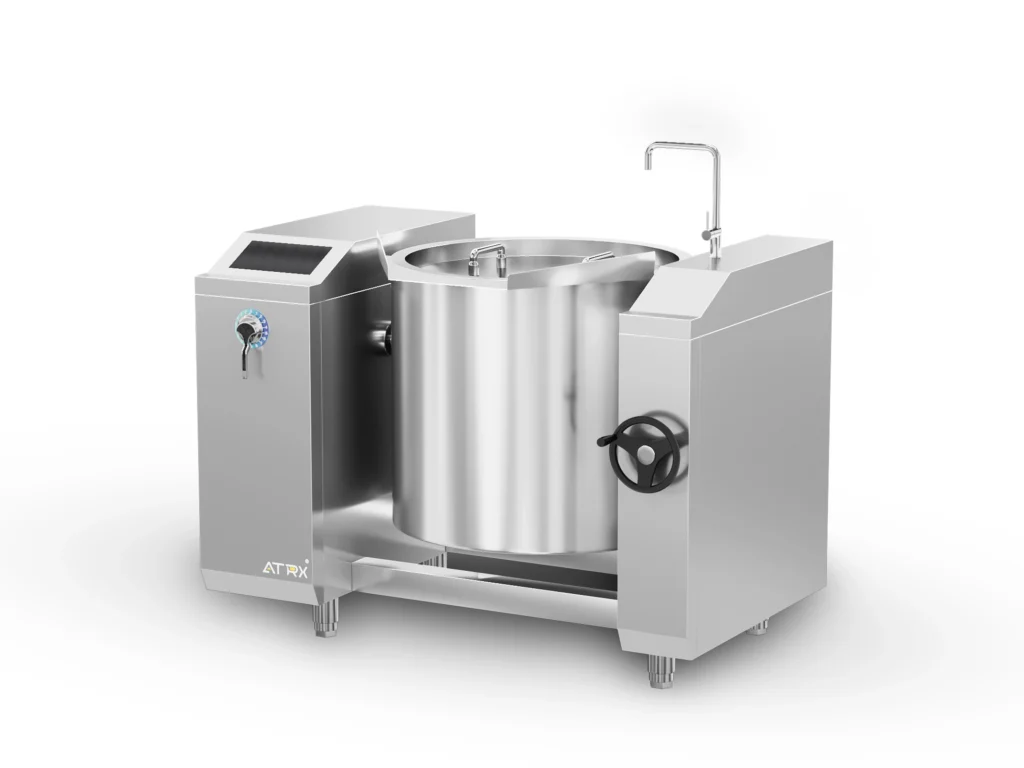
Commercial Induction Soup Kettles ➚
80L Small-Batch Model
Our 80L model suits soup shops, congee bars and smaller restaurants with lower batch demand. It handles one main stock, porridge or stew recipe at a time and supports a focused daily menu. Choose it when the kitchen needs repeatable commercial batches without moving directly to the largest kettle.
Commercial Induction Soup Kettles ➚
100L Daily-Prep Model
Our 100L model combines a built-in 800mm pot with 20kW induction heating for routine soup, stock and porridge preparation. It suits restaurants and canteens that repeat stable recipes. One planned batch replaces several smaller cooking tasks and supports consistent daily preparation.
Commercial Induction Soup Kettles ➚
150L Expanded-Batch Model
Our 150L model provides a larger batch option than 100L for canteens, banquet kitchens and caterers. It suits soup, stew or porridge prepared for one service. Choose it when 100L is too small but a 200L kettle offers more capacity than the kitchen requires.
Commercial Induction Soup Kettles ➚
200L Central-Kitchen Model
Our 200L model is the largest in this range and uses 30kW induction heating. It suits central kitchens and large caterers preparing stock, grain soup, cream soup or sauce for several serving lines. A larger batch reduces repeated cooking of the same recipe.
Match Power to Food and Batch Size
How Do You Choose Power for Different Foods?
Small-Batch Broth: 18kW
Consider the 80L, 18kW model for smaller batches of chicken soup, bone broth or daily stock. Match rated power to batch volume, then lower the heat for simmering and finishing stages. Gentle, steady heat helps keep the broth clear, rich and flavorful.
Daily Stock: 20kW
Choose the 100L, 20kW model for routine stock and soup batches. Its rated power suits a larger batch, while adjustable heat supports both the initial boil and later simmering. Consistent output makes every batch easy to repeat in busy daily kitchens.
Porridge: Power by Batch
For rice congee, oat porridge or cream soup, match power to batch size: use 18kW for 80L, 20kW for 100L, or 30kW for 200L. Then lower heat as the recipe thickens. Strong heat early speeds up the boil, while gentle heat later helps prevent sticking.
Bulk Soup: 30kW
Consider the 200L, 30kW model for larger stock or grain-soup batches. Match power to the full batch, then adjust heat for boiling, simmering and finishing. Strong, even output keeps large volumes moving, ideal for canteens, hotels and central kitchens.
Start with Demand per Service
How Do You Choose Capacity for Your Kitchen?
Calculate finished soup demand from portion size and servings per batch, then compare the four capacities.
01
80–100L: Restaurant Prep
For 200–250 servings at 300mL each, plan for 60–75L of finished soup. Compare the 80L and 100L models with this batch demand. The 80L option suits a smaller soup or porridge batch, while 100L gives more room for routine restaurant preparation. Base the decision on the amount made at one time, not total daily sales.
02
150L: Canteen Service
A service of 400 portions at 300mL each requires 120L of finished soup. Compare the 150L model when one recipe must cover a school canteen, employee dining room or catering service. Combine serving lines that share the same soup at the same meal, then use that total as the batch reference. This keeps capacity connected to one production task.
03
200L: Central Production
For 500 portions at 300mL each, plan for 150L of finished soup and compare the 200L model for a larger shared batch. It suits central kitchens and caterers preparing one stock, soup or sauce for several service points. Add serving lines using the same recipe, then compare the total with kettle capacity before portioning or distribution.
WHAT YOU GET
Which Features Should You Look For?
Handwheel Pouring
A handwheel tilts the pot for transferring soup, porridge or stew without lifting the vessel from its frame. It supports direct discharge into receiving containers and keeps large-batch transfer at one workstation. Smooth, controlled tilting reduces splashing and manual handling during busy service.
Adjustable Heat
Adjustable output supports boiling, simmering and thickening. Match heat to stock, porridge, soup and sauce recipes as the cooking stage changes, so one kettle can handle different menus. Stronger heat speeds up the boil, while gentler heat protects texture and flavor in the final cooking stage.
Tilt-to-Drain Cleaning
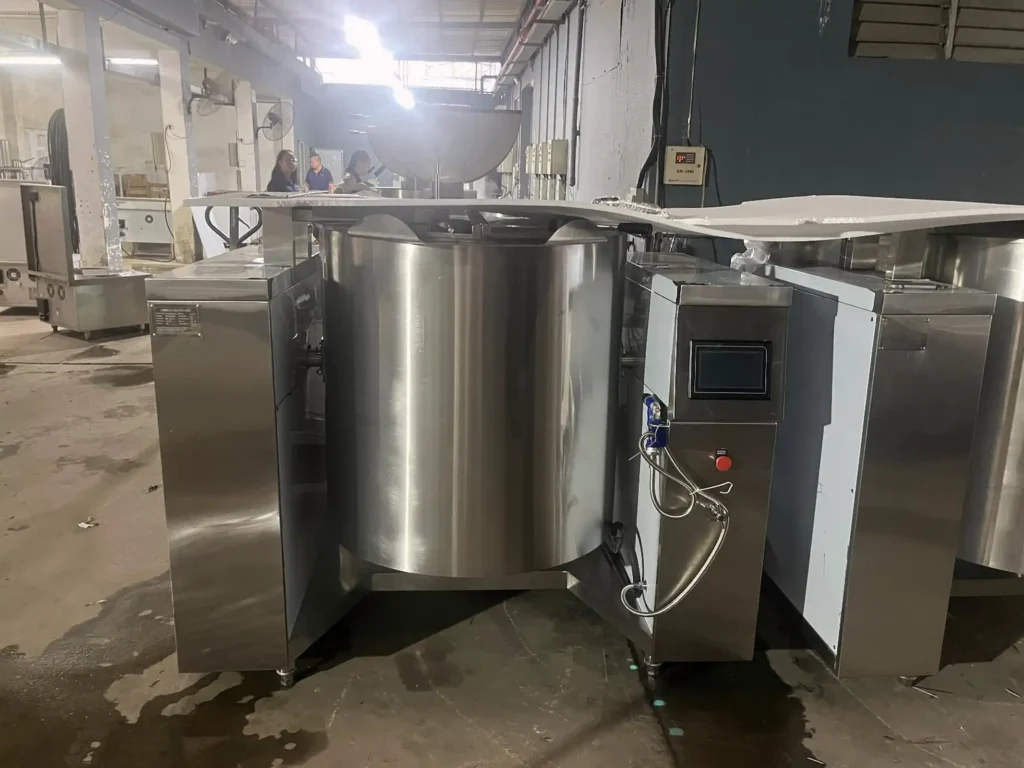
The 100L model can remain tilted after discharge, giving better interior access and helping residue and rinse water move toward the pour opening between cooking batches. This shortens turnaround time, makes rinsing and wiping easier, and keeps the kettle clean and ready for the next cooking batch.

Question
Checks from Circuit Board to Finished Unit
How Do We Control Product Quality?
Our quality-control process covers circuit assembly, thermal stress, environmental testing and complete-unit checks.
Circuit Assembly Checks
We inspect component placement, orientation, solder joints, connectors, fans and wiring during circuit-board assembly for the tilting soup cooker. Online optical inspection and manual review identify missing, shifted, reversed or poorly soldered components, including bridged or cold joints. Connectors are checked for secure seating. Abnormal boards are sent for rework or isolation and reviewed again. Assembly quality is tied to power control and heating response, from the first boil to simmering.
Thermal Stress Testing
A tilting soup cooker runs at high power for long boils and low heat for hours of simmering, so its control boards face repeated heating cycles. We use PCB drying, heat-aging and thermal-shock equipment to test them: drying removes moisture, heat-aging holds boards under sustained heat to expose weak components, and thermal shock cycles hot and cold to test solder joints. These checks add to visual inspection and electrical review. Boards that fail any test are removed before final assembly.
Humidity & Corrosion Tests
Soup kitchens are full of steam, grease and washdown water, and a tilting soup cooker sits in that environment every day. We use temperature-and-humidity and salt-spray equipment to examine selected boards, metal parts and connectors under environmental stress. Humidity testing checks changes under controlled moisture, while salt spray supports corrosion checks on relevant surfaces and connections. Testing goes beyond appearance to daily use. Abnormal results are reviewed before parts are used.
Complete-Unit Checks
After assembly, we power the cooker and check the control interface, heating output at each setting, fan operation, cooling and applicable protection responses. We also operate the handwheel to confirm the pot tilts and returns smoothly. Model, power, voltage and frequency are compared with the order before the nameplate and packaging are applied. Both checks are done on the same unit before shipment. A unit that does not match the order or responds abnormally is held back for correction.
——Factory quote & RFQ
Partner with a Trusted Commercial Induction Cooker Manufacturer
Whether you need wholesale commercial induction cookers, an OEM product line or a commercial kitchen project configuration, send a focused commercial brief. An ATRX team member can review the product, power, certification and customization requirements before quotation.
Useful information to include:
Target country · Product category · Application · Voltage / phase · Estimated quantity · Required certifications · OEM / branding needs