

How Do Gas, Infrared, and Induction Cooktops Heat Cookware?
Gas stoves burn gas to heat cookware with a flame
A gas cooktop uses a gas burner to burn natural gas, liquefied petroleum gas (LPG), or another compatible fuel. The resulting flame and hot combustion gases transfer heat to the pan base. The process is straightforward:
- The burner releases gas and produces a flame.
- The flame reaches the pan base, and the cookware absorbs heat.
- As the base heats up, it transfers heat to the water, oil, or food inside.
The main heat source is therefore outside the cookware. Cooks can judge changes in heat output by watching the flame, but not all the heat around it reaches the pan base. Pan shape, flame coverage, and the distance between the burner and the base all affect heating performance.

Electric infrared cooktops transfer heat through a heating element and the cooking surface
When an electric infrared cooktop is switched on, its internal heating element warms up first. Heat then reaches the pan base through thermal radiation and heat transfer through the cooking surface. The path is: heating element → cooking surface → pan base → food.
The term “infrared” can be misleading. An electric infrared cooktop does not generate heat directly in the pan base. In product listings, the same technology may also be described as an electric radiant cooktop. It first heats the element inside the appliance. The cooking surface forms part of the heat-transfer path, while the pan base absorbs heat through contact and radiation. Because the surface itself gets hot, the cooktop takes time to reach its operating temperature and may retain heat for a while after it is switched off.

Induction cooktops use electromagnetic induction to generate heat in the pan base
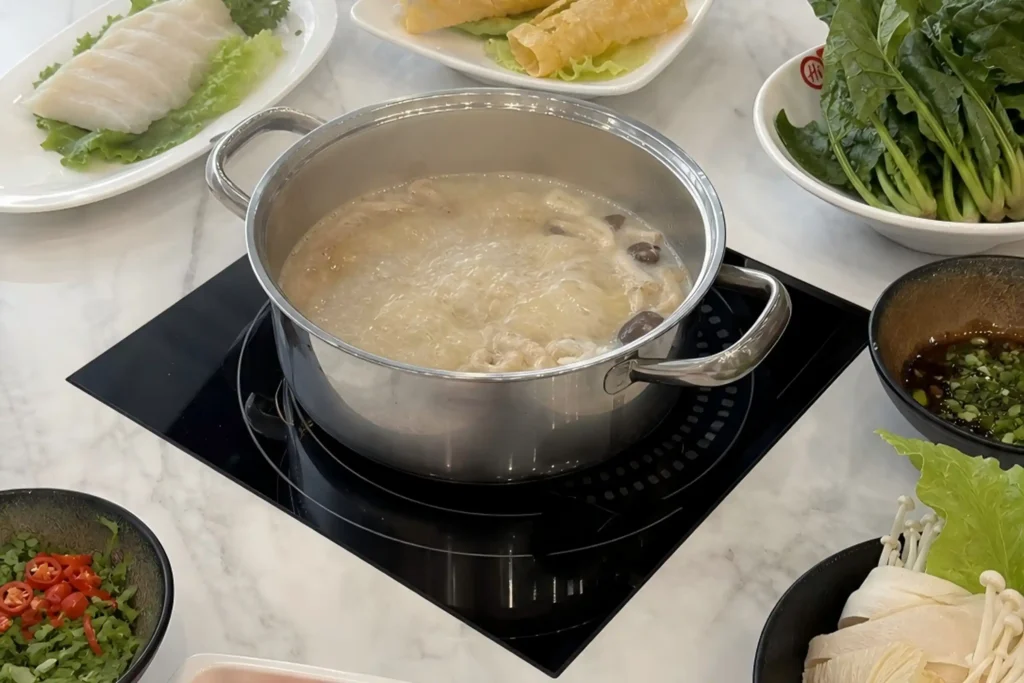
The coil inside an induction cooktop creates an alternating magnetic field. When cookware with a magnetic base is placed on it, the field induces electrical currents in the base. The base itself generates heat and transfers it to the food.
The main steps are:
- The coil creates an alternating magnetic field.
- The field interacts with a compatible pan base.
- The base generates heat and directly heats the food.
With induction, heat is generated mainly in the pan base, not the cooking surface. The surface still absorbs heat from the hot pan, so it should not be assumed to stay cool during use. The table below summarizes the main differences.

| Cooktop type | Main heat source | How heat reaches the cookware |
|---|---|---|
| Gas | Flame and hot combustion gases | The flame heats the pan base |
| Electric infrared | Heating element and cooking surface | Heat transfers between the cooking surface and the pan base |
| Induction | Compatible pan base | An alternating magnetic field generates heat in the pan base |
What Are the Advantages and Drawbacks of Each Type?
Gas offers visible heat control but carries an open-flame risk
A defining feature of gas cooking is that the flame is visible and responds directly when the control knob is adjusted. When stir-frying over high heat, frying, or making quick heat adjustments, cooks can respond to both the flame and what is happening in the pan.
The drawbacks are equally clear. An exposed flame can reach pan handles, kitchen towels, or other combustible materials. The hot area around the flame also increases the risk of burns and fire. A visible change in flame size does not mean the food temperature changes immediately or precisely. Pan thickness, the amount of food, and the position of the pan base all affect the final temperature.
Gas suits kitchens that value visible flame feedback and high-temperature cooking. Managing the open flame must remain a priority.
Infrared cooktops have no open flame but respond more slowly to heat changes
Infrared cooktops do not rely on combustion, so no open flame touches the cookware during use. This makes them an option for kitchens where a gas connection is impractical or where reducing open-flame cooking is a priority.
Their main limitation is thermal inertia. When the cooktop starts, the element and cooking surface must heat up first. When power is reduced or switched off, the surface retains some heat. As a result, changes in heat output are generally less immediate than with gas and slower than with induction.
Induction responds quickly but may produce fan noise and cookware humming
Induction acts directly on a compatible pan base, usually without first heating the entire cooking surface to a high temperature. This gives it a fast heating response. Citing Consumer Reports testing, the U.S. Department of Energy says induction can boil water approximately 20% to 40% faster than the gas and conventional electric cooktops tested. The page uses the wording “can boil water 20-40% faster.” That 20% to 40% figure applies only to the cited test conditions. Actual speed still depends on power, cookware, and water volume, but the results illustrate induction’s advantage in rapid-heating tasks. U.S. Department of Energy introduction to induction cooktops
Induction can also produce noise. Cooling fans create airflow noise, and some cookware may hum slightly in the alternating magnetic field. The sound level varies with the model, pan-base construction, cookware placement, and power setting. It may not affect cooking results, but it can affect the experience, particularly in open kitchens or noise-sensitive work environments.
Which Uses Less Energy and Costs Less to Run?
Gas loses more heat, and running costs depend on gas prices.
Some heat from a gas cooktop escapes into the surroundings with the flame and hot combustion gases rather than being absorbed by the cookware. There is therefore a gap between the energy supplied to the appliance and the energy actually used to heat the food.
To estimate running costs, consider energy efficiency alongside local fuel prices. A simple calculation is:
Cost per cooking task = Gas consumed to complete the same cooking task × Local gas price per unit
For a fair comparison, keep the water volume, starting temperature, and target temperature as consistent as possible. Comparing only the same operating time can be misleading: one appliance may have finished heating while another has not yet reached the target.
Infrared generally uses more electricity than induction, while running costs also depend on electricity prices.
An infrared cooktop must heat its element and cooking surface before transferring heat to the cookware. Some of that heat is absorbed by the surface and the surrounding environment. Completing the same cooking task therefore generally requires more electrical energy than with induction.
However, using more electricity does not automatically mean a higher bill in every location. Actual costs also depend on power, operating time, frequency of use, and local electricity rates. Rated power indicates the appliance’s power level at a particular setting. It does not, by itself, tell you how much electricity a complete cooking task will consume.
To calculate the cost:
- Record the actual electricity used to complete the same task.
- Multiply it by the local price per kilowatt-hour.
- Compare the result with induction or gas under the same conditions.
Energy costs for all three types should be calculated using actual readings for the same cooking task and local energy prices.
Induction is more energy-efficient and generally uses less electricity.
Induction generates heat directly in the pan base, reducing the intermediate step of heating the cooking surface before transferring heat. It therefore generally uses less electricity than an electric infrared cooktop for the same heating task. The U.S. Department of Energy describes induction as “up to three times more efficient than gas stoves” and “up to 10% more efficient” than conventional smooth-top electric stoves. These are comparisons between technologies; actual results vary with the appliance and operating conditions. U.S. Department of Energy overview of induction cooking
Citing Frontier Energy data, ENERGY STAR’s electric cooking materials state that approximately 85% of induction heating energy reaches the cookware, compared with about one-third for gas cooking. The original wording is “about 85% of heating energy is transferred to what is in the cookware compared to only a third … with gas cooking products”. The same material also notes that induction may boil water in close to half the time required by gas, infrared, or electric-coil appliances. These figures illustrate differences in heat transfer and speed.ATRX has also produced a video demonstrating a gas and induction cooker water heating test. You can refer to it as follows.
Induction’s actual running cost still depends on power and operating time. A higher-powered appliance does not necessarily use more electricity than a lower-powered one if it finishes the task sooner. The most reliable comparison records the energy input required by each type to complete the same task, then applies local energy prices.
For commercial purchasing, ATRX recommends recording the electricity meter readings, heating target, cookware, water volume, and test duration together. A complete set of conditions provides a stronger basis for assessing costs than a power figure alone.
What Cookware Can You Use on Each Type?
Gas works with iron, aluminum, and other cookware suitable for open flames.
Gas cooktops generally do not require a magnetic pan base. Stainless steel, iron, cast iron, and aluminum cookware can generally be used if it is suitable for cooking over an open flame.
The key questions are whether the cookware is flame-safe and whether it sits securely on the grate. A round-bottom wok needs adequate support from the grate, while a flat-bottom pan should not have a noticeably warped base. For materials such as glass or ceramic, the material name alone is not enough. Follow the cookware manufacturer’s guidance on open-flame use.
Gas offers relatively broad cookware compatibility, but being able to heat a pan does not necessarily make it suitable for frequent commercial use. Commercial kitchens also need to consider base thickness, weight, grate support, and stability during operation.
Infrared works with many flat-bottom pans, without requiring a magnetic base.
Electric infrared cooktops generally do not depend on magnetism, so flat-bottom cookware such as stainless steel and aluminum pans can usually be used. A flat base increases contact with the cooking surface and helps heat transfer remain consistent. GE’s cookware guidance for smooth glass cooktops, for example, identifies a flat bottom as a basic requirement for effective heat transfer. Such guidance also highlights that infrared compatibility depends on pan-base shape and the appliance instructions, not magnetism.
Not needing a magnetic base does not mean every pan is suitable. Whether glass, ceramic, rough cast iron, or visibly warped cookware can be used on a particular infrared cooktop depends on both the appliance and cookware instructions. An excessively rough base can also scratch the cooking surface or reduce contact.
When selecting cookware for an infrared cooktop, check the following in order:
- The cookware is explicitly marked as suitable for electric cooktops or glass cooking surfaces.
- The base is flat, dry, and free from noticeable warping.
- The base size covers the heating area recommended for the appliance.
Induction needs magnetic cookware, with flat or round bottoms matched to the cooking surface.
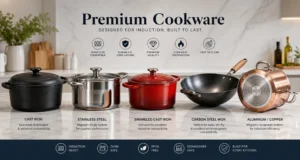
Induction requires cookware that can interact with the magnetic field. Iron, cast iron, and stainless steel with a magnetic base are common options. Pure aluminum, pure copper, and ordinary glass cookware generally cannot be heated directly on induction unless they have a magnetic base.
A magnet test provides an initial check: if a magnet sticks to the base, the base may contain magnetic material. However, this does not establish full compatibility with the appliance. Flat induction cooktops generally need flat-bottom pans. Commercial concave induction cooktops require round-bottom woks that match the curved cooking surface. These base shapes are different; using the wrong shape is not enough to conclude that the cookware is simply “not induction-compatible.”
| Induction cooktop type | Common compatible cookware | Key checks |
|---|---|---|
| Flat induction cooktop | Magnetic flat-bottom cookware | Flat base and appropriate size |
| Commercial concave induction cooktop | Magnetic round-bottom wok | Curvature matches the cooking surface |
| Portable induction cooker | Small magnetic flat-bottom cookware | Base diameter and appliance load limit |
If you’re wondering which cookware works with an induction cooktop, check out our dedicated ATRX guide on how to choose induction cookware that matches the induction cooker. It explains in detail which cookware is suitable and which is not, along with important points to keep in mind.
Which Kitchen Applications Suit Each Type?
Choose gas for frequent wok tossing or cooking that requires an open flame.
Gas is an option for stations where cooks frequently toss a wok, move cookware, or prepare dishes that genuinely require an open flame. Cooks can watch the flame and quickly adjust the knob in response to what is happening in the pan. When the pan is briefly lifted off the grate, the flame and hot gases may continue to supply some heat. This helps explain why gas suits certain traditional stir-frying movements.
This is a judgment about cooking technique, not a claim that frying or stir-frying can only be done with gas. Induction can handle many stir-frying tasks too. What matters is cookware shape, equipment design, and whether the cook adapts to the different feedback.
The risks associated with gas and open flames should not be overlooked. In June 2023, an LPG leak caused an explosion at a barbecue restaurant in Yinchuan, Ningxia, China, killing 31 people and injuring seven. The Guardian’s report on the incident quoted Xinhua: “A leak of liquefied petroleum gas … caused an explosion during the operation of a barbecue restaurant.” The report confirms a specific incident at that restaurant. It does not establish that every gas cooktop will experience a similar accident. It does, however, remind restaurant operators that gas lines, valves, leak checks, and ventilation must be part of day-to-day management whenever gas is used. Induction is one alternative for kitchens seeking to reduce open-flame use and gas-management requirements. Its suitability still depends on power, voltage, and menu requirements.
Consider infrared for kitchens without gas that mainly boil and simmer.
An infrared stove can be considered for kitchens without a gas connection that mainly prepare soups and stews and do not need rapid changes in heat output. Tasks that maintain heat for long periods place less emphasis on instant adjustment. They can therefore accommodate the thermal inertia of an infrared cooktop at startup and after power is reduced.
There is an important qualification: having no gas connection does not automatically make infrared the right choice, because induction also runs on electricity. The real questions are whether the kitchen can work with infrared’s heating and cooling response and whether its existing cookware is compatible. If frequent high-heat stir-frying and rapid heat adjustments are required, infrared’s slower response may reduce operating efficiency.
Choose induction for quick water heating and everyday cooking.
Induction is an option for kitchens that frequently need to heat water quickly, heat food in batches, or cook continuously during peak service. It acts directly on a compatible pan base and generally heats up quickly, making it suitable for workflows involving repeated starts and heat adjustments.
For example, when a commercial kitchen needs to prepare several pots of soup or water in quick succession, or heat ingredients in batches, waiting time directly affects service. Induction’s advantage is that it concentrates more of the input energy in the pan base, reducing the wait for a cooking surface to heat up first. Actual performance still depends on appliance power, cookware, batch size, and the electrical supply. Induction’s generally faster heating does not mean every model will shorten service times. If you are matching equipment to your own menu and peak-hour workload, you may want to look through our commercial induction equipment to compare power levels and configurations.
If you’re interested in our commercial induction cookers, you can view the full ATRX commercial induction cooker range, which covers flat cooktops, wok cookers, stockpot cookers, and noodle cookers, with power and voltage options for different models.