

How ATRX Handles OEM Custom Orders for Commercial Induction Cookers
10/24/2026
Estimated reading time: 2 minutes

This article explains ATRX’s process for handling OEM custom orders for commercial induction cookers, from adjustable product configurations to requirement confirmation, prototype testing, workshop production, and pre-shipment inspection. Distributors, importers, and foodservice project buyers can use this information to prepare quotation materials, arrange prototype testing, and agree with the manufacturer on exactly what needs to be delivered before placing an order.
What Can ATRX Customize According to Customer Requirements?
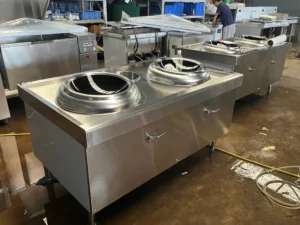
Appearance and Dimensions Can Be Customized
You can send ATRX dimension drawings or photos of the installation area, along with information about the old equipment you plan to replace. Based on these materials, the engineering team will discuss the cabinet length, width, and height, the overall shape, control-panel position, and enclosure material before deciding whether the unit should be countertop or floor-standing. Requirements for appearance and placement in different markets can also be discussed at this stage.
Ps:The enclosures are processed at ATRX’s own factory, including laser cutting, CNC bending, welding, and surface treatment. The outlines, bends, and openings shown in the drawings are formed step by step through these processes. If you would like to learn more about the equipment used and how dimensional requirements are applied during production, please read ATRX’s commercial induction cooker enclosure manufacturing process.
Power and Voltage Can Be Customized
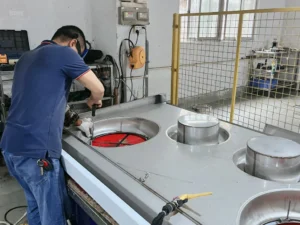
When asking about power and voltage configurations, please provide the power-supply information for the target country or installation site at the same time. ATRX needs to confirm the operating voltage, single-phase or three-phase power, frequency, plug or wiring method, and how many hours the equipment will operate each day. The team will also ask what cookware will be used and what heating tasks the unit will perform. This information helps determine a suitable power configuration for the order.
At present, ATRX produces and assembles nearly all of its circuit boards in-house, including surface-mount assembly, through-hole assembly, soldering, and functional checks. The engineering team can coordinate the circuit-board, power-component, and cooling-component configuration for each order. You can visit ATRX’s commercial induction cooker PCB assembly workshop to learn more about how these components are assembled.

Control-Panel Display Languages Can Be Customized
Language requirements can be discussed during the OEM process for the text used to adjust power levels, set timers, and view the operating status on the control panel. ATRX supports multiple languages, including English, Arabic, and Spanish. The exact display content will be confirmed according to the selected control panel.

What Is ATRX’s Process After Receiving an OEM Order?
Confirm the Product Customization Details First (Then Make the Prototype Based on the Confirmed Requirements)
At the beginning of the discussion, documents can be provided in stages. A customer who already has the model and kitchen layout can send those two items first. Voltage information, panel translations, or brand files that are not yet finalized can be added by both parties one by one. The ATRX engineering team organizes the collected requirements into product specifications, and any unresolved items are confirmed before the prototype is made.
The following checklist can be used to prepare the information and helps both sides check for missing details.
| Item to Confirm | Materials Prepared by the Customer | What Must Be Confirmed Before Prototyping |
|---|---|---|
| Model and application | Base model, main cooking tasks, and expected operating intensity | Selected model and functional adjustments |
| Appearance and structure | Length, width, height, placement method, material requirements, and layout drawing | Cabinet drawing and structural solution |
| Power and power supply | Target country, site voltage, phase, frequency, and wiring conditions | Rated parameters and electrical configuration |
| Panel and language | Button text, display language, and translated operating prompts | Panel text and layout artwork |
| Branding and markings | LOGO source file, printing position, and nameplate content | Marking style, size, and position |
The engineers match the drawings, electrical parameters, panel artwork, and branding materials to the same product, then make the prototype according to the confirmed requirements. Before prototyping, the customer can review the organized materials once more to check whether the measurement units, language version, and electrical parameters are correct. When the prototype arrives, these materials can be used for the item-by-item review.
Make and Test a Prototype Before Starting Mass Production
ATRX offers prototype approval for every OEM commercial induction cooktop order. The prototype uses the same key configuration as the production units and is made according to mass-production standards. The customer can inspect it independently or verify the appearance, dimensions, panel operation, and heating performance together with the factory. Any required changes can be raised and reviewed at this stage.
Once the prototype arrives, the inspection can be arranged in the following order:
- Measure the dimensions, check the material, panel position, and brand markings, and then confirm that the planned installation area is suitable. Every relevant part of the appearance drawing should be checked.
- Operate each button one by one. Try the power-level settings, timer, and other configured functions to see whether the display and the actual response match.
- Use the target cookware to test heating performance at the agreed voltage. Record the response at each power level, heating time, and continuous-use performance. Record the test conditions as well so the factory can review them if needed.
- Send ATRX a list of any required changes. After the changes are made, recheck the affected items. Mass production can be arranged after the prototype has passed testing and received customer approval.
How Does ATRX Maintain the Customer’s OEM Requirements During Production?
Produce Every Unit According to the Approved Prototype and Documentation
Once mass production begins, the workshop uses the customer-approved prototype and the supporting documents. Fabrication staff need the dimensions, materials, and hole positions shown in the drawings. Assembly staff check the component and wiring configuration. The prototype remains available as a reference for the appearance, layout, and operating performance.
Each process follows the corresponding documentation:
- Enclosure fabrication follows the drawings for dimensions, bends, hole positions, and surface treatment, while the panel and internal components are checked for correct installation positions.
- Panel production uses the approved text, button layout, and branding artwork, with the language version for the current order checked before use.
- Wiring assembly checks the circuit board, power components, cables, and cooling components, which are installed according to the order configuration.
- During complete-unit assembly, the enclosure, panel, and electrical components are checked to ensure that they belong to the same approved version before the unit is passed to inspection.
These main fabrication and assembly operations are completed inside ATRX’s own factory. Engineers can communicate directly with the relevant production roles, and when a dimensional or assembly issue appears, they can trace it back to the corresponding drawing more easily. This reduces deviations caused by transferring documents between different parties.
If the customer continues to revise the order after prototype approval, the changed requirements need to be identified clearly. The relevant drawings, panel artwork, or electrical documents should be updated at the same time. The affected items should be reviewed before production resumes, so the workshop does not continue using an outdated version.
How Does ATRX Check Whether Every Product Meets the OEM Standard?
Check the Appearance of Each Product Against the Approved Prototype
Before the finished products are packed, inspectors compare each unit with the approved prototype and documentation. They check the cabinet shape, panel layout, surface treatment, and color, then review the assembly condition. Seams, panel installation positions, scratches, and dents are all included in the inspection.
OEM orders also require a review of the customer’s branding. The team checks which LOGO artwork is being used, where it is printed, and whether its size and proportions are correct. The panel text must match the agreed language, while the parameters on the labels and nameplate must match the individual unit. Special attention is paid to distinguishing different voltage configurations.
ATRX records the results of its unit-by-unit appearance and label inspection before packing. If a printing, label, or assembly issue is found, it is corrected and checked again before the product is packed.
Test Startup, Buttons, and Every Power Level on Each Unit
After the unit is powered on, the inspector operates the switch and each button, observes whether the display works correctly and whether the power level responds, and then tests the different power levels. ATRX performs functional testing and full-power operation testing on every finished unit. The results are compared with the approved prototype and the production standard for that model, and the inspection record is retained after the unit passes.
The inspection items include the following. Specific test requirements depend on the model and the confirmed configuration.
| Test Item | What Is Operated or Observed During Testing |
|---|---|
| Startup and display | Whether the power-on, startup, display, and shutdown processes work correctly and whether the status prompts are accurate |
| Buttons and controls | Whether the switch, power levels, timer, and other configured functions respond as required |
| Power levels | Whether the power response and heating status after switching between levels remain within the agreed range |
| Full-power operation | Whether power stability and heat dissipation remain acceptable during continuous operation according to the model requirements |
| Protection functions | Whether the protection actions, post-trigger response, and prompts work according to the confirmed configuration |
When comparing the prototype with the production units, both sides should use the agreed voltage, load, cookware, and test method, then judge the results against the permitted tolerances in the production specifications. A short power-on check can show whether startup works. The performance at each power level and during continuous operation requires the corresponding tests to be completed. For a more detailed inspection arrangement, please see ATRX’s commercial induction cooker quality-control and pre-shipment inspection process.
If you would like to discuss a custom commercial induction cooker order with ATRX, you can first send the model you plan to use, the target market, and the customization materials you already have. Any configurations that are still undecided can then be discussed with the engineering team. To learn more about the product range and factory, visit the ATRX commercial induction cooker manufacturer’s website.
About the author
ATRX Team| 18 Years Commercial
Induction Cooker Manufacturer in China
Induction Cooker Manufacturer in China
Related Posts

Portable Induction Hobs vs Built-in Cooker: Which Is Right for You?
10/26/2026
How ATRX Handles OEM Custom Orders for Commercial Induction Cookers
10/24/2026

Commercial Induction Cooker Operating Instructions
10/23/2026

What Parts Are Typically Found Inside a Commercial Induction Cooker?
10/23/2026

Gas vs Infrared vs Induction: Efficiency, Cost & Cookware
10/22/2026

Commercial Induction Cooker Maintenance: 5 Tips to Extend Its Service Life
10/22/2026

How ATRX Controls the Quality of Commercial Induction Cookers: From Incoming Inspection to Final Quality Inspection
10/22/2026
How Are Commercial Induction Cookers Made?
10/21/2026
Should a Hot Pot Restaurant Choose an Induction Cooker or a Gas Stove?
10/21/2026

How Much Electricity Does a Commercial Induction Cooker Use
10/20/2026