

—— Commercial Induction Equipment Manufacturer
Commercial Induction Cookers for Restaurants
Commercial induction cookers transfer 85–95 % of energy directly to the pan — roughly double the rate of gas. But choosing the right restaurant unit still depends on station type, menu, cookware, counter format and electrical supply. ATRX helps distributors, contractors and restaurant groups match the correct commercial induction configuration before moving into model specs.
GET A RESTAURANT INDUCTION QUOTEEXPLORE PRODUCT SERIES
COMMERCIAL INDUCTION EQUIPMENT
RESTAURANT STATION PLANNING
OEM / ODM SUPPLY
Built for service
RESTAURANT-GRADE INDUCTION SERIES
First question
Confirm whether induction fits the work your kitchen actually needs to perform.
Professional cooking application
Can Restaurants Use Induction Cookers for Professional Cooking?
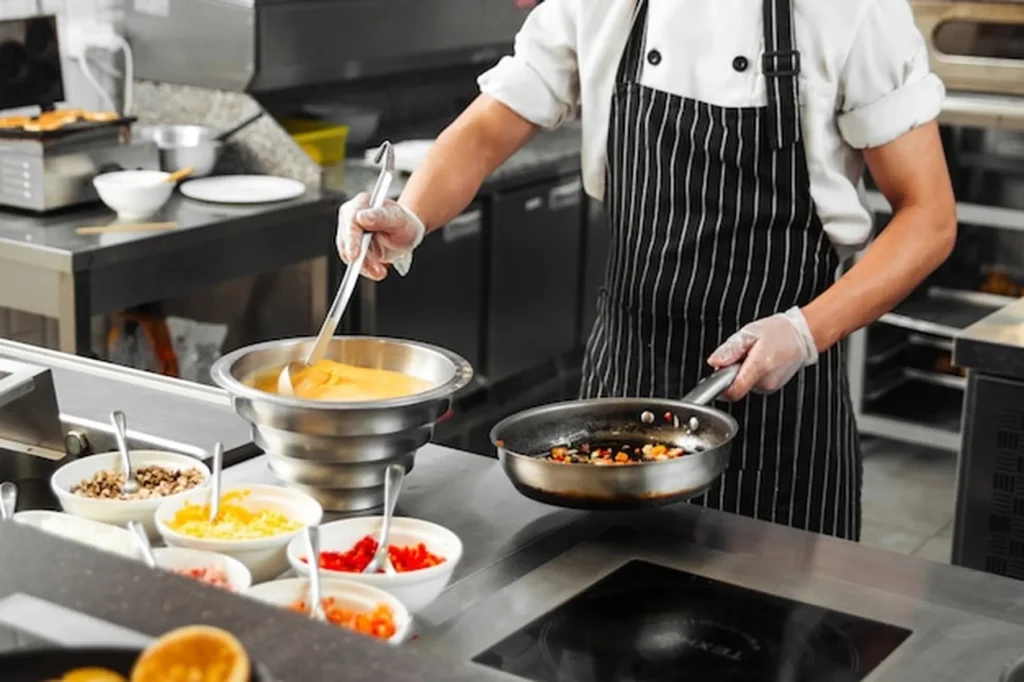
Yes — commercial induction is already used in professional restaurant kitchens for à la carte cooking, sauce work, open-kitchen presentation, buffet holding and backup stations. It delivers around 90 % of energy to the pan versus under 50 % for gas, with significantly faster heat-up. The key is matching equipment to the cooking task. These are the four restaurant stations where commercial induction applies most.
01
À la carte line
Sauté, searing, sauce finishing and repeatable heat control — induction responds in seconds, matching the pace of à la carte service.
02
Wok station
Stir-fry, flash-cooking and high-heat tossing — commercial induction wok units reach wok-hei temperatures without an open flame.
03
Buffet & holding
Precise holding temperatures, guest-facing safety and a flat surface that wipes clean — induction suits buffet and live-cooking stations.
04
Backup & mobile
Plug-in operation with no gas line — induction adds cooking capacity for prep, events or overflow without fixed installation.
Second question
Choose the equipment format by cooking station, counter condition and workflow.
Cooking station formats
Which Type of Commercial Induction Cooker Is Best for Restaurant Use?
There is no single best commercial induction cooker — the right type depends on how the station is used. A portable countertop unit suits flexible or temporary stations; a built-in or drop-in cooktop fits fixed counters and open kitchens; multi-burner equipment serves main cooking lines with several pans running together; and a dedicated wok cooker matches menus that depend on high-heat tossing. Compare the four formats below, then confirm specifications against your project requirements.
01
Countertop & Portable
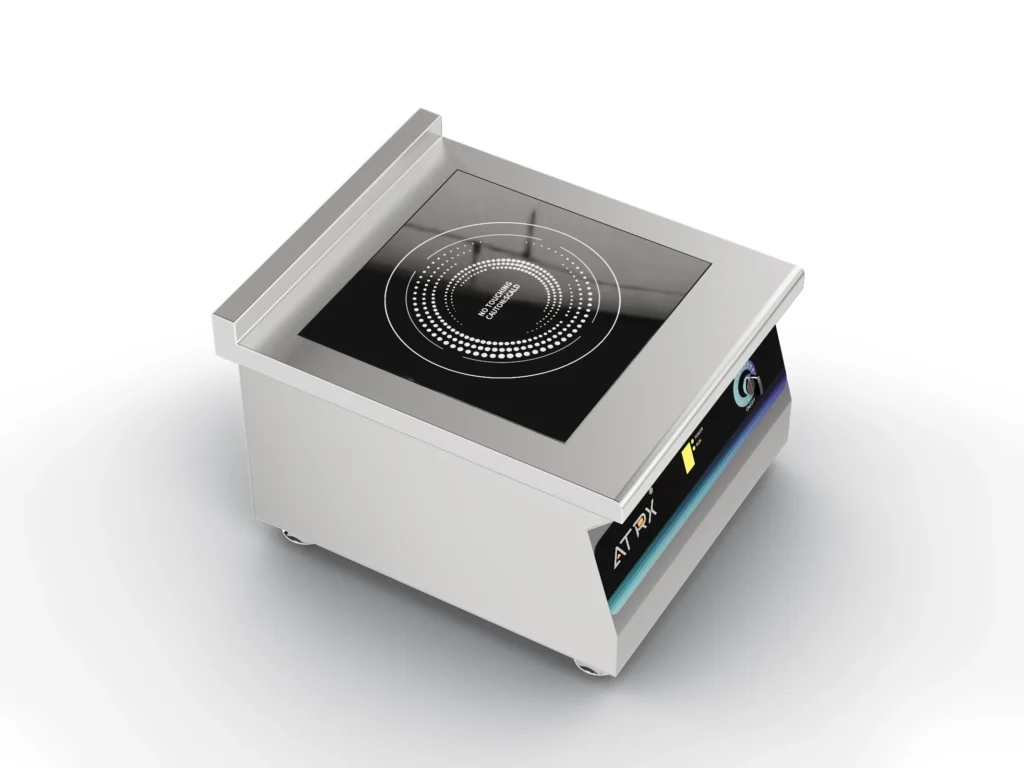
Plug-in units that can be placed, moved or stored without modifying the counter. Best fit: prep, finishing, events and flexible backup stations. Key advantage — no fixed installation needed.
View countertop Type↗
View built-in equipment↗
02
Built-In & Drop-In
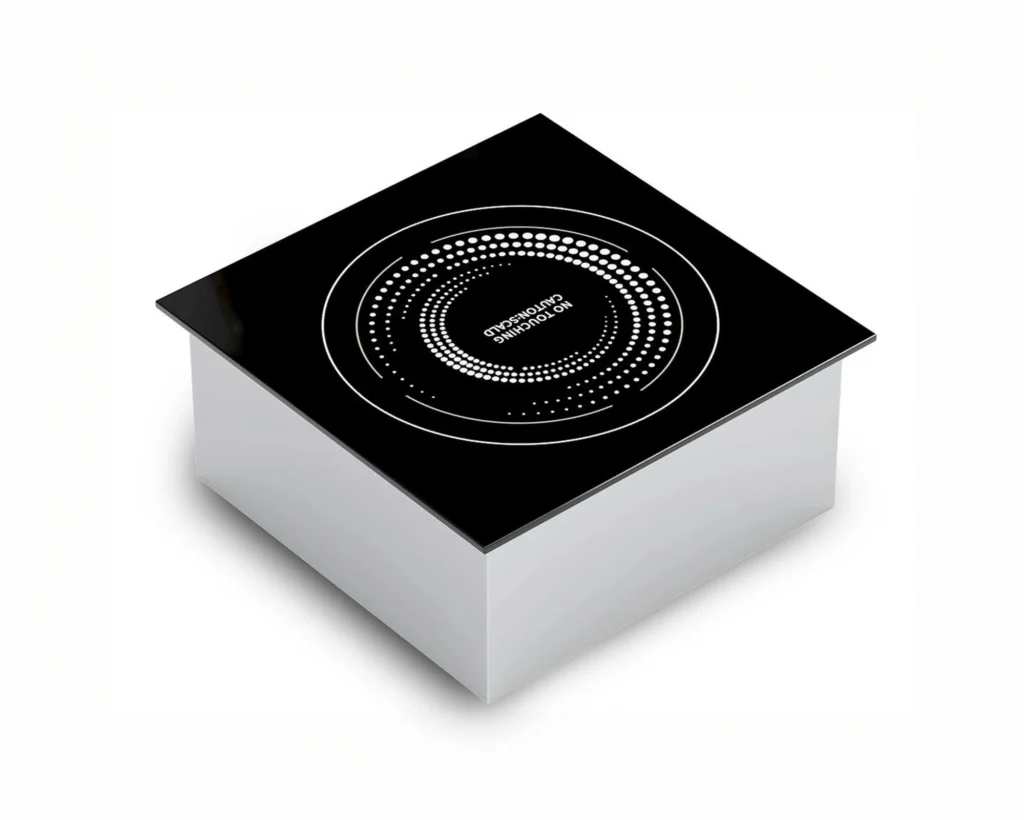
Units that sit flush inside the counter for a clean, integrated look. Best fit: open kitchens, buffet counters and fixed cooking stations. Key consideration — cutout dimensions, ventilation clearance and service access must be planned with the counter.
03
Multi-Burner
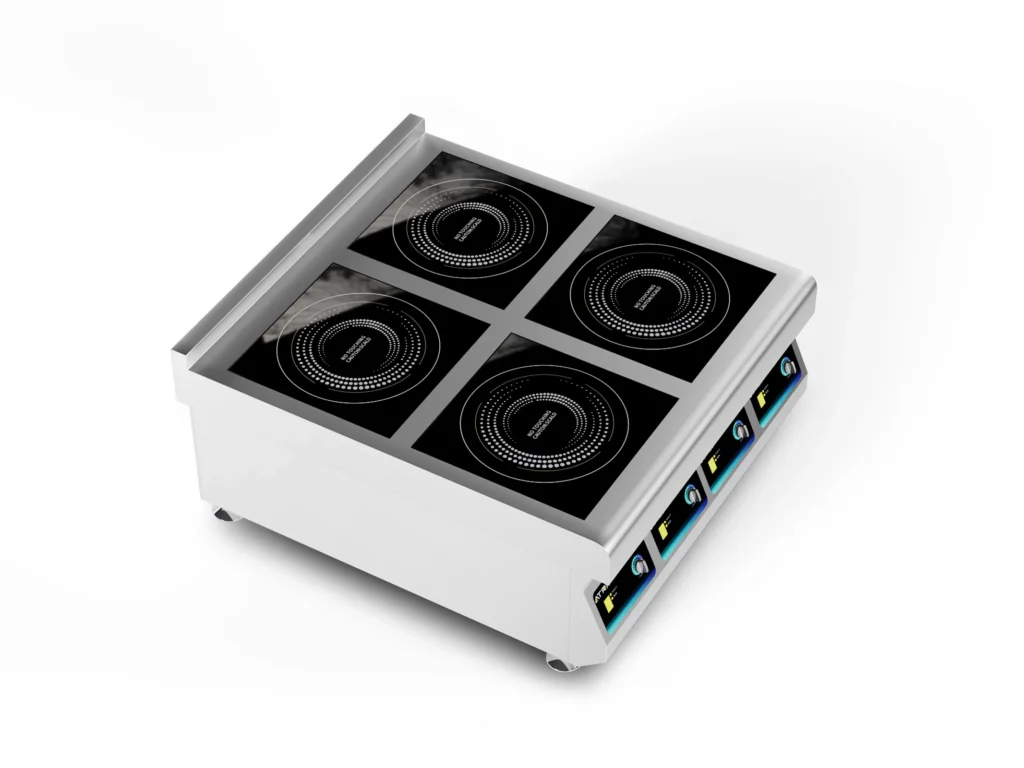
Two or more zones in one unit so several pans can run at the same time. Best fit: main cook lines and production stations. Key consideration — total connected load, zone spacing and cookware diameter must be reviewed as one system.
View multi-burner equipment↗
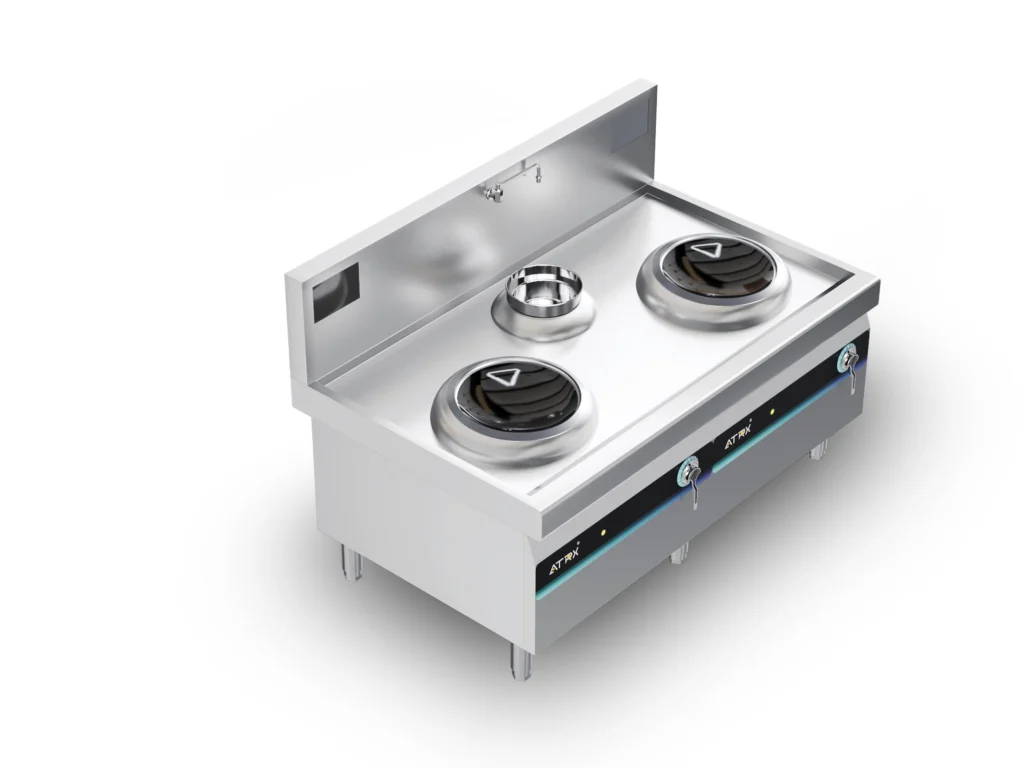
View commercial wok equipment↗
04
Wok Cookers
Concave-surface cookers built for the movement, pan shape and high heat of wok cooking. Best fit: Asian and stir-fry menus. Key difference — a dedicated wok coil geometry cannot be replaced by a flat countertop unit.
Third question
Capacity is a workflow decision first, and a product specification second.
Capacity and infrastructure
How Many Burners and How Much Power Does a Restaurant Need?
Do not choose burner count from the restaurant name alone. Start with how many pans, pots or woks must run at the same time during peak service, then match each station to a power range — from as low as 450 W for holding and warming up to 15 000 W for heavy wok work. Total connected load and available voltage (single-phase 220 V or three-phase 380 V) must be confirmed before finalising the configuration. Use the burner reference and power table below to match each station to the correct specification.
01
Small café / fast-casual
1–2 burners per station. Covers single-pan cooking, reheating and simple prep tasks.
02
Full-service restaurant
4–6 burners across the line. Supports sauté, sauce, grill-finishing and side dishes running together.
03
High-volume / banquet kitchen
6+ burners or multi-unit combination. Handles bulk production and continuous peak-hour output.
04
Wok-focused concept
Dedicated wok zones + flat support burners. Separates high-heat tossing from prep and holding.
05
Buffet / holding
2–4 low-output built-in zones. Keeps dishes at serving temperature with flush counter mounting.
How to Choose the Right Power for a Restaurant Induction Cooker
Power per zone should match the cooking process. ATRX commercial units offer 8-level rotary control from 450 W to full output, so one cooker can cover holding through high-heat cooking.
Holding & warming
Simmering & sauce work
1 800–3 500 W
Sauté & à la carte
3 500–5 000 W
Boiling & stock work
5 000–8 000 W
Wok / high-heat stir-fry
5 000–15 000 W
Peak connected load
Confirm with electrical supply
Fourth question
Cookware with a magnetic base that makes firm contact with the induction surface will heat normally.
Cookware and menu fit
What Cookware Works on a Commercial Induction Cooker in a Restaurant?
Induction only heats cookware with a magnetic base — but in a restaurant kitchen, material alone does not decide compatibility. Base flatness, diameter relative to the coil zone, pan condition and weight all affect whether a pot or pan will perform on a commercial induction unit. A quick magnet test on the base is the easiest first check. Before finalizing any restaurant induction order, test your actual cookware on the equipment — especially stockpots, woks and specialty pans.
Works
These cookware types work on a commercial induction cooker.
Stainless-steel pans and stockpots (magnetic)
Cast iron and carbon-steel pans
Any pot that a magnet sticks to on the bottom
Flat-bottom pans that match the burner size
Does Not Work
These will not heat on induction.
Aluminum, copper or glass pots — magnet won't stick, burner won't turn on
Pans with a bent or uneven bottom — won't make full contact, heats unevenly
Pans too big for the burner — the outer area won't heat
Round-bottom woks — won't sit flat, need a wok-specific induction cooker
Fifth question
Limitations are easier to manage when they are identified during project planning.
Practical limitations
What Are the Limitations of Induction Cookers in a Restaurant Kitchen?
Every cooking technology has trade-offs. For commercial induction in a restaurant, the main limitations are cookware compatibility, electrical capacity, initial equipment cost, heating-zone fit, staff learning curve and surface durability. None of these are reasons to reject induction — they are checkpoints to address during project planning so the equipment works from day one.
Cookware compatibility
Some existing pans may not be magnetic. Test the cookware your kitchen actually uses before ordering equipment.
Electrical capacity
Commercial induction draws heavy current. Confirm voltage, wiring and total load when multiple units run at the same time.
Initial cost
Induction equipment costs more upfront than gas. The gap narrows over time through lower energy use and reduced ventilation needs.
Heating-zone fit
Large stockpots, small pans and wok shapes each need a coil size designed for that cookware — one surface does not fit all.
Staff learning curve
Induction heats much faster than gas. Cooks used to open flame may burn food at first until they adjust to the speed and controls.
Surface durability
Glass-ceramic tops can scratch or crack if heavy cast-iron pans are dropped. Handle cookware with care and choose commercial-grade glass rated for daily use.
Sixth question
Confirm your kitchen conditions step by step before requesting a final quotation.
Pre-order checklist
What Should You Confirm Before Ordering Induction Cookers for a Restaurant?
Before placing an order, walk through four checks in sequence. Each step narrows down the equipment specification so the final choice fits your actual kitchen — not just a product catalogue.
01 Confirm what your kitchen cooks
Start with the menu. À la carte sautéing, wok stir-fry, buffet holding and prep work each point to a different type of commercial induction cooker. The cooking task decides the equipment format.
02 Confirm your service volume and pace
How many dishes per service, how many pans at the same time, how fast each dish must leave the pass. This decides wattage, burner count and whether you need single or multi-zone equipment.
03 Confirm your kitchen layout and counter space
Measure the available counter or cutout area, check ventilation clearance, and plan service access. A unit that fits on paper still needs room for airflow, cleaning and daily operation.
04 Confirm your electrical supply
Check voltage, available amperage and wiring at the installation point. Multiple induction units running together draw heavy current — confirm total load with an electrician before ordering.
Application guide
Start from your restaurant type, then narrow down by station and menu.
Restaurant concepts
Commercial Induction Solutions for Different Restaurant Concepts
Different restaurants cook differently. The right induction setup depends on what you serve, how fast you serve it, and how your kitchen is arranged. Use the four guides below to find your starting direction.
Quick-Service & Fast-Casual
Speed and simplicity matter most. Portable induction cookers in the 1 800–3 500 W range handle fast, repeatable cooking — and they are easy to clean, move or swap out as your menu changes.
Full-Service Kitchens
Several cooking tasks run at once — grilling, sauces, prep, plating. Combine multi-burner induction on the main line with portable units for backup and overflow.
Open Kitchens & Live Cooking
Guests see everything. Flat, built-in induction cookers sit flush in the counter — no flame, no noise, cool surface. The kitchen stays clean and safe in front of customers.
Asian & Stir-Fry Concepts
Wok cooking needs very high heat and a curved pan shape. Use a dedicated induction wok cooker at 5 000 W or above — a standard flat cooker cannot do the job.
Start with the station brief
Need a Restaurant Induction Cooking Solution?
Tell us what you need to cook, how many stations you are planning and whether the equipment will be countertop, portable, built-in, multi-burner or wok. ATRX can start with the application and help identify the commercial induction cooker direction that deserves a closer technical review.