

Portable Induction Hobs vs Built-in Cooker: Which Is Right for You?
10/26/2026
Estimated reading time: 2 minutes

Portable and built-in induction cookers can both handle everyday heating, but they suit different kitchen setups. Portable units are designed to be moved, repositioned, and stored, making them useful in small kitchens with changing layouts, food stalls, and outdoor food trucks. A built-in cooker requires a fixed installation and is better suited to a kitchen with an established layout intended for long-term use. This article compares what each type is, how it heats cookware, its practical advantages and drawbacks, where it fits best, and what to check before buying. The aim is to help you choose a design that works with your existing counter, the way you run your operation, and your kitchen plans, so you can avoid buying unsuitable equipment or discovering installation problems after delivery.

What Is a Portable Induction Hob?
A Portable Induction Hob Is an Induction Cooker You Can Move
A portable induction hob is an induction cooker that sits directly on a counter without being built into a fixed location. Its defining feature is the ability to change position as your work requires, then be moved out of the way or stored when it is no longer needed. A small footprint alone does not make a hob portable.
This design suits situations such as:
- Kitchens with limited counter space, where equipment needs to move between food preparation, cooking, and cleaning;
- Food stalls or outdoor food trucks where the work area changes to suit the serving workflow;
- Rented premises where modifying the counter is impractical, or businesses that may change locations;
- Operations that need a temporary extra cooking station without redesigning the whole kitchen.
A portable induction hob typically looks like a self-contained appliance sitting on a counter. Unlike a built-in model, it requires no countertop cutout, and its body does not have to be fixed in one location. To identify this type of product, look at whether it is a freestanding countertop unit. The number of cooking zones and the size of the appliance do not tell the whole story.
It Heats Cookware Directly Through Electromagnetic Induction
A portable induction hob generates heat in the base of the cookware, rather than heating the entire cooking surface first. A coil inside the unit produces an alternating magnetic field. When that field interacts with a pan base made from a suitable magnetic material, it induces electrical currents in the base. The cookware itself heats up and transfers that heat to the food (Source: U.S. Department of Energy information on heating cookware directly through electromagnetic induction).
The process works as follows:
- The coil produces an alternating magnetic field.
- The field interacts with a compatible magnetic pan base.
- Heat is generated in the pan base.
- That heat passes to the water, oil, and food.
This is the main difference between induction cooking and cooking with a flame or a conventional electric heating element. Flames and conventional electric elements generate heat outside the cookware. Induction makes the compatible pan base generate heat itself. The cooking surface can still become hot as heat transfers back from the pan, but it is not the primary heat source.

Built-in induction cookers use the same principle. The key distinction in this comparison is how the units are installed. Both heat cookware through induction; neither relies on heating the cooking surface first.
What Is a Built-in Induction Cooker?
A Built-in Induction Cooker Is a Fixed Unit Installed in a Countertop
A built-in induction cooker is a fixed induction appliance installed in a countertop cutout. Before installation, the counter must be prepared to match the external dimensions, cutout dimensions, and installation requirements of the specific model. Once installed, the unit becomes part of the kitchen worktop.
The main difference from a portable induction hob is how the appliance fits into the counter:
| Comparison | Portable Induction Hob | Built-in Induction Cooker |
|---|---|---|
| Installation | Sits on the counter | Fits into a countertop cutout |
| Position | Can be changed as needed | Generally remains fixed after installation |
| Counter requirements | Usually no cutout needed | Cutout and installation space must be checked |
| Suitable settings | Rented homes, small kitchens, food trucks, temporary cooking stations | Permanent kitchens, restaurant kitchens, long-term business premises |
A built-in induction hob is a different installation format, rather than simply a more powerful portable hob. It suits premises where the kitchen layout is already established and the operator wants equipment positions and workflows to remain consistent over time. ATRX installation drawings for built-in products help show how this works. The cooking surface remains above the counter while the appliance body sits in the installation space below.

What Are the Advantages and Disadvantages of Each Type?
Portable Induction Hobs Can Be Repositioned to Suit Small Kitchens or Outdoor Food Trucks
The main advantage of a portable induction burner is that its position can be adjusted to suit the work area and serving workflow. A small kitchen counter often has to accommodate preparation, cooking, plating, and cleaning. In a food truck, the workflow may need to change around equipment, ingredients, and staff positions. A movable appliance gives the operator flexibility beyond a fixed installation point.
For example, a food truck can place the hob closer to the serving side before opening, reducing trips between cooking and plating. After service, the unit can be allowed to cool, disconnected from the power supply, and moved somewhere that leaves room for cleaning and transport. This flexibility comes from the portable design itself, without requiring extensive kitchen modifications.
Here, portability means changing the position where the unit is used. It does not mean carrying the hob while cooking. Suitability for a food truck also does not mean the appliance can be left exposed to rain or operated in any environment. The permitted operating conditions of the specific model still apply.

Portable Induction Hobs Take Up Counter Space and Need Storage After Use
The main drawback of a portable induction hob is that it occupies counter space during use and needs a suitable storage location when put away. The more often you reposition it, the more carefully you need to manage where it goes. Otherwise, moving it can disrupt food preparation, plating, or staff activity.
Before buying, consider the following in the context of your actual workflow:
- Whether there is enough room for pan handles and staff to work once the hob is in place;
- Whether the unit blocks food preparation, serving, or cleaning areas;
- Whether a dry, stable storage location is available after service without obstructing access;
- Whether the unit and its power cord have designated places during food truck transport.
Portability still comes with placement constraints. If counter space is already tight, or the equipment has to be moved frequently every day, repeatedly putting it away can offset its convenience. The trade-off is between flexible positioning and the work of managing counter space.
A hob that stays at a dedicated station may not need to be stored every day. This drawback mainly affects kitchens where the same counter is used for different tasks at different times. Frequent moving is not a requirement for every portable unit.
Built-in Induction Cookers Integrate with the Counter for a Tidier Kitchen
A built-in induction cooker places most of the appliance body below the counter, so there is no complete countertop unit with a separate base sitting above it. This makes it easier to create a consistent layout between the cooking surface and the surrounding work area. Some models still have frames or raised edges. Whether the surface sits flush depends on the product design and installation method.
That tidier layout has practical value. Permanent kitchens repeat similar cooking routines every day. Once the appliance position is established, the surrounding area does not need to be rearranged as a hob is brought in and put away. Daily cleaning also involves one less task: lifting a freestanding unit to wipe the counter beneath it. The cooking surface and the joint where it meets the counter still need cleaning, however. An integrated installation is not maintenance-free.
The finished result depends on the countertop cutout, the appliance dimensions, and the quality of the installation. A good fit is not automatic with every product. When reviewing photos of completed ATRX installations, look at the cooking-surface edges, the countertop joints, and the surrounding work area as well as the appearance of the appliance itself.
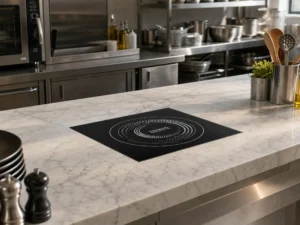
Built-in Induction Cookers Require More Installation Work and Are Harder to Relocate
The limitations of a built-in induction cooker begin with its installation requirements. It needs a matching countertop cutout, along with space below for ventilation, electrical connections, and servicing. If the kitchen layout changes after installation, the appliance usually cannot simply be moved like a portable unit. Relocation may involve removal, a new cutout, changes to electrical connections, or alterations to the counter structure.
Typical installation requirements include:
| Installation aspect | What needs to be confirmed |
|---|---|
| Countertop cutout | Cutout length, width, edge clearances, and tolerances |
| Counter structure | Material, thickness, load-bearing capacity, and suitability for cutting |
| Space below | Ventilation clearance, electrical connection location, and service access |
| Appliance position | Compatibility with the kitchen workflow and long-term operating plans |
These requirements reflect a design suited to a kitchen that is planned once and used over the long term. They do not make the appliance difficult to operate. If the business may relocate, or the counter layout is still undecided, installing a built-in unit too early can add to the cost of later changes.
ATRX installation drawings for the specific model help distinguish the dimensions of the cooking surface from the appliance body fitted inside the counter. This built-in arrangement is what makes relocation more involved than moving a countertop unit.
Which Type Should You Choose?
Choose a Portable Induction Hob If You Move Often or Rent
A portable induction hob is usually the better fit when equipment needs to move frequently or the premises do not allow counter modifications. Rented kitchens, temporary food stalls, outdoor food trucks, and shared kitchens have something in common: the working location or kitchen layout may change. In those situations, being able to reposition the appliance quickly matters more than integrating it into the counter.
A portable induction hob makes sense when:
- You may move to a different kitchen or business location;
- The existing counter is unsuitable for a cutout;
- You only need a temporary or backup cooking station;
- The appliance needs different positions during service, closing, and transport.
A portable induction cooker is not the best choice for every setting. It still takes up counter space, and storage needs to be planned. The deciding factor is whether you expect to keep changing its position. For commercial purchasing, portability and suitability for sustained business use are separate considerations. Portability tells you how easily the unit can change location. Suitability for ongoing service must be assessed using the intended use and technical documentation of the specific model.
Choose a Built-in Induction Cooker for a Permanent Kitchen and an Integrated Design
A built-in induction cooker is the better fit when the kitchen will stay in one location, the counter layout is settled, and a consistent work area matters to you. Its value is in being able to plan equipment positions, staff movement, and cleaning routines during installation. Looking more premium is not the main reason to choose it.
Permanent kitchens often place more value on the following:
- Stable appliance positions that allow staff to develop consistent working habits;
- A counter layout that stays consistent without moving the equipment every day;
- A cooking surface integrated with the counter for a more unified appearance and cleaning routine;
- Equipment planned around the long-term menu, cookware, and workstation positions.
The site conditions must be clear before choosing a built-in unit. If the kitchen is still being renovated, or the counter, cabinets, and power supply locations are undecided, confirm the installation conditions before selecting a model. Review ATRX installation drawings alongside photos of completed installations. The drawings show how the appliance fits into the counter, while the photos help you judge whether the finished layout meets your expectations.
What Should You Check Before Choosing Each Type?
Check Counter Space and Storage Before Choosing a Portable Induction Hob
Before choosing a portable induction hob, confirm that there is a suitable location both for using it and for storing it. Checking whether the appliance itself fits on the counter is only the starting point. Cookware, pan handles, ingredients, and staff all need room, and repositioning the unit must not obstruct preparation, serving, or cleaning areas.
For example, IKEA lists its TILLREDA 104.935.20 portable induction cooktop as 10⅝ inches wide and 12¾ inches deep, approximately 27.0 × 32.4 cm (Source: IKEA TILLREDA 104.935.20 product dimensions). These are the external dimensions of that particular household model. They are not standard dimensions for commercial equipment or ATRX products. The space you reserve must also account for pan handles, room to work, and the ventilation requirements of the model you choose.
Check the space in the order you would actually use it:
- Mark the area the appliance is expected to occupy on the counter.
- Position your usual cookware to check pan-handle clearance and room for staff to work.
- Walk through the routes used for preparation, cooking, and plating.
- Confirm where the appliance, power cord, and cookware will be stored after service.
- Check the product dimension drawing to confirm that the unit can be positioned securely and moved as needed.
When buying an ATRX portable unit, check the counter and storage location against the external dimensions of the selected model. Portability does not mean it will fit on every counter.
Confirm the Countertop Cutout Dimensions Before Choosing a Built-in Induction Cooker
When choosing a built-in induction cooktop, the external dimensions of the cooking surface are only part of the picture. Whether the unit can be installed depends on the required cutout dimensions, edge clearances, and installation tolerances. A cutout that is too small will not accept the unit. One that is too large may compromise fixing, sealing, and the load-bearing capacity of the counter.
External dimensions and cutout dimensions are different measurements. For example, the specification drawing for the Vollrath Mirage 59501 commercial induction cooker shows a cooking surface 12½ inches wide and 14½ inches deep, but a main through-cut opening 11¾ inches wide and 13⅜ inches deep. The drawing also provides separate dimensions for the countertop recess required for a countersunk installation (Source: Vollrath Mirage 59501 external, cutout, and countersunk installation dimensions). These measurements apply only to that model and must not be used to install ATRX equipment. They illustrate why cutting an opening to match the cooking surface can leave the opening too large.
The purchasing sequence should begin with measuring the counter, then confirming the model:
| Item to check | Why it matters |
|---|---|
| External cooking-surface dimensions | Establish whether the appliance suits the overall counter layout |
| Countertop cutout dimensions | Establish whether the appliance will fit the opening correctly |
| Countertop edge clearances | Avoid placing the cutout too close to an edge and weakening the structure |
| Installation tolerances | Ensure the finished opening matches the product requirements |
When purchasing an ATRX built-in unit, use the installation drawing for that specific model to check the cutout. For an existing counter, measure it first and confirm that its structure is compatible. For a new counter, select the model and confirm the installation drawing before arranging the cutout. Different models must not share an unverified set of cutout dimensions.
Check Countertop Material and Installation Space Before Choosing a Built-in Induction Cooker
A successful built-in induction cooker installation depends on the countertop material and the space below, as well as the cutout dimensions. The counter needs to support the appliance during installation and everyday use. Its material must also be suitable for cutting and for long-term exposure to heat. Cabinets, partitions, or other equipment must not completely enclose the space below the appliance in a way that restricts ventilation or service access.
Vollrath’s commercial drop-in induction range manual explicitly requires installers to check the preparation requirements for the countertop material and consult the equipment specification drawing for ventilation, minimum clearances, and installation space. It also calls for exposed wood or particleboard edges to be sealed with a suitable waterproofing material (Source: Vollrath Mirage manual, page 2, on countertop materials and installation space). These requirements show why matching cutout dimensions do not necessarily mean matching installation conditions. ATRX equipment must follow the installation requirements for its own model; another brand’s installation methods cannot simply be carried over.
Before buying, check:
- Countertop thickness, material, and load-bearing capacity;
- Whether the proposed cutout position suits the existing counter structure;
- Whether there is enough ventilation space below the appliance;
- Whether the power cord and electrical connection location allow straightforward installation;
- Whether service technicians can reach the appliance body if a fault occurs.
This check establishes whether the appliance can be installed safely and correctly once it arrives. It is different from checking where a portable hob will sit, and the external dimensions of the cooking surface cannot replace it. When reviewing an ATRX installation drawing, assess the actual space around cabinets, partitions, and service access routes. A photo of the cooking surface alone cannot confirm whether the space below the counter is suitable.
Neither portable induction hobs nor built-in cookers are universally better. Portable units prioritize mobility and flexible positioning, while built-in units prioritize a fixed layout and integration with the counter. Start with a portable model if you move equipment often, have limited space, or cannot easily modify the counter. Start with a built-in model if the kitchen will stay in one location, you expect long-term use, and an integrated work area matters to you. Ultimately, suitability comes down to whether the appliance design matches your kitchen space, workflow, and installation conditions.
About the author

ATRX Team| 18 Years Commercial
Induction Cooker Manufacturer in China
Related Posts

Portable Induction Hobs vs Built-in Cooker: Which Is Right for You?
10/26/2026
How ATRX Handles OEM Custom Orders for Commercial Induction Cookers
10/24/2026

Commercial Induction Cooker Operating Instructions
10/23/2026

What Parts Are Typically Found Inside a Commercial Induction Cooker?
10/23/2026

Gas vs Infrared vs Induction: Efficiency, Cost & Cookware
10/22/2026

Commercial Induction Cooker Maintenance: 5 Tips to Extend Its Service Life
10/22/2026

How ATRX Controls the Quality of Commercial Induction Cookers: From Incoming Inspection to Final Quality Inspection
10/22/2026
How Are Commercial Induction Cookers Made?
10/21/2026

Should a Hot Pot Restaurant Choose an Induction Cooker or a Gas Stove?
10/21/2026

How Much Electricity Does a Commercial Induction Cooker Use
10/20/2026