

PRODUCT HIGHLIGHTS
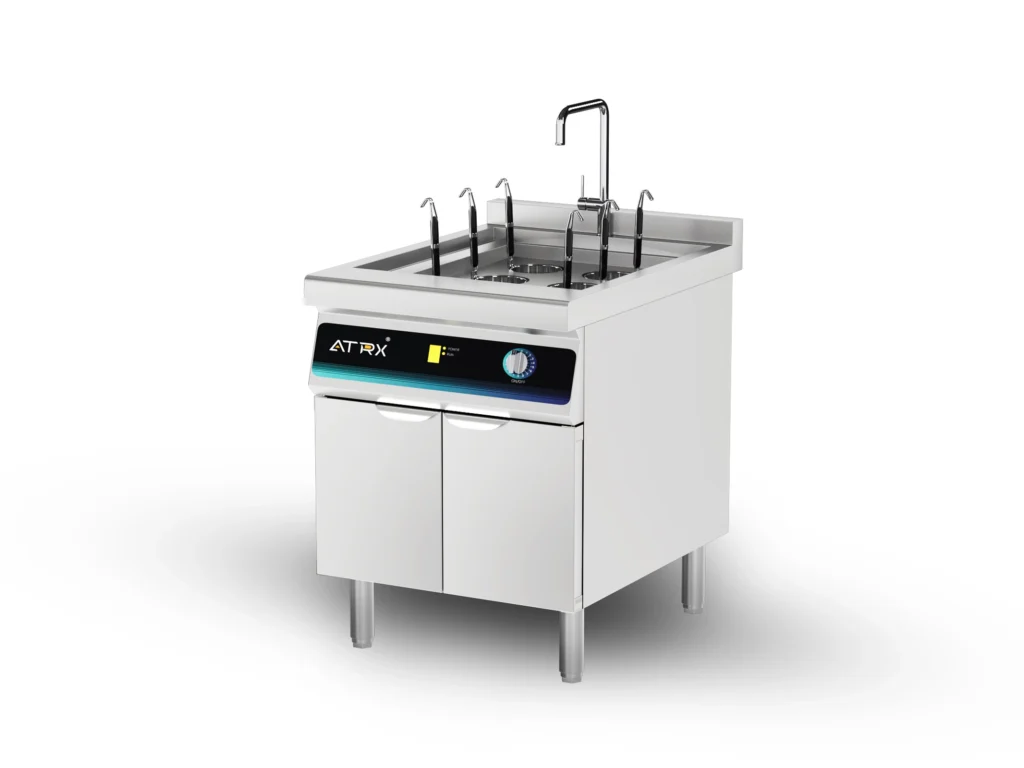
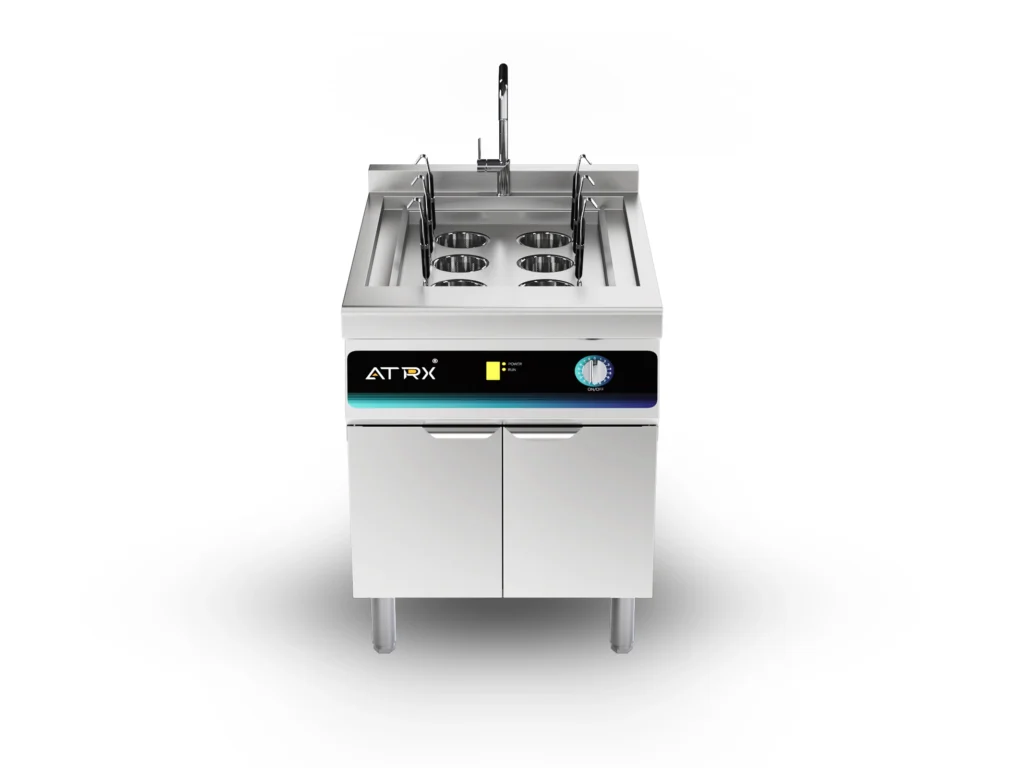
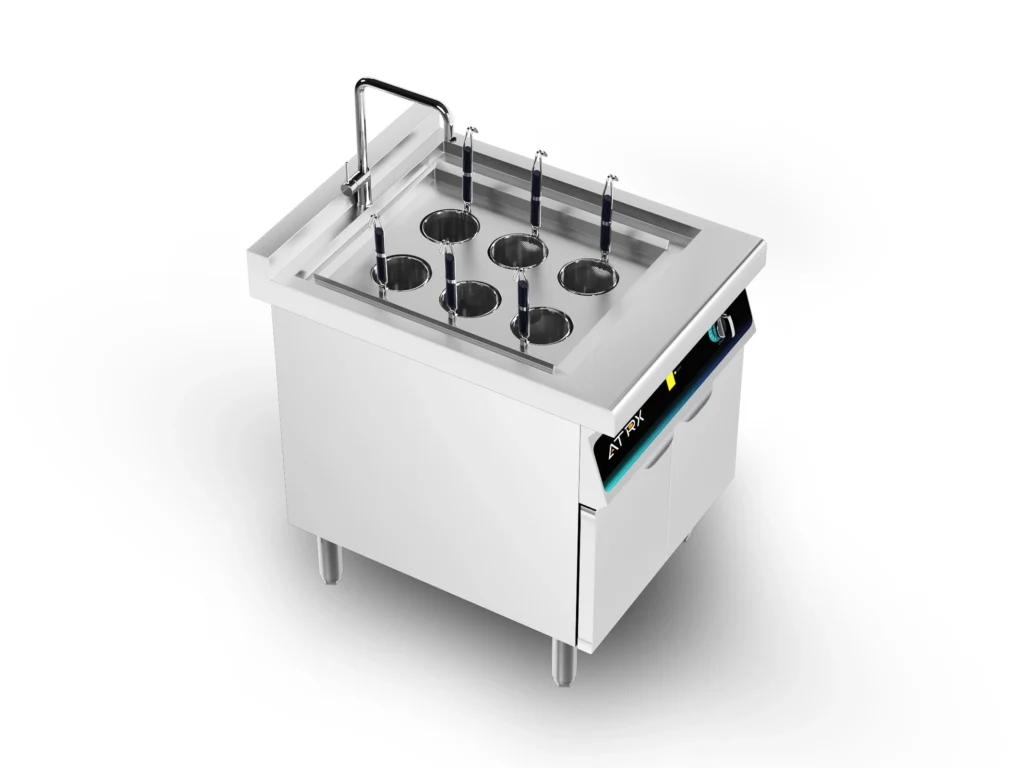
15kW Commercial Induction Pasta Cooker for Frozen Noodles
Floor Commercial Induction Pasta Cooker | 15KW
Value of the 220V Front-to-Back 2-Burner Induction Cooktop
No Thawing: Frozen Noodles Go Straight into the Water
Frozen ramen, udon, and similar noodles go straight into the pot—no thawing. The 15kW system removes a prep step, cutting peak-hour waiting and texture variation.
15kW Heat Recovery for Continuous Basket Loads
Frozen noodles draw heat rapidly when they enter the water. If heat recovery cannot keep up, water temperature falls and noodles can absorb broth and soften in water that is no longer at a rolling boil. The 15kW frozen-noodle cooker continuously restores heat to shorten the wait for a return to boiling, supporting smoother basket-to-basket cooking and more consistent results.
Eight Power Levels for Consistent Noodle Texture
Ramen, udon, soba, and pasta have different tolerances for cooking. One power level cannot take every product from start to finish. The rotary control offers eight levels, allowing the chef to adjust output to noodle type, portion size, and the boil after loading, making it easier to keep batch-to-batch texture consistent.
Inquiry UsView Specifications
01 / SPECIFICATIONS
Product Specification
Product Name
Product Model
Power(Kw)
Voltage(V)
Product Size
Product Material
Hs Code
02 / GETTING STARTED
How To Operate This Machine
Step 1
Place your commercial induction cooker in position and connect the power cable based on the required voltage. Make sure all wiring is done correctly before turning on the unit.
Step 2
Once powered on, place your induction cookware on the commercial induction cooker, prepare your ingredients, and get ready to start cooking.
Step 3
Turn the knob from 0 to your desired setting to begin cooking. During the cooking process, simply adjust the knob between levels 1 to 8 to control the heat output to your needs.
Step 4
Once cooking complete,then turn the knob back to 0 to power off the unit. Wipe down and clean the surface of your commercial induction cooker to keep it in top condition.
03 / QUALITY ASSURANCE
15kW Commercial Induction Pasta Cooker: Factory Testing for Frozen Noodles
01
SS304 Cabinet with Water-Vapor Weld Recheck
Our stainless-steel fabrication team verifies the SS304 grade and sheet thickness against the order drawing, then completes cutting, bending, and welding for the cabinet and tank. After welding, frame distortion, mounting-hole alignment, burrs, and sharp edges are checked to reduce the risk of moisture-related corrosion and difficult cleaning. This matters in frozen-noodle service, where steam, cleaning chemicals, and repeated temperature swings are part of every shift.
02
Thermal-Cycle-Critical Parts Verified Before Assembly
A receiving check compares power modules, capacitors, coils, and connectors with the order list, supplier labels, and physical parts, then re-tests key parameters such as capacitance on a sample basis. Visually similar parts are not treated as interchangeable; a model, parameter, or interface mismatch can cause unstable heating, signal faults, or nuisance shutdowns when frozen baskets are loaded continuously. Stopping non-conforming lots before the line supports stable heating for a 15kW cooker expected to handle repeated freezer-to-pot orders.
03
Coil Winding and Tank-Bottom Alignment Recheck
The winding process uses model- and wattage-specific turns, spacing, and tension; afterward, the coil is fixed, cured, and checked for dimensions and electrical values. Installation checks then confirm center position, insulation parts, and supports, with any offset, looseness, or missing part treated as a risk to even heat transfer. Alignment and support at this stage keep heat transfer more even during repeated frozen-noodle loads.
04
PCB Solder Recheck for Thermal-Shock Resistance
On the PCB line, surface-mount parts are positioned and soldered by program, then through-hole parts are added and inspected for misalignment, reversed parts, bridges, insufficient solder, missed joints, loose connectors, and reversed polarity. These small joints face steam, grease, and frequent starts and stops, the conditions most likely to create intermittent faults, so the joints are tested before assembly. Screening them supports consistent heating response as frozen loads drive rapid thermal cycling in a ramen or delivery kitchen.
05
Power-On and Full-Load Testing at Every Level
After assembly, every 15kW unit is powered on to check the control panel, indicators, and all eight power levels, with heating response, fan cooling, and fault protection confirmed at each setting. A power fluctuation, abnormal shutdown, or protection action during full-load testing sends the machine back for rework; release follows only after model, wattage, voltage, frequency, and the ordered 380V three-phase version are verified before the nameplate is applied. That full-unit screen is aimed at the gap between passing one test and sustaining repeated frozen-noodle loads at peak.
06
Power-On and Transport-Vibration Testing
Before packing, our inspection team powers on the assembled unit, checks the display, buttons, and indicators, tests every power level, and confirms heating response, fan cooling, applicable protection actions, insulation, and grounding. A simulated transport-vibration test then checks for loose parts or assembly errors from transport and routine knocks, along with the model, wattage, voltage, and supplied accessories. Catching those issues before shipment limits the chance of a 15kW frozen-noodle station arriving with a fault that appears only after repeated start-stop service.
All results above are from our own factory. See related pages below.
Production Line Center Manufacturing Machines PCB Assembly Center04 / COOKING APPLICATIONS
15kW Commercial Induction Pasta Cooker: Ramen Shops, Chains and Snack Counters
Own factory
CE certified
OEM available
Ramen and Udon Shops
During lunch and dinner peaks, frozen tonkotsu ramen, shoyu ramen, udon, and soba can be taken from the freezer and placed directly into separate baskets, then cooked continuously for dine-in and takeout orders. A noodle shop can link cooking, broth dipping, topping, and bowl assembly into a single service line, and the unit also suits small shops serving soup noodles, mixed noodles, and dipping noodles.
Noodle Chains and Delivery Stores
Central kitchens for chain brands can freeze ramen, udon, or pasta by portion and ship it to mall, office-building, or neighborhood stores, where staff place it directly into the pot when an order arrives. During concentrated delivery orders, dine-in queues, or single-staff shifts, employees can follow standardized power levels, loading sequence, and lift times, reducing on-site weighing, portioning, and advance thawing.
Wonton, Dumpling and Snack Counters
Breakfast counters, late-night stalls, food courts, and neighborhood noodle shops often keep frozen wontons, dumplings, ramen, udon, and a small amount of frozen vegetables at the same noodle station. Staff can start with wontons, then cook dumplings, noodles, or vegetables and lift each basket by order—well suited to small shops with focused menus, frequent service, and limited back-of-house space.
FAQs
Frequently Asked Questions
We've gathered the most common questions buyers ask before placing their first order — browse through and find the answers that matter most to you.
Can Frozen Noodles Go Directly into the Water?
Yes—frozen ramen, udon, soba, and pasta can go straight from the freezer into separate baskets without thawing. That removes an advance prep step and lets a ramen shop or delivery store cook to order instead of thawing batches in anticipation. The basket-based workflow keeps each portion contained while it cooks from frozen, without a separate tempering stage.
Can the Water Keep Up with Continuous Basket Loads?
Yes—the water can keep up when frozen baskets are added in stages rather than all at once. The 15kW induction system heats directly through the tank bottom and applies high power after each load to shorten recovery. Adding one basket every 20–30 seconds and maintaining the water level keeps that recovery rhythm manageable for dine-in and delivery orders.
How Should Power Be Adjusted for Different Noodles?
Set one shared power level for the most heat-demanding noodle in the tank, then control thinner items through loading order. Thick udon and frozen pasta generally need more heat than soba or thin noodles, but all baskets draw from the same tank and power setting. Load long-cooking items first and add thin noodles later to avoid one turning soft while another stays hard at the center.
What Power Supply Does the Unit Require?
This unit requires a 15kW, 380V three-phase supply and cannot run on an ordinary 220V outlet. Its rated current is approximately 22.8A, with 4mm² copper cable and a 32A residual current device recommended. A dedicated supply sized for repeated frozen loads supports stable heating and reduces nuisance tripping or shutdowns at peak.
Is Cleaning Starch and Grease Easy?
Yes—starch and grease are manageable when the tank, baskets, and exterior are cleaned before residue hardens. SS304 construction, removable baskets, and a drain valve keep the work focused on a small number of accessible surfaces. After shutdown and cooling, the tank can be drained and washed with a soft cloth and neutral detergent; because starch enters the water continuously in frozen-noodle service, periodic descaling should follow water quality.
——07 / Factory quote & RFQ
Partner with a Trusted Commercial Induction Cooker Manufacturer
Whether you need wholesale commercial induction cookers, an OEM product line or a commercial kitchen project configuration, send a focused commercial brief. An ATRX team member can review the product, power, certification and customization requirements before quotation.
Useful information to include:
Target country · Product category · Application · Voltage / phase · Estimated quantity · Required certifications · OEM / branding needs