

PRODUCT HIGHLIGHTS
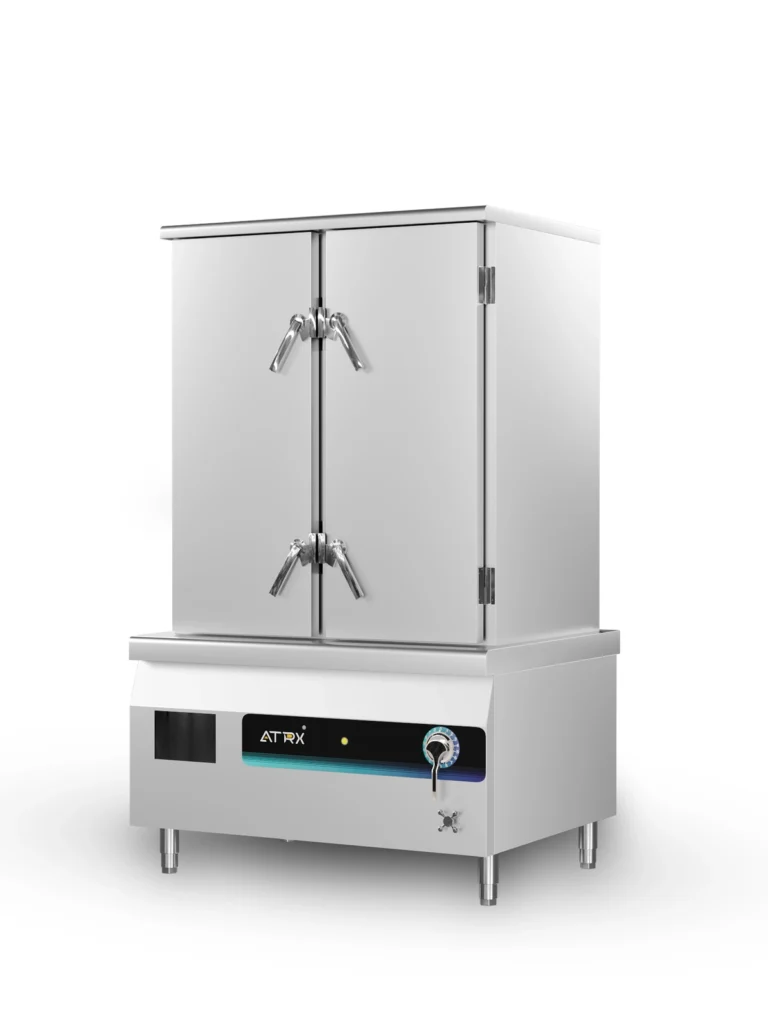
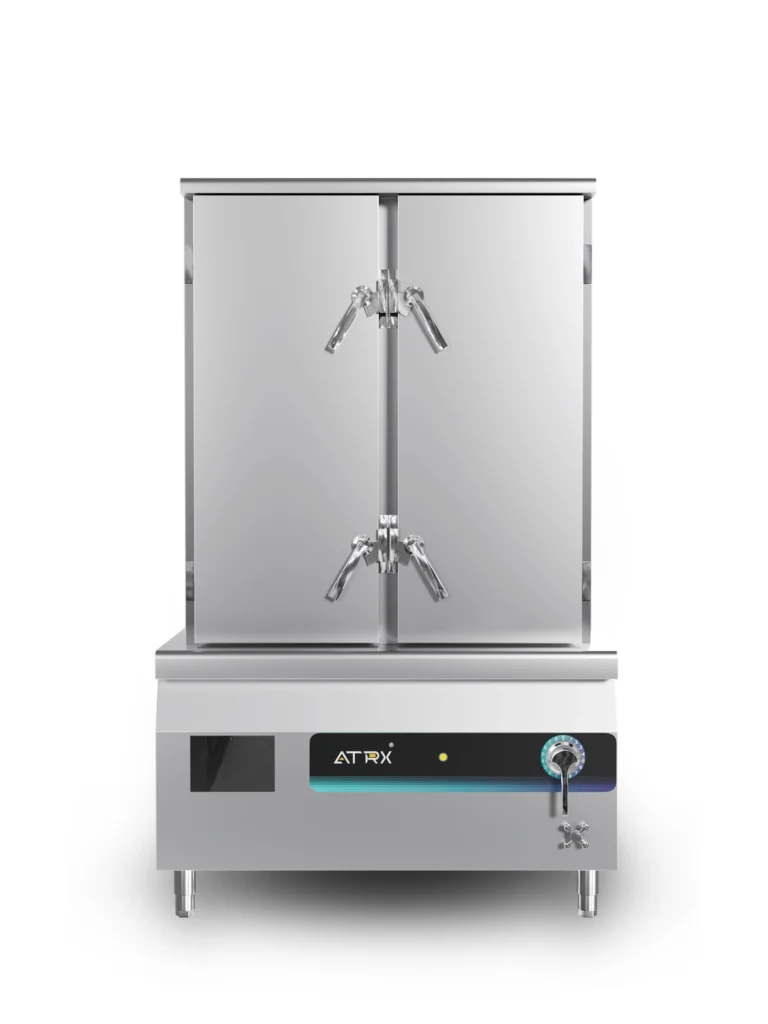
36-Tray Double-Door Commercial Rice Steamer
Commercial Induction Double Door Rice Steamer | 35KW
Value of the 220V Front-to-Back 2-Burner Induction Cooktop
Steam 36 Trays for a Single Meal Service
With 36 trays at about 3.5 kg each and 25 portions per tray, one full load yields around 900 portions. This consolidates a whole meal service into one cabinet.
Double Doors, One Chamber for Consistent Batch Control
Both doors open into one shared chamber, so all 36 trays cook in the same environment. There are no separate temperature zones to manage, which helps keep batch texture consistent.
Confirm Electrical Supply for 35/40 kW Models in Advance
The 36-tray SS304 (304 stainless steel) cabinet comes in 35 kW and 40 kW versions, both on a 380V three-phase supply. Both require 25 mm² copper cable and an 80 A residual-current breaker, so check the site’s supply before ordering.
Inquiry UsView Specifications
01 / SPECIFICATIONS
Product Specification
Product Name
Product Model
Power(Kw)
Voltage(V)
Product Size
Product Material
Hs Code
02 / GETTING STARTED
How To Operate This Machine
Step 1
Place your commercial induction cooker in position and connect the power cable based on the required voltage. Make sure all wiring is done correctly before turning on the unit.
Step 2
Once powered on, place your induction cookware on the commercial induction cooker, prepare your ingredients, and get ready to start cooking.
Step 3
Turn the knob from 0 to your desired setting to begin cooking. During the cooking process, simply adjust the knob between levels 1 to 8 to control the heat output to your needs.
Step 4
Once cooking complete,then turn the knob back to 0 to power off the unit. Wipe down and clean the surface of your commercial induction cooker to keep it in top condition.
03 / QUALITY ASSURANCE
36-Tray Double-Door Commercial Rice Steamer: Six High-Load Tests
01
Incoming Inspection Prevents Mixed Power Components
Incoming inspection starts by matching the bill of materials, supplier labels, inspection reports and physical part numbers. A mismatched power device or capacitor in a high-load steamer can cause power fluctuation and frequent protective shutdowns. Rated voltage, capacitance, dimensions and interfaces are checked, and key electrical parameters are sample-tested by batch. Wrong-model or damaged parts never reach the 35 kW or 40 kW assembly line. In high-volume cafeteria or banquet production, this control at the start helps protect output through concentrated meal service.
02
Cleanroom Control-Board Assembly and Solder Inspection
With the parts confirmed, control boards go through SMT and soldering in a sealed cleanroom. Missing parts, misalignment, bridges, insufficient solder, cold joints or shifted components could otherwise reach final assembly and disturb high-load operation. Optical inspection follows SMT, through-hole parts are then installed and soldered, and joints are rechecked. Each board must pass a powered functional test. For a double-door cabinet working long meal shifts, this screening keeps both halves of the batch under stable control.
03
Verify Coil Positioning and Cooling Airflow
Coil winding is programmed by model and power, with turns, spacing and tension preset before the coil is secured and cured. A coil that moves or sits incorrectly can reduce cooling and create uneven heating during continuous output. Dimensions and electrical parameters are checked first. During cabinet assembly, position, insulation, spacers, lead routing, fan direction and the airflow path are verified. On the 35 kW and 40 kW models, this helps the cooling design work as intended through repeated high-load batches.
04
Check Cabinet Weld Distortion and Door-Frame Fit
Fabrication of the 36-tray double-door body starts at the panel stage, where SS304 grade, thickness and dimensions are checked before laser cutting, punching and bending. Weld distortion can shift openings, the top frame or cover panels and make doors and racks hard to fit on site. After welding, alignment is checked, burrs and sharp edges are removed, and weld areas are corrected without thinning load-bearing welds. In a double-door steamer, a square body helps both doors and the shared rack system assemble and seal correctly.
05
Humidity, Salt-Spray and Thermal-Shock Testing
Heat aging, damp-heat exposure, salt spray and thermal shock form an environmental test sequence for boards, metal parts and connectors. A single power-on check cannot reveal moisture ingress, corrosion or a joint that weakens after repeated heating and cooling. Boards are heat-aged for several hours, then put through constant-temperature/humidity, salt-spray and thermal-shock tests, so these conditions are more likely to be found before shipment. For institutional meal peaks, this reduces the risk of a control or contact fault interrupting a large batch.
06
Full-Load Testing and Electrical Safety Inspection
Final assembly includes a point-by-point wiring check before the full-load test. Missed plugs, loose screws, leftover wire ends or a harness touching a fan blade can cause a shutdown or electrical fault in service. The main power, control board, sensor and fan wiring are checked against the model diagram, connectors are locked and grounding points are inspected. Switch, indicator, setting-by-setting, insulation, grounding-continuity and leakage checks follow. The nameplate must match the ordered 35 kW or 40 kW rating, 380V three-phase supply and frequency, and failed units are repaired and retested.
All results above are from our own factory. See related pages below.
Production Line Center Manufacturing Machines PCB Assembly Center04 / COOKING APPLICATIONS
36-Tray Double-Door Commercial Rice Steamer for High-Volume Kitchens
Own factory
CE certified
OEM available
School and Factory Cafeteria Meal Peaks
This cabinet suits elementary and secondary school lunch programs, multi-line university cafeterias, factory shift meals and corporate-campus dining. When headcount varies, staff can add or remove trays to match the day’s demand. When one meal service needs a large volume of rice, all 36 trays can be loaded at once, which reduces queues at serving stations and repeated small-batch re-steaming.
Central-Kitchen and Boxed-Meal Production
This cabinet suits boxed-meal production, chain-restaurant central kitchens and multi-line meal preparation for schools or employers. A large base batch of rice can be cooked in one cabinet, then divided by store, serving line or delivery batch. Trays can be loaded and unloaded through either door, so upstream and downstream tasks connect more easily and one recipe does not have to be split across several small units.
Banquet and Large-Event Batch Service
This cabinet suits wedding banquets, corporate annual meetings, large-event catering, military dining facilities and government support kitchens. When several hundred portions must be ready within a fixed service window, or when rice, buns, corn and root vegetables are steamed together, trays can be assigned by menu item. A full load is produced in one cabinet and removed in stages through the two doors, which makes portioning easier for banquets and institutional kitchens.
FAQs
Frequently Asked Questions
We've gathered the most common questions buyers ask before placing their first order — browse through and find the answers that matter most to you.
How Many People Can One 36-Tray Cabinet Serve?
One full load supports rice service for about 900 people at one meal. With 36 trays, about 3.5 kg of rice per tray and about 25 portions per tray, the cabinet yields roughly 900 portions. Smaller headcounts map to about 20 trays for 500 people and 30 trays for 750. In schools, factories and group-catering kitchens, this reduces repeated small-batch cooking and peak queues, and makes one production round easier to plan. Portion weight, rice type and fill level change actual coverage, so large cafeterias should keep a small buffer.
How Long Does a Full 36-Tray Load Take?
A full cabinet typically completes one steaming round in about 25-50 minutes. Kitchens can work backward from meal time to set loading, start-up and unloading points. Once the local rice and fill quantity are fixed, a test steam gives a usable schedule and removes repeated checking. Rice type, fill level and desired texture determine where the run falls within the range, so the local standard should take precedence over the published interval.
Do the Two Doors Create Two Temperature Zones?
No. Both doors open into one steam chamber, so all 36 trays cook in the same environment as a single batch. This avoids separate left and right temperature zones and makes texture easier to keep consistent across a large rice batch, while the doors can still be opened separately for loading or unloading during cafeteria peaks. If you need two
How Should the 380V Three-Phase Supply Be Wired?
Use a dedicated 380V three-phase circuit sized for the 35 kW or 40 kW model. Rated current is about 53.2 A at 35 kW and 60.8 A at 40 kW, and both models use 25 mm² copper cable and an 80 A breaker. This configuration supports steam output during high-load service and reduces the risk of nuisance tripping or voltage loss. For high-output cafeteria and banquet production, have an electrician verify the site capacity and the ordered rating before installation.
Can the 36-Tray Rice Steamer Cook More Than Rice?
The cabinet also handles buns, mantou, dumplings, siu mai, vegetables, fish, ribs and braised meat, with different foods assigned to different trays. One unit can therefore cover cafeteria staples, breakfast dim sum and some steamed dishes, which improves utilization and menu flexibility. Strong-smelling seafood, cured items and other pungent foods should use separate batches and should not share the cabinet with rice for long periods.
——07 / Factory quote & RFQ
Partner with a Trusted Commercial Induction Cooker Manufacturer
Whether you need wholesale commercial induction cookers, an OEM product line or a commercial kitchen project configuration, send a focused commercial brief. An ATRX team member can review the product, power, certification and customization requirements before quotation.
Useful information to include:
Target country · Product category · Application · Voltage / phase · Estimated quantity · Required certifications · OEM / branding needs