

PRODUCT HIGHLIGHTS
5kW Multi-Basket Induction Pasta Cooker with Custom 4-Compartment Design
Contertop Commercial Induction Pasta Cooker | 5KW
Value of the 220V Front-to-Back 2-Burner Induction Cooktop
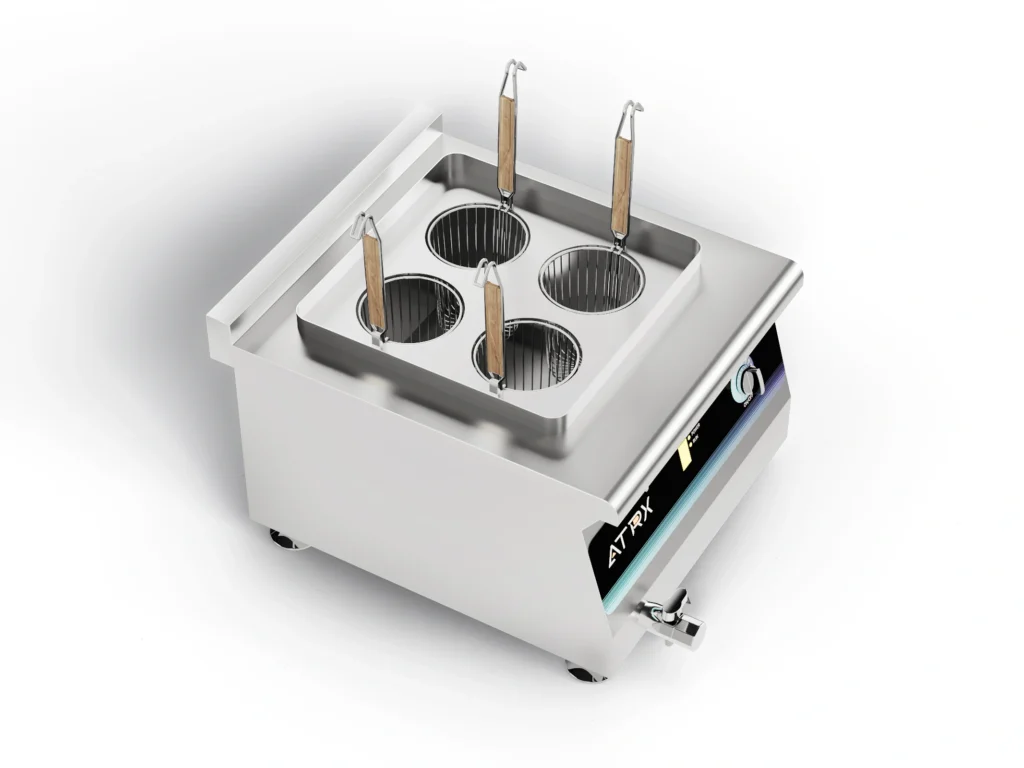
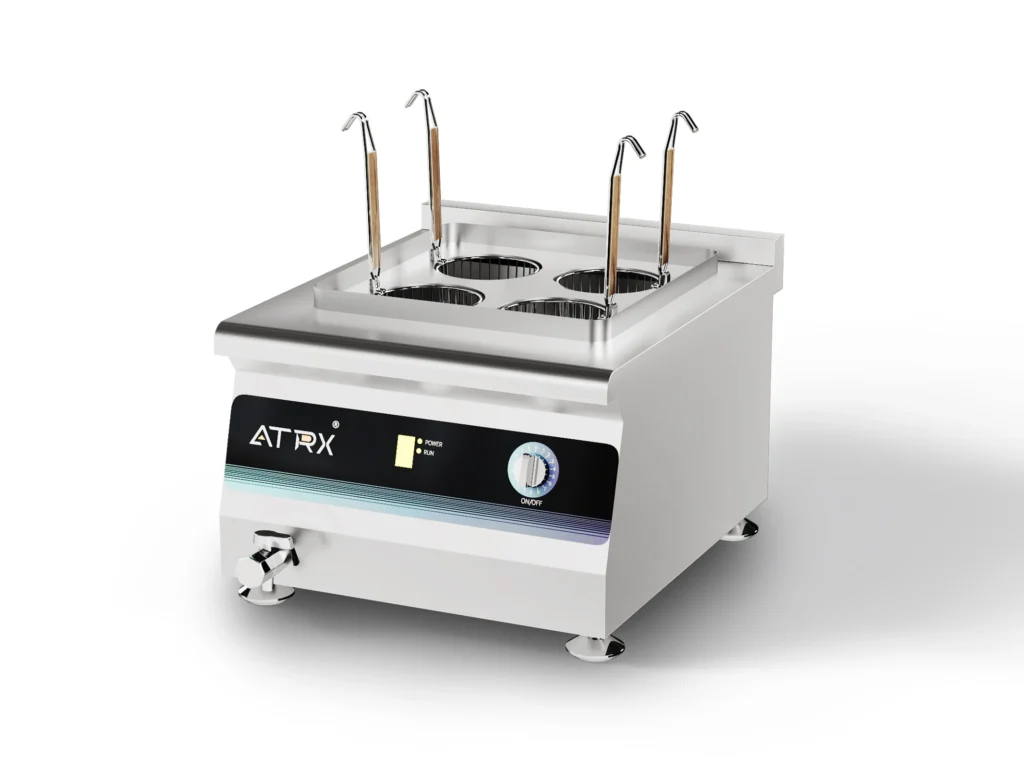
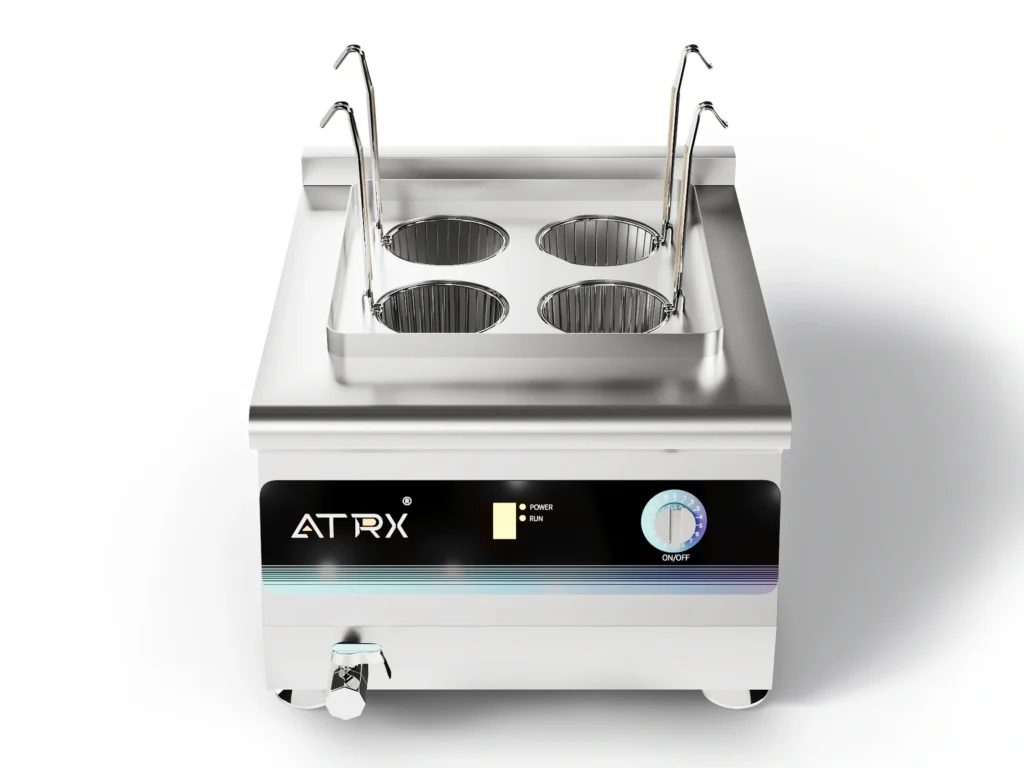
One Basket per Portion, Four Portions at Once
Four baskets sit in separate compartments and lift independently, so thin noodles, thick noodles, and separate orders finish without one pot waiting for another.
Solid Divider Panels Keep Broths Separate
Removable solid stainless-steel dividers split one tank into four separate zones. Each zone can hold water, broth, or seasoned stock. The dividers block liquid flow and reduce the transfer of noodle starch between zones, allowing clear broth, spicy broth, dumplings, and vegetables to be cooked side by side while retaining their own flavors.
Four Zones, One Base: Less Counter Space
The unit has a 500 × 470 × 400 mm countertop design, and all four zones share one 5kW induction heating system at the base. You do not need four separate machines, nor four separate power connections for four cooking positions. When the dividers are removed as a set, the unit converts back to a single full tank—useful for portioned service at peak times and bulk blanching during slower periods.
Inquiry UsView Specifications
01 / SPECIFICATIONS
Product Specification
Product Name
Product Model
Power(Kw)
Voltage(V)
Product Size
Product Material
Hs Code
02 / GETTING STARTED
How To Operate This Machine
Step 1
Place your commercial induction cooker in position and connect the power cable based on the required voltage. Make sure all wiring is done correctly before turning on the unit.
Step 2
Once powered on, place your induction cookware on the commercial induction cooker, prepare your ingredients, and get ready to start cooking.
Step 3
Turn the knob from 0 to your desired setting to begin cooking. During the cooking process, simply adjust the knob between levels 1 to 8 to control the heat output to your needs.
Step 4
Once cooking complete,then turn the knob back to 0 to power off the unit. Wipe down and clean the surface of your commercial induction cooker to keep it in top condition.
03 / QUALITY ASSURANCE
Four-Zone Commercial Induction Pasta Cooker: Factory Testing for Separate Broths and Stable Heat
01
First-Article Approval Before Four-Zone Production
Each four-zone production run starts by locking the wattage, voltage, tank structure, and accessory list, then building a first article to that approved configuration. Structural, functional, and fitment testing must pass before mass production, and later units follow the same parts and process documents. If a production issue appears, engineering traces the operation and corrects the batch, limiting the chance of divider misfit or liquid movement between clear and red-broth zones in a multi-brand delivery kitchen.
02
Sheet-Metal Tank and Divider Dimensions Verified
Laser cutting, CNC punching, and bending shape the tank and housing; before batch processing, we verify SS304 grade, sheet thickness, profile, and structural dimensions. Key hole positions, bend angles, weld distortion, and assembly clearances are measured item by item, and burrs or sharp edges are removed. Accurate dimensions here help the dividers and baskets seat tightly, limiting broth seepage between zones during separate-broth service.
03
Divider and Basket Fitment Rechecked
During assembly, technicians check each removable solid divider for seating, contact gaps, and reset position after removal, then test all four strainers for dimensions, hanging position, and lift smoothness; together, these parts allow each zone to hold its own water or broth. A divider that sits poorly or a basket that catches can undermine zone separation before the unit ever reaches service. With those fit points controlled, clear, spicy, and dumpling baskets are better placed to work side by side without avoidable liquid exchange in a delivery kitchen.
04
5kW Coil and Airflow Path Verified Across Four Zones
The shared 5kW coil is wound to the model's specified turns, spacing, and tension, fixed and cured, then checked for dimensions and electrical values. Installation checks cover coil position, insulation, and supports, while fans are set for intake/exhaust direction, polarity, and clearance before heating, cooling, and airflow are tested together. Correct alignment and airflow support several broth zones through a sustained lunch rush without localized overheating becoming a service interruption.
05
Four-Zone Control Board Tested Before Installation
Control-board checks begin before final assembly: the board is surface-mounted, reflow-soldered, populated, and wave-soldered in a clean area, then optically, electrically, and functionally tested. During assembly, power, fan, sensor, and control interfaces are checked point by point against drawings, wire numbers, and ports; the completed unit then undergoes dielectric strength and applicable protection-function tests. A control fault screened at this point is less likely to interrupt all four separated cooking zones once the unit is in service.
06
Nameplate Applied Only After Full Four-Zone Inspection
Before the nameplate is applied, every four-zone unit is run through all eight power levels, heating response, fan cooling, applicable protection actions, and a simulated transport-vibration test. The final check confirms the model, wattage, voltage, frequency, accessories, and appearance, and any abnormality or loose part blocks release; only then is the unit rust-protected and packed to specification. That final gate is aimed at delivery kitchens where an intact-looking unit must still hold separated broths and shared 5kW heat through peak orders.
All results above are from our own factory. See related pages below.
Production Line Center Manufacturing Machines PCB Assembly Center04 / COOKING APPLICATIONS
Four-Zone Commercial Induction Pasta Cooker for Noodle, Delivery and Snack Kitchens
Own factory
CE certified
OEM available
Noodle Shops and Noodle Counters
During the lunch rush, one zone can cook clear-broth noodles, another red-broth noodles, a third thin rice noodles, and a fourth pasta or wide noodles. Each basket corresponds to one order or one category, and the cook can lift each basket when its contents reach the right doneness. Thin noodles do not need to keep cooking with thick noodles, and clear and red broths are less likely to pick up each other's flavors.
Multi-Brand Delivery Kitchens
When one kitchen handles delivery brands for beef noodles, hot-and-sour noodles, and wontons, the four zones can be assigned to different broths, staples, and sides, with each basket removed according to its order. Packers no longer need to search among several standalone machines for an order, and shared base heating reduces equipment footprint.
Dumpling and Snack Counters
At breakfast and late-night counters, one zone can cook wontons, one can boil dumplings, one can prepare noodle soup, and one can blanch vegetables. Each category uses its own basket, so thin-skinned wontons are less likely to stick to noodles, and vegetables do not pick up the flavor of neighboring meat broth or chili oil. When traffic changes, remove the dividers to restore a full tank, making it easier to increase blanching or noodle capacity at short notice.
FAQs
Frequently Asked Questions
We've gathered the most common questions buyers ask before placing their first order — browse through and find the answers that matter most to you.
Can the Four Zones Cook Different Ingredients at Once?
Yes. Solid stainless-steel dividers let the four zones hold different ingredients at the same time, although all four share one 5kW heater. Each compartment can carry its own water, broth, or seasoned stock. For example, a delivery kitchen might assign clear beef broth, hot-and-sour broth, wontons, and vegetables to separate zones. The dividers restrict liquid movement and reduce starch and flavor carry-over, and grouping broths with similar boiling needs keeps the shared heat efficient.
Can the Four Baskets Be Timed Separately?
Only with the optional custom timing configuration; the standard tank uses one shared timer. In either build, each basket can still be lifted out independently, so thin noodles can come out before thick noodles, wontons, or dumplings.
Can 5kW Handle a Noodle-Shop Rush?
Yes, for a typical noodle shop, delivery counter, or small-to-medium kitchen, provided baskets are staged and the circuit is correctly sized. The unit runs on 220V single-phase power at 22.7A, and induction heats the tank bottom directly, so finished baskets can be lifted one by one without stopping the whole tank. Actual throughput depends on water volume, portion size, starting food temperature, and local voltage.
Can the Dividers and Baskets Be Removed for Cleaning?
Yes. Both the four baskets and the divider set come out for cleaning. Removing them exposes the tank floor and divider edges, where broth residue can otherwise collect in the joints, and everything returns to its original position for four-zone operation.
How Should Power Be Planned for a Four-Zone Cooker?
Plan a dedicated 220V single-phase circuit for the 5kW four-zone model; an ordinary household outlet is not suitable. At 22.7A, it calls for 4mm² copper cable and a 32A residual current device. By comparison, the 3.5kW version draws 15.9A and uses 2.5mm² cable with a 20A device.
——07 / Factory quote & RFQ
Partner with a Trusted Commercial Induction Cooker Manufacturer
Whether you need wholesale commercial induction cookers, an OEM product line or a commercial kitchen project configuration, send a focused commercial brief. An ATRX team member can review the product, power, certification and customization requirements before quotation.
Useful information to include:
Target country · Product category · Application · Voltage / phase · Estimated quantity · Required certifications · OEM / branding needs