

PRODUCT HIGHLIGHTS
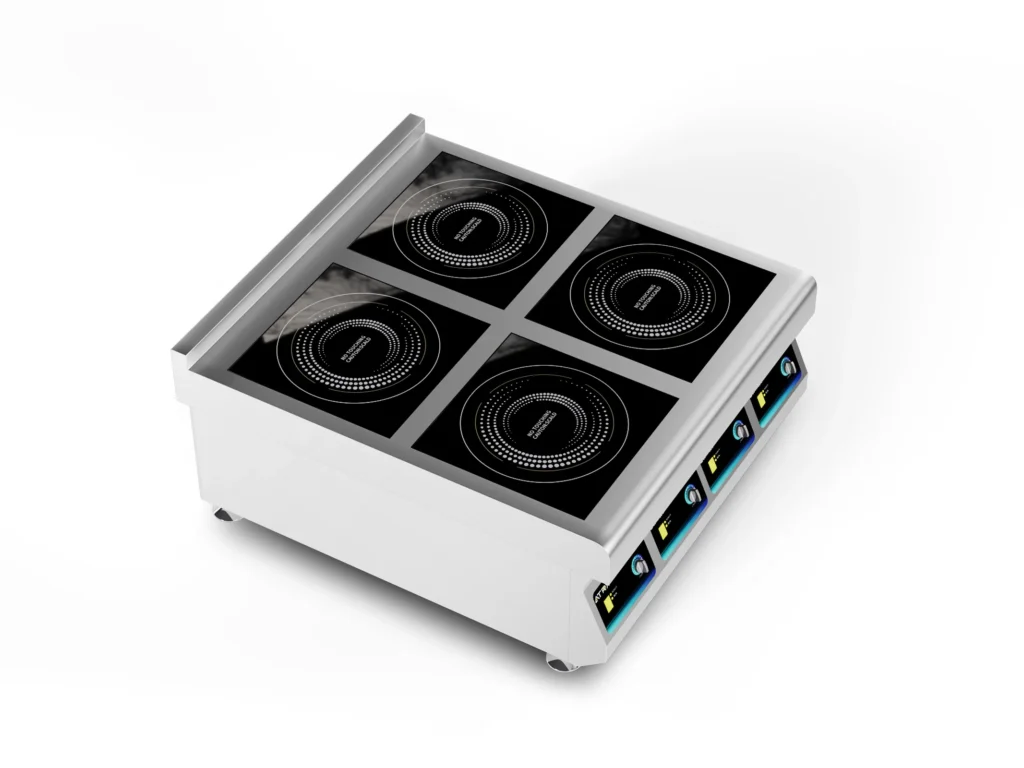
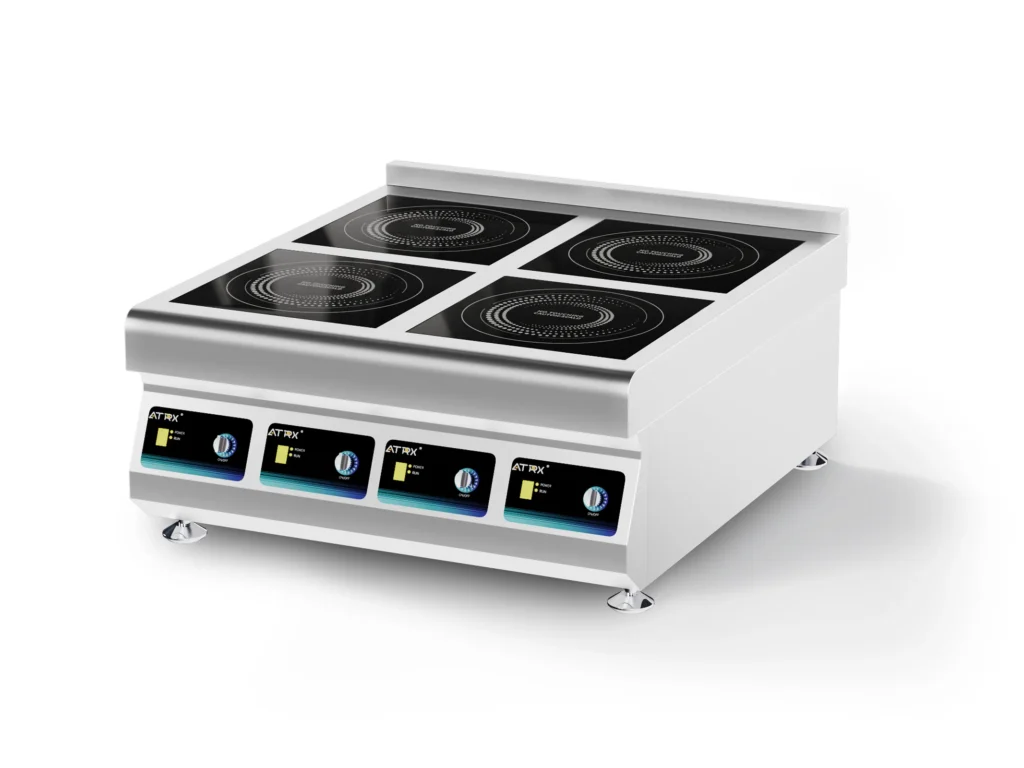
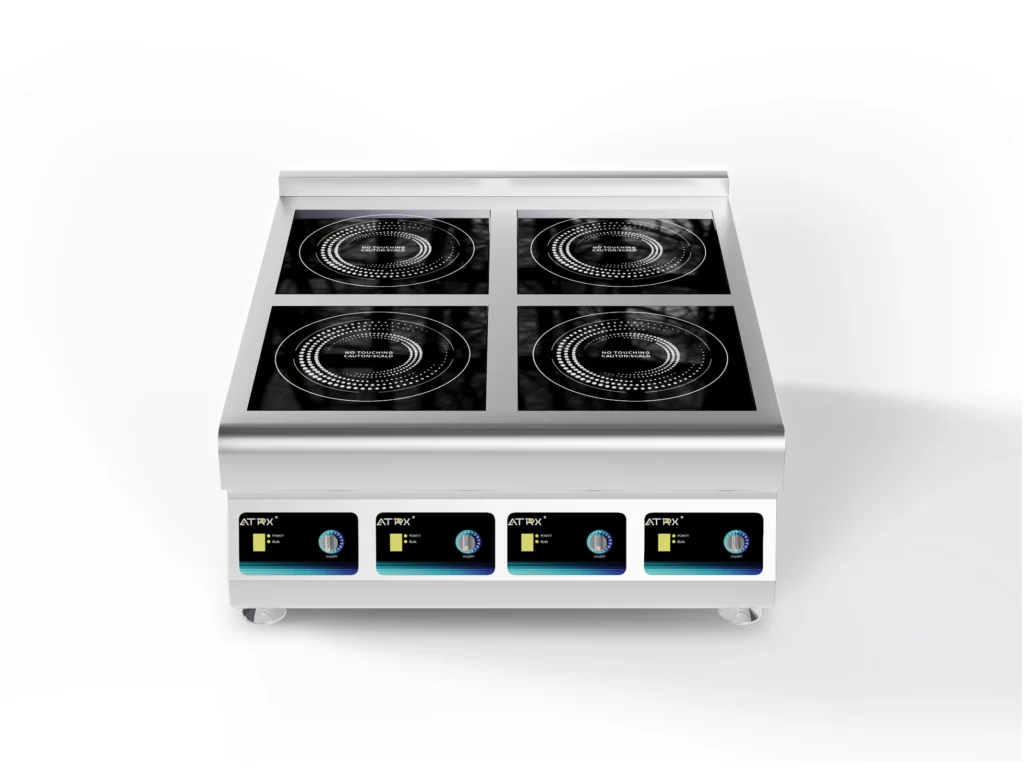
4-Burner Precision Temperature Induction Cooktop
Countertop Induction Four Burners | 5KW*4
Value of the 220V Front-to-Back 2-Burner Induction Cooktop
Commercial Zone-by-Zone Fine Power Control for Consistent Sauces
Hollandaise, custard, and chocolate sauce can curdle or split, and stock can scorch; four zones with 1–8 levels make low heat easier to hold.
Fast Heat Response on the Commercial Cooktop with Less Scorching and Sticking
After searing or toasting aromatics, induction lets the same zone drop quickly to a simmer; searing, simmering, and holding flow in one pan with less swapping.
Four Independently Controlled Commercial Zones for Multi-Step Cooking
When soup, braises, pan sauces, and holding sides run at once, four zones adjust separately; one can hold a low simmer while another sears on its own schedule.
Inquiry UsView Specifications
01 / SPECIFICATIONS
Product Specification
Product Name
Product Model
Power(Kw)
Voltage(V)
Product Size
Product Material
Hs Code
02 / GETTING STARTED
How To Operate This Machine
Step 1
Place your commercial induction cooker in position and connect the power cable based on the required voltage. Make sure all wiring is done correctly before turning on the unit.
Step 2
Once powered on, place your induction cookware on the commercial induction cooker, prepare your ingredients, and get ready to start cooking.
Step 3
Turn the knob from 0 to your desired setting to begin cooking. During the cooking process, simply adjust the knob between levels 1 to 8 to control the heat output to your needs.
Step 4
Once cooking complete,then turn the knob back to 0 to power off the unit. Wipe down and clean the surface of your commercial induction cooker to keep it in top condition.
03 / QUALITY ASSURANCE
Six Quality Controls for the Precision Heat Control 4-Burner Commercial Induction Cooktop
01
Board-by-Board Control-Board Solder Checks
Every control board is checked from paste and placement through reflow and cooling, with nitrogen used to reduce oxidation. In-line optical inspection looks for missing parts, shifting, bridging, low solder, cold joints, and lifted components, and failing boards are repaired or quarantined before they move on. Smooth board-level output gives sauce work a steadier base for small heat adjustments.
02
Coil and Power-Part Matching
Matched sets are issued for coils, power modules, cooling parts, and connectors by order model. High-power devices are checked for model, position, orientation, and polarity against drawings, leads are confirmed through the holes, and wave-soldered joints are rechecked for fill, missed joints, bridges, and lead condition. Keeping those parts matched keeps each zone's response consistent, so the four cooking areas behave predictably instead of drifting apart in low-heat work.
03
Control-Board Electrical Testing Before Assembly
Before a board goes inside the machine, it is tested for shorts, opens, and wrong component values, then powered on for startup, output, control response, and protection. A fault found at this stage is easier to repair than one buried in a finished unit, and board-level results give a traceable starting point if a control anomaly appears later. Electrical testing before assembly is meant to protect the fine power response that sauce and low-heat work depends on.
04
Full-Unit Level-by-Level Heating and Cooling Tests
After assembly, the display, buttons, and indicators are checked, then every power level is run in sequence to confirm heating follows the setting. Fan startup, airflow, cooling, and protection response are checked, and a simulated shipping vibration test rechecks fasteners, connectors, and full-unit function. Stepping through every level confirms that the cooktop actually responds across its 1–8 range, which is the practical basis for sauce and low-heat control.
05
Humidity and Thermal-Cycling Verification of Boards
At component stage, boards go through baking, thermal aging, thermal shock, constant humidity, and salt-spray verification. The screen watches for weak points under moisture, heat, sudden temperature change, and corrosion, so material and connection problems surface before final assembly; the full unit then gets separate power-on, heating, cooling, and vibration checks. Environmental screening protects that control response through steam, heat cycles, and wash water, so precision does not fade after the unit enters a working kitchen.
06
First-Article Approval and Batch Consistency Control
Before production, a first sample is built and checked for structure, function, and compatibility; production continues on the same materials and defined processes only after approval. Every machine carries a process card, and model, coil, power module, cooling parts, and connectors are checked station by station, with anomalies traced to the specific step and corrected across the batch. That batch discipline keeps later units close to the approved first sample, so precision heat-control behavior is not limited to a single demonstration machine.
All results above are from our own factory. See related pages below.
Production Line Center Manufacturing Machines PCB Assembly Center04 / COOKING APPLICATIONS
Commercial Kitchen Dishes and Processes for the Precision Heat Control 4-Burner Induction Cooktop
Own factory
CE certified
OEM available
Sauces and Desserts
Suited to hollandaise, custard, chocolate ganache, and cheese sauce, plus melting chocolate, holding caramel, and dessert glazes — especially small batches needing slow emulsification and steady low heat. (One of four zones holds that setting without disturbing the others.)
Soups and Braises
Suited to beef-bone stock, chicken stock, brisket, red-braised pork, and braised chicken that boil then simmer low; also holding stock, batch curry, beans, and root vegetables. (Four independent zones keep each pot at its own low setting at the same time.)
Searing and Reduction
Suited to fried noodles, seared steak, quick vegetable stir-fries, and chicken legs that color at high heat and finish low; also sautéing onions or mushrooms and reducing stock in the same zone. (Four-zone control makes the sear-to-sauce transition repeatable.)
FAQs
Frequently Asked Questions
We've gathered the most common questions buyers ask before placing their first order — browse through and find the answers that matter most to you.
How does the precision commercial four-burner control heat?
Heat is controlled by splitting the cooktop into four independently adjustable zones, each with eight power steps. A sauce can be held gently on a low setting, searing can be cut back without moving the pan, and separate zones let several dishes proceed at once; on a sauce station, that is the difference between holding a hollandaise and scrambling it. “Precision” here means finer power steps and clearer zone control, not automatic temperature measurement or a built-in temperature display.
Can power levels on the commercial cooktop replace a temperature display?
No. Power levels set and repeat output; they do not show the actual temperature of the food. Chocolate, hollandaise, or a thick cut of meat still needs a probe thermometer when the recipe depends on a specific temperature, with the level serving as the repeatable setting to return to. If the process requires automatic setting, display, or recording, confirm that configuration and its test conditions with the factory before purchase.
How do I choose between the 3.5 kW and 5 kW commercial four-burner models?
Start with the number of zones running at peak, the heat recovery the menu needs, and the available electrical capacity. AT-CTSBZ-003 is 3.5 kW × 4 and AT-CTSBZ-005 is 5 kW × 4; both use 220V single-phase, with the higher rating for high-heat, high-load stations and the lower rating for kitchens with limited circuit headroom. Confirm the chosen model against the final rating plate and the actual menu before ordering.
Is the kitchen supply enough when all four zones run?
Not from the cooktop alone; the site supply must be checked against the selected model. The four-zone totals are 14 kW for AT-CTSBZ-003 and 20 kW for AT-CTSBZ-005, and a licensed electrician should size the incoming line, breaker, wire gauge, and grounding from the rating plate, preferably on a dedicated circuit. The 700 × 800 × 300 mm body also needs rear clearance for wiring and airflow, so that space belongs in the counter plan.
Does changing cookware affect heat control on the commercial cooktop?
Yes, and the effect is noticeable at low settings because induction transfers heat through the pan base. A flat, magnetic base that sits squarely on the zone holds a low setting more steadily than a warped, undersized, or non-matching base. When all four zones run, the body’s intake and exhaust must remain clear or the electronics can lose cooling capacity. For sauce work, match each pan to its zone and avoid moving a poorly seated pan between settings.
——07 / Factory quote & RFQ
Partner with a Trusted Commercial Induction Cooker Manufacturer
Whether you need wholesale commercial induction cookers, an OEM product line or a commercial kitchen project configuration, send a focused commercial brief. An ATRX team member can review the product, power, certification and customization requirements before quotation.
Useful information to include:
Target country · Product category · Application · Voltage / phase · Estimated quantity · Required certifications · OEM / branding needs