

PRODUCT HIGHLIGHTS
3.5kW 220V Countertop Induction Wok Cooker
Countertop Induction Wok Cooker | 3.5KW
Value of the 220V Front-to-Back 2-Burner Induction Cooktop
An Independent Wok Station on a Narrow Counter
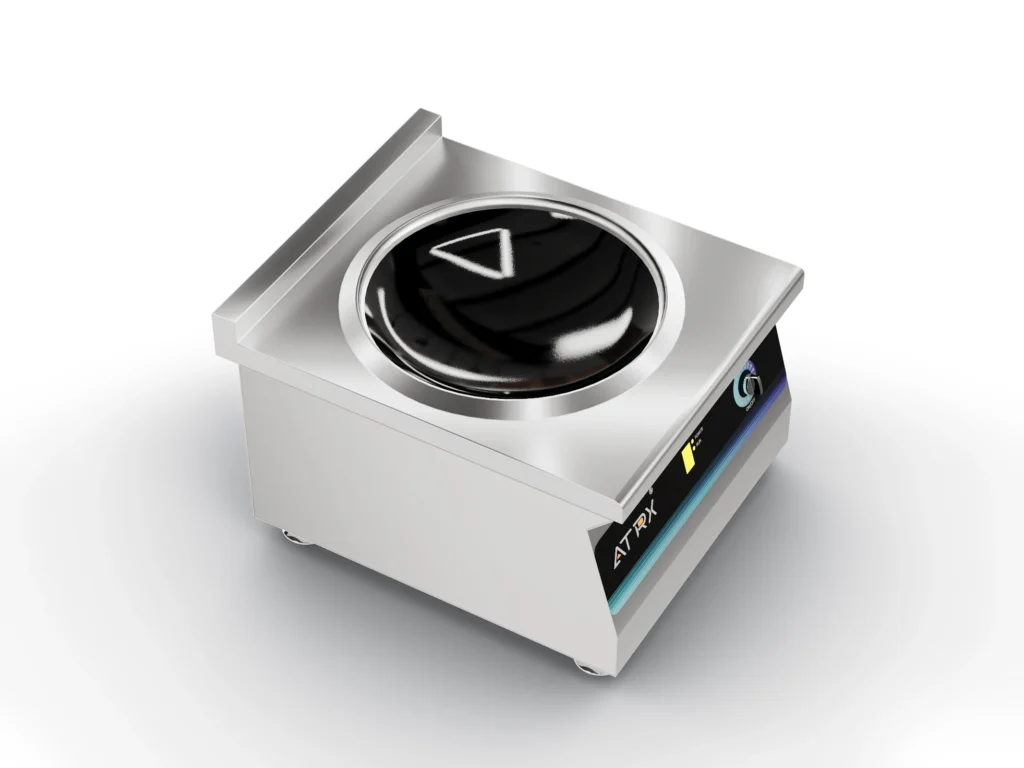
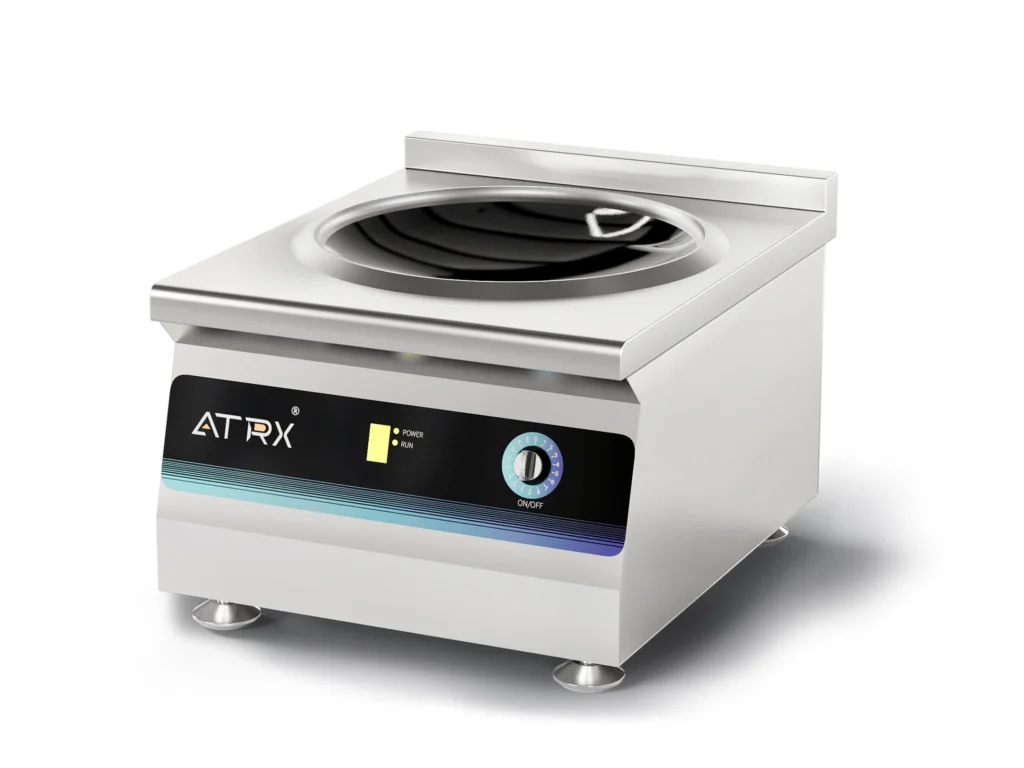
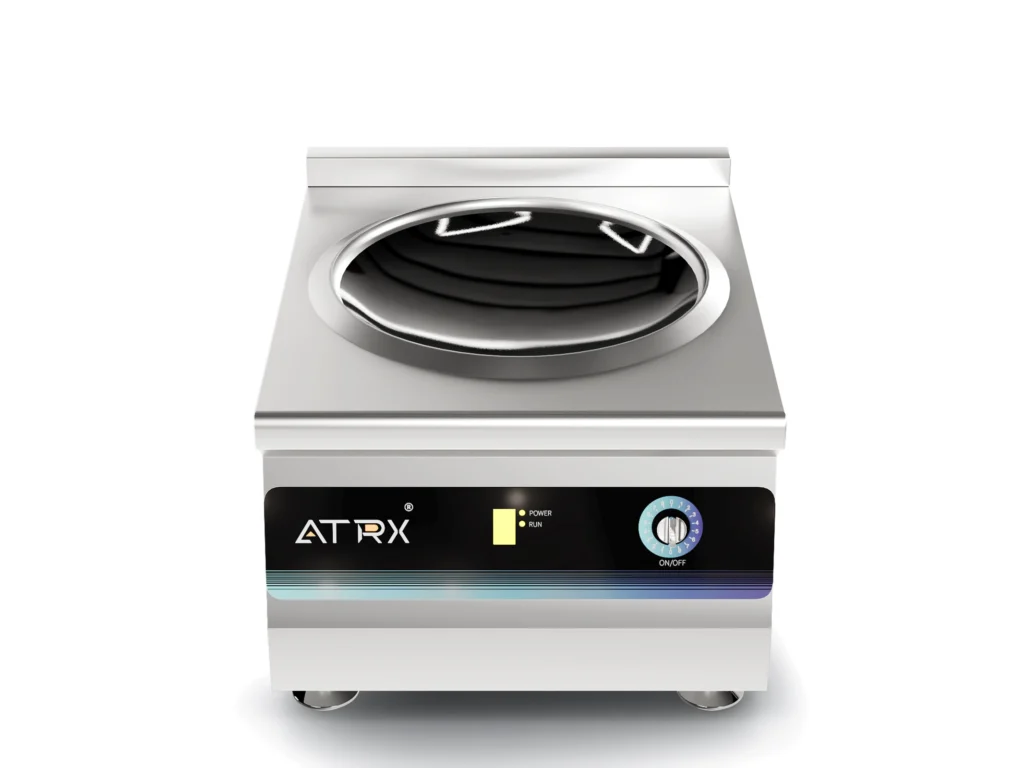
The AT-CTW-003 body measures about 420 × 470 mm and gives one wok a 3.5kW zone with 1–8 levels. Fried rice, noodles, and toppings stay on one compact station.
Concave Surface Cradles Round-Bottom Woks
The concave zone supports the wok from below and follows its curve with heat, steadying the pan while tossing and helping fried rice or beef ho fun cook continuously.
Flame-Free Design Reduces Kitchen Heat Radiation
Induction heats the wok without gas or open flame. Its 1–8 knob covers stir-frying, frying, and simmering; wiring, RCD protection, and ventilation still follow local codes.
Inquiry UsView Specifications
01 / SPECIFICATIONS
Product Specification
Product Name
Product Model
Power(Kw)
Voltage(V)
Product Size
Product Material
Hs Code
02 / GETTING STARTED
How To Operate This Machine
Step 1
Place your commercial induction cooker in position and connect the power cable based on the required voltage. Make sure all wiring is done correctly before turning on the unit.
Step 2
Once powered on, place your induction cookware on the commercial induction cooker, prepare your ingredients, and get ready to start cooking.
Step 3
Turn the knob from 0 to your desired setting to begin cooking. During the cooking process, simply adjust the knob between levels 1 to 8 to control the heat output to your needs.
Step 4
Once cooking complete,then turn the knob back to 0 to power off the unit. Wipe down and clean the surface of your commercial induction cooker to keep it in top condition.
03 / QUALITY ASSURANCE
Concave Assembly and Testing of the 3.5kW Single Countertop Wok Induction Cooker
01
304 Stainless Steel Housing Material Verification
At incoming inspection, our quality team verifies the 304 stainless steel grade, sheet thickness, and structural requirements against the approved drawings before any cutting or bending begins. Material substitution or an undersized sheet is caught before it becomes a finished housing. For a compact single-wok cooker at a noodle shop or food-truck counter, the specified 304 grade gives the concave zone a stable base that holds its shape through heat and repeated cleaning.
02
Concave Structure and Assembly Dimension Inspection
At the first-article stage, our team checks the housing profile, cooktop opening, and mounting holes against the drawings, verifies bend angles, and then trial-fits the parts before final assembly. If the housing profile, opening, or mounting holes drift, the trial fit catches it while the parts are still easy to correct. In a fast-food or food-truck single-wok station, the wok then seats correctly and stays stable for tossing during cook-to-order service.
03
Vent Position and Air-Duct Consistency Inspection
At the CNC punching stage, we position the cooling vents and mounting holes, check them on the first article, and recheck critical dimensions by batch. A shifted vent or mounting pattern is caught before it becomes a restricted duct or a hot control area. On a single-wok counter working through fried rice and noodle orders, air moves along the intended path through lunch and dinner peaks.
04
Coil and Control Board Stage-by-Stage Testing
At the coil and board stations, our production line inspects coil winding and circuit-board assembly separately, then board-tests every control board in a clean assembly area. Only parts that pass inspection move on to full-unit heating and control-function testing. A weak coil, cold joint, or board fault is caught before the two become one heating system. At a single-wok station running made-to-order rice bowls, fried rice, and noodles, coil and board work together so the wok holds the heat it needs from the first order to the last.
05
Humidity, Heat, and Corrosion Reliability Testing
At our reliability test station, we put relevant parts through constant-temperature/constant-humidity, thermal-shock, and salt-spray testing, then check performance under temperature, humidity, and corrosion exposure. At a noodle counter or food-truck stall, steam and washdown are part of the day; parts that struggle with damp heat or salt fog are held back, corrected, or quarantined. That improves readiness for the splashes and cleaning routine of a compact countertop wok station.
06
Full-Unit Power-On and Safety Acceptance
On the finished wok cooker, our final-test team checks power output, temperature-control response, safety circuits, and insulation, then verifies the order configuration and packing information before the unit is boxed. A component that passed inspection is not treated as a substitute for full-unit acceptance. The wok, control system, and safety circuit are checked together as one system. For a single-wok, cook-to-order station, each unit ships as a complete system for rice bowls, fried rice, and noodles.
All results above are from our own factory. See related pages below.
Production Line Center Manufacturing Machines PCB Assembly Center04 / COOKING APPLICATIONS
Single-Wok, Cook-to-Order Applications of the Single Countertop Wok Induction Cooker
Own factory
CE certified
OEM available
Fast-Food Single-Wok Cooking
In rice-bowl fast-food shops, fried-rice counters, fried-noodle shops, and small Chinese fast-food outlets, this 3.5kW single countertop wok induction cooker runs one wok station through lunch and dinner peaks. It can cook toppings such as shredded pork with green pepper or tomato and egg for rice bowls, then move on to egg fried rice, beef ho fun, and stir-fried greens, with dine-in, takeout, and delivery orders all built around the same wok.
Noodle Toppings
At noodle shops, rice-noodle shops, neighborhood snack shops, and breakfast noodle counters, the same single-wok countertop induction cooker can prepare toppings in sequence before opening, such as minced pork sauce, pickled mustard greens with minced pork, and diced chicken with mushrooms. At meal times, it stir-fries shredded pork with green pepper, tomato and egg, or twice-cooked pork to top soup noodles, tossed noodles, rice noodles, and rice bowls, and can add greens, egg, or fried rice for a walk-in order.
Food Trucks and Market Counters
On food trucks, weekend market stalls, mall pop-up counters, and outdoor events, the single-wok induction cooker is limited to a focused menu that works in continuous operation, such as fried rice, fried noodles, beef ho fun, pan-fried dumplings, and spring rolls. One wok station handles staples, fried snacks, and last-minute add-ons while the cook tosses, boxes, and hands over food at the same counter.
FAQs
Frequently Asked Questions
We've gathered the most common questions buyers ask before placing their first order — browse through and find the answers that matter most to you.
Which Round-Bottom Woks Can Be Used?
Use a magnetic round-bottom wok that sits securely in the concave zone. Carbon steel, cast iron, and magnetic stainless steel are the usual choices; aluminum and pure copper need a magnetic base layer to work. The wok curve and diameter also have to match the concave heating zone. The page does not publish one universal diameter. Trial-fit the actual wok: it should sit without rocking, meet the concave surface, and be recognized as soon as it is placed.
Is 3.5kW Enough for Single-Portion Stir-Frying?
Yes, for single-portion wok cooking. The 3.5kW AT-CTW-003 is built for small restaurants, counters, and food trucks making fried rice, beef ho fun, fried noodles, greens, and small stir-fries in sequence. It is not a two-wok station, and large woks, bulk batches, or long periods at maximum heat sit outside its intended use. If the menu runs at full load for long stretches or batch size keeps growing, compare a higher-power model.
Is It Suitable for Frying and Small-Batch Deep-Frying?
Yes, for pan-frying, shallow-frying, and small-batch deep-frying such as spring rolls, pan-fried dumplings, and tempura. The 1–8 levels let the cook adjust as food goes in, is turned, and comes out. Oil temperature still depends on oil volume, wok mass, and how much food is added at once, so a power level is not a fixed oil temperature. Use an oil thermometer, fry in small batches, and keep exhaust and ventilation running.
Can the 3.5kW 220V Model Use a Standard Outlet?
No—a 10A household circuit is not enough for this load. The AT-CTW-003 is a 3.5kW, 220V single-phase unit listed at 15.9A, with 2.5mm² copper wire and a 20A residual-current device recommended. Circuit length, ambient temperature, and local code can change the final requirement. Have a licensed electrician verify the circuit; food trucks and older shops should confirm total capacity and circuit condition before ordering.
How Should a Concave Induction Wok Cooker Be Cleaned?
Switch off and disconnect the unit, let it cool, then wipe the curve and rim with a soft cloth or sponge, a little neutral cleaner, and a wrung-out cloth. A concave surface collects oil carried down by the wok base and residue around the rim, so soften dried grease before wiping. Do not use steel wool or metal scrapers, and keep water out of the control area, edges, and vents. Clean the curve and rim after each shift, wipe the housing with a damp cloth, and keep the cooling vents clear.
——07 / Factory quote & RFQ
Partner with a Trusted Commercial Induction Cooker Manufacturer
Whether you need wholesale commercial induction cookers, an OEM product line or a commercial kitchen project configuration, send a focused commercial brief. An ATRX team member can review the product, power, certification and customization requirements before quotation.
Useful information to include:
Target country · Product category · Application · Voltage / phase · Estimated quantity · Required certifications · OEM / branding needs