

PRODUCT HIGHLIGHTS
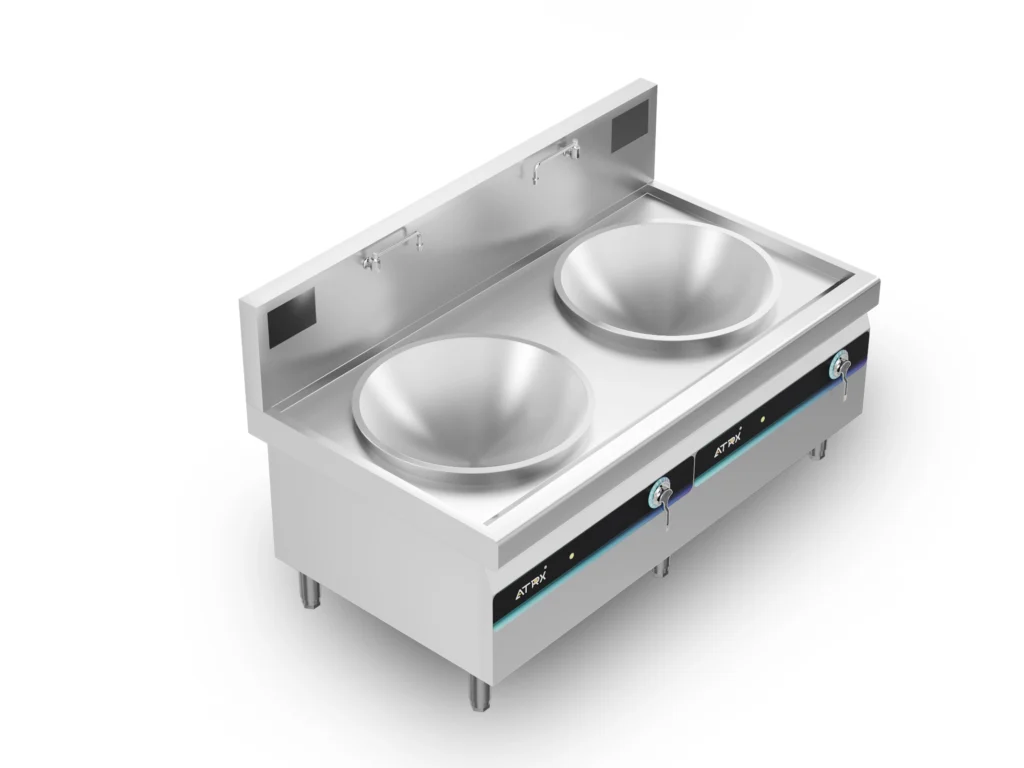
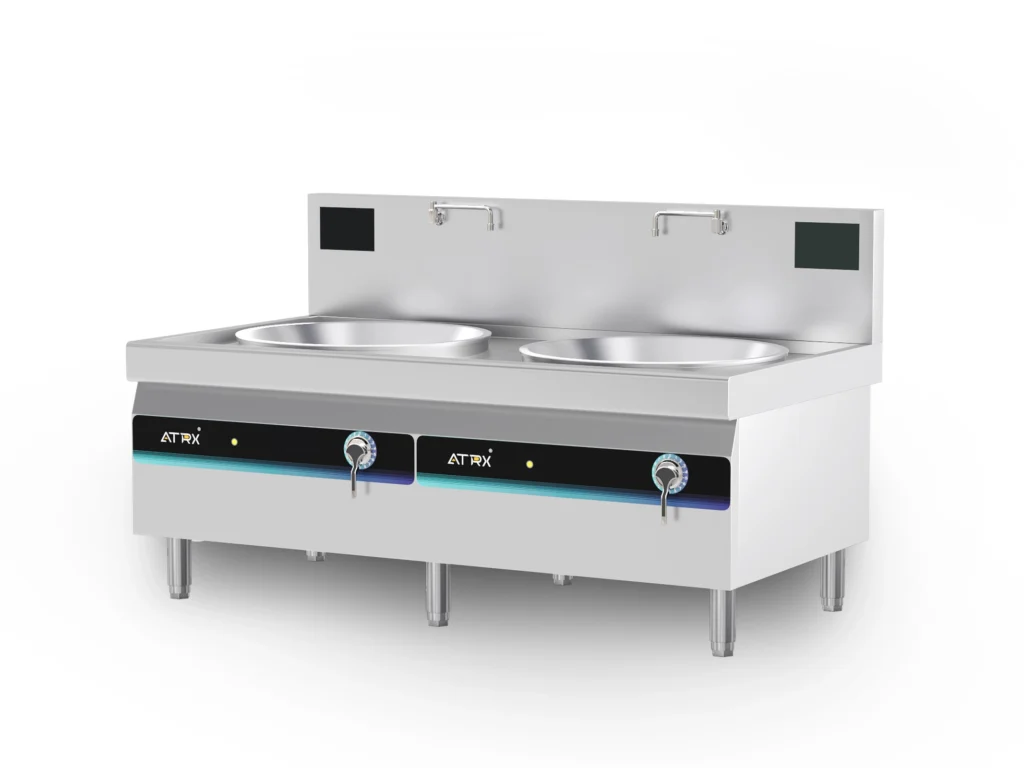
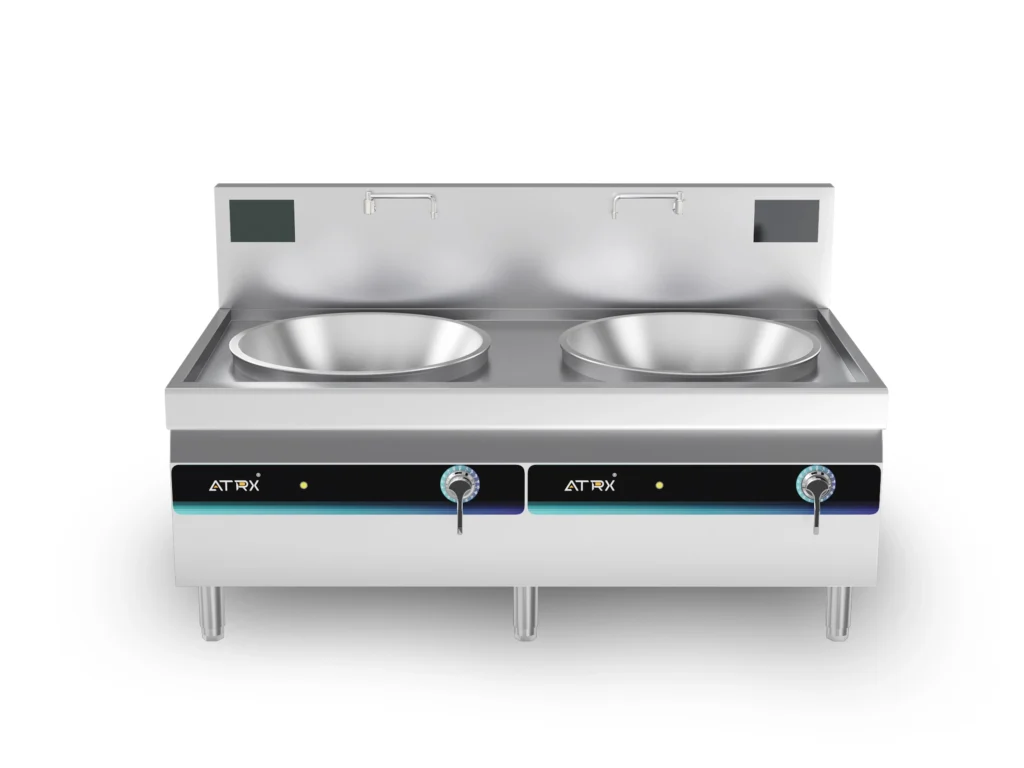
Low-Exhaust Commercial Induction Wok Cooker
Floor Commercial Induction Chinese Double Wok Cooker | 10KW*2
Own factory
CE certified
OEM available
No Combustion, No Toxic Flue Gas
Gas wok burners pump carbon monoxide and nitrogen dioxide straight into your kitchen. This floor induction wok cooker produces none. Heat is generated inside the pan by electromagnetic energy, not by burning fuel. Your extraction system no longer needs to handle toxic combustion gases—only steam and cooking vapors.
Exhaust Power Cut from 125kW to Under 31kW
A gas wok kitchen of equal output needs 89–125kW of extraction fan power to clear heat and fumes. This commercial induction wok station wastes over 60% less heat into the room. Engineers can size the exhaust at just 22–30.5kW. The result: a smaller fan, narrower ductwork, and a lighter makeup air unit.
Compact Hood, Quiet Fan, Less Upkeep
Lower CFM demand means a physically smaller canopy hood that sits closer to the 500mm wok. The fan runs at lower speed, cutting kitchen noise noticeably. Cooler exhaust also stops grease from baking onto baffle filters, so duct cleaning intervals stretch out and maintenance bills shrink.
Faster, Easier Planning Permission
Smaller ductwork and quieter rooftop fans draw fewer objections from neighbors and building inspectors. Zero flue-gas emissions remove another common permit hurdle. For restaurant owners targeting high-street units, basements, or heritage buildings, this induction wok range makes sites viable that gas extraction requirements would have ruled out.
Inquiry UsView Specifications
01 / SPECIFICATIONS
Basic Specification
Product Name
Product Model
Power(Kw)
Voltage(V)
Product Size
Product Material
Hs Code
AT-FLWD500II-010
10kw*2
380V/3Phase
L1500*750*H800+400mm
SS304 Stainless Steel
8419810000
10KW Electric Requirement (One Burner,One Wire)-(18L)-Pot:500mm
- Rated at: 15.2A
- Voltage: 380V (Three-phase)
- Wire: 2.5mm² Copper Cable
- Breaker: 20A RCD (Residual Current Device)
AT-FLWD800II-020
20kw*2
380V/3Phase
L2000*W1100*H800+400mm
SS304 Stainless Steel
8419810000
20KW Electric Requirement (One Burner,One Wire)-(60L)-Pot:800mm
- Rated at: 30.4A
- Voltage: 380V (Three-phase)
- Wire: 10mm² Copper Cable
- Breaker: 40A RCD (Residual Current Device)
AT-FLWD900II-025
25kw*2
380V/3Phase
L2200*W1200*H800+400mm
SS304 Stainless Steel
8419810000
25KW Electric Requirement (One Burner,One Wire)-(80L)-Pot:900mm
- Rated at: 38.0A
- Voltage: 380V (Three-phase)
- Wire: 10mm² Copper Cable
- Breaker: 50A RCD (Residual Current Device)
AT-FLWD1000II-030
30kw*2
380V/3Phase
L2400*W1300*H800+400mm
SS304 Stainless Steel
8419810000
30KW Electric Requirement (One Burner,One Wire)-(105L)-Pot:1000mm
- Rated at: 45.6A
- Voltage: 380V (Three-phase)
- Wire: 16mm² Copper Cable
- Breaker: 63A RCD (Residual Current Device)
02 / GETTING STARTED
How To Operate This Machine
Step 1
Place your commercial induction cooker in position and connect the power cable based on the required voltage. Make sure all wiring is done correctly before turning on the unit.
Step 2
Once powered on, place your induction cookware on the commercial induction cooker, prepare your ingredients, and get ready to start cooking.
Step 3
Turn the knob from 0 to your desired setting to begin cooking. During the cooking process, simply adjust the knob between levels 1 to 8 to control the heat output to your needs.
Step 4
Once cooking complete,then turn the knob back to 0 to power off the unit. Wipe down and clean the surface of your commercial induction cooker to keep it in top condition.
03 / QUALITY ASSURANCE
6-Step Quality Checking of Every Unit
Every testing machine shown below is physically present in our factory — no fabrication.
01
Dust-free PCB assembly
Every board built in a sealed cleanroom, no dust or grease particles get trapped under components — eliminates 40% short-circuit failures compare to competitors.
02
Electric Heating Constant Temperature Drying Oven
Bakes out all moisture from PCBs before soldering — boards that skip this step blister and crack under high-power heat within months.
03
Electric Heating Constant Temperature Incubator
Every board is heat-aged for hours to force weak solder joints to fail in our lab, not in your kitchen after installation.
04
Constant Temperature and Humidity Test Chamber
Simulates years of steam and humidity from a real commercial kitchen to verify no board corrosion or short circuits develop over time.
05
Salt Spray Test Chamber
Tests every metal part and connector against aggressive corrosive vapor — the same oils, acids, and moisture your cooker faces daily in a commercial kitchen environment.
06
Thermal Shock Test Chamber
Mimics the hundreds of rapid heat-up / cool-down cycles your cooker endures every single day, cracking any weak solder joint before it ever ships.
04 / COOKING APPLICATIONS
What Food Can You Cook With It?
Own factory
CE certified
OEM available
Stir-Fried Dishes
Beef chow fun, kung pao chicken, and egg fried rice need explosive heat. The dual 10kW burners deliver fierce wok hei to the 500mm pan while sending almost no waste heat into the room, keeping extraction demand far below what a gas wok kitchen would require.
Braised & Slow-Simmered Recipes
Red-braised pork belly, curries, and bone broth hold at precise temperatures in the deep 58L wok. Long simmering produces mostly steam instead of combustion fumes, so the exhaust fan stays on low speed and ventilation energy cost drops across every extended cook cycle.
Deep-Fried Items
Spring rolls, fried dumplings, and tempura hit target oil temperature fast with 90% energy-to-pan efficiency. No open flame means grease splatter never ignites, and cooler exhaust prevents carbon buildup inside hood filters—directly reducing extraction system maintenance frequency and cost.

FAQs
Frequently Asked Questions
We've gathered the most common questions buyers ask before placing their first order — browse through and find the answers that matter most to you.
How much does a floor induction wok cooker reduce kitchen extraction costs?
Gas wok kitchens typically need 89–125kW of exhaust fan power. This induction wok eliminates combustion gases and cuts waste heat by over 60%, letting you spec the extraction system at 22–30.5kW. That means a smaller hood, narrower ducts, and a lighter makeup air unit. Owners commonly report 40–60% lower total ventilation build-out cost versus an equivalent gas kitchen.
Do I still need a Type I grease hood with an induction wok?
Yes. Codes like NFPA 96 require a Type I hood wherever grease-laden vapors are produced, regardless of heat source. However, because induction creates no combustion plume, required CFM drops 30–50%. The hood can be smaller, closer-mounted, and paired with demand-controlled ventilation that shuts off when the cooker is idle.
Does an induction wok kitchen make planning permission easier?
Often, yes. Smaller ductwork, quieter roof fans, and zero CO or NO₂ emissions remove the most common objections in the permit process. For dense urban sites or heritage buildings where large external extraction was a dealbreaker, a compact induction ventilation setup can unlock locations gas kitchens never could.
How much quieter is extraction in an induction wok kitchen?
Noise tracks directly with fan size and airflow. A 30–50% CFM reduction lets you run a smaller fan at lower RPM. Operators typically see an 8–15 dB drop versus gas—roughly halving perceived loudness. That quieter rooftop unit also helps satisfy planning noise limits for evening service in residential areas.
Can this induction wok work with a ventless recirculating hood?
Gas woks cannot, because combustion produces carbon monoxide that filters cannot safely recirculate. This induction wok generates zero CO, making it compatible with UL 710B ventless hoods. That opens up high-rise, basement, and heritage sites where external ductwork is impractical or prohibited. Always verify local code before installing.
——07 / Factory quote & RFQ
Partner with a Trusted Commercial Induction Cooker Manufacturer
Whether you need wholesale commercial induction cookers, an OEM product line or a commercial kitchen project configuration, send a focused commercial brief. An ATRX team member can review the product, power, certification and customization requirements before quotation.
Useful information to include:
Target country · Product category · Application · Voltage / phase · Estimated quantity · Required certifications · OEM / branding needs