

PRODUCT HIGHLIGHTS
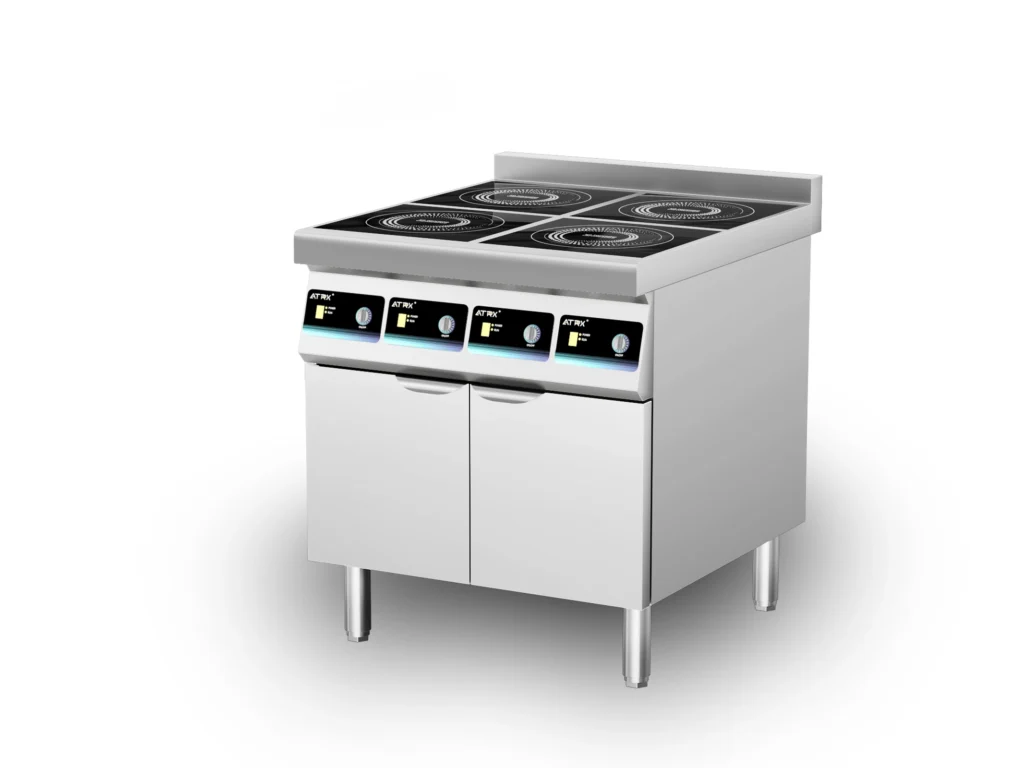
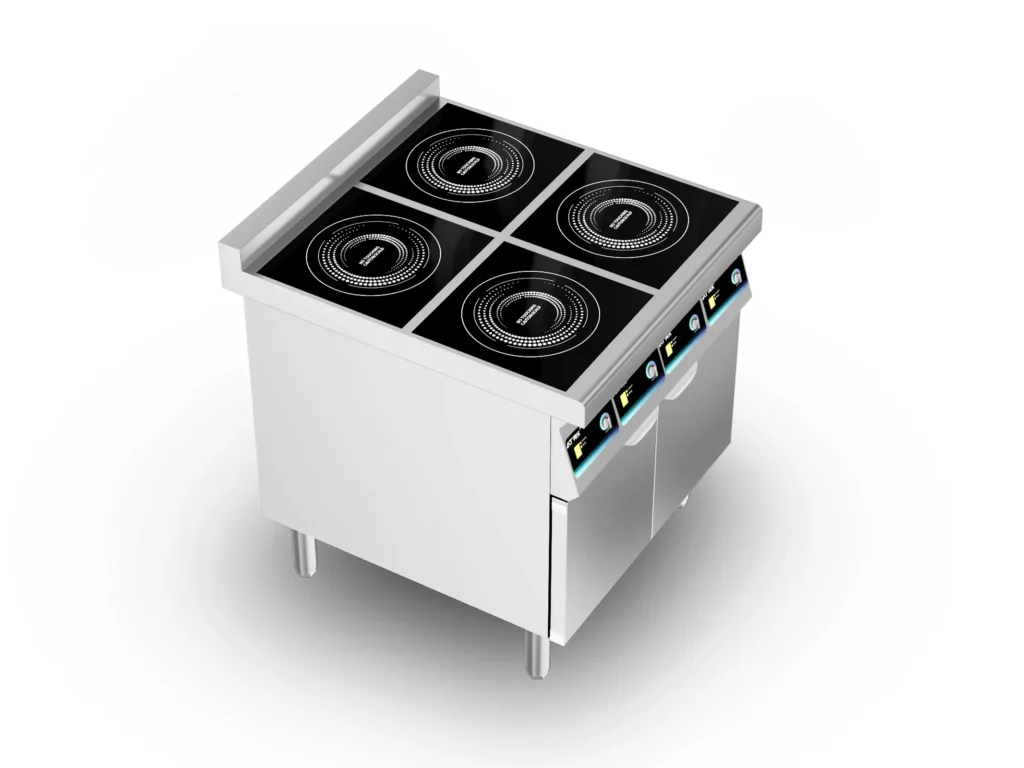
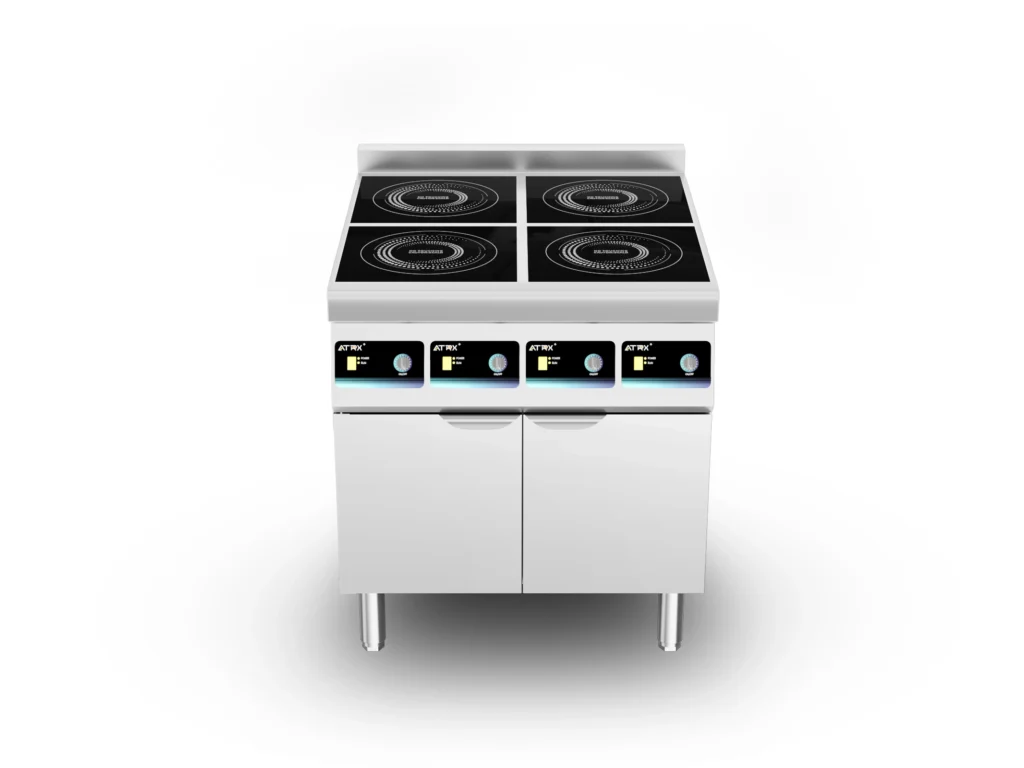
Heavy-Duty 4-Burner Commercial Floor Induction Cooktop
Floor Induction Four Burners | 5KW*4
Value of the 220V Front-to-Back 2-Burner Induction Cooktop
Four Zones Running Together for Peak Service
At peak, fried rice, noodles, soup, and fried items compete for burner space; four zones share 20 kW, so each dish keeps its own zone and orders do not queue.
Floor-Standing Station Built for Big Pots and Continuous Cooking
Soup bases, braised food, and noodles need sustained heat; 380V three-phase drives all four zones, so big pots stay on their burners and finish independently.
SS304 Body That Handles Heavy-Grease Cleaning
The SS304 frame and flat cooktop wipe down after hot soup, oil, and wash water; the floor-standing body needs no countertop cutout and makes closing cleanup easier.
Inquiry UsView Specifications
01 / SPECIFICATIONS
Product Specification
Product Name
Product Model
Power(Kw)
Voltage(V)
Product Size
Product Material
Hs Code
02 / GETTING STARTED
How To Operate This Machine
Step 1
Place your commercial induction cooker in position and connect the power cable based on the required voltage. Make sure all wiring is done correctly before turning on the unit.
Step 2
Once powered on, place your induction cookware on the commercial induction cooker, prepare your ingredients, and get ready to start cooking.
Step 3
Turn the knob from 0 to your desired setting to begin cooking. During the cooking process, simply adjust the knob between levels 1 to 8 to control the heat output to your needs.
Step 4
Once cooking complete,then turn the knob back to 0 to power off the unit. Wipe down and clean the surface of your commercial induction cooker to keep it in top condition.
03 / QUALITY ASSURANCE
Six Quality Controls for the Heavy-Duty 4-Burner Floor-Standing Induction Cooktop
01
Incoming Inspection of Core Components and Panels
On arrival, power modules, capacitors, coils, connectors, and glass panels are checked against the order BOM, supplier labels, test reports, and part markings. Capacitors are verified by capacitance, voltage rating, and part number; power modules by full model, package, and electrical parameters; panels by thickness, flatness, edge cracks, and mounting-surface deformation. A wrong high-power part can look fine outside and still weaken heating under load, so this screen is aimed at the 20 kW duty the floor unit is built for.
02
Circuit-Board Soldering with Manual Re-Check
SMT parts follow preheat, soldering, and cooling profiles by board type in a nitrogen atmosphere, with optical inspection and manual recheck for misalignment, bridging, low solder, and cold joints. Larger power devices and terminals get model, orientation, and polarity checks, and leads are confirmed through the holes; after wave soldering, hole fill, missed joints, and bridges are rechecked. This is aimed at the repeated expansion and contraction of a 20 kW unit running four zones, where a cold joint can take days to show.
03
Coil and Airflow Assembly Checks
During assembly, coils are checked for position, support, insulation, and fastening, and fans for model, voltage, connector, and airflow direction. A shifted coil changes how the pot base heats, while a reversed fan traps heat inside; harnesses are kept clear of blades, and duct space is left around heatsinks and power parts. After power-up, heating and cooling are watched again, so large pots can heat evenly without the machine retaining heat internally.
04
Chassis Dimension and Assembly Accuracy Control
The SS304 shell is laser-cut to profile, CNC-punched, and press-brake formed, with key outlines held to about ±0.1 mm, hole positions to about ±0.03 mm, and bend angles to about ±0.1°. Each batch measures a first article before production continues, and assembly checks fit, gaps, and connections station by station. A square body keeps the cooktop, control panel, and internal brackets aligned when four heavy pots sit on the unit, reducing the chance of panel shift or loosening over time.
05
Humidity, Salt-Spray, and Thermal-Shock Verification
Boards are dried before soldering, then thermal aging, constant temperature and humidity, salt spray, and thermal shock are used to check boards, metal parts, and connections. Steam, wash water, and oil mist are constant in commercial kitchens, and moisture or oxidation can leave problems that only appear after the unit is in service. Rust protection is applied before shipping, and floor models ship in export crates. For a 20 kW floor unit in a heavy-duty line, the aim is to keep the four-zone station in service through that daily exposure.
06
Full-Unit Load and Safety-Function Testing
Assembly checks the main supply, fans, thermostats, and control-board connections against the wiring diagram, then the finished unit runs power-on, heating, cooling, and vibration checks. Display, knobs, stop response, and applicable overheat and empty-pan protections are confirmed level by level, with insulation and withstand tests per model, and the unit also runs under load while power, temperature, fans, and fault protection are watched. That final load check is what confirms the 20 kW, 380V three-phase unit can enter a heavy-duty station with four working zones and its rated configuration intact.
All results above are from our own factory. See related pages below.
Production Line Center Manufacturing Machines PCB Assembly Center04 / COOKING APPLICATIONS
Commercial Kitchen Applications for the Heavy-Duty 4-Burner Floor-Standing Induction Cooktop
Own factory
CE certified
OEM available
Chinese Stir-Fry and Sauce Stations
At peak, one zone handles fried rice, noodles, and toppings, one boils soup or finishes sauce, and two blanch vegetables, fry items, and handle re-orders. (All four zones share 20 kW and work in parallel, so orders stay on one floor station instead of spreading across counters.)
Hotel Banquets
Before a wedding, conference, or buffet, soup, blanched vegetables, pasta, dumplings, and fried items must finish at once; four zones hold a stock pot, boiling pot, wok, and fryer. (Big pots stay on one 20 kW floor station instead of many small ranges across the counters.)
Cafeteria Group Meals
School, hospital, and staff cafeterias prepare mains, soup, noodles, and vegetables before service; four zones handle braising, noodles, blanching, and stir-fry. (Four pots run in parallel on one 20 kW floor station, and the SS304 top wipes down for the next service.)

FAQs
Frequently Asked Questions
We've gathered the most common questions buyers ask before placing their first order — browse through and find the answers that matter most to you.
How is the heavy-duty four-burner different from an ordinary four-burner?
The difference is duty class, not burner count: this is a 20 kW floor-standing machine on 380V three-phase, built for four heavy pots to operate together. Its SS304 body and fixed floor position remove the need for a countertop cutout and suit a dedicated cooking line. It fits busy restaurants, hotel kitchens, and cafeterias; a light-volume counter would pay for capacity it does not use.
Can all four zones on the heavy-duty unit run at the same time?
Yes, when the dedicated 20 kW three-phase supply and protection are in place. The four zones share that supply and are independently controlled, so braising, soup, noodles, and stir-fry can run together under heavy pots. Wire size, breakers, and protection must follow the final rating plate and wiring diagram. An ordinary socket or a small shared circuit can trip or derate the four-zone load and should not be used.
What site conditions does the heavy-duty four-burner need?
The kitchen needs 380V three-phase power, a dedicated 20 kW circuit, a level floor that can carry the machine and pots, and adequate ventilation. The unit is floor-standing and needs no countertop cutout, but its sides, rear, and bottom require clear airflow. Cookware must be flat-bottomed and magnetic, and a licensed electrician should complete the connection against the rating plate, wiring diagram, and local code.
How do I confirm the unit is the heavy-duty four-burner configuration?
Check the rating plate and contract, not only the four-burner appearance. The specification should state four-zone control, 20 kW total, 380V three-phase, SS304 construction, and floor-standing design, and the supplier should provide the matching wiring diagram and factory inspection records. Confirm model, power, voltage, and frequency item by item so a lower-spec look-alike is not accepted as the same unit.
How should continuous use and daily cleaning be managed?
Heavy-duty construction does not make the cooktop maintenance-free. Keep side, rear, and bottom vents clear during continuous use, avoid long dry-boiling, and treat a louder fan, falling power, or a temperature alarm as a reason to reduce load and check pot position and airflow. After service, disconnect power, let the surface cool, wipe with a wrung-out soft cloth, and keep water out of knobs, gaps, and vents.
——07 / Factory quote & RFQ
Partner with a Trusted Commercial Induction Cooker Manufacturer
Whether you need wholesale commercial induction cookers, an OEM product line or a commercial kitchen project configuration, send a focused commercial brief. An ATRX team member can review the product, power, certification and customization requirements before quotation.
Useful information to include:
Target country · Product category · Application · Voltage / phase · Estimated quantity · Required certifications · OEM / branding needs