

PRODUCT HIGHLIGHTS
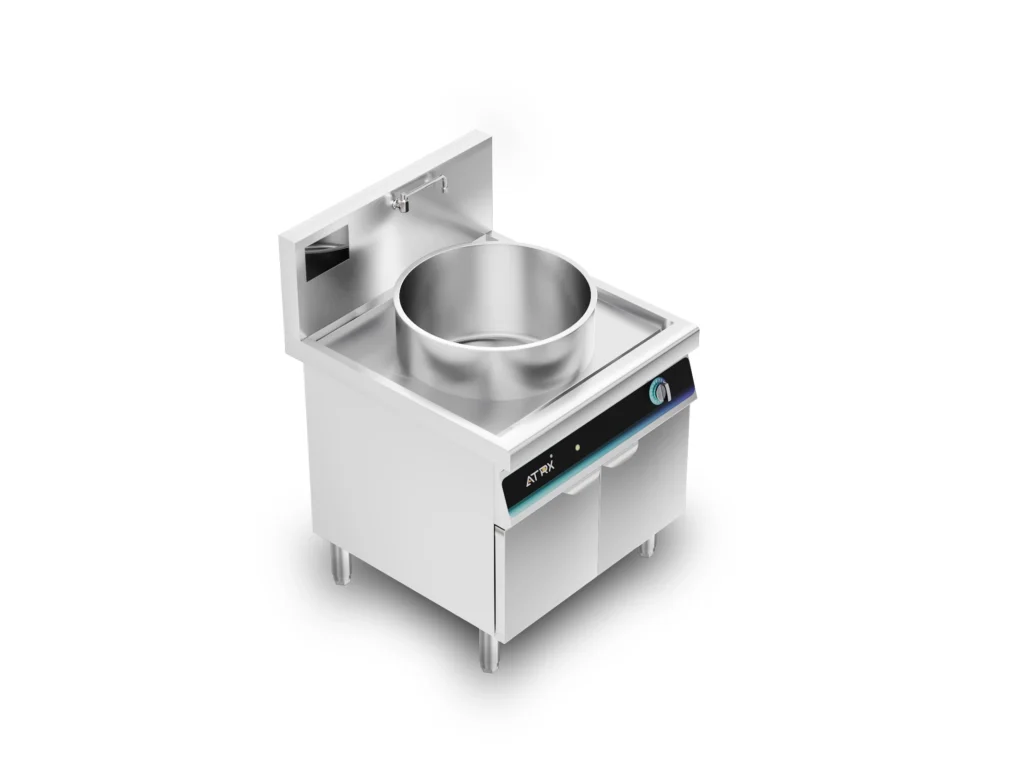
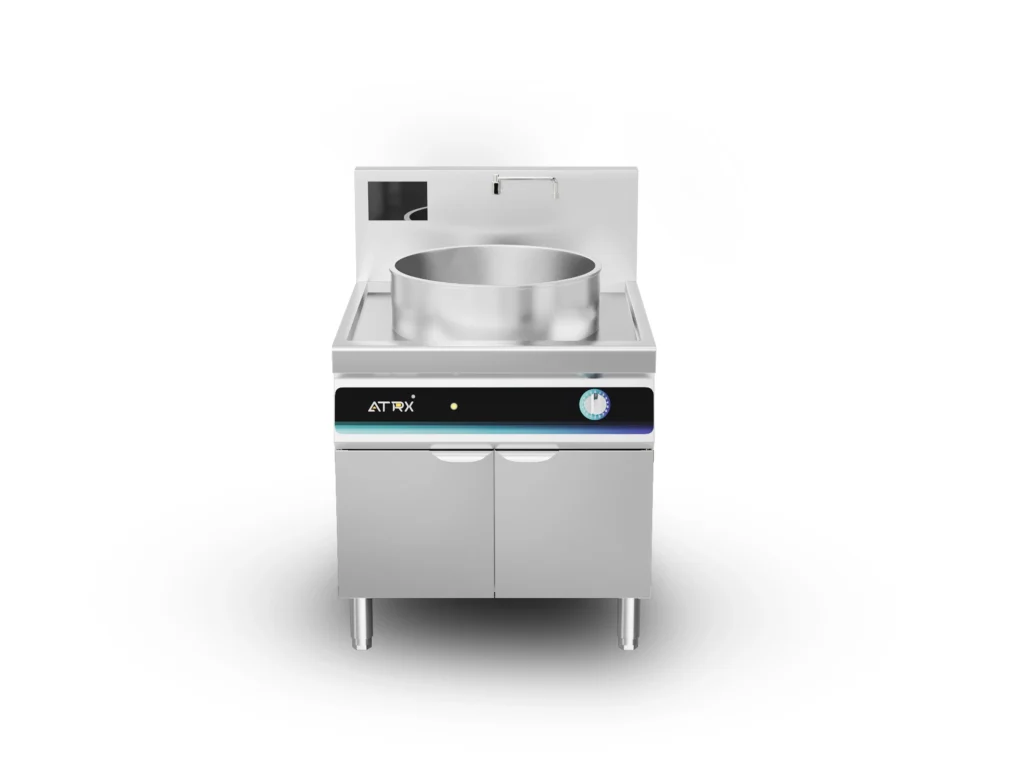
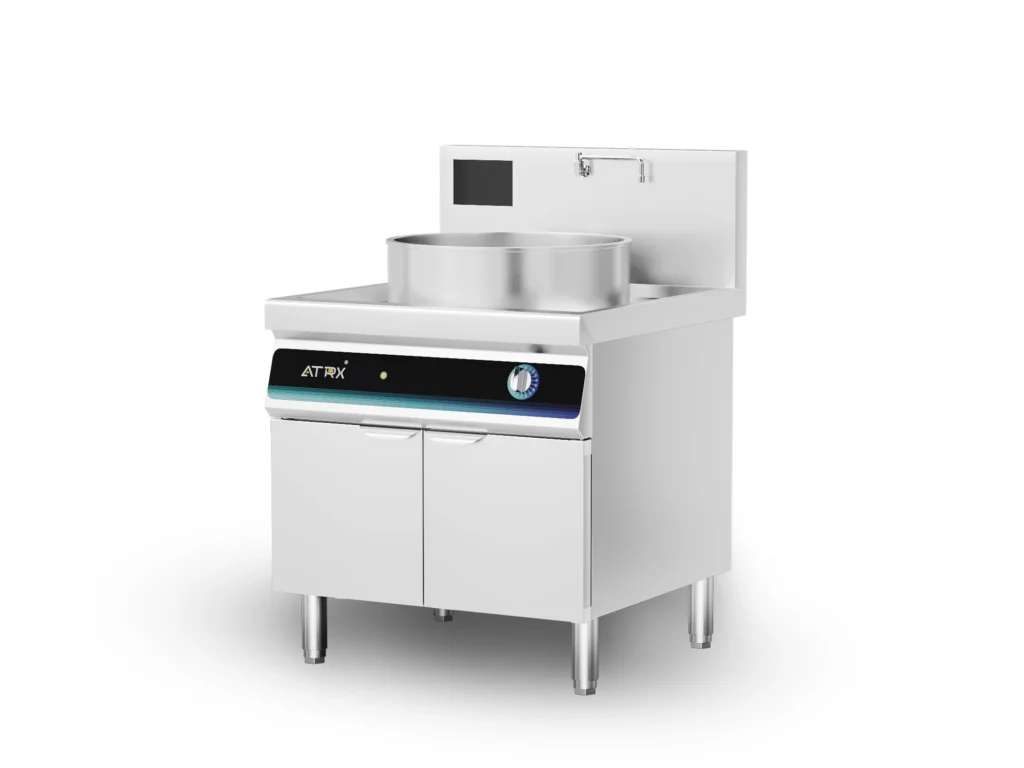
115L Commercial Induction Soup Cooker for Canteens
Floor Commercial Induction Stew Soup Cooker | 115L
Value of the 220V Front-to-Back 2-Burner Induction Cooktop
One Batch Covers a Meal and Reduces Topping Up in Small Pots
The built-in 115 L SS304 kettle needs no separate pot and covers a 200–300-person meal in one batch; an optional drain valve supports portioned service without tilting.
About 30 Minutes to a Boil, Three Batches in Two Hours
The 18 kW heater and 700 mm zone run on 380V three-phase power, bringing a full batch to a boil in about 30 minutes; three batches fit a two-hour prep window.
Even Heating Across the Kettle for Long Braises with Less Scorching
Full-base contact heats the center and edges together, reducing scorching; eight levels move from a rolling boil to a gentle simmer for stock, clear soup, meat, and porridge.
Inquiry UsView Specifications
01 / SPECIFICATIONS
Product Specification
Product Name
Product Model
Power(Kw)
Voltage(V)
Product Size
Product Material
Hs Code
02 / GETTING STARTED
How To Operate This Machine
Step 1
Place your commercial induction cooker in position and connect the power cable based on the required voltage. Make sure all wiring is done correctly before turning on the unit.
Step 2
Once powered on, place your induction cookware on the commercial induction cooker, prepare your ingredients, and get ready to start cooking.
Step 3
Turn the knob from 0 to your desired setting to begin cooking. During the cooking process, simply adjust the knob between levels 1 to 8 to control the heat output to your needs.
Step 4
Once cooking complete,then turn the knob back to 0 to power off the unit. Wipe down and clean the surface of your commercial induction cooker to keep it in top condition.
03 / QUALITY ASSURANCE
115L Stationary Commercial Soup Kettle: Six Checks for Reliable 200–300-Person Batch Service
01
Match the 115L Kettle to Its 700 mm Heating Zone
Kettle fit-up matches the SS304 115L vessel to the 700 mm heating zone as a set. An unsupported base can create local overheating and uneven contact. Assembly checks full-base contact, and any ordered drain-valve port direction, size, and seals are confirmed against the order. That gives the 115L batch full-base contact for large canteen service.
02
Stop Weak Joints from Receiving Through SMT
Incoming electronics are checked for model, package, rated voltage, supplier report, and sample capacitance before boards enter a closed cleanroom for nitrogen reflow. A wrong component or weak solder joint can make trouble during a busy canteen prep window. AOI, wave soldering for through-hole parts, and electrical plus power-on testing keep those boards out of final assembly. For the fixed 115L unit, that lowers the chance of a board fault interrupting a canteen prep window.
03
Wind the Coil for Even Heat Across the 115L Base
Coil installation uses a program-controlled winding machine to set turns, spacing, and tension, followed by curing and dimensional and electrical checks. If the coil center does not align with the heating zone, a 115L batch can heat unevenly across the base and develop local hot spots. Insulation and spacers are checked at the same stage to keep the full base in contact with the intended heat pattern.
04
Pass Three Consecutive Full-Load Cooling Runs
Cooling runs verify the Infineon IGBT power module and forced-air system before the complete unit is released. A fan with the right voltage but the wrong rotation, airflow, or bearing condition can allow heat to build during consecutive canteen batches. The fan is checked for model, connector, speed, vibration, and noise, and the assembled unit is monitored under full-load continuous operation. Across consecutive canteen batches, that lowers the chance of a cooling-related power drop during the lunch peak.
05
Protect Electrics from Steam, Grease, and Water
Electrical protection checks every wire against the model drawing, confirms terminal seating and harness routing, and tests grounding and dielectric strength after assembly. A loose connector or compromised ground can stay hidden until steam, grease, and wash water reach the control area. Boards and metal parts also undergo damp-heat, salt-spray, and thermal-shock testing.
06
Every 115L Unit Tested, Every Repair Rechecked
Before release, each unit is checked one by one: display, buttons, indicator lights, all eight heat levels, heating response, over-temperature protection, and fault shutdown. Passing at a single heat level isn’t enough, since a missed control or protection function can still cause a failure later. Any unit that fails is tagged and set aside. After repair, we recheck the original fault and every related function before the unit is cleared for release.
All results above are from our own factory. See related pages below.
Production Line Center Manufacturing Machines PCB Assembly Center04 / COOKING APPLICATIONS
115L Stationary Commercial Soup Kettle: Canteen Service, Noodle-Shop Stews, and Breakfast Porridge
Own factory
CE certified
OEM available
School and Factory Canteens
Suitable for school, factory, and military canteens serving 200–300 people. Before lunch, position the 115 L kettle at the serving counter or back-of-house station; one batch yields 200–300 portions. A two-hour prep window can accommodate three batches, more than 300 L in total.
Noodle and Stew Stations
Suitable for noodle and rice-noodle shops making bone stock, clear soup, beef soup, and chicken stock, as well as stew restaurants preparing beef brisket, pork ribs, chicken curry, and lamb casserole. The 115 L kettle handles one batch of stock or stew at a time.
Canteen Breakfast and Porridge
Suitable for canteen breakfast counters, group-catering breakfast points, and specialty porridge shops. High-volume, adhesion-prone items such as white rice porridge, millet porridge, and red-bean paste can simmer for long periods in the 115 L kettle. The 700 mm heating zone heats the entire base, reducing local hot spots and frequent stirring.
FAQs
Frequently Asked Questions
We've gathered the most common questions buyers ask before placing their first order — browse through and find the answers that matter most to you.
How Many People Can One Batch Serve, and How Many Batches in Two Hours?
One 115 L batch is positioned for 200–300 people in a school, factory, military unit, or similar operation, and a two-hour prep window can complete three batches, more than 300 L in total. That supports continuous replenishment and keep-warm service before the lunch peak, with one batch serving the meal when one soup is offered; actual servings depend on bowl size, soup concentration, and whether customers take more than one bowl.
Is the Kettle Included, and Does Porridge or Braised Meat Stick Easily?
Yes—the 115 L kettle is included, but porridge, thick soup, and braised meat can still stick if the heat is too high or stirring is insufficient. The vessel is supplied as part of the unit and matched to the 700 mm heating zone, so no separate pot is needed, which removes a pot-finding, matching, and changing step for a canteen and helps service stay continuous. Heating across the entire base narrows the center-to-edge temperature difference and reduces local hot spots and scorching.
Will Power Drop After Three or Four Consecutive Batches?
No—normal continuous service should not reduce power simply because three or four batches have been cooked. The model uses an Infineon IGBT power module and continuously operating forced-air cooling, and under our in-house continuous-service testing protocol it maintains stable output for three to four consecutive batches without the second- or third-batch power reduction seen on a low-end machine, so a canteen can keep replenishing without stopping to cool the machine and maintain a steadier lunch-to-dinner rhythm.
How Does a Stationary Model Dispense Soup, and Can a Drain Valve Be Added?
Yes—a drain valve can be added, and soup can also be served directly with a ladle. This stationary model does not tilt, so soup stays in the kettle and remains warm, which suits canteen counters, noodle shops, and soup stalls serving one bowl at a time; a bottom drain valve makes dispensing more concentrated and speeds portioning at a back counter or self-service station, keeping cooking, holding, and portioning in one place.
How Is the 115L Unit Wired, and How Do I Estimate Running Power?
Use a 380V three-phase supply wired for 18 kW; the 115 L model draws about 27.3 A. The product page recommends 6 mm² copper wire and a 40 A residual-current device, with final wire size, breaker, and grounding confirmed by a licensed electrician against local codes and cable length; at 18 kW × actual full-power hours, one hour is theoretically about 18 kWh, while normal use stays below that because the unit is turned down to hold after boiling, balancing peak heating speed and electricity cost.
——07 / Factory quote & RFQ
Partner with a Trusted Commercial Induction Cooker Manufacturer
Whether you need wholesale commercial induction cookers, an OEM product line or a commercial kitchen project configuration, send a focused commercial brief. An ATRX team member can review the product, power, certification and customization requirements before quotation.
Useful information to include:
Target country · Product category · Application · Voltage / phase · Estimated quantity · Required certifications · OEM / branding needs