

PRODUCT HIGHLIGHTS
3.5kW x 2 Countertop Double Induction Fryer for Consistent Frying
Countertop Induction Double Tank Fryer | 3.5KW*2
Value of the 220V Front-to-Back 2-Burner Induction Cooktop
Rotating Tanks Keep Peak Orders Moving
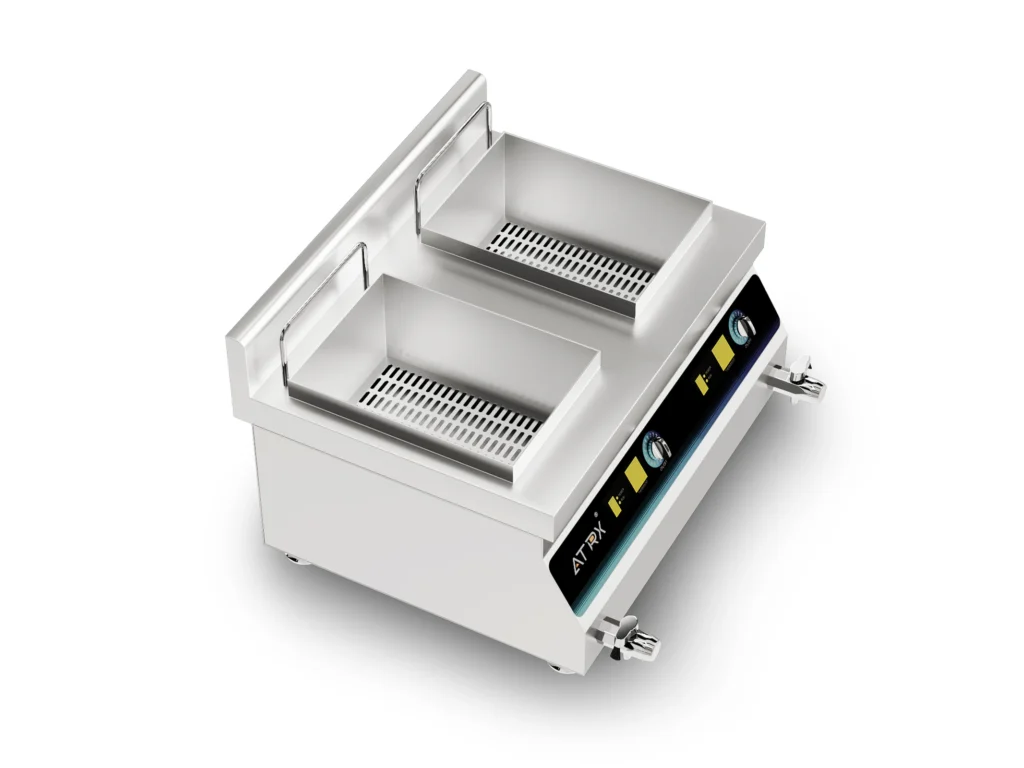
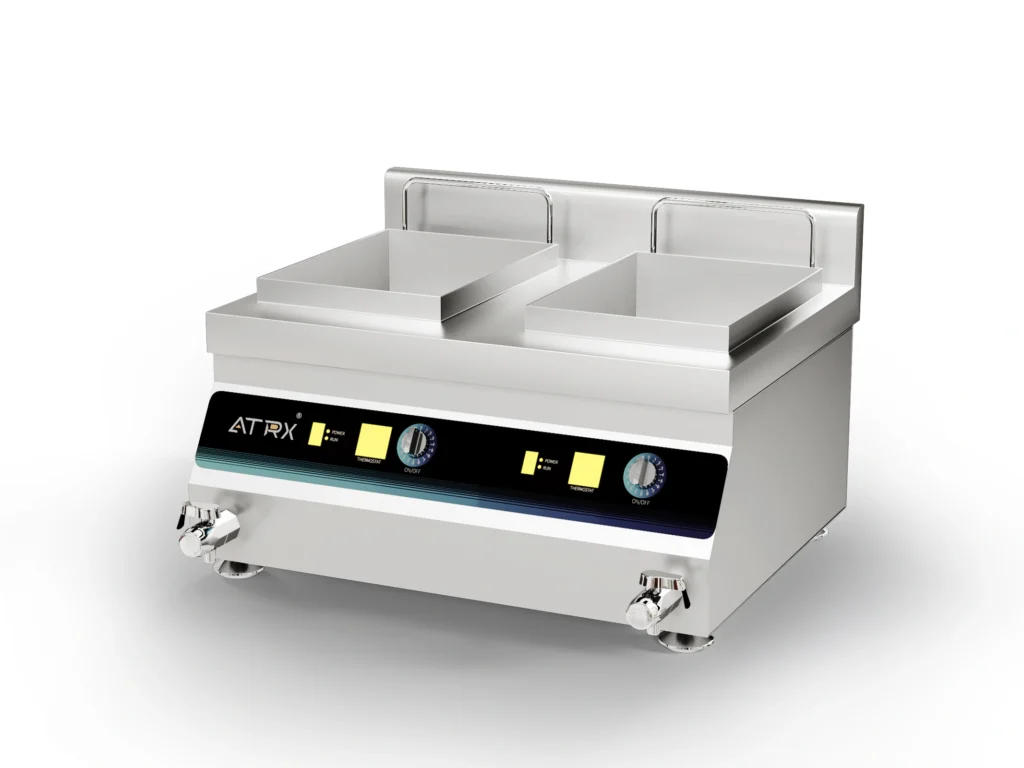
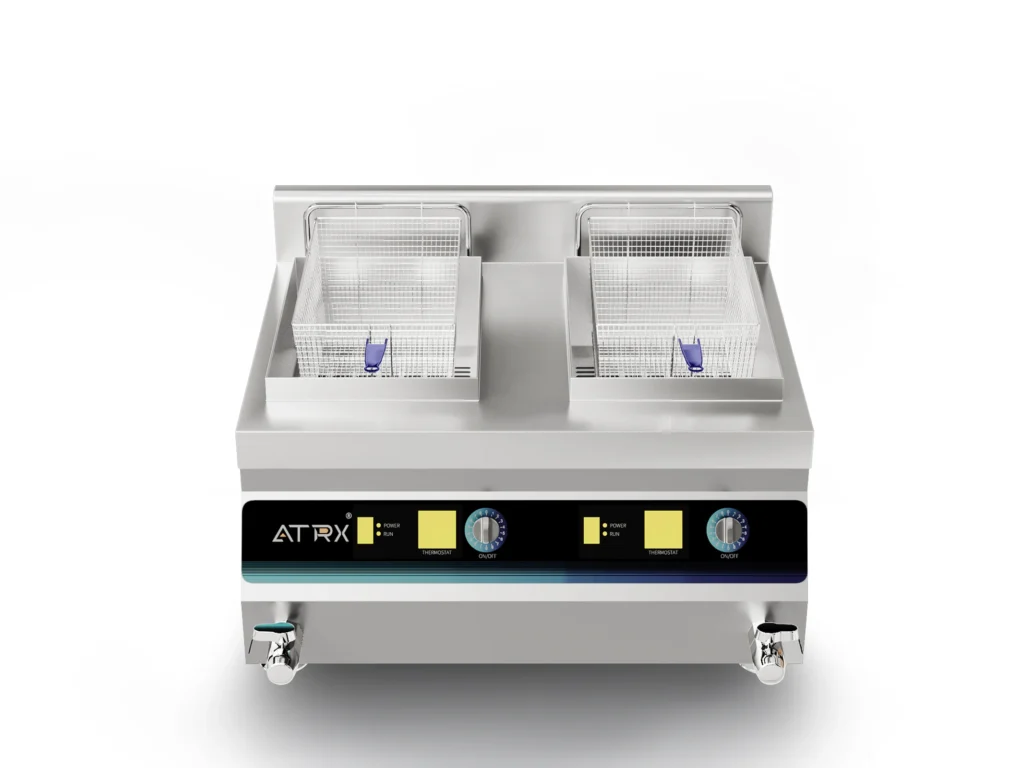
Two independent 9L tanks, each with 3.5kW heating and its own basket, let one side fry fries while the other handles chicken wings during peak orders.
Separate Tanks and Oil Control Flavor Transfer and Batch Variation
Separate oil and heat settings keep fries, chicken and desserts apart; eight levels let each tank run its own fry program for more repeatable color and texture.
A Compact Counter That Fits Double-Tank Frying
At 800×500 mm, this SS304 countertop unit fits two 9L tanks into a tight back-of-house; run both at peak and one during slower periods.
Inquiry UsView Specifications
01 / SPECIFICATIONS
Product Specification
Product Name
Product Model
Power(Kw)
Voltage(V)
Product Size
Product Material
Hs Code
02 / GETTING STARTED
How To Operate This Machine
Step 1
Place your commercial induction cooker in position and connect the power cable based on the required voltage. Make sure all wiring is done correctly before turning on the unit.
Step 2
Once powered on, place your induction cookware on the commercial induction cooker, prepare your ingredients, and get ready to start cooking.
Step 3
Turn the knob from 0 to your desired setting to begin cooking. During the cooking process, simply adjust the knob between levels 1 to 8 to control the heat output to your needs.
Step 4
Once cooking complete,then turn the knob back to 0 to power off the unit. Wipe down and clean the surface of your commercial induction cooker to keep it in top condition.
03 / QUALITY ASSURANCE
Countertop Commercial Double-Tank Induction Fryer: Six Production Inspections and Factory Tests
01
Double-Tank Incoming Parts: Critical Components Checked
Before assembly, our incoming-inspection team matches the double-tank fryer's steel grade and thickness, power devices, capacitors, coils and connectors to the order, then spot-checks critical ratings against supplier reports. This prevents a near-identical part from entering the two-tank line, where one wrong component could affect one basket independently and disrupt mixed-menu service.
02
Double-Tank Coils: Formed and Re-Checked in Position
On the coil-winding line, ATRX presets turns, spacing and tension for each double-tank model and power, then fixes, cures and checks the coils before fitting. In the body, we separately confirm each coil's centre, insulation, spacers and supports; a coil that fits but sits off-centre can heat one 9L tank unevenly and blur the independent performance customers expect.
03
Double-Tank Control Boards: Moisture Removed, Solder Joints Inspected
Double-tank boards are dehumidified before soldering, reflowed under controlled preheat, soak, reflow and cooling with nitrogen, then checked by optical and manual inspection; through-hole parts are verified for model, orientation, polarity and hole fill. A joint that looks connected can fail when one 9L tank cycles repeatedly, so this staged check supports independent, stable control on both sides of a busy countertop unit.
04
Double-Tank Airflow: Heat-Sink Assembly Checked
When both 9L tanks run at peak, our team matches each fan to the model, confirms airflow direction, position and polarity, cleans the heat-sink contact and checks intake, exhaust and clearance. A fan that spins can still miss the hot components; verifying the actual path reduces the risk of power reduction or protection shutdown during a busy double-tank service.
05
Double-Tank Terminals: Tightened With Grounding Re-Checked
For the high-power double-tank unit, our team checks conductor cross-section, insulation rating and temperature class, then confirms terminal fit, plug seating, polarity, harness routing and protective grounding. A connection that heats slowly can loosen over time; this inspection reduces the risk of a terminal fault interrupting both 12L tanks during peak service.
06
Complete Countertop Double-Tank Unit: Load Testing and Re-Inspection
No countertop double-tank unit leaves without the full sequence: indicators, knobs and stop response, level-by-level heat checks, a loaded run watching power, temperature, fan and protection, applicable electrical-safety tests and a vibration check. A failed item is quarantined and retested; this confirms that both 9L tanks can carry continuous peak orders as a complete system, not as separate working parts.
All results above are from our own factory. See related pages below.
Production Line Center Manufacturing Machines PCB Assembly Center04 / COOKING APPLICATIONS
Countertop Commercial Double-Tank Induction Fryer: Built for Burger and Fried-Chicken Shops, Noodle Snacks and Breakfast Add-Ons
Own factory
CE certified
OEM available
Burger and Fried-Chicken Shops
Burger shops, fried-chicken shops and Western-style fast-food restaurants usually need to handle potato products and battered meat at the same time during lunch and dinner peaks. One tank can run fries and hash browns continuously while the other fries chicken wings, tenders or fish fillets; when set meals are ordered together, the two categories are handled separately, reducing flavor transfer and waiting for the same pot. Each tank holds 9L, and baskets can be rotated by order, which suits sustained peak output.
Noodle and Snack Stalls
Noodle shops, snack shops, fried-food takeout counters and night-market stalls can use fried items as sides, add-ons or standalone snacks. The unit handles spring rolls, onion rings, battered chicken and frozen ready-to-fry snacks; one tank processes potato items while the other processes battered meat, with baskets rotated when orders cluster. When evening, late-night and takeout orders spike, two tanks ease the queue pressure of a single tank, which suits high-volume counters with short menus.
Breakfast Add-On Stations
Breakfast stations at boutique hotels, small and medium staff canteens and school cafeterias can fry hash browns, chicken nuggets, spring rolls and frozen ready-to-fry snacks in batches before or during breakfast service; instead of filling one large pot at once, they replenish in small batches as traffic builds. Two tanks let one side serve the current batch while the other prepares the next; when two categories run at once, each can keep separate oil and its own heat setting. This configuration suits kitchens with concentrated service windows and frequent small refills.
FAQs
Frequently Asked Questions
We've gathered the most common questions buyers ask before placing their first order — browse through and find the answers that matter most to you.
Can Both Tanks Run at the Same Time?
Running both tanks through a lunch or dinner rush is possible, but the electrical plan has to treat them as a combined load. Both tanks can run simultaneously and are controlled independently, so they can handle different orders; but when both run at full load, the store circuit must be sized for the complete machine’s actual load. The product page lists 220V, 15.9A, 2.5 mm² copper wire and a 20A RCD as per-circuit parameters.
How Long Does Oil Take to Recover After Loading?
There is no universal recovery time, but in normal peak service the two-tank design keeps orders moving by alternating them. Each 9L tank has its own 3.5kW induction system, so one side can hold or reheat oil while the other is loaded; when the first returns to range, the next basket can go in without waiting for a full single-vat recovery. The exact interval still varies with batch weight, oil volume, starting and ambient temperature and heat setting.
Is 9L per Tank Enough?
Yes—for the batch sizes this countertop unit is designed for, 9L per tank is enough. That 9L is oil capacity, not the food capacity of a basket, and the 18L total does not mean 18L of food at once; actual throughput comes from batch weight, fry time, basket load and order intervals. The two tanks let one side fry while the other holds temperature.
Can the Two Tanks Use Separate Oil and Separate Settings?
Yes—each tank has its own oil and independent 0–8 control, so one side can fry hot and fast while the other runs a lower setting or a second fry. This works because the tanks are separate oil bodies rather than one shared vat, which reduces flavour transfer and lets meat, seafood and desserts run in rotation. Record the level, load and time as an SOP so the settings stay repeatable in a busy countertop shop.
How Should the Double Tank Be Cleaned After Heavy Use?
After heavy use, clean at close in this order: power down and disconnect, let the oil and body cool, then decide whether to filter or replace the oil from colour, smell, foam and sediment. That sequence removes the main handling risk and prevents sediment from cooking into the next service; once the oil is out, wash both tanks, baskets, housing and visible vents, and keep water away from the control panel and electrical areas. During service, skim floating debris promptly so the closing clean is shorter, and treat this step as part of the standard closing routine to make the next day’s startup easier.
——07 / Factory quote & RFQ
Partner with a Trusted Commercial Induction Cooker Manufacturer
Whether you need wholesale commercial induction cookers, an OEM product line or a commercial kitchen project configuration, send a focused commercial brief. An ATRX team member can review the product, power, certification and customization requirements before quotation.
Useful information to include:
Target country · Product category · Application · Voltage / phase · Estimated quantity · Required certifications · OEM / branding needs