

PRODUCT HIGHLIGHTS
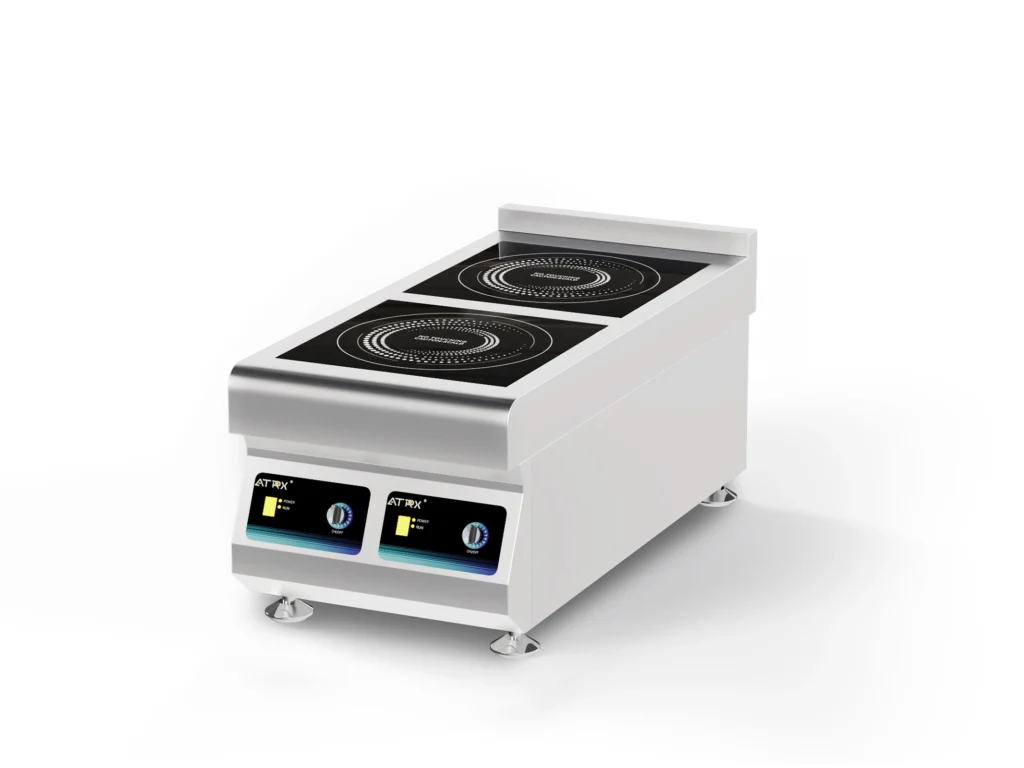
Low-Maintenance 2-Burner Commercial Induction Cooktop
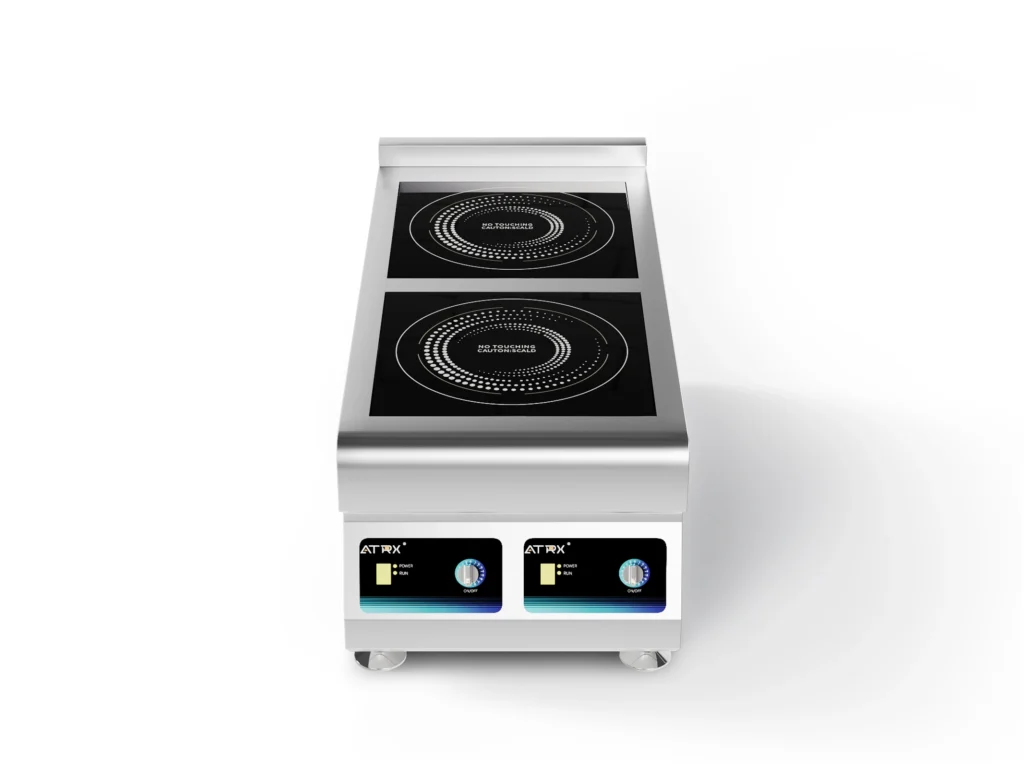
Countertop Induction Two Burners | 5KW*2
Value of the 220V Front-to-Back 2-Burner Induction Cooktop
Commercial Flat Cooktop with Fewer Parts to Disassemble
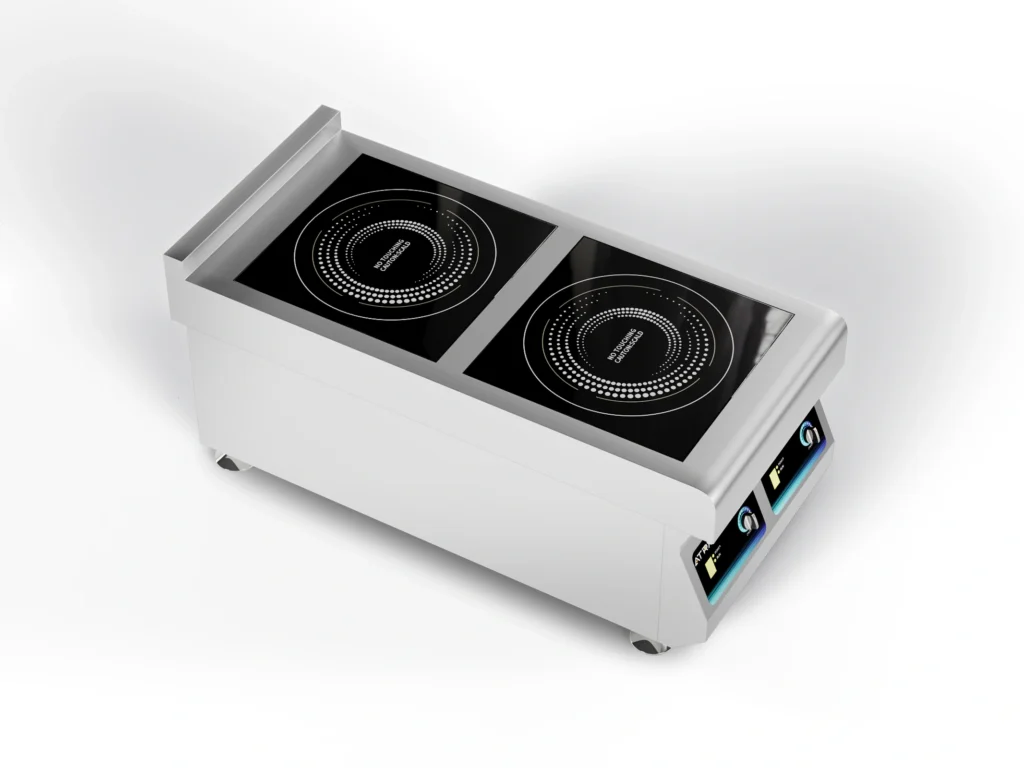
The two heating zones are flat ceramic glass with no grate or drip tray, so oil and broth stay visible and wipe off with a wrung-out cloth after the panel cools.
No Gas Components, So Fewer Gas-Related Repairs on the Commercial Cooktop
The AT-CTEBZ-005 has no igniter, gas valve, thermocouple, or gas line; daily care focuses on the panel, vents, and power connection, removing one class of shutdowns.
Commercial SS304 Body That Stands Up to Frequent Cleaning
The SS304 body and ceramic-glass top stand up to daily wiping and steam, but durable does not mean maintenance-free: rinse grit off pot bases and keep vents clear.
Inquiry UsView Specifications
01 / SPECIFICATIONS
Product Specification
Product Name
Product Model
Power(Kw)
Voltage(V)
Product Size
Product Material
Hs Code
02 / GETTING STARTED
How To Operate This Machine
Step 1
Place your commercial induction cooker in position and connect the power cable based on the required voltage. Make sure all wiring is done correctly before turning on the unit.
Step 2
Once powered on, place your induction cookware on the commercial induction cooker, prepare your ingredients, and get ready to start cooking.
Step 3
Turn the knob from 0 to your desired setting to begin cooking. During the cooking process, simply adjust the knob between levels 1 to 8 to control the heat output to your needs.
Step 4
Once cooking complete,then turn the knob back to 0 to power off the unit. Wipe down and clean the surface of your commercial induction cooker to keep it in top condition.
03 / QUALITY ASSURANCE
Six Quality Controls for the Low-Maintenance Commercial 2-Burner Induction Cooktop
01
Incoming Inspection of Core Components and Panels
Incoming material is checked against the order BOM, supplier labels, test reports, and part markings: capacitors by capacitance, voltage rating, and part number; power parts by full model, package, and electrical parameters; ceramic-glass panels by edge chipping, surface defects, and mounting-surface flatness. Core parts also have batch test reports reviewed and samples re-tested by rule, so wrong or damaged material is stopped before it reaches the line. That screen reduces the risk of a bad component becoming a premature repair on a two-burner unit meant to stay in service.
02
Circuit-Board Pre-Solder Baking and Dehumidification
Boards go through a constant-temperature dryer before placement and soldering, then follow preheat, soak, reflow, and cooling curves by board type. Moisture carried into high-temperature soldering can leave hidden joint defects, and in a steamy kitchen those defects may only show after weeks of daily use. Dry boards and controlled soldering support longer intervals between electrical faults, which is central to the low-maintenance promise.
03
Staged SMT and Through-Hole Solder Checks
Solder quality is checked in two stages: after surface mounting, in-line optical inspection and a manual recheck look for bridging, low solder, offset, and lifting; after wave soldering, hole fill, missed joints, bridges, and lead condition are checked again. Power parts and terminals are also verified against drawings for model, position, orientation, and polarity. Staged checks reduce intermittent faults that would otherwise turn into service calls on a compact two-burner cooktop.
04
Coil Position and Electrical-Value Checks
Coil turns, spacing, and tension are preset by model and power, then the winding is fixed, cured, and checked for dimensions and electrical values. During installation, the coil centre must align with the heating zone, leads must be dressed, and supports, insulation, and shims must not be missing or able to shift after fastening; a level panel does not mean the coil underneath is right. Correct coil position and values support even heating on both zones, helping the unit stay in daily use without repeated burner-related repairs.
05
Fan and Internal Airflow Assembly Checks
Fan fitting begins with a model, voltage, connector, and size check; after installation, airflow direction, position, and connector polarity are confirmed, the harness is kept clear of blades, and duct space is left around the heatsink and power parts. The heatsink contact surface is cleaned first, then thermal and insulation parts are fitted and fastened. A spinning fan is not a pass: speed, airflow, vibration, and bearing noise are also watched, because trapped heat is the main risk to a low-maintenance unit.
06
Full-Unit Function and Electrical Safety Testing
Before closing, plugs, terminals, brackets, grounding, harness routing, and internal foreign objects are checked; after assembly, every unit gets power-on, heating and cooling, and vibration checks, with indicator, knob-level, stop-response, and applicable overheat and empty-pan protections verified one by one. Insulation and withstand tests are performed per model, and a unit that fails does not move to the next station. These checks are done before shipping to cut later downtime and service visits on a two-burner cooktop that is meant to stay in daily use.
All results above are from our own factory. See related pages below.
Production Line Center Manufacturing Machines PCB Assembly Center04 / COOKING APPLICATIONS
Commercial Kitchen Applications for the Low-Maintenance 2-Burner Induction Cooktop
Own factory
CE certified
OEM available
Noodle and Fast-Food Shops
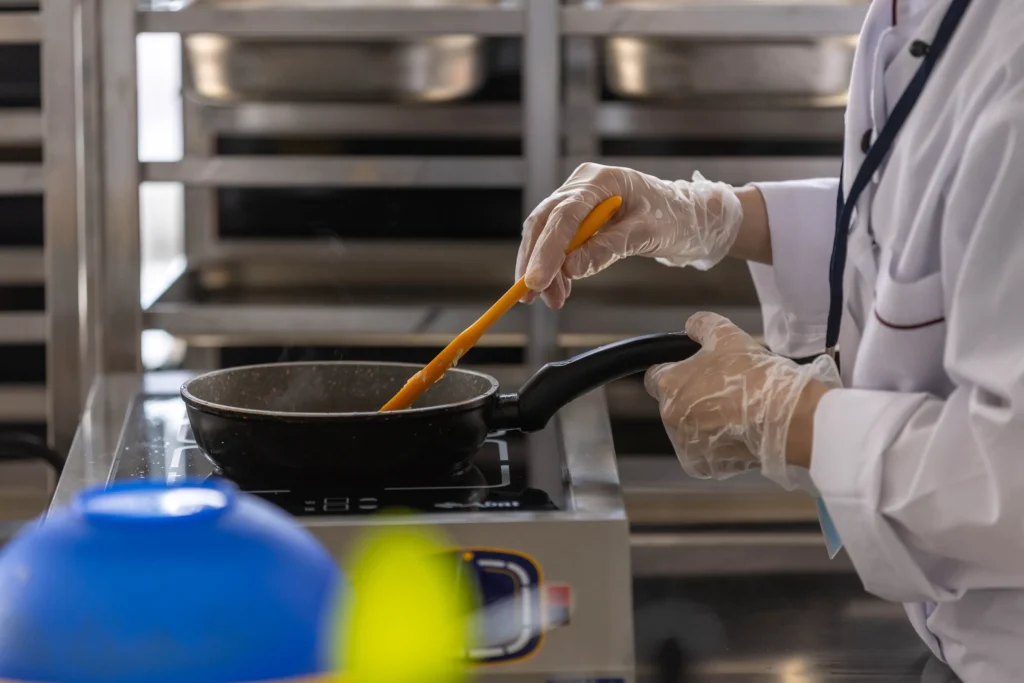
Common in noodle shops, malatang shops, rice-bowl fast food, and small stir-fry outlets; at peak, one burner holds stock or mala soup while the other cooks noodles or blanches greens. (The flat top wipes down after service, suiting small shops that open and close daily.)
Hotel Breakfast
Suited to hotel breakfast noodle, egg, soup, and vegetable stations, and small all-day restaurants; one burner cooks noodles while the other boils eggs, heats soup, or warms congee. (The flat top has no grates or drip trays, so milk, egg, and broth wipe off in sections.)
Community Cafeterias
Suited to community cafeterias, senior-care dining, and small staff canteens; one burner simmers soup or congee while the other blanches greens, cooks noodles, or heats sauce. (Two zones handle small batches without a large range, and the flat top wipes clean between services.)
FAQs
Frequently Asked Questions
We've gathered the most common questions buyers ask before placing their first order — browse through and find the answers that matter most to you.
Does having no gas parts mean less maintenance on a commercial cooktop?
Yes for gas-related maintenance: this commercial two-burner has no igniter, gas valve, thermocouple, or gas line, so those checks and repairs disappear. Daily care still covers the panel, vents, and power connection; the glass must be switched off, disconnected, and cooled before wiping, and vents must stay clear of grease, packaging, or cabinetry. For a noodle shop or community cafeteria without a gas fitter on call, that removes one class of shutdown, but legally required inspections remain unchanged.
How do I clean burned-on spills from the cooktop?
Cool the cooktop before attempting any spill: switch off, disconnect power, and wait until the glass and surrounding area are completely cool. Wipe fresh oil with a wrung-out soft cloth, soften dried residue according to the cleaning instructions, and avoid steel wool, metal scrapers, or large amounts of water. Dry the knobs, edges, and vents before restarting, and keep pot bases free of grit so dragging does not scratch the panel.
How do I choose between the 3.5 kW and 5 kW commercial two-burner models?
The 5 kW × 2 AT-CTEBZ-005 uses 22.7 A per zone, 4 mm² copper wire, and a 32 A RCD. The 3.5 kW × 2 AT-CTEBZ-003 uses 15.9 A per zone, 4 mm² copper wire, and a 20 A RCD. Choose 5 kW when larger batches and faster heat recovery justify the higher circuit load, or 3.5 kW when supply is limited and the work is mainly small-pot, low-volume service. Both zones are wired independently, so match the rating to cookware, batch size, shift length, and local electrical rules.
What should I check when buying the low-maintenance commercial two-burner?
Verify the model, power, voltage, body material, cooktop construction, and per-zone supply requirements first. Then ask how incoming parts, circuit-board joints, coil winding and electrical values, fan and airflow, and full-unit power-on, heating, cooling, and vibration checks are controlled. Request the certifications and paperwork required in the destination market, including any corrective-action evidence for anomalies. Put those items in the order documents so durability is supported by documented specifics rather than a general claim.
How do I reduce failure risk under heavy daily use?
Most failure risk is reduced through correct use and early shutdown rather than by pushing through a fault. Use flat, magnetic cookware, center each pot on its zone, lift rather than drag it, and avoid long dry-boiling. Keep water or broth out of knobs, edges, and vents. If heating slows, the fan changes sound, the plug runs hot, alarms repeat, or burning is smelled, stop and disconnect for inspection, and leave internal fans and power parts to a professional.
——07 / Factory quote & RFQ
Partner with a Trusted Commercial Induction Cooker Manufacturer
Whether you need wholesale commercial induction cookers, an OEM product line or a commercial kitchen project configuration, send a focused commercial brief. An ATRX team member can review the product, power, certification and customization requirements before quotation.
Useful information to include:
Target country · Product category · Application · Voltage / phase · Estimated quantity · Required certifications · OEM / branding needs