

PRODUCT HIGHLIGHTS
Commercial Induction Wok Cooker Applications
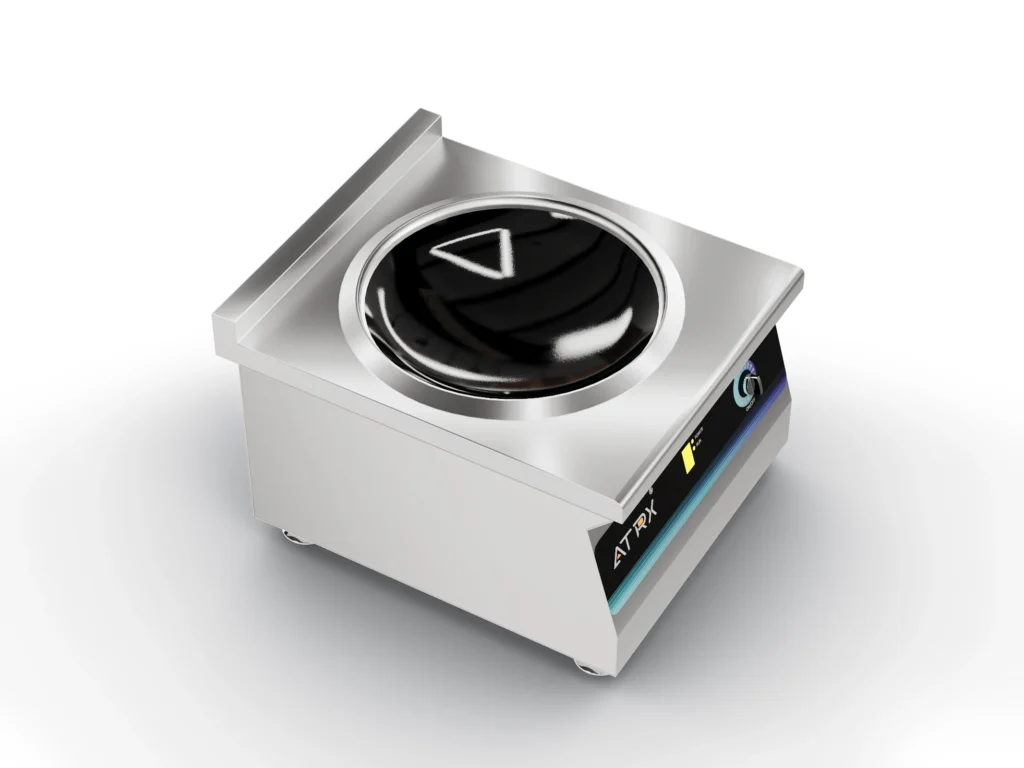
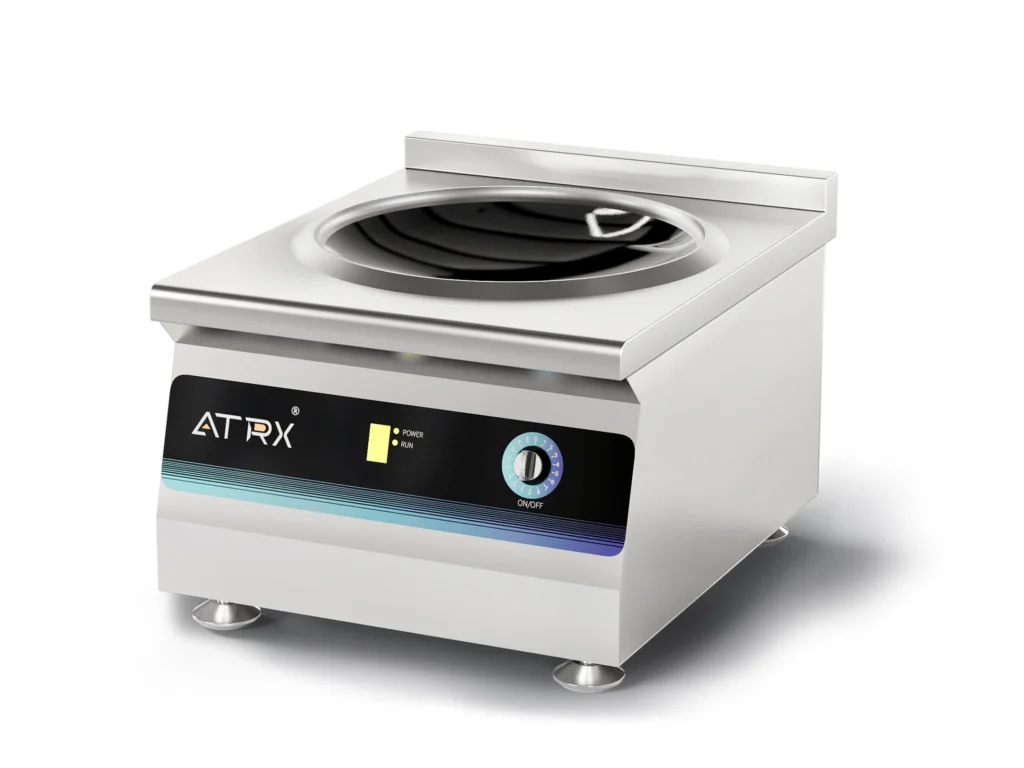
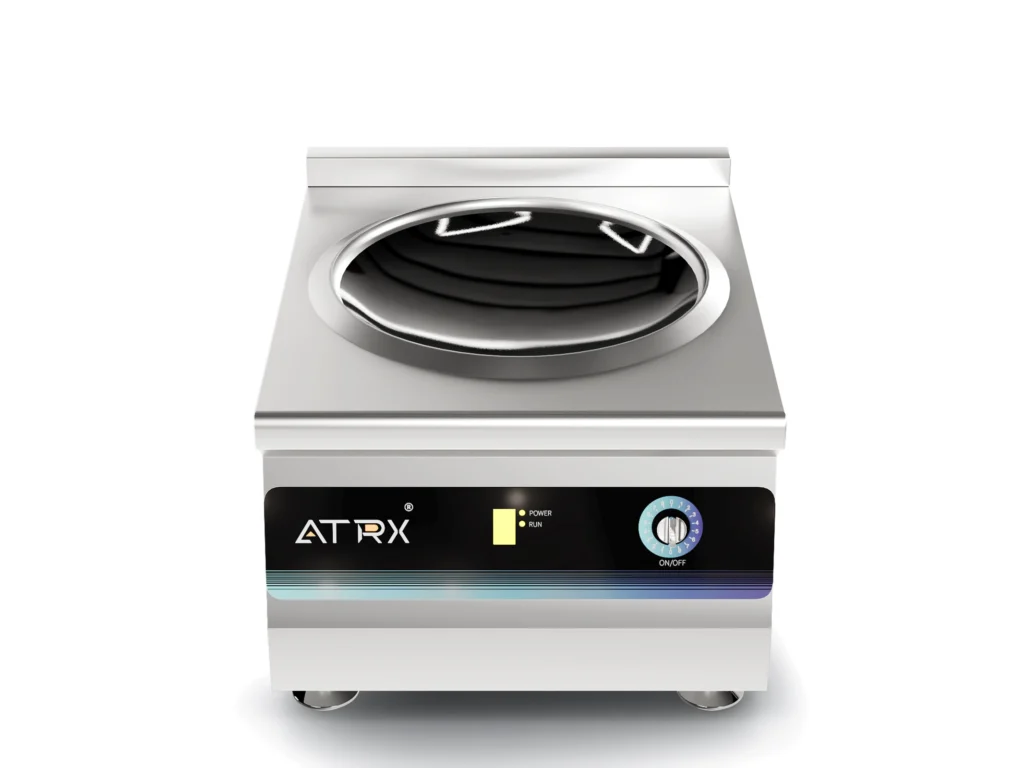
Countertop Induction Wok Cooker | 5KW
Value of the 220V Front-to-Back 2-Burner Induction Cooktop
Stable Heat During Peak-Hour Stir-Frying
The concave coil follows the round-bottom wok, while 1–8 power levels match each dish. Stir-frying and sauce reduction connect with less waiting for heat recovery.
Flame-Free Design Suits Open Kitchens
With no open flame or gas supply, heat stays concentrated in the cookware. This lowers radiant heat at the chef’s station and simplifies open-kitchen planning.
8 Power Levels Support Consistent Output
Fixing power level and time for common dishes helps chains and caterers deliver consistently across chefs and shifts, with less effect from gas-pressure swings.
Inquiry UsView Specifications
01 / SPECIFICATIONS
Product Specification
Product Name
Product Model
Power(Kw)
Voltage(V)
Product Size
Product Material
Hs Code
02 / GETTING STARTED
How To Operate This Machine
Step 1
Place your commercial induction cooker in position and connect the power cable based on the required voltage. Make sure all wiring is done correctly before turning on the unit.
Step 2
Once powered on, place your induction cookware on the commercial induction cooker, prepare your ingredients, and get ready to start cooking.
Step 3
Turn the knob from 0 to your desired setting to begin cooking. During the cooking process, simply adjust the knob between levels 1 to 8 to control the heat output to your needs.
Step 4
Once cooking complete,then turn the knob back to 0 to power off the unit. Wipe down and clean the surface of your commercial induction cooker to keep it in top condition.
03 / QUALITY ASSURANCE
Kitchen-Scenario Testing of the Commercial Induction Wok Cooker
01
Power-Level Output Stability Testing
At the board-test station, we check for shorts, opens, and component values after assembly, then power on the board and test startup, each power level, control response, and protection functions. The finished unit rechecks power at every level before it moves on. Output drift and weak control response are caught before the board reaches a wok station. During a quick-stir-fry lunch rush, a setting that holds output gives fried rice and stir-fries the heat to brown rather than steam.
02
Control Board Moisture Protection and Solder Quality Inspection
In our clean assembly room, we populate and solder control boards, bake them before soldering to remove moisture, and inspect them after SMT and through-hole work. Automated optical inspection checks for missing parts, displacement, and cold joints; after through-hole soldering, we recheck bridges, missed joints, and pin condition, and a board is installed only after it passes power-on function and protection tests. If moisture is left in the board, it can blister the laminate or hide a cold joint until the unit is in a steamy kitchen. For hotel, canteen, and chain-store wok stations, the board is better prepared for daily steam, oil mist, and cleaning moisture.
03
Curved Surface Dimensions and Coil Positioning Inspection
At the curved-head cell, our team presses the heating head in-house, measures the curve, opening, and assembly dimensions, and confirms the first article before production. When the coil is installed, we check position, insulation, and spacing item by item. A curve or coil mismatch is caught before it becomes a wok center that burns before the sides or a tossing action that feels unstable. In an open kitchen doing quick stir-frying, the heating zone follows the wok profile so center and sides heat together.
04
Rated-Power Continuous Operation and Cooling Test
At the cooling and continuous-run station, we select fans by model, voltage, connector, and size, confirm the airflow path, exhaust direction, and cooling clearance during assembly, and then run heat-up, cooling, and a continuous test at rated power after power-on. A reversed fan, blocked duct, or heat buildup that could trip over-temperature protection is caught before shipment. For a multi-hour dinner peak in a hotel, canteen, or chain outlet, the cooker is less likely to lose a service window to a heat-related stop.
05
Stainless Steel Housing and Glass-Ceramic Panel Inspection
At incoming inspection, we verify the 304 stainless steel grade, sheet thickness, and 6mm glass-ceramic panel, checking for cracks, lifted edges, and burrs; the housings are then laser-cut, CNC-punched, and bent in our own workshop. The first article is measured for dimensions, holes, and angles, and after assembly we check gaps, appearance, and screw tightness before a simulated transport vibration test. In a hotel or mall open kitchen, the housing is wiped between services; a damaged panel or poor fit is caught before it creates edges that trap grease or a surface that looks worn early. The unit keeps a clean, fitted appearance through frequent wiping.
06
Sample Approval and Batch Delivery Consistency Control
Before mass production, our team completes and approves a first sample for structure, function, and fit, then keeps the same model on one bill of materials and one process. Each unit carries a process inspection card, and any item that fails cannot move to the next station; production issues are corrected by the in-house team and the whole batch is checked. Before the nameplate is applied, we verify model, power, voltage, and frequency against the order. Batch consistency is checked before release so drift does not become a visible difference between chain locations. For chain stores, every site receives the same wok cooker structure, function, and fit as the approved first article.
All results above are from our own factory. See related pages below.
Production Line Center Manufacturing Machines PCB Assembly Center04 / COOKING APPLICATIONS
Three Food-Service Scenarios for the Commercial Induction Wok Cooker
Own factory
CE certified
OEM available
Asian Restaurants
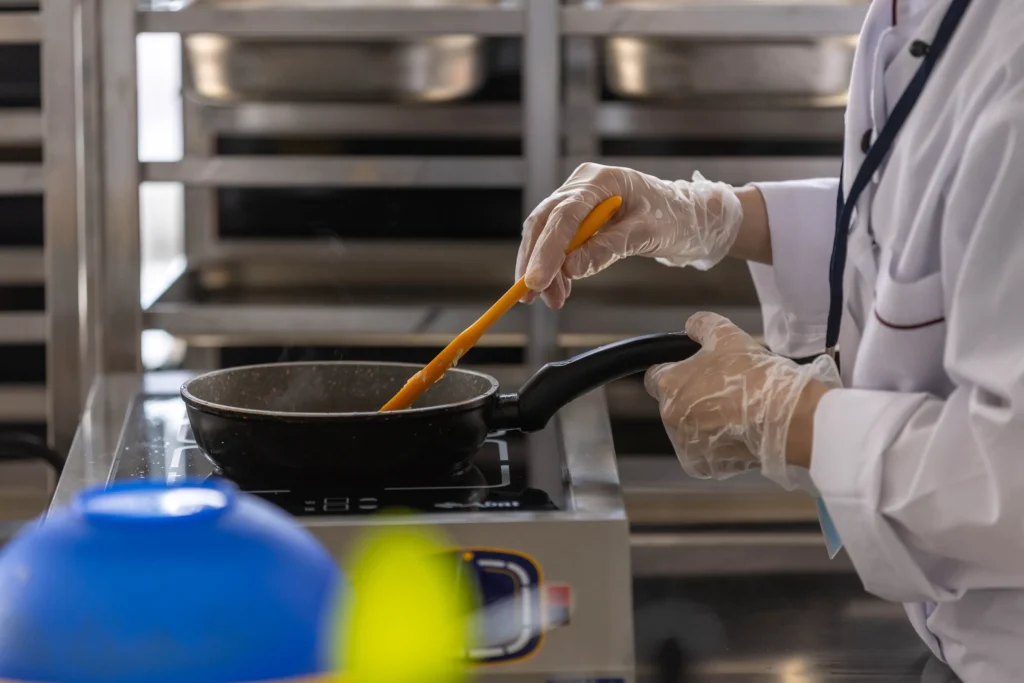
In Chinese restaurants, Sichuan and Hunan restaurants, Cantonese restaurants, noodle shops, Hong Kong-style cafés, Southeast Asian restaurants, takeout shops, and neighborhood Chinese restaurants, this commercial induction wok cooker is used for lunch and dinner stir-fries, high-heat wok cooking, beef ho fun, made-to-order toppings, fried rice and noodles, and quick takeout dishes. One curved wok position is dedicated to made-to-order stir-frying rather than bulk batch production.
Hotel and Group-Catering Kitchens
In hotel Chinese restaurants, banquet halls, buffet stations, school and hospital canteens, factory dining halls, and group-catering central kitchens, the commercial induction wok cooker handles à la carte stir-fries, wedding and conference meals, live cooking, high-volume vegetables, sliced meat, fried rice, fried noodles, and sauce reduction. It gives these kitchens a single wok position that can move between live cooking and volume service.
Mall Open Kitchens and Small Restaurants
In mall food courts, open kitchens, small store kitchens, takeout-only shops, and neighborhood restaurants, the commercial induction wok cooker supports live stir-fry counters, visible open-kitchen cooking, lunch and dinner output, fried rice and noodles, and single-wok made-to-order dishes. It fits a compact counter where the wok station itself becomes part of the service and display area.
FAQs
Frequently Asked Questions
We've gathered the most common questions buyers ask before placing their first order — browse through and find the answers that matter most to you.
Can a Commercial Induction Wok Cooker Create Wok Hei?
Yes, but the heat source alone does not create wok hei. Wok hei comes from a very hot wok, a dry ingredient surface, oil, and fast tossing that drives off moisture and browns the food. The curved coil and 8 power levels supply heat and recovery for that sequence, while wok material, preheating, batch size, and tossing rhythm shape the result. Match the wok and batch before judging performance; a thin carbon-steel wok and a heavy banquet wok will behave differently.
Can It Keep Up with Continuous Stir-Frying During Peak Hours?
Yes, it can carry a normal dinner peak when the air path is clear, the pan matches the zone, and the kitchen does not trap heat. Heat buildup is the main limit on output. The unit is tested at each power level and checked for heat-up and fan cooling, and over-temperature protection is a normal protective action. Keep the inlet and outlet clear, prevent grease from blocking them, and plan that clearance as part of the wok station; if ambient heat or cooling space is insufficient, expect reduced output or a protection trip.
Which Round-Bottom Woks Are Suitable?
Use a magnetic round-bottom wok whose curve and diameter match the concave heating zone. Cast iron, carbon steel, and magnetic stainless steel are suitable; ordinary aluminum, copper, and glass woks are not. Do the magnet test, then confirm that the base curve fits the heating surface and the wok diameter sits within the zone. Trial-fit the actual wok; diameter alone does not prove curve and contact are right.
How Do I Confirm a Store's Power Capacity?
Check four things in order: the unit’s rated voltage, phase, and current; the existing breaker and wire gauge; the total load on that kitchen circuit; and local code requirements. The 3.5kW and 5kW countertop units use 220V single-phase power, while the 8kW unit usually uses 380V three-phase. Some models can be configured for 208V, 240V, 415V, or 480V three-phase for the target market. Breaker, wire gauge, and outlet requirements differ by model. Send those details to the manufacturer and have a licensed electrician confirm the final circuit and wiring diagram.
Is a Commercial Induction Wok Cooker Suitable for an Open Kitchen?
Yes, it can be used in mall open kitchens, hotel open kitchens, and street-front stores when circuit capacity and exhaust meet project requirements. There is no open flame or gas connection, and less heat radiates into the kitchen than from a gas burner. Oil smoke and steam are still produced, so a hood and exhaust are still required. Fire-safety, property-management, and local code requirements still apply.
——07 / Factory quote & RFQ
Partner with a Trusted Commercial Induction Cooker Manufacturer
Whether you need wholesale commercial induction cookers, an OEM product line or a commercial kitchen project configuration, send a focused commercial brief. An ATRX team member can review the product, power, certification and customization requirements before quotation.
Useful information to include:
Target country · Product category · Application · Voltage / phase · Estimated quantity · Required certifications · OEM / branding needs