

PRODUCT HIGHLIGHTS
Dual-Zone Flat and Wok Induction Cooker | 3.5kW*2
Countertop Induction Flat and Wok Cooker | 3.5KW*2
Value of the 220V Front-to-Back 2-Burner Induction Cooktop
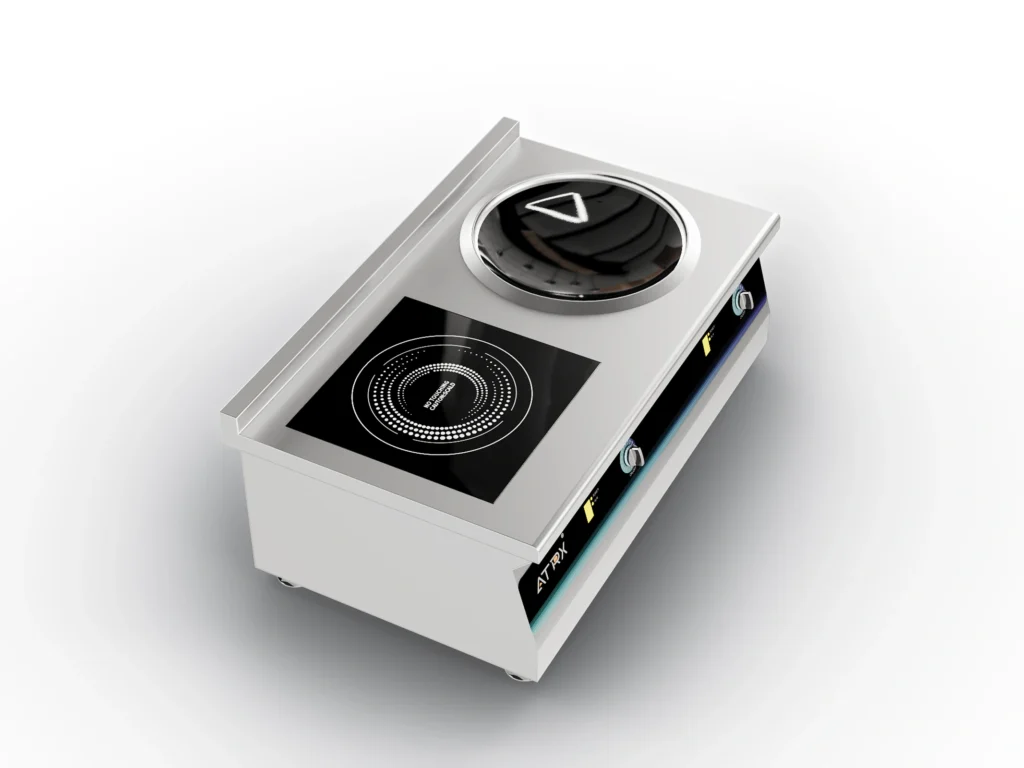
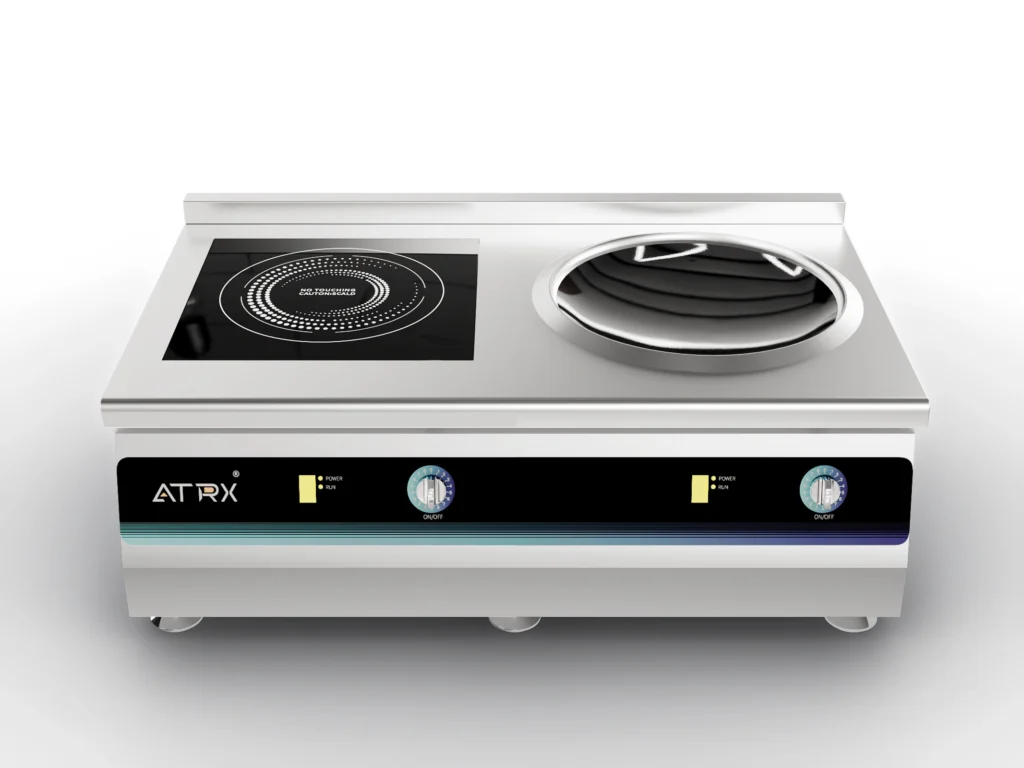
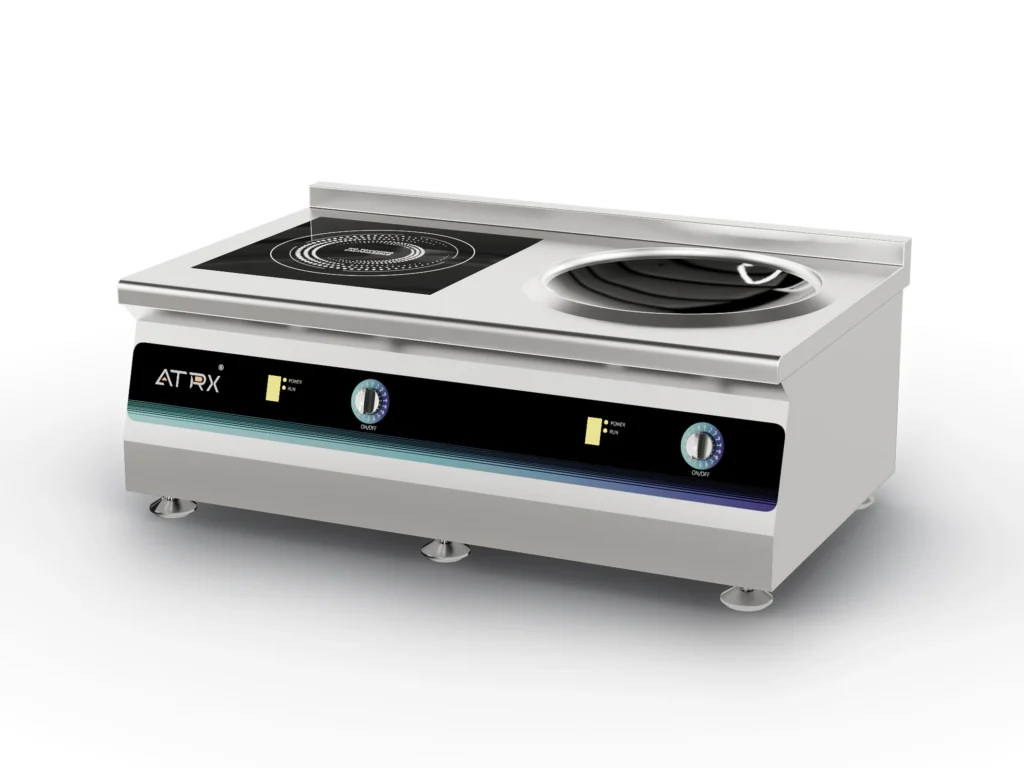
Flat Frying and Concave Wok Zones Matched to Different Cooking Tasks
The flat zone takes 12–30 cm flat-bottom pans; the concave zone holds 34–40 cm round-bottom woks. Each pan shape gets proper contact and support without compromise.
Independent Dual-Zone Power Supports Simultaneous Full Load
Each AT-CTWII-003 zone delivers 3.5kW independently at full load. Fry or reduce sauce on the flat zone while the concave zone cooks rice, noodles, or greens.
800mm Housing Integrates Two Cooking Positions
The 800 × 470 × 300 mm SS304 body combines a flat frying zone and a round-bottom wok zone on one countertop or hot pot table, simplifying purchasing and counter planning.
Inquiry UsView Specifications
01 / SPECIFICATIONS
Product Specification
Product Name
Product Model
Power(Kw)
Voltage(V)
Product Size
Product Material
Hs Code
02 / GETTING STARTED
How To Operate This Machine
Step 1
Place your commercial induction cooker in position and connect the power cable based on the required voltage. Make sure all wiring is done correctly before turning on the unit.
Step 2
Once powered on, place your induction cookware on the commercial induction cooker, prepare your ingredients, and get ready to start cooking.
Step 3
Turn the knob from 0 to your desired setting to begin cooking. During the cooking process, simply adjust the knob between levels 1 to 8 to control the heat output to your needs.
Step 4
Once cooking complete,then turn the knob back to 0 to power off the unit. Wipe down and clean the surface of your commercial induction cooker to keep it in top condition.
03 / QUALITY ASSURANCE
Dual-Zone Quality Control for the Flat-and-Wok Commercial Induction Cooktop
01
Key Incoming Material Model and Parameter Verification
At the receiving dock, our QC team checks the power devices, capacitors, and interfaces used in the flat and concave zones against the order bill of materials, supplier label, batch report, and part marking. Capacitors are checked for capacitance, voltage rating, and part number; power devices for full model and package; connectors for interface type; and key parts are sampled and retested by batch, with source and results recorded. A part that would power on but deliver different power or durability in one zone is caught before assembly. For a dual-zone cooktop boiling on the flat side and stir-frying on the concave side, each zone gets components matched to its role.
02
Flat and Concave Structure and Assembly Dimension Inspection
At the housing and panel stage, our team checks mounting holes, support surfaces, and post-weld distortion after the AT-CTWII-003's SS304 housing is cut, bent, and welded, then checks panel thickness, flatness, chipping, cracks, and surface defects at incoming inspection. Assembly uses locating supports and specified fasteners; if a panel is uneven, we check dimensions and supports instead of forcing it flat with over-tightened screws. If a panel or support is off, it can become a rocking surface or a weak contact area and cause uneven heating in either zone. For a dual-zone station, the flat pan and round-bottom wok each need to sit firmly in their own zone without a gap.
03
Separate Coil Winding for Flat and Concave Zones
At the dual-coil winding station, our team sets turns, spacing, and tension by model and power, then fixes, cures, and measures each coil's dimensions and electrical values. During assembly, we align each coil center with its heating zone, route the leads, confirm insulation, spacers, and supports, and control coil-to-panel spacing per drawing. The dual-coil station is set up to keep a misplaced coil or missing part from causing slow heating on one side, localized overheating, or repeated protection trips. In a flat-and-wok cooktop, the flat zone heats a frying pan across its base while the concave zone follows the wok curve, so both methods can run together.
04
Control Board Dehumidification, Soldering, and Function Testing
Before soldering, our board team bakes the control board to remove moisture, then inspects SMT joints for bridges, insufficient solder, displacement, and lifting, and checks through-hole power devices and terminals against drawings for model, orientation, and polarity. We then run short-circuit, open-circuit, power-on, power-output, and control-response tests. Cold joints or wrong parts are caught at board level before the unit is closed, lowering the risk of tearing down final assembly to find a fault. For a dual-zone station running a frying pan and a wok side by side, both zones are checked to respond predictably.
05
Dual-Zone Air Duct and Cooling System Inspection
At the cooling check, our team confirms the fan model, voltage, connector, and dimensions, then checks supply and exhaust direction, keeps the harness away from the blades, and leaves an airflow path around the heat sink. We clean the contact surface between power devices and the heat sink, install thermal and insulating materials as required, and tighten them; cooling acceptance does not stop at whether the fan spins. When both zones run, heat accumulates; a reversed fan or blocked airflow is caught before it can cause heat buildup, power reduction, or shutdown. For a dual-zone cooktop, both zones are checked at full load together so heat does not build up inside the 800mm housing.
06
Flat and Concave Zone Power-Level and Full-Load Acceptance
Ahead of final closure on the AT-CTWII-003, our inspectors check plugs, terminals, brackets, harness, grounding, and foreign objects. We then check the knobs and 1–8 heating response of the flat and concave zones separately and perform applicable insulation/dielectric-strength and transport-vibration checks. Problems are tagged and removed from the normal flow, and after repair the original fault and related items are retested before model, power, voltage, and frequency are confirmed and the nameplate applied. Before packing, each zone is run at every level so a zone that does not hold its setting is caught before delivery. For the AT-CTWII-003, the unit leaves as a complete two-zone station with the flat pan and wok checked to run at the same time.
All results above are from our own factory. See related pages below.
Production Line Center Manufacturing Machines PCB Assembly Center04 / COOKING APPLICATIONS
Flat-and-Wok Combination Scenarios for the Dual-Zone Countertop Induction Cooktop
Own factory
CE certified
OEM available
Noodle and Fast-Food: Boil on the Flat Zone, Stir-Fry on the Concave Zone
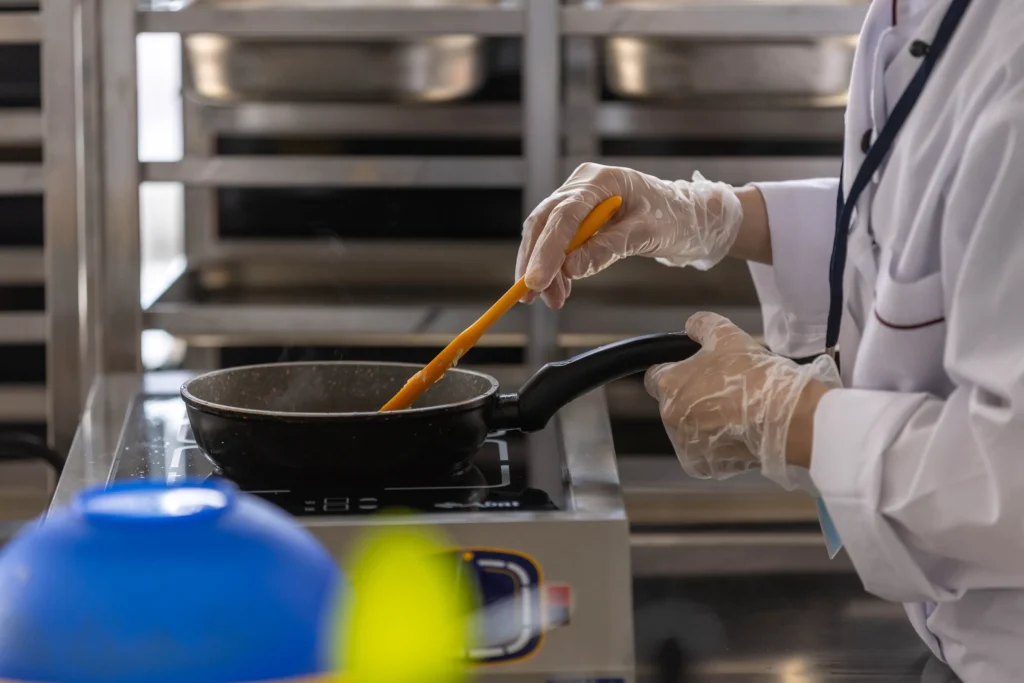
At noodle shops and rice-bowl restaurants that serve both soup noodles and made-to-order stir-fried toppings, this dual-zone commercial countertop induction cooktop puts a flat-bottom stockpot on the flat zone for soup base and hot braising sauce, and a round-bottom wok on the concave zone for stir-fried meat slices, vegetables, or fried rice. During lunch and dinner peaks, the two zones adjust separately, so boiling and wok cooking proceed in parallel on one countertop unit.
Hotel Breakfast: Western Frying and Chinese Stir-Frying
At hotel open kitchens that serve both Western breakfast and Chinese hot food, the dual-zone commercial countertop induction cooktop uses its flat zone for eggs, pancakes, or hot sauce in a frying pan, and its concave zone for fried rice, fried noodles, and vegetables in a round-bottom wok. Each type of cookware stays on its matching heating zone, so the chef can switch menus without changing equipment or waiting for one zone to free up.
Hot Pot and Buffet: Heating and Live Stir-Frying in Parallel
At hot pot restaurants and buffet counters that need both hot soup and live stir-fried dishes, the dual-zone commercial countertop induction cooktop holds a flat-bottom stockpot on the flat zone for replenishing broth or heating dipping sauce, while the concave zone stir-fries sides, fried rice, and fried noodles in a round-bottom wok. One unit covers two different output tasks, making it a better fit for a live-cooking position with limited counter space.
FAQs
Frequently Asked Questions
We've gathered the most common questions buyers ask before placing their first order — browse through and find the answers that matter most to you.
Can the Flat and Concave Zones Run at Full Power Simultaneously?
Yes, the two zones can run at full power together. On the AT-CTWII-003, the flat and concave zones each have an independent 3.5kW power module, so raising heat on one side does not take power from the other. That is what lets a noodle shop boil stock on the flat zone while stir-frying toppings in the wok zone, but the switch working does not prove the distribution can support both at full load. Give each zone its own circuit and have the distribution checked before both are used at full power.
How Much Electrical Capacity Is Needed for Both Zones at Full Power?
Plan two dedicated 220V circuits, one per zone, each rated 15.9A with 4mm² copper wire and a 20A residual-current device, for 7kW total at full load. The AT-CTWII-003 cannot be plugged into an ordinary 16A outlet or an uncalculated old circuit. The 5kW × 2 version uses 22.7A per zone with a 32A residual-current device. A hot pot table, buffet island, or noodle counter needs both circuits planned before the counter is built. Grounding, protection, and local code should be confirmed by a licensed electrician.
Can a Round-Bottom Wok Be Used on the Flat Heating Zone?
Not recommended. A round-bottom wok on the flat zone usually touches the surface only at its lowest point, the wok body is unstable, and most of the base is not close to the surface. The concave zone supports the wok and its curved coil follows the wok profile. Keep round-bottom tossing on the concave side and reserve the flat zone for flat-bottom pans and stockpots.
Which Cookware Fits the Flat and Concave Zones?
Use induction-compatible flat-bottom pans, stockpots, or saucepans with a base diameter of about 12–30cm on the flat zone. Use induction-compatible round-bottom carbon steel or stainless steel woks with a rim diameter of about 34–40cm on the concave zone. A magnet must attract the base, and a pan that is too small, off-center, or deformed can cause unstable detection or uneven heating. Plan the station around that split: flat pans and stockpots on one side, the wok on the other.
Can It Be Built Into a Hot Pot Table or Buffet Island?
Yes, it can be built into a hot pot table or buffet island, but the cutout must be designed around the unit rather than guessed from the housing size. The 800 × 470 × 300mm figure is the housing size, not the cutout size. Leave room for panel support, housing clearance, air intake and exhaust, wiring, and service access; the product page confirms hot pot, buffet-island, and live-cooking counter use. Confirm cutout, cooling, and electrical conditions against project drawings, or let the unit sit on a worktop or cart if built-in installation is not needed.
——07 / Factory quote & RFQ
Partner with a Trusted Commercial Induction Cooker Manufacturer
Whether you need wholesale commercial induction cookers, an OEM product line or a commercial kitchen project configuration, send a focused commercial brief. An ATRX team member can review the product, power, certification and customization requirements before quotation.
Useful information to include:
Target country · Product category · Application · Voltage / phase · Estimated quantity · Required certifications · OEM / branding needs