

—— PRODUCT HIGHLIGHTS
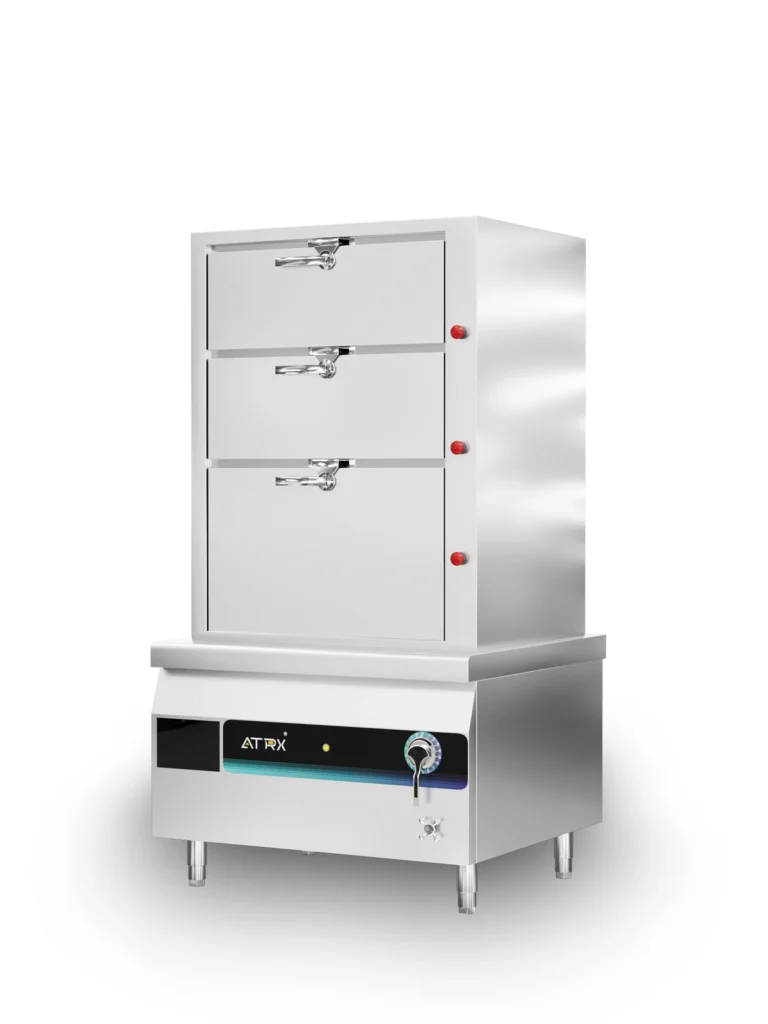
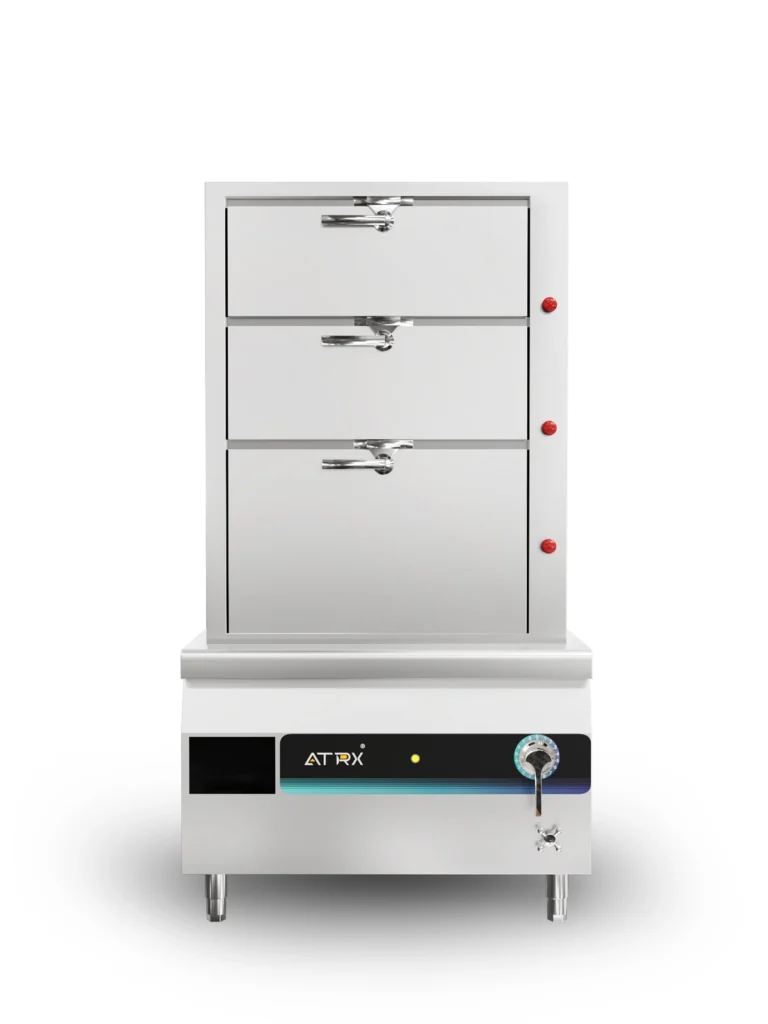
3-tier Induction Seafood Steamer Cabinet | 30KW
Pure Copper Coil Rated to 150°C
The high-frequency pure copper winding sits below the shared water tank, offering lower resistivity than aluminum — more electricity converts to heat, less is wasted inside the coil itself.
Uniform Steam Across All Three Tiers
One powerful copper coil drives a single steam source upward through three sealed compartments, producing a stable electromagnetic field that eliminates hot spots and cold zones on every tray.
Coil Lifespan Matches the Machine
Copper resists thermal fatigue far better than aluminum, holding above 95% of its original conductivity after years of daily heat cycles — no mid-life coil swap needed.
Rapid Heat Dissipation at 30KW
At ~398 W/m·K thermal conductivity — nearly double aluminum — the copper coil sheds excess heat fast under full load, protecting power boards and keeping output steady.
Basic Specification
Product Name
Product Model
Power(Kw)
Voltage(V)
Product Size
Product Material
Hs Code
How To Operate This Machine
Step 1
Place your commercial induction cooker in position and connect the power cable based on the required voltage. Make sure all wiring is done correctly before turning on the unit.
Step 2
Once powered on, place your induction cookware on the commercial induction cooker, prepare your ingredients, and get ready to start cooking.
Step 3
Turn the knob from 0 to your desired setting to begin cooking. During the cooking process, simply adjust the knob between levels 1 to 8 to control the heat output to your needs.
Step 4
Once cooking complete,then turn the knob back to 0 to power off the unit. Wipe down and clean the surface of your commercial induction cooker to keep it in top condition.
6-Step Quality Checking of this Machine | Every Unit
Every testing machine shown below is physically present in our factory — no fabrication.
PERFORMANCE
Dust-free PCB assembly
- Every board built in a sealed cleanroom, no dust or grease particles get trapped under components — eliminates 40% short-circuit failures compare to competitors.
Electric Heating Constant Temperature Drying Oven
- Bakes out all moisture from PCBs before soldering — boards that skip this step blister and crack under high-power heat within months.
Electric Heating Constant Temperature Incubator
- Every board is heat-aged for hours to force weak solder joints to fail in our lab, not in your kitchen after installation.
Constant Temperature and Humidity Test Chamber
- Simulates years of steam and humidity from a real commercial kitchen to verify no board corrosion or short circuits develop over time.
Salt Spray Test Chamber
- Tests every metal part and connector against aggressive corrosive vapor — the same oils, acids, and moisture your cooker faces daily in a commercial kitchen environment.
Thermal Shock Test Chamber
- Mimics the hundreds of rapid heat-up / cool-down cycles your cooker endures every single day, cracking any weak solder joint before it ever ships.
What Food Can You Cook With It?
Shellfish & Crustaceans
Crabs, lobsters, clams, prawns, and mussels need strong, penetrating steam through thick shells. The copper coil’s stable output sends uniform steam upward into all three tiers at once.
Whole Fish & Fillets
Sea bass, grouper, snapper, and salmon need gentle, consistent steam to stay moist and flaky. Even heat from the copper coil prevents dried edges or undercooked centers.
Soups, Custards & Steamed Specialties
Herbal broths, egg custards, and silken tofu require steady, low-fluctuation steam. The copper coil’s efficient energy conversion holds precise temperatures for these delicate dishes.

FAQs
Frequently Asked Questions

Most People Curious
We've gathered the most common questions buyers ask before placing their first order — browse through and find the answers that matter most to you.
Submit Your InquiryWhy is a pure copper coil better than aluminum in an induction seafood steamer?
Copper has lower electrical resistivity, so more energy becomes usable heat instead of warming the coil. Its thermal conductivity (~398 vs. 235 W/m·K for aluminum) also means faster steam generation and quicker heat shedding. Over years of commercial use, aluminum loses conductivity from oxidation and micro-cracking, while copper holds above 95% performance for the life of the unit.
How does one copper coil heat all three compartments evenly?
The single high-frequency copper coil heats a shared water tank at the base. Because copper produces a highly stable electromagnetic field, the water heats uniformly across the full tank surface. Steam then rises naturally through all three sealed tiers, delivering consistent density to every compartment without hot or cold spots.
How long does the copper coil last under daily restaurant use?
The dual-layer pure copper coil is designed to match the full machine lifespan — typically 10+ years in a multi-shift kitchen. Copper withstands tens of thousands of heat-cool cycles without cracking. Aluminum coils often need mid-life replacement due to thermal fatigue, adding cost and downtime that copper avoids entirely.
Is this 30KW steamer energy-efficient for high-volume service?
Yes. The pure copper coil achieves around 93–95% energy conversion, so nearly all electricity goes into steam. That cuts energy costs 40–50% versus a comparable gas seafood steamer. When demand is light, lowering the 8-level power control reduces consumption further without shutting down the unit.
What electrical setup does this steamer cabinet require?
It runs on standard 380V three-phase power at 30KW total. A dedicated circuit with a 60A breaker is recommended. The unit measures L950 × W900 × H1870mm — allow 150mm clearance on sides and rear for ventilation. Water supply needs