

PRODUCT HIGHLIGHTS
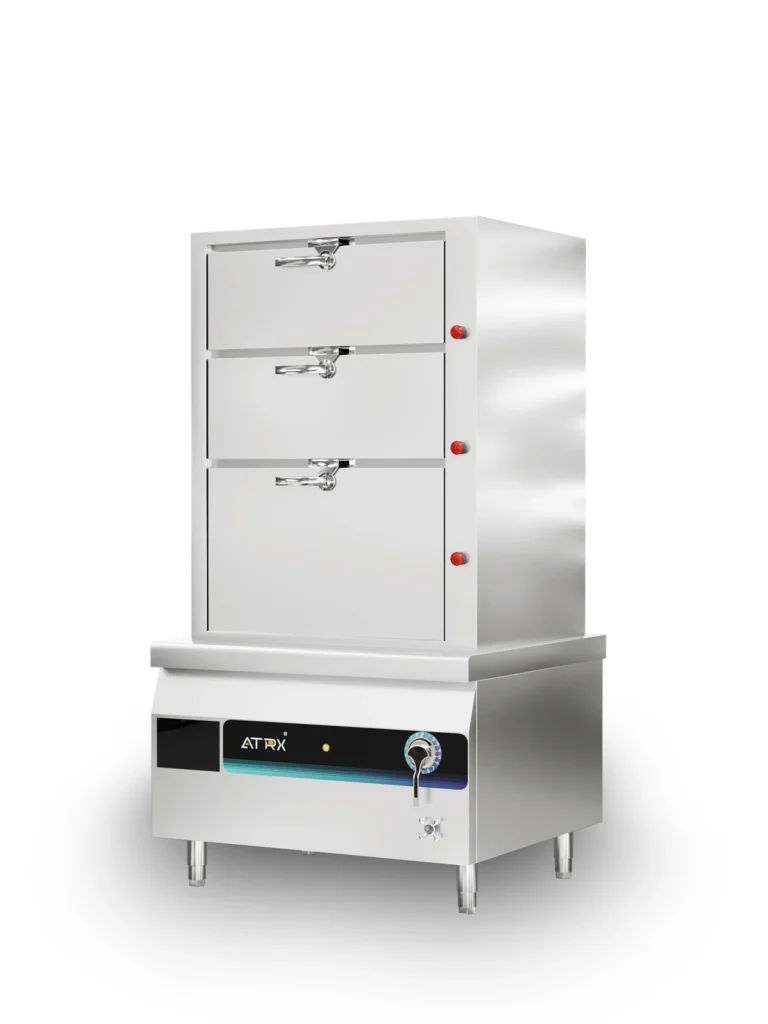
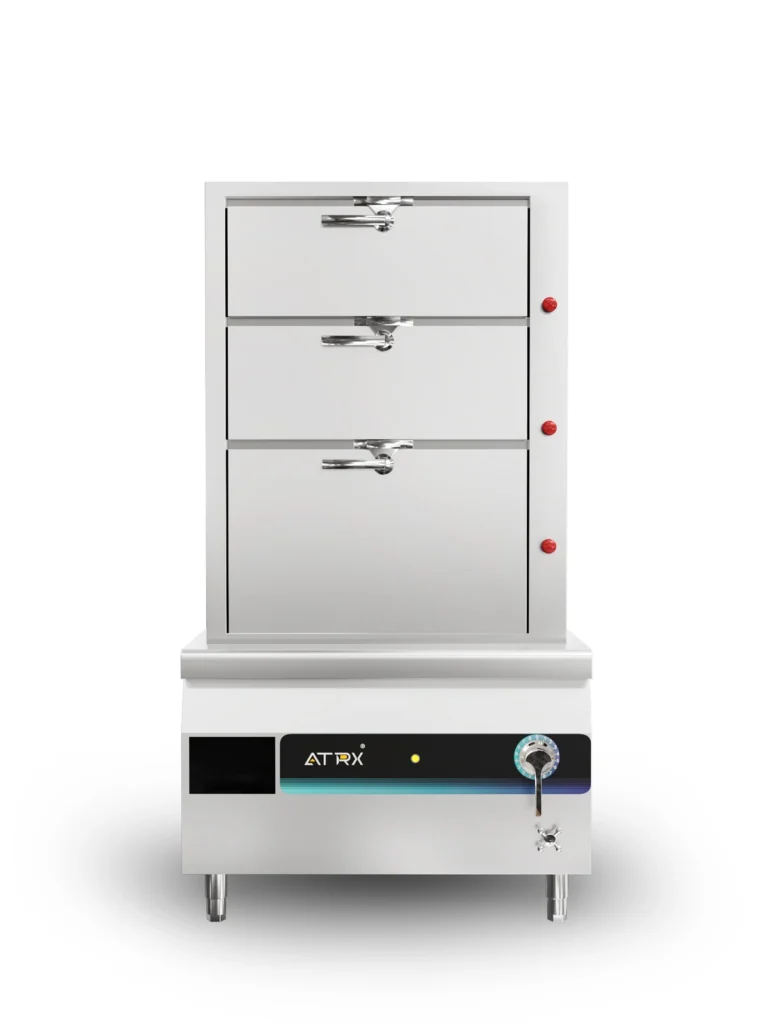
Quiet Pressure-Relief Seafood Steamer Cabinet
3-tier Induction Seafood Steamer Cabinet | 20KW
Value of the 220V Front-to-Back 2-Burner Induction Cooktop
Baffled Steam Exhaust Cuts Pressure-Release Noise
Internal baffles break high-speed steam into several slower streams, which then leave through curved channels. The result is a softer release, without the sharp hiss of a concentrated blast near guests.
Staged Steam Release Lowers Scalding Risk and Wear
Because steam exits in stages rather than in one concentrated burst, there is less sudden hot-steam exposure at the outlet. The seals and nearby parts also take fewer repeated impacts, which helps them last longer.
Independent Exhaust on Each Tier Limits Flavor Transfer
Each of the three tiers has its own pressure-relief path, so seafood, dim sum, and vegetables vent separately. During batch service, aromas stay with the dish they belong to instead of mixing between tiers.
Inquiry UsView Specifications
01 / SPECIFICATIONS
Product Specification
Product Name
Product Model
Power(Kw)
Voltage(V)
Product Size
Product Material
Hs Code
02 / GETTING STARTED
How To Operate This Machine
Step 1
Place your commercial induction cooker in position and connect the power cable based on the required voltage. Make sure all wiring is done correctly before turning on the unit.
Step 2
Once powered on, place your induction cookware on the commercial induction cooker, prepare your ingredients, and get ready to start cooking.
Step 3
Turn the knob from 0 to your desired setting to begin cooking. During the cooking process, simply adjust the knob between levels 1 to 8 to control the heat output to your needs.
Step 4
Once cooking complete,then turn the knob back to 0 to power off the unit. Wipe down and clean the surface of your commercial induction cooker to keep it in top condition.
03 / QUALITY ASSURANCE
Low-Noise Commercial Seafood Steamer: Six Pressure-Relief Tests
01
Key-Part Checks for Pressure-Relief Stability
Incoming key parts are checked by model, specification, appearance, and batch against the order. A mismatched sensor, fan, or connector can disturb pressure release, heat dissipation, or protection response in a steamer placed near guests. Electrical parameters are sample-tested by batch, and look-alike parts are not treated as interchangeable. For open kitchens, consistent sensor and fan condition helps the exhaust system release steam more smoothly instead of producing an unexpected change in noise.
02
First-Article Dimension Check for Pressure-Relief Channels
First-article approval covers the cabinet, baffles, and mounting positions before full production. If the profile, hole positions, bend angles, or clearances drift, the three diversion channels can sit unevenly and change how steam leaves the cabinet. The first article is checked against the same drawing used for laser cutting, CNC punching, and bending, then production follows that approved setup. In an open kitchen, consistent channel geometry helps keep pressure release steadier rather than adding a sharp noise near diners.
03
Post-Weld Alignment and Trial Fit of Pressure-Relief Parts
Post-weld inspection checks heat distortion and the squareness of door frames and tier openings. A shifted frame, weld spatter, or tight partition can create a leak path or interfere with the pressure-relief parts during trial fit. We preserve the thickness of load-bearing welds while removing burrs and sharp edges, then trial-fit doors, partitions, supports, and relief components in the same locating arrangement. For a low-noise cabinet, that fit helps reduce abnormal steam escape and the noise that can come with it.
04
Board-by-Board Inspection and Damp-Heat Verification
Control boards pass through cleanroom SMT, optical inspection, electrical testing, moisture control, and heat aging. Missing parts, bridges, cold joints, or damp-related faults can otherwise affect pressure release, fan control, or protection logic. Key metal parts and connections are also checked through damp heat, salt spray, and thermal shock for humid operating conditions. In an open-kitchen setting, that board-level screening helps reduce the risk of a control fault changing exhaust behavior while guests are nearby.
05
Full-Unit Exhaust and Protection-Function Testing
After assembly, the unit is powered and each protection function is triggered according to the model's inspection file. A display, keypad, fan, or protective response that does not behave as intended can change pressure release or stop the steamer during service. We check heating at each level, fan operation, heat dissipation, output response, and applicable withstand-voltage, grounding, leakage, vibration, and nameplate requirements. For a live station or dining-room-adjacent kitchen, this final test helps confirm that steam release and shutdown response work as expected before the unit is installed.
06
Batch First-Article Approval and Retest After Repair
Before each production run, the first article is approved for structure, function, and fit. Batch-to-batch changes in parts or assembly can otherwise produce a unit that looks correct but releases steam differently. The production traveler records the model, parts, assembly, and inspection status, and any problem triggers a concurrent check of the batch. Repaired units repeat the original and affected tests before returning to the flow. For open-kitchen projects, that traceable check helps keep the low-noise exhaust behavior consistent across units.
All results above are from our own factory. See related pages below.
Production Line Center Manufacturing Machines PCB Assembly Center04 / COOKING APPLICATIONS
Low-Noise Commercial Seafood Steamer: Open-Kitchen Applications
Own factory
CE certified
OEM available
Live Seafood Steaming in Restaurants
Seafood restaurants can place the steamer at a live station or near the guest area and steam whole fish, crab, lobster, shrimp, and shellfish in view of diners. Guests can see the process, while softer, more continuous exhaust noise is less likely to interrupt conversation. Three independent tiers also let different seafood items be separated and served table by table with less pressure.
Concentrated Steaming in Hotel Banquet Kitchens
Chinese restaurants, banquet halls, and buffet restaurants in hotels often steam in concentrated batches before service. Whole fish can go on the top tier, dim sum in the middle, and vegetables or egg custard on the bottom; each tier has independent heating and pressure relief, so different dishes can start together. When the cabinet is close to guest areas, softer exhaust noise makes the kitchen-to-front-of-house handoff less disruptive.
Replenishment at Dim Sum Shops and Buffet Stations
Cantonese dim sum shops, premium Chinese restaurants, and upscale buffet stations often serve har gow, siu mai, char siu bao, rice rolls, and vegetables continuously. Three independent tiers can hold dim sum on one level, vegetables on another, and the next batch on the third, with each tier managed separately as items are ready. Near a pickup area, quieter pressure release helps prevent sudden steam noise from interrupting guests.
FAQs
Frequently Asked Questions
We've gathered the most common questions buyers ask before placing their first order — browse through and find the answers that matter most to you.
How do the pressure-relief channels reduce exhaust noise?
Steam is divided into slower streams by several baffle stages, then exits through curved channels, so a concentrated sharp pressure-release sound becomes softer and more continuous. That smoother exhaust makes the steamer easier to place at a live station or near guests without abrupt steam noise dominating the room. Each of the three tiers has its own relief path, so pressure release from one tier is less likely to carry noise or hot steam into another.
Is the unit suitable for an open kitchen?
Yes, the unit suits open kitchens, hotel live stations, seafood restaurants, and steaming areas near guest seating. Softer, more continuous exhaust sound helps preserve the dining atmosphere, and guests can watch food being steamed without conversation being cut off by sudden steam noise, which is useful where display cooking and a quieter environment must coexist.
Does noise reduction affect safe steam release?
No, noise reduction does not compromise safe steam release. It works by splitting and gradually releasing steam, not by sealing it inside the cabinet; steam still exits through the designed channels, but pressure changes are smoother and hot steam is less concentrated, while dry-boil, high-water-level, and low-water-level protection remain in place.
Is flavor transfer likely when all three tiers are steaming?
No, flavor transfer is unlikely when all three tiers are steaming under normal use. Each tier has its own steaming zone and pressure-relief path, with no shared airflow, so whole fish, crab, shrimp, dim sum, and vegetables can run together and still suit mixed open-kitchen seafood service.
Will exhaust noise increase over time?
No, age alone should not make the exhaust louder. The more likely causes are scale or food debris in the exhaust opening, poor door-seal contact, or loose fasteners. Cleaning residue and standing water at closing, together with planned checks of the exhaust opening, baffle area, door seals, and fasteners, catches those issues before they reach the dining area.
——07 / Factory quote & RFQ
Partner with a Trusted Commercial Induction Cooker Manufacturer
Whether you need wholesale commercial induction cookers, an OEM product line or a commercial kitchen project configuration, send a focused commercial brief. An ATRX team member can review the product, power, certification and customization requirements before quotation.
Useful information to include:
Target country · Product category · Application · Voltage / phase · Estimated quantity · Required certifications · OEM / branding needs