

—— PRODUCT HIGHLIGHTS
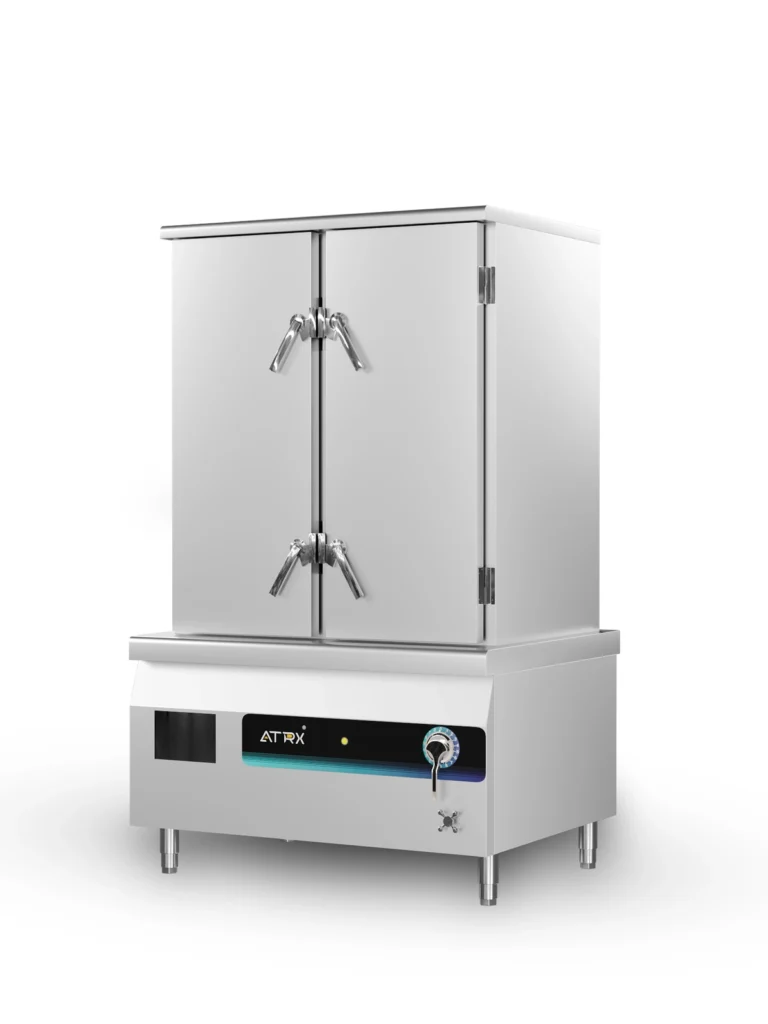
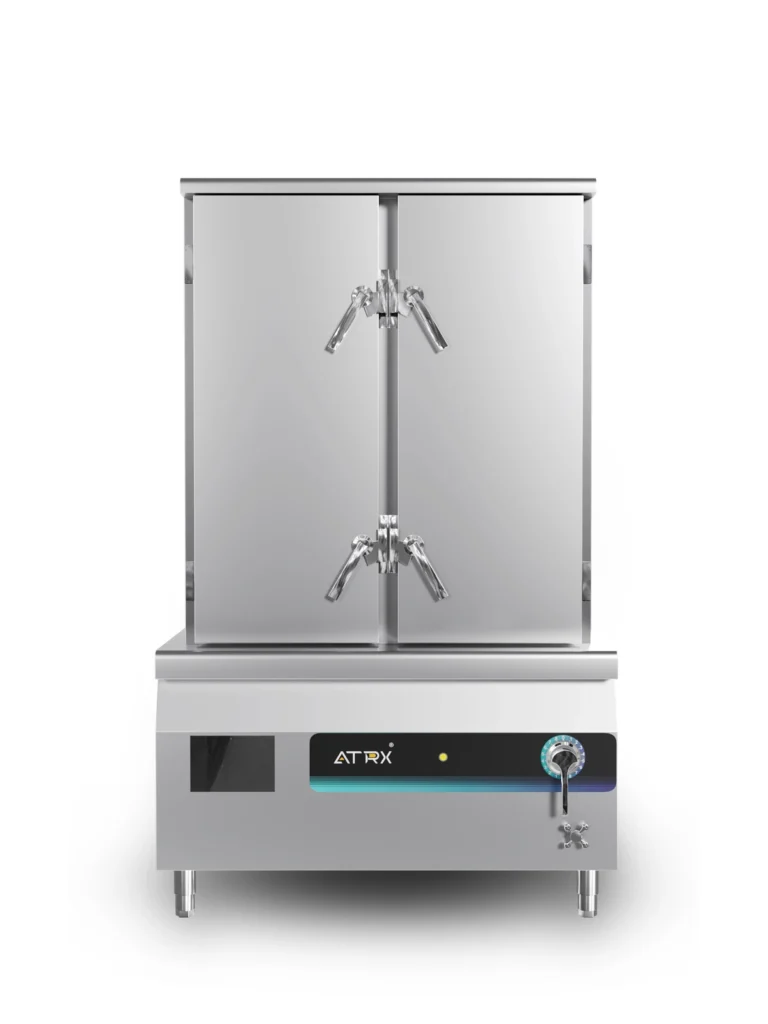
Commercial Induction Double Door Rice Steamer | 30KW
Full Steam in 3–5 Min from Cold
This induction rice steamer controls water level precisely so a small amount of water boils fast — full steam in 3–5 minutes.
24 Trays, About 84 kg of Rice at Once
All 24 trays share one induction-heated chamber. Each tray holds roughly 3.5 kg of rice, so a full load produces around 84 kg — enough for over 500 servings in a single run.
95% Efficiency, Less Heat in the Kitchen
Induction heats the water directly, not the air around it. That means 95% of the energy goes into making steam, your energy bill stays lower, and your kitchen does not overheat during service.
No More Waiting Between Rush Hours
Traditional steamers need 15–20 min to reheat each service. This unit restarts in 3–5 min, so there is almost no downtime between lunch and dinner rushes.
Basic Specification
Product Name
Product Model
Power(Kw)
Voltage(V)
Product Size
Product Material
Hs Code
How To Operate This Machine
Step 1
Place your commercial induction cooker in position and connect the power cable based on the required voltage. Make sure all wiring is done correctly before turning on the unit.
Step 2
Once powered on, place your induction cookware on the commercial induction cooker, prepare your ingredients, and get ready to start cooking.
Step 3
Turn the knob from 0 to your desired setting to begin cooking. During the cooking process, simply adjust the knob between levels 1 to 8 to control the heat output to your needs.
Step 4
Once cooking complete,then turn the knob back to 0 to power off the unit. Wipe down and clean the surface of your commercial induction cooker to keep it in top condition.
6-Step Quality Checking of this Machine | Every Unit
Every testing machine shown below is physically present in our factory — no fabrication.
PERFORMANCE
Dust-free PCB assembly
- Every board built in a sealed cleanroom, no dust or grease particles get trapped under components — eliminates 40% short-circuit failures compare to competitors.
Electric Heating Constant Temperature Drying Oven
- Bakes out all moisture from PCBs before soldering — boards that skip this step blister and crack under high-power heat within months.
Electric Heating Constant Temperature Incubator
- Every board is heat-aged for hours to force weak solder joints to fail in our lab, not in your kitchen after installation.
Constant Temperature and Humidity Test Chamber
- Simulates years of steam and humidity from a real commercial kitchen to verify no board corrosion or short circuits develop over time.
Salt Spray Test Chamber
- Tests every metal part and connector against aggressive corrosive vapor — the same oils, acids, and moisture your cooker faces daily in a commercial kitchen environment.
Thermal Shock Test Chamber
- Mimics the hundreds of rapid heat-up / cool-down cycles your cooker endures every single day, cracking any weak solder joint before it ever ships.
What Food Can You Cook With It?
Rice & Grains
White rice, brown rice, glutinous rice, mixed grains, and congee. Steam reaches all 24 trays within minutes, so every tray cooks evenly — no half-done rice on the top rack while the bottom is already overcooked.
Seafood & Meat
Whole fish, shrimp, pork ribs, chicken pieces, and egg custard. Steam is ready so quickly that proteins go in while the heat is at its peak. A whole sea bass takes about 7 minutes — fast enough to keep dinner service moving.
Dim Sum & Buns
Bao buns, siu mai, har gow, rice noodle rolls, and steamed cakes. No waiting for the cabinet to warm up between batches, so your team can load tray after tray without a gap in output during the lunch or dinner rush.
FAQs
Frequently Asked Questions

Most People Curious
We've gathered the most common questions buyers ask before placing their first order — browse through and find the answers that matter most to you.
Submit Your InquiryHow does this induction rice steamer produce steam so fast from a cold start?
It keeps a shallow layer of water right above the induction plate instead of filling a large tank. Induction heating brings that small volume to a boil in 3–5 minutes because energy transfers directly into the steel tray, not into the air. Traditional electric tube steamers heat a bigger water body through a slower element, which is why they take 15–20 minutes.
How much time does the quick steam feature save in a real kitchen?
About 45 minutes a day. Most kitchens preheat before breakfast, lunch, and dinner — three sessions. If each preheat drops from 15–20 minutes to 3–5 minutes, you get roughly 15 minutes back each time. Over a month, that is around 22 extra hours of steaming time you can use for actual cooking instead of waiting.
Can this steamer handle more than just rice?
Yes. The same steam that cooks rice works for fish, ribs, chicken, dumplings, bao buns, and egg custard. A whole sea bass steams in about 7 minutes. Because the 30kW induction core brings steam back quickly after you open the doors, you can switch between rice and other dishes with very little wait in between.
Why use a shared cavity instead of two separate heating zones?
One induction element heats one water source for the whole cabinet. All 24 trays get the same steam at the same temperature — no hot spots on one side and cold spots on the other. When you need 84 kg of evenly cooked rice, that consistency matters. It also means one fast preheat cycle covers the entire unit, not two separate warm-ups.
Does this induction steamer cost less to run than a gas model?
Yes. Induction runs at about 95% efficiency — nearly all the electricity becomes steam. Gas steamers sit around 45%, losing over half their energy as heat into the room. Most operators see energy costs drop by 40–50% after switching. Your kitchen also stays cooler, which means less spending on ventilation. Add zero gas-line maintenance, and the running cost difference is significant over time.