

PRODUCT HIGHLIGHTS
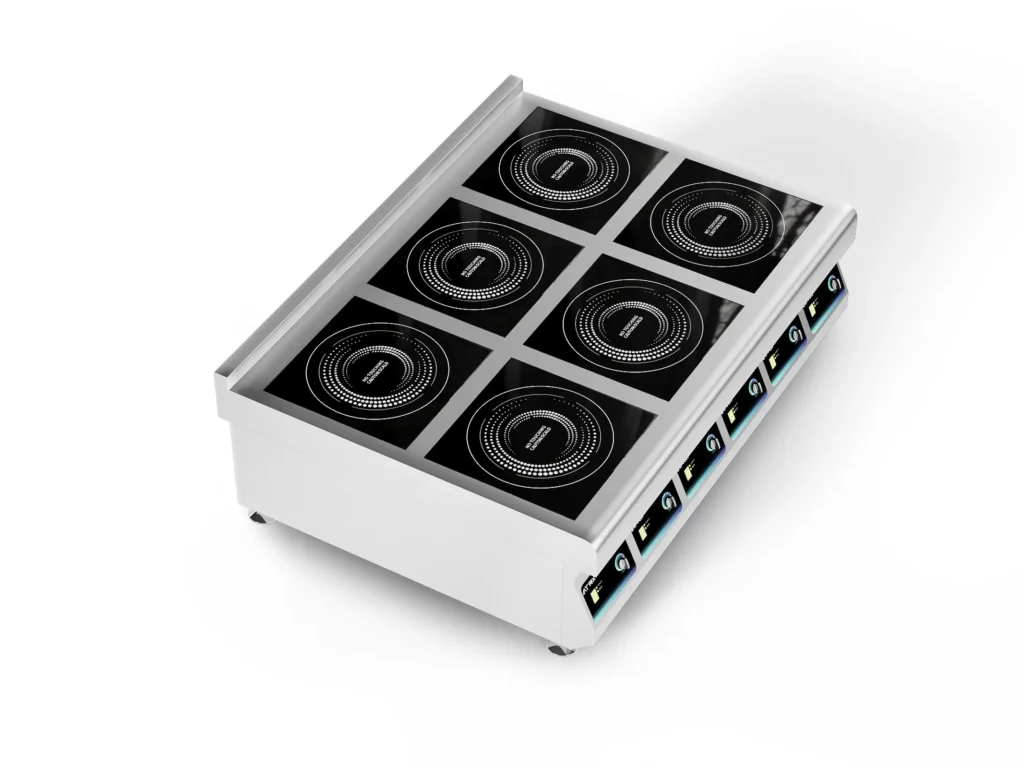
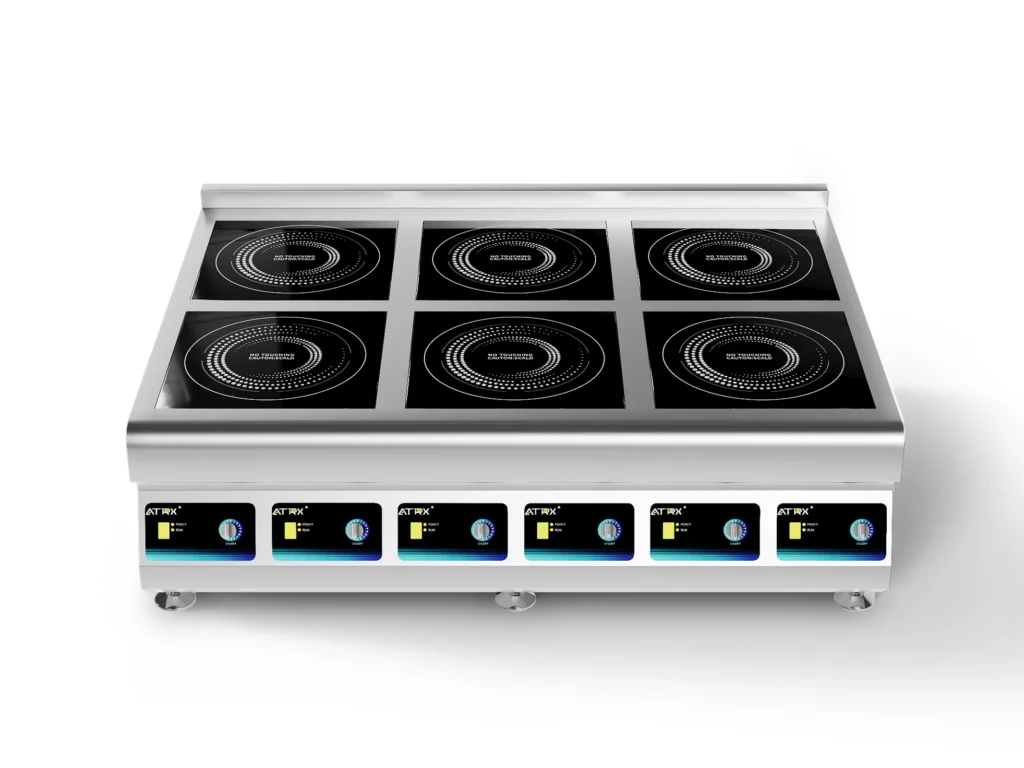
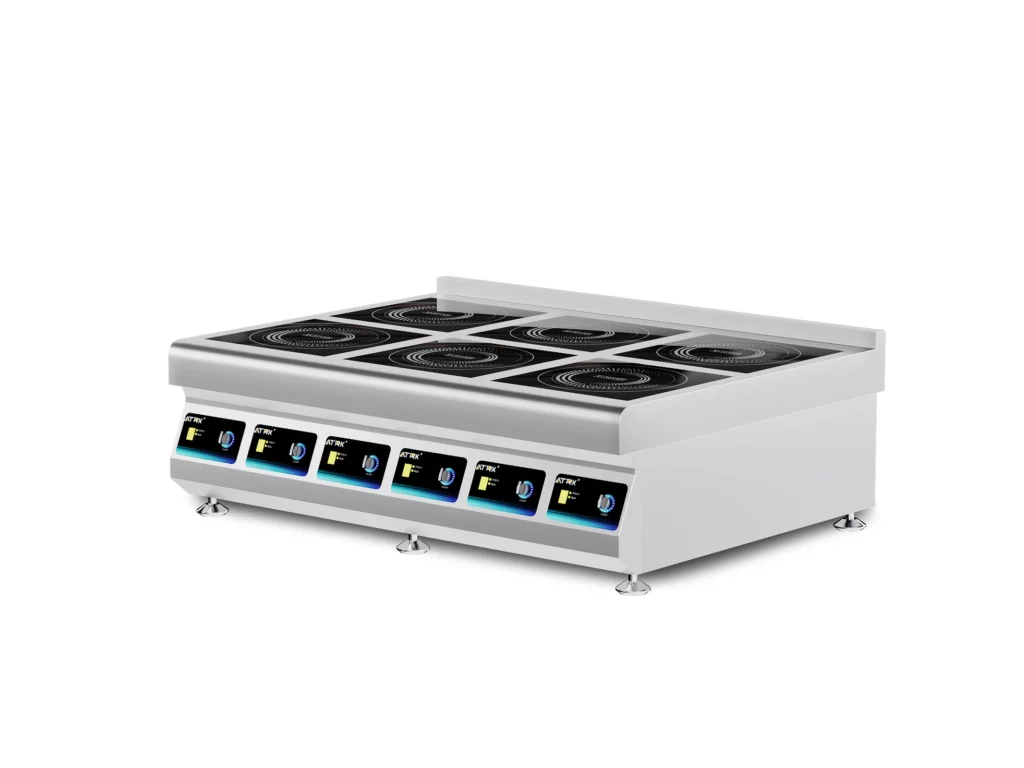
6-Burner Commercial Induction Range, 220V
Countertop Induction Six Burners | 3.5KW*6
Value of the 220V Front-to-Back 2-Burner Induction Cooktop
Six Commercial Zones Running Together to Cut Peak-Hour Waiting
At clay-pot-rice stations, induction-compatible clay pots let six dishes start at once; each zone switches off as its dish finishes, so nothing queues.
Six Independently Controlled Commercial Zones for Parallel Cooking
In breakfast or catering kitchens, congee, soup, and sauce simmer at once; each burner has its own knob and eight levels, so pots do not affect one another.
Commercial Tabletop Installation with No Gas Connection
For rented shops, mall counters, or food trucks, the 1050 × 800 × 330 mm body runs on 220V single-phase with no gas; each burner still needs its own line.
Inquiry UsView Specifications
01 / SPECIFICATIONS
Product Specification
Product Name
Product Model
Power(Kw)
Voltage(V)
Product Size
Product Material
Hs Code
02 / GETTING STARTED
How To Operate This Machine
Step 1
Place your commercial induction cooker in position and connect the power cable based on the required voltage. Make sure all wiring is done correctly before turning on the unit.
Step 2
Once powered on, place your induction cookware on the commercial induction cooker, prepare your ingredients, and get ready to start cooking.
Step 3
Turn the knob from 0 to your desired setting to begin cooking. During the cooking process, simply adjust the knob between levels 1 to 8 to control the heat output to your needs.
Step 4
Once cooking complete,then turn the knob back to 0 to power off the unit. Wipe down and clean the surface of your commercial induction cooker to keep it in top condition.
03 / QUALITY ASSURANCE
Six Quality Controls for the 6-Burner Commercial Tabletop Induction Range
01
Clean Circuit-Board Assembly and Solder Inspection
Six control channels are assembled in a clean environment, then checked by optical inspection for missing parts, misalignment, bridging, and low solder. Dust or excess solder on one board can throw a single burner's control off while the other five appear normal, which is difficult to trace at the counter. Keeping the six channels distinct supports a clay-pot or soup station where several pots run at once and one drifting zone can slow the whole order.
02
Circuit-Board Baking and Dehumidification
Moisture is removed before soldering: boards go into a constant-temperature oven, then on to assembly. A board that carries dampness into the soldering heat can bubble or weaken connections, and the fault may only surface after weeks of steam exposure. Removing that moisture early supports stable six-zone output on a countertop that runs congee, soup, and clay-pot pots through service.
03
Control-Board Thermal Aging Before Assembly
Before installation, control boards spend several hours in thermal aging so weak joints have a chance to surface while the board is still in the factory. Six burners running together generate repeated heat cycles; a joint that fails later can slow several orders at once on a six-pot station. The aging step is intended to expose those boards before they reach a congee or clay-pot counter, where one failed zone affects the whole line.
04
Full-Unit Constant Temperature and Humidity Verification
Full units are placed in a temperature-humidity chamber that simulates the steam-heavy conditions around a six-burner countertop. Moisture can corrode boards and connections or create short-circuit risk, and those symptoms often appear after hours of soup and congee service rather than at startup. This check is tied to the clay-pot and soup applications the range is built for, helping six-zone control stay stable in a damp commercial environment.
05
Salt-Spray Testing of Metal Parts and Connectors
Related metal parts and connectors go through salt-spray testing. Stock, soy sauce, vinegar, and cleaning agents splash around the six pot positions, and the check looks for corrosion and poor contact under that daily exposure; a corroded terminal can interrupt one zone without warning. Salt-spray screening supports the six-pot station through daily sauce and cleaning exposure, reducing the chance of a connector fault stopping service.
06
Thermal Shock Testing of Circuit Boards
Boards are cycled through high and low temperatures in a thermal-shock chamber. Six zones rarely start and stop together, so solder joints and connectors see repeated expansion and contraction; weak points are meant to surface during this screen rather than after the range is in service. Thermal-shock screening helps the six burners keep consistent response as zones are switched independently through lunch and dinner.
All results above are from our own factory. See related pages below.
Production Line Center Manufacturing Machines PCB Assembly Center04 / COOKING APPLICATIONS
Commercial Kitchen Applications for the 220V 6-Burner Tabletop Induction Range
Own factory
CE certified
OEM available
Clay-Pot Rice and Casserole Stations
Cured-meat, chicken, spare-rib, and seafood clay-pot rice cook in separate pots, with two positions left for soup and soy-based sauce; staff add rice and toppings and adjust heat per order. (Six zones let a clay-pot station fire several orders without crowding one burner.)
Braised-Food and Roast-Meat Kitchens
Braising liquid, beef brisket, trotters, soup, blanching, and sauce each occupy their own burner; heat before lunch and top up by sales volume in the evening. (Six zones let a braised-food or roast-meat kitchen prep and replenish on the same tabletop range.)
Hotel Show Kitchens
Breakfast congee, soup, and noodles; buffet noodle soup, toppings, and soup of the day; and conference live-noodle service all run on one six-burner range, each order in its own pot. (Six zones keep breakfast, buffet, and live stations running without moving pans between burners.)
FAQs
Frequently Asked Questions
We've gathered the most common questions buyers ask before placing their first order — browse through and find the answers that matter most to you.
How does a commercial six-burner tabletop induction stove heat without a flame?
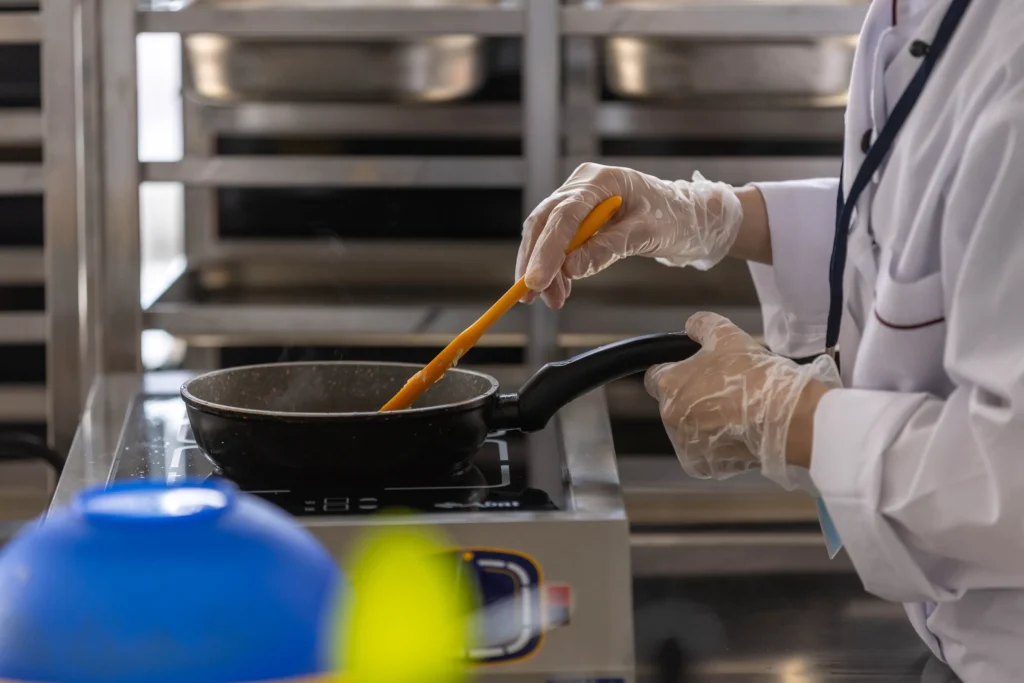
Heat is generated by electromagnetic induction: the coil creates a field that turns the pan base itself into the heat source, without an open flame beneath the vessel. The cookware must be flat and magnetic, and the zone is then adjusted through levels 1–8 for braising, stewing, searing, or stir-frying. In a clay-pot rice or braised-food kitchen, several pots can hold different dishes without a flame under each, although the glass may still become hot from contact with the pan.
Can a commercial six-burner model plug into an ordinary socket?
No. The six-burner range requires six separate 220V single-phase circuits, not one ordinary socket. Each 3.5 kW zone uses 4 mm² copper wire with a 20 A RCD, each 5 kW zone uses 4 mm² copper wire with a 32 A RCD, and all six zones total 21 kW or 30 kW respectively. Final wire and protection must also be checked against local electrical codes, and a shop moving up from a two- or four-burner tabletop should have the six-zone supply confirmed before rebuilding the counter.
How do I choose between the 3.5 kW and 5 kW commercial six-burner models?
Choose from batch size and the kitchen’s available electrical capacity. The 3.5 kW × 6 version totals 21 kW and suits soup, congee, stews, and clay-pot rice, while the 5 kW × 6 version totals 30 kW for searing and larger batches that need stronger heat. The 9 kW difference must be supported by the site, so confirm the supply before selecting the higher rating.
Will the commercial six-burner model fit my countertop?
The body measures 1050 × 800 × 330 mm, so the counter must provide that footprint plus room for pot handles, operation, and cooling. Check load capacity and rear clearance as well as width, and make sure the cook can reach the rear pots comfortably. Final wall and ventilation clearances should follow the manual and local kitchen rules.
Can I use both clay pots and woks?
Use only clay pots made with an induction-compatible base; ordinary earthenware will not heat on this range. Woks must be flat-bottomed and magnetic, and stock or stew pots follow the same rule because a non-magnetic base draws no useful heat from the coil. Test each vessel with a magnet before service, especially in kitchens where clay-pot rice, braised dishes, and wok cooking share the six zones.
——07 / Factory quote & RFQ
Partner with a Trusted Commercial Induction Cooker Manufacturer
Whether you need wholesale commercial induction cookers, an OEM product line or a commercial kitchen project configuration, send a focused commercial brief. An ATRX team member can review the product, power, certification and customization requirements before quotation.
Useful information to include:
Target country · Product category · Application · Voltage / phase · Estimated quantity · Required certifications · OEM / branding needs