

How Much Electricity Does a Commercial Induction Cooktop Use Per Hour?
06/08/2026
Estimated reading time: 2 minutes

Before buying a commercial induction cooktop, nearly every restaurant owner asks the same question first: “How many kWh per hour? And what’s the monthly bill going to look like?”
That question decides your operating budget. If you can’t pin down the electricity cost, you can’t compare it against your current gas setup — and you can’t tell whether the equipment is worth the investment. This article covers real-world commercial induction cooker power consumption per hour, how to calculate monthly costs, and a side-by-side cost comparison with gas stoves. Every number here comes from loaded tests and public industry data, not back-of-napkin theory.
IN THIS ARTICLE
Actual Hourly Power Consumption of Commercial Induction Cooktops
Real Power Consumption Data by Wattage Level (3.5kW to 30kW)
Straight to the numbers. The table below shows commercial induction stove electricity consumption measured with pots loaded and food cooking — not empty-pot, air-burning lab values.
| Rated Power | Actual Hourly Consumption (kWh) | Typical Use Scenario |
|---|---|---|
| 3.5kW | 2.5–2.8 | Clay pot stove, tea/beverage heating, light-duty counters |
| 5kW | 3.5–4.0 | Fast-food stir-fry station, canteen secondary burner |
| 8kW | 5.5–6.5 | Chinese stir-fry, noodle shops, sustained high-temp service |
| 12kW | 8.5–9.5 | Hotel wok station, canteen primary burner |
| 15kW | 10.5–12.0 | Large canteen primary burner, chain restaurant kitchen |
| 20kW | 14.0–16.0 | Central kitchen, military canteen, school canteen |
| 30kW | 21.0–24.0 | Factory-scale batch cooking, large-pot braising |
Why Is Actual Power Consumption Lower Than the Nameplate Rating?
A lot of people think a 15kW unit burns 15 kWh every single hour. It doesn’t.
Inside a commercial induction cooktop, there’s a temperature sensor at the pot bottom. When the temperature hits the target, the control board dials the power down automatically. When it drops, power ramps back up. Power is constantly cycling up and down through the whole cook. It never just sits at max.
On average, actual draw runs about 70%–85% of the nameplate number. But the exact ratio shifts with what you’re cooking:
- Stir-frying and flash-frying: heavy heat demand keeps power high — roughly 80%–85%.
- Pan-frying and deep-frying: once the oil temperature stabilizes, power drops back — roughly 75%–80%.
- Slow stewing and soup-making: low power holds temperature for long stretches — utilization falls to 60%–70%.
Same 12kW machine — stir-frying for an hour uses around 9.5 kWh. Switch to soup, and it might only pull 7 kWh. That’s a big gap.
Bottom line: don’t multiply nameplate watts by hours to get your electricity bill. The real-world ranges in the table above are much closer to what you’ll actually pay. According to ENERGY STAR’s testing standards for commercial electric cooktops, certified commercial induction units are about 5% more efficient per hob than standard electric models — and they don’t run at full output the entire time.
How to Calculate Your Restaurant’s Monthly Induction Cooktop Electricity Cost
Monthly Electricity Cost Formula
You know the hourly number now. The monthly math is simple. One formula:
Monthly electricity cost = Actual hourly consumption (kWh) × Daily usage hours × Monthly operating days × Local electricity rate ($/kWh)
Three steps:
Step 1: Find your hourly consumption. Go back to the table. Match your unit’s wattage. A 5kW unit, for example — take the midpoint: 3.75 kWh.
Step 2: Get the monthly total. Say you run it 6 hours a day, 26 days a month. That’s 3.75 × 6 × 26 = 585 kWh/month.
Step 3: Multiply by your rate. The average U.S. commercial rate is about $0.14/kWh (2026 EIA data). So: 585 × 0.14 = $81.90/month.
Rates vary a lot by region. Across U.S. states, commercial electricity runs anywhere from $0.12 to $0.41 per kWh. Use the rate on your own bill — that’s your real number.
Or skip the manual math — plug your numbers into the calculator below and get the result right away.
Monthly Electricity Cost Calculator
Common commercial induction cooker power: 3.5kW / 5kW / 8kW / 12kW / 15kW
US commercial average: $0.13–$0.15/kWh; rates vary by state
Estimated Monthly Electricity Cost
$0.00
Actual hourly consumption per unit: 0 kWh
Monthly total consumption: 0 kWh
Formula: Rated Power × 0.8 × Hours × Units × Rate × 30 days
Monthly total consumption: 0 kWh
Formula: Rated Power × 0.8 × Hours × Units × Rate × 30 days
Electricity Cost Estimates for Small Restaurants, Canteens, and Central Kitchens
The formula works for everyone, but the scale differences are huge. Here are three scenarios so you can quickly pin down your commercial induction cooker monthly electricity cost range.
Scenario 1: Small Restaurant
1 unit at 5kW, 6 hours/day, 26 days/month.
- Monthly consumption: 3.75 × 6 × 26 = 585 kWh
- Monthly cost (at $0.14/kWh): about $82
Scenario 2: Mid-Size Canteen
3 units at 8kW running at the same time, 10 hours/day, 30 days/month.
- Per unit: 6.0 × 10 × 30 = 1,800 kWh
- All 3 units: 5,400 kWh
- Monthly cost (at $0.14/kWh): about $756
Scenario 3: Central Kitchen
2 units at 15kW + 1 unit at 20kW, 12 hours/day, 30 days/month.
- 15kW per unit: 11.25 × 12 × 30 = 4,050 kWh
- 20kW unit: 15.0 × 12 × 30 = 5,400 kWh
- Total: 4,050 × 2 + 5,400 = 13,500 kWh
- Monthly cost (at $0.14/kWh): about $1,890
| Kitchen Type | Equipment Setup | Daily Usage | Monthly Consumption (kWh) | Monthly Cost (at $0.14/kWh) |
|---|---|---|---|---|
| Small Restaurant | 1 × 5kW | 6 hours | 585 | $82 |
| Mid-Size Canteen | 3 × 8kW | 10 hours | 5,400 | $756 |
| Central Kitchen | 2 × 15kW + 1 × 20kW | 12 hours | 13,500 | $1,890 |
These are reference baselines. Your real bill comes down to three things: equipment wattage, hours per day, and your local rate. Swap in your own numbers and you’ve got your budget.
If you run a hot pot restaurant with a burner at every table, the math works differently from a standard back-of-house kitchen. For that setup, see this real-world cost comparison of induction vs. gas in hot pot restaurants.
Is a Commercial Induction Cooktop Really Cheaper to Run Than a Gas Stove?
Cooking the Same Dish — How Much Does Each One Cost?
This is the question that tips the buying decision. A lot of articles just compare efficiency percentages — induction 90%, gas 40% — and conclude “induction saves half the energy.” Technically true. But it’s only half the story.
The other half: electricity costs a lot more than natural gas per unit of energy.
Per EIA 2025–2026 data, the average U.S. commercial electricity rate is about $0.14/kWh. Commercial natural gas averages about $10.97 per thousand cubic feet (roughly $1.07/therm). Convert both to the same unit (BTU), and electricity is roughly 3.5–4× the price of gas.
So here’s what actually happens: induction uses half the energy, but each unit of that energy costs close to four times more. The two factors push against each other. The result isn’t one-sided.
Let’s run a specific task to see the real commercial induction vs gas stove running cost. Boiling 20 liters of water from room temperature — one of the most basic, everyday operations in a commercial kitchen.
| Comparison Item | Commercial Induction Cooktop | Commercial Gas Stove |
|---|---|---|
| Energy Efficiency | 85%–90% | 35%–45% |
| Energy Required to Complete Task | Approx. 2.0 kWh | Approx. 0.14 therm (accounting for low efficiency) |
| Energy Unit Price | $0.14/kWh | $1.07/therm |
| Fuel Cost for This Task | $0.28 | $0.15 |

For this single task, gas costs less. That’s the core point Zanduco makes in its commercial kitchen analysis — “a more efficient appliance doesn’t necessarily cost less to run” — because the energy price gap eats into the efficiency advantage.
And that gap gets wider where gas is cheap. ChooseEnergy’s 2026 figures show Nevada’s commercial gas at just $5.28/Mcf — a quarter of Massachusetts’ $22.01/Mcf. In markets like that, the gas stove’s fuel edge is real. If your restaurant sits in a low-gas-price area with existing gas lines, your monthly fuel bill on gas will very likely be lower. No point pretending otherwise.
Flip it around, and cheap electricity changes the picture. Washington State and Oregon have commercial rates as low as $0.08–$0.10/kWh. At those prices, induction’s per-task cost matches gas — or beats it.
One more variable people miss: cooking speed. Induction boils the same pot of water 40%–50% faster than gas (Hatco’s test: 6 cups in 3 minutes on induction, 8 minutes on gas). Faster cooking means less time drawing power. When you look at the commercial induction stove kWh per hour and factor in that shorter cook time, the per-task cost gap shrinks.
Consumer Reports’ lab testing backs this up — induction boils water 20%–40% faster than gas or standard electric. Less time cooking means less energy spent.
So the answer isn’t “induction always wins” or “gas is always cheaper.” Each has a sweet spot. What decides it is your local electricity-to-gas price ratio. Pull out your own electricity bill and gas bill, plug them into the formula, and you’ll have your answer.
For a full comparison covering cooking performance, safety, cleaning, and more, see this complete breakdown of gas stoves vs. induction cooktops.
Common Questions People Ask
Q1: Does a commercial induction cooktop still draw power on standby when it’s not cooking?
It does, but the amount is tiny. Standby draw is typically 1–2 watts. Over a full year at $0.15/kWh, that adds up to about $0.66. A gas stove’s pilot light, by comparison, costs roughly 19× more per year in fuel. Standby power isn’t something worth worrying about in your budget.
Q2: If all burners on a multi-hob unit are on full at once, is total consumption just each burner added up?
No. Most multi-hob commercial induction units have built-in power allocation — there’s a ceiling on total output. When every burner runs full blast at the same time, each one gets dialed back. A unit rated at 4 hobs × 3.5kW, for example, might only deliver about 2.5kW per hob with all four going. For your cost calculation, use the unit’s total rated power — not single-hob power times the number of hobs.
Q3: Will peak-hour pricing during lunch and dinner rush push the bill way above estimates?
Depends on your area’s rate structure. Some regions split commercial rates into peak and off-peak, with peak rates running 2–3× higher. If your main service hours land right in the peak window — say 11 AM to 1 PM, 5 PM to 7 PM — the actual bill will come in above what you’d get using the average rate.
Our suggestion: take the peak rate from your utility bill and calculate your rush-hour induction cost separately. That number will be more accurate than an average-rate estimate.
Done with the math and ready to pick your equipment? Filter by wattage, installation type, and kitchen scenario: ATRX commercial induction cooktop — full product lineup.
About the author

ATRX Team| 18 Years Commercial
Induction Cooker Manufacturer in China
Induction Cooker Manufacturer in China
Related Posts
Commercial Induction Cooker 3500W: Model Selection, Commercial Power and Installation
09/29/2026
How to Install a Built-In Induction Cooktop: A Step-by-Step Guide
09/17/2026
How to Clean a Commercial Deep Fryer: A Step-by-Step Guide
09/13/2026
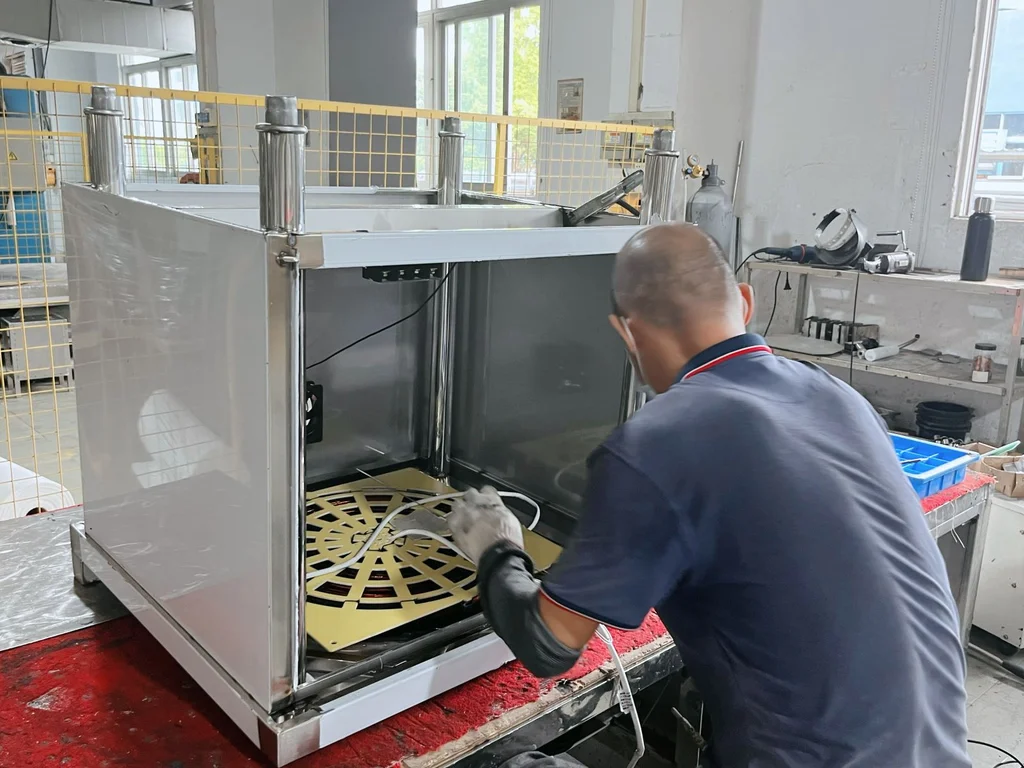
High Quality Commercial Induction Cooker Manufacturer
09/09/2026
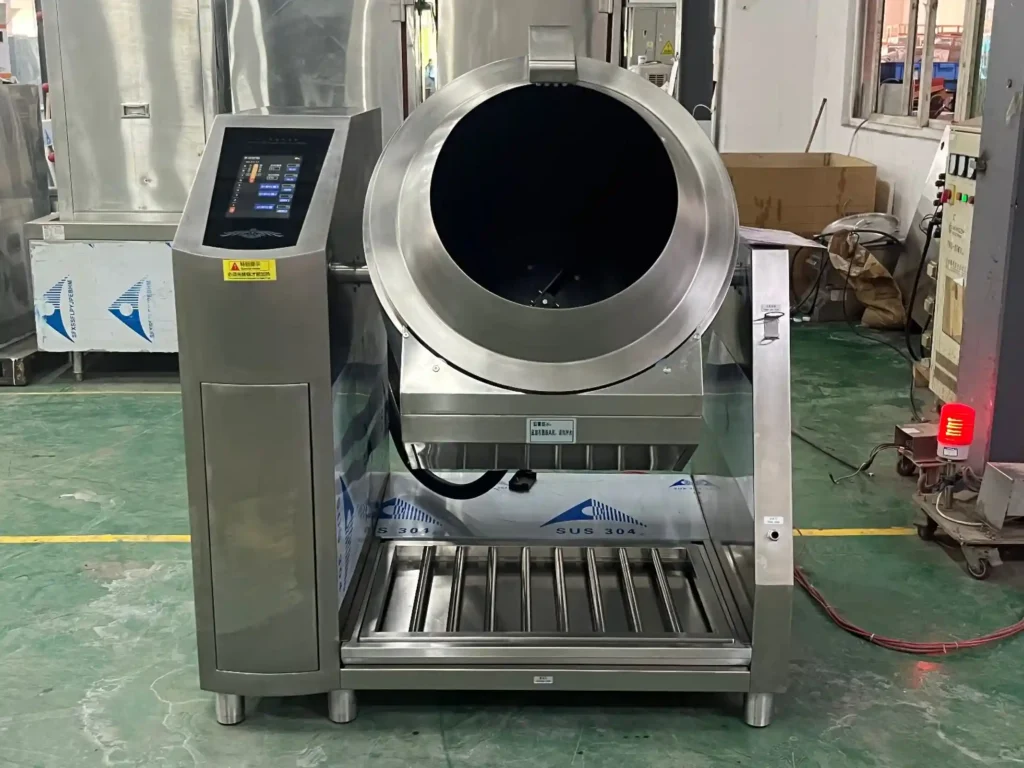
Automatic Wok Machine: Types, Specifications, Applications and Buying Guide
08/18/2026
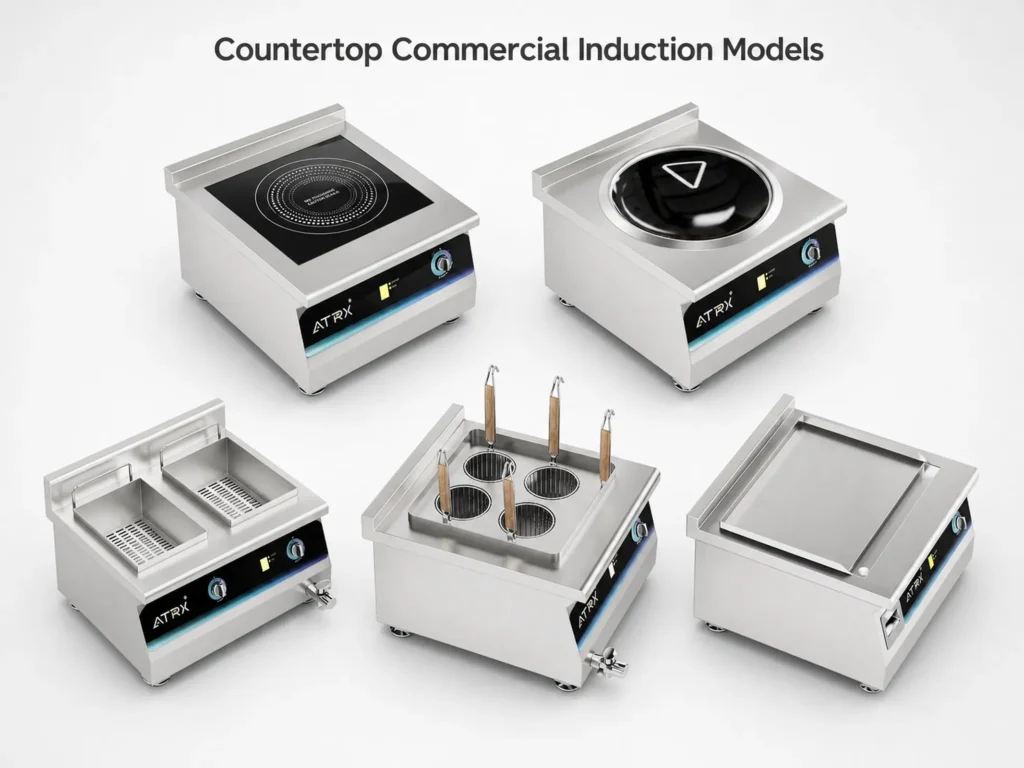
Commercial Induction Range: How to Choose the Right Size, Power, and Configuration for a Commercial Kitchen
08/15/2026
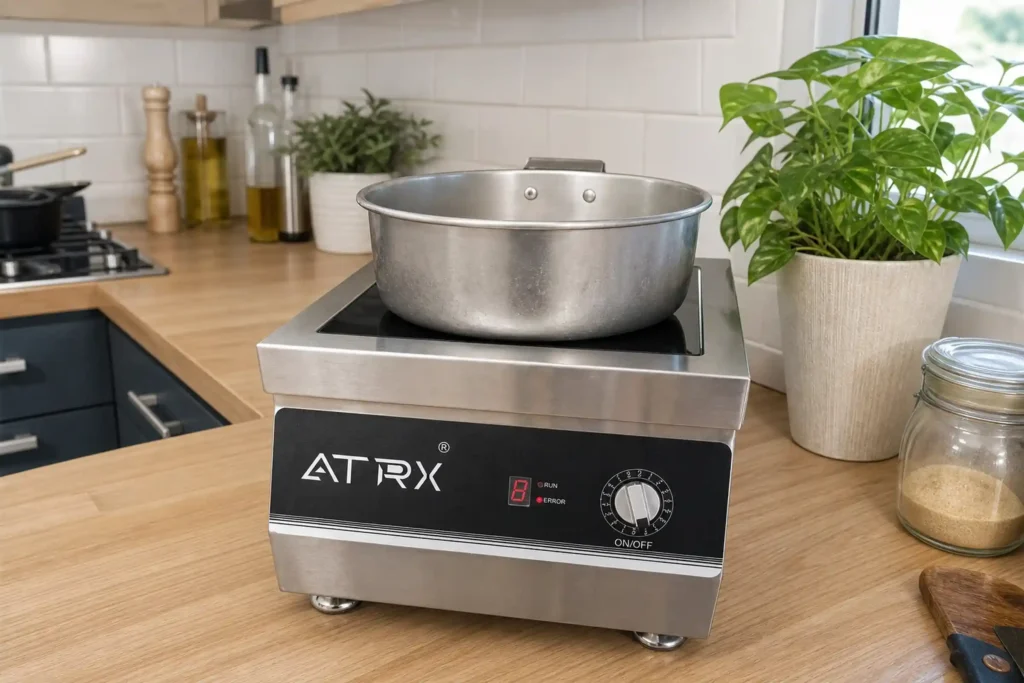
What Is a Commercial Induction Cooker and How Does It Work
08/13/2026
Commercial Induction Range for Hotel Kitchens: How to Choose the Right Model
08/11/2026
China Commercial Induction Cooker Manufacturer
08/09/2026
10 Best Commercial Induction Cooker Manufacturers & Supplier Selection Guide [2026]
08/07/2026