

Induction vs Ceramic Cooktop: Key Differences in Heating, Efficiency & Safety
07/15/2026
Estimated reading time: 2 minutes

This guide breaks down the real differences between induction and ceramic cooktops—from heating principles and induction cooktop heating efficiency to safety and real-world use cases. We use lab-tested data and cost analysis to lay out the gap between the two, so you can make a confident decision based on your budget, cookware, and cooking intensity. Whether you’re weighing the ceramic vs induction stove top pros cons for a home kitchen or evaluating an induction vs ceramic cooktop for commercial kitchen use, every section below is built to help you judge clearly.
IN THIS ARTICLE
How Induction and Ceramic Cooktops Differ in Heating Principles
An induction cooktop generates heat directly inside the cookware through electromagnetic induction. The cooktop surface itself does not get hot. A ceramic cooktop relies on resistive heating elements to first heat the glass panel, which then conducts heat to the cookware—a three-stage chain of “element → panel → pot.” This difference in mechanism means an induction cooktop can boil one liter of water in under 2 minutes, while a ceramic cooktop takes 5–8 minutes. Temperature control tells the same story: induction adjusts almost instantly, while ceramic lags noticeably because of residual heat stored in the panel.
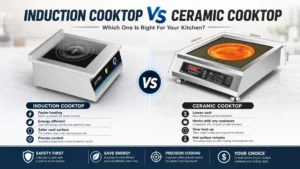
Below, we break down these two heating methods and compare them from principles to real-world test data.
Electromagnetic Induction vs. Radiant Heat: Two Entirely Different Heating Methods
How an induction cooktop heats: the pot itself becomes the heat source. Beneath the surface sits a high-frequency electromagnetic coil, typically running at 25–50 kHz. Once powered on, it generates a rapidly alternating magnetic field that passes straight through the glass-ceramic panel and acts on the ferromagnetic metal of the pot—cast iron and magnetic stainless steel both work. The field induces massive eddy currents in the pot’s base metal; when these currents hit electrical resistance, they convert into Joule heat. Put simply, the heat comes from inside the pot. The cooktop surface is not a heat source at all.
You’ve probably seen the classic demo: slide a sheet of newspaper between the induction cooktop and the pot. The paper stays perfectly intact while the water boils above it. That captures the core of the induction cooktop vs radiant cooktop divide—one heats the cookware directly, the other heats everything around it first.
How a ceramic cooktop heats: it bakes the surface hot first, then passes heat to the pot. Beneath a ceramic cooktop’s surface are nichrome wire resistive heating elements wound into coils. When energized, the wire heats up and transfers energy—through infrared radiation and conduction—to the glass-ceramic panel above. The panel then conducts heat into the pot’s base. The full chain runs “heating element → glass panel → cookware.” Three stages, with energy lost at every handoff.
The core difference in one sentence: Induction heats the pot. Ceramic heats the surface. The first turns the pot into its own heat source; the second has to get the cooktop hot before any heat reaches the food.
Below are diagrams illustrating the different heating principles of the two types of tableware, allowing you to clearly see the differences between them.
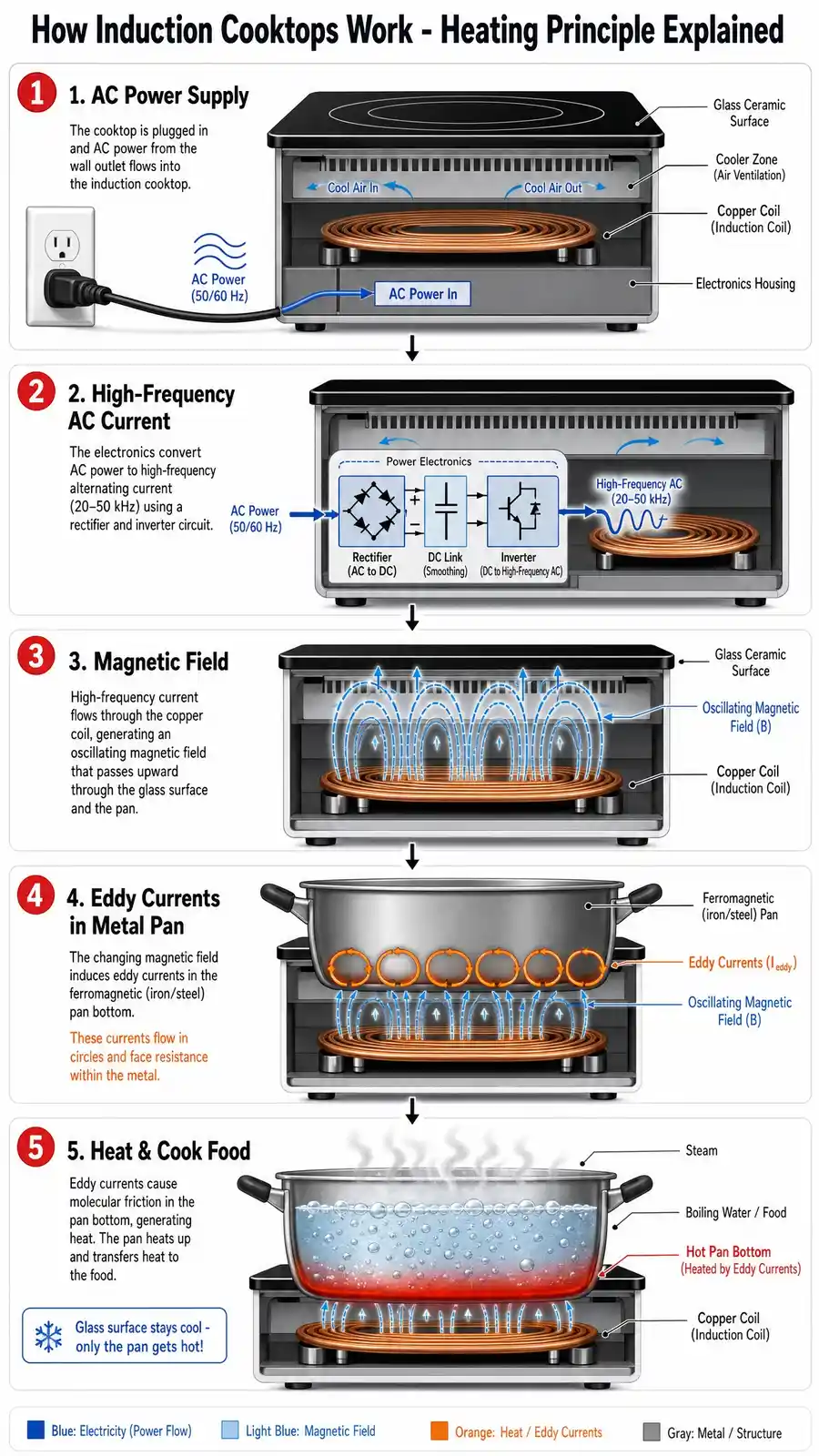
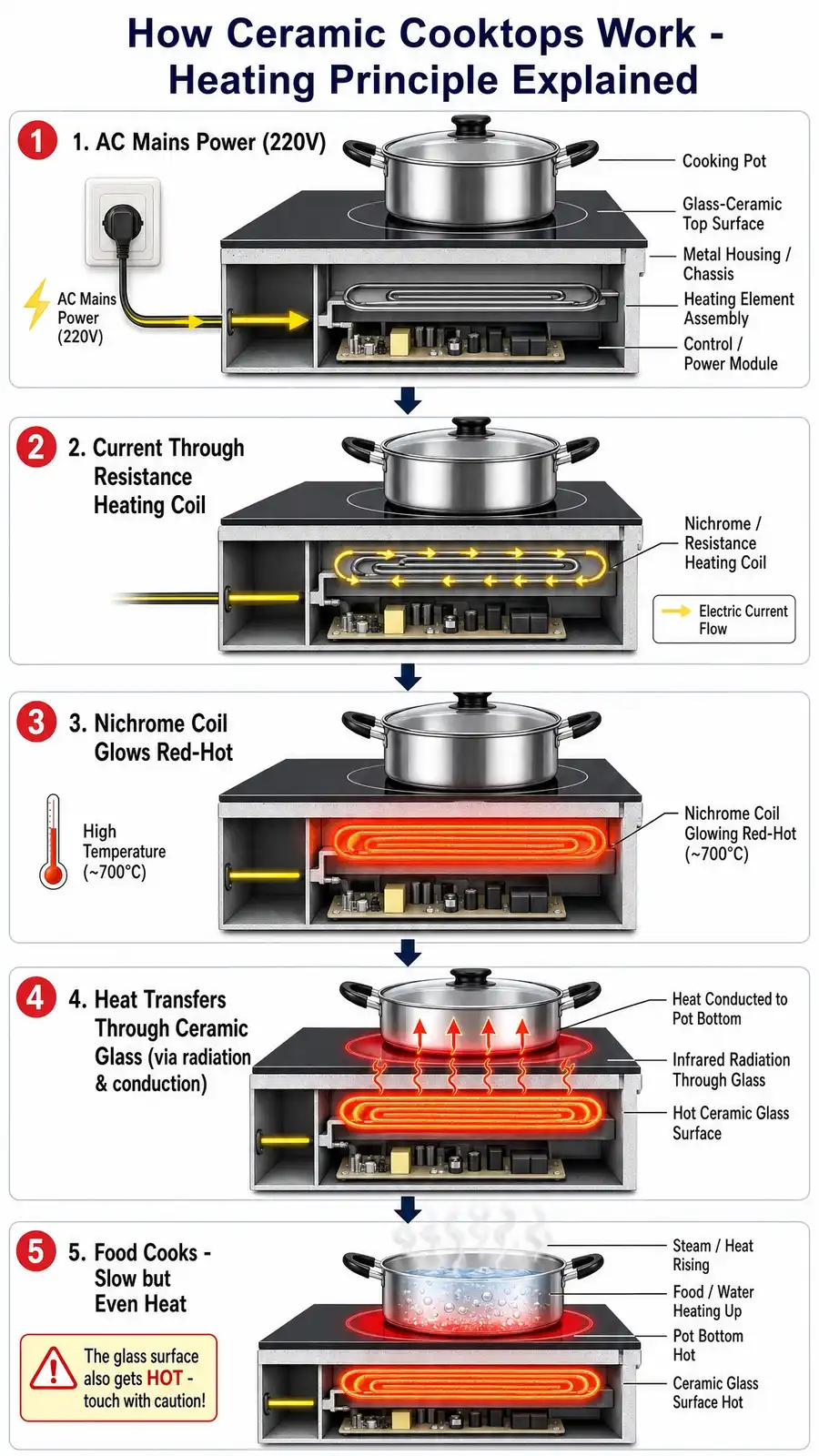
This is not a subtle conceptual difference—the gap shows up on a thermal camera instantly. During routine R&D testing at our facility, we place the same pot on an induction and a ceramic cooktop side by side, then shoot both with a thermal imager. The induction side keeps the panel center below 60 °C. The ceramic side blows past 300 °C within 30 seconds. A fivefold temperature gap, hidden beneath identically smooth glass. That’s the most direct physical expression of the two mechanisms—and the starting point for every performance split that follows.
Heating Speed and Temperature Control Precision: Lab-Tested Data Comparison
Different heating principles, different boil times—the gap shows up immediately. CHOICE Australia, a leading consumer testing body, ran standardized boil tests. Among the induction cooktops they tested, the fastest boiled one liter of water in about 1 minute 51 seconds. Every model finished within 5 minutes. The ceramic results? The fastest took 5 minutes 2 seconds; the slowest crept close to 8 minutes. That means the fastest ceramic was still slower than the slowest induction. The speed gap runs roughly 3–4×. In a commercial kitchen doing high-volume boiling and rapid dish turnover, that’s not “a few minutes”—it’s throughput.
Temperature precision tells the same story. An induction cooktop controls eddy-current intensity directly in the pot. Drop the power level, and heat generation falls in step—near-instantly. Maytag uses the phrase “respond almost instantly” in its official comparison. Ceramic cooktops can’t match that. Both the glass panel and the resistive element carry thermal mass. Turn the dial down, and the stored heat keeps flowing into the pot for a while, creating a clear lag.
Finishing a high-heat stir-fry and immediately switching to low heat to reduce the sauce? On a ceramic cooktop, it is hard to nail this moment precisely, and that directly affects dish quality and service rhythm. When using an induction cooktop at home, the same kind of stable control is needed too: lock the induction cooktop at a lower power, and the water evaporation of every batch stays consistent. Our ATRX brand once published an article that ran a test of replicating Starbucks oatmeal calories at home with an induction cooktop, which showed that the finished weight of five batches differed by less than 5 g.
Here’s a quick summary of the key parameters:
| Comparison Metric | Induction Cooktop | Ceramic Cooktop |
|---|---|---|
| Time to boil 1 liter of water (tested range) | Approx. 1 min 51 sec – under 5 min | Approx. 5 min 02 sec – nearly 8 min |
| Temperature adjustment response | Near-instant (second-level response) | Noticeable delay (panel heat retention) |
| Cool-down performance | Pot temperature drops quickly after power reduction | Residual panel heat continues conducting; slow cool-down |
| Suitable for rapid temperature changes | Yes (excels at stir-frying, sauce reduction, etc.) | Limited (temperature lag hinders precise control) |
Data sources: CHOICE Australia laboratory tests; Maytag official product comparison. See: CHOICE – Induction vs Ceramic Cooktops.
Worth noting: the numbers above come from standard household test conditions. But the speed and control advantages induction holds over ceramic are rooted in the electromagnetic induction mechanism itself. That means the same advantage carries over to commercial induction cookers—and because commercial units run at higher power (typically 3.5–8 kW per burner) for longer stretches, the real-world gap only gets wider.
At ATRX, we’ve spent close to two decades building and shipping commercial induction cookers worldwide, and real-world feedback from professional kitchens consistently backs that up. The second half of this article digs into commercial-scenario data; first, let’s finish the two remaining household comparisons—efficiency and safety.
Efficiency & Safety: Where Induction Cooktops Beat Ceramic
Thermal Efficiency Gap: Induction 85% vs. Ceramic 75%—Where the Savings Come From
Induction cooktops clearly outperform ceramic on both energy efficiency and safety. On efficiency: induction delivers roughly 85% thermal efficiency versus ceramic’s ~75%, with an annual electricity gap of about 50 kWh. Over years of use, those induction cooktop energy savings add up to hundreds of dollars in high-frequency cooking households. On safety: induction surfaces don’t generate heat directly, carry almost no residual-burn risk after power-off, and come standard with pan detection, auto shut-off, and child lock. Ceramic cooktops take 4–5× longer to cool, and their safety toolkit is mostly passive—think indicator lights. Details below.
1. Efficiency data: where the 10-percentage-point gap comes from. U.S. Department of Energy (DOE) data puts induction cooktop heat transfer efficiency at roughly 84%–86%, and ceramic at about 74%–76%. That’s a ~10-point spread. For every 1 kWh you feed an induction cooktop, over 85% lands in the pot. Ceramic has to heat the glass first, then pass that heat along—and with that extra step, nearly a quarter of the energy escapes as waste heat into the kitchen air.
EPRI (Electric Power Research Institute) lab testing for the California Energy Commission confirmed this: when pot size matches the burner ring, the gap is 6%–10%. But once the pot is smaller than the ring, things diverge hard—ceramic drops to around 42% efficiency, while induction stays at 76%–77%. The worse the pot-to-burner match, the bigger induction’s lead. This electric ceramic vs induction cooking efficiency gap is especially visible in real kitchens, where pot sizes vary constantly.

The EPA’s ENERGY STAR Commercial Electric Cooktop discussion guide goes further, noting induction efficiency potential can reach 90%—and that less waste heat also means a lighter load on the kitchen’s air conditioning.
2. Translated to electricity bills: how much do you actually save per year? Coolblue’s calculations put the numbers in plain view: an induction cooktop uses about 175 kWh per year versus about 225 kWh for ceramic—a 50 kWh difference. At the average U.S. household rate (~$0.16/kWh), that’s roughly $8–$10 a year.
CHOICE Australia’s field testing came to a similar conclusion—annual operating cost difference between the two: roughly $10–$30, depending on model and usage habits.
3. Long-term accumulation: the cost advantage under heavy use. $10–$30 a year—small at a glance. But that’s based on cooking three times a week, 30 minutes per session. A household doing two or three meals a day blows past that baseline, and the savings scale up with it. Over a typical 10-year cooktop lifespan, cumulative savings land in the $100–$300 range—enough to claw back a chunk of the upfront price difference.
In commercial kitchens, the gap widens further. Pots go on and off burners constantly, and sizes vary all over the place. EPRI’s data already showed that pot-to-burner mismatch is where induction pulls away hardest. Higher volume, longer hours, more mismatch—that all compounds. Real-world data from commercial operators switching from ceramic to induction consistently shows monthly electricity drops in the range of 15%–20%, often exceeding what lab tests predict under controlled conditions.
Safety Differences: Surface Residual Heat, Burn Risk, and Child Protection
The biggest safety gap between induction and ceramic cooktops comes down to one thing: residual surface heat. Any serious ceramic cooktop safety comparison has to start here.
A ceramic cooktop’s surface is the heat source. After you turn it off, the surface stays too hot to touch. Cool-down takes 4–5× as long as induction. During that window, a child’s hand on the surface means a burn. An elderly person who forgets the glass is still hot faces the same risk.
It’s not just burns, either. Spattered broth and grease keep getting baked by that residual heat, carbonizing onto the surface. Cleaning is one problem. In rare but real cases, carbonized residue can smoke or even ignite a nearby paper towel—and that crosses from nuisance into genuine safety incident.
Induction works differently at every level. The surface itself never generates heat. All the thermal energy comes from the electromagnetic field acting inside the pot’s base. Turn off the power, lift the pot, and the surface retains only a small amount of warmth conducted from the cookware. It drops to a safe-to-touch temperature quickly.
The feature gap is just as wide. Induction cooktops nearly all include “pan detection”—if there’s no suitable pot on the surface, the electromagnetic field simply won’t activate. Dry-firing is eliminated at the source. Auto shut-off, overheat protection, and child safety locks are standard, too. NYSERDA and Consumer Reports both list these as core induction safety advantages.
Ceramic cooktops, by contrast, rely on passive reminders. The most common is a residual heat indicator light—a small light that stays on while the surface is still hot. It works if you notice it. If you don’t, that’s exactly why the San José Fire Department featured induction safety in their kitchen fire-prevention demonstrations. San José Clean Energy put it bluntly: “Induction is the safest option for cooking.”
| Safety Comparison Dimension | Induction Cooktop | Ceramic Cooktop |
|---|---|---|
| Residual surface heat after power-off | Only minor warmth conducted from pot base; cools rapidly | Surface remains at high temperature; cool-down time approx. 4–5× that of induction |
| Burn risk | Low—surface doesn’t heat directly; safe to touch shortly after removing pot | High—surface stays hot long after power-off; especially dangerous for children and the elderly |
| Spill carbonization | Minimal—low surface temperature means spills wipe off easily | Severe—residual heat bakes spills onto the surface, increasing cleaning difficulty and safety hazards |
| Pan detection (no-pot-no-heat) | Standard—electromagnetic field won’t activate without a pot, preventing dry-firing | Not available—heating elements can run continuously without cookware |
| Auto shut-off / overheat protection | Standard | Available on some high-end models; not universal |
| Child safety lock | Standard | Available on some models |
| Safety approach | Active protection—prevents hazards mechanically | Passive alerts—residual heat indicator light; relies on user awareness |
| Fire department recommendation | San José Fire Department publicly recommends as a safer cooktop choice | No equivalent public endorsement |
If you’re evaluating the full selection logic for commercial induction cookers—countertop vs. floor-standing, power matching, circuit requirements, daily maintenance—our commercial induction cooker buying guide walks through everything from equipment types to deployment.
Induction or Ceramic Cooktop: Deciding Based on Your Use Case
For home use, a ceramic cooktop is often the pragmatic pick. No cookware restrictions, lower upfront cost, no electrical upgrades needed—lowest barrier to entry all around. For commercial use, induction wins outright: 3 kW+ per burner, 85%–95% energy efficiency, and a surface that doesn’t get hot. Over 10+ hours of daily high-intensity operation, those advantages compound into dominant cost and efficiency returns.
Still, one-line conclusions don’t cover every situation. If you’re asking induction vs ceramic cooktop which is better, the honest answer is: it depends on your specifics. Here’s how to sort it out by scenario.
How to Choose for Daily Home Use: Cookware Compatibility, Budget, and Installation Requirements
At the household level, specs are secondary. Three practical factors decide it. Work through them in order before buying.
1. Cookware compatibility—check your pots before you pick a cooktop. Induction uses electromagnetic fields to heat cookware directly, so the pot must be ferromagnetic. Cast iron and most stainless steel are fine. Pure aluminum, copper, glass, and standard ceramic pots won’t respond at all—placing them on the surface does nothing.
Quick test: stick a refrigerator magnet to the pot’s bottom. If it holds, the pot works. If it doesn’t, you need new pots or a different cooktop. Ceramic has no such restriction. It heats the glass panel with radiant heat, then transfers that to the pot—any material works, as long as the bottom is flat. If you already own a full set of aluminum or copper cookware and don’t plan to replace it soon, ceramic saves you that cost right away.

2. Budget—it’s not just the cooktop sticker price. At comparable tiers, induction costs more. Entry-level models differ by roughly $300–$500. High-end units with Flex Zones and multi-stage power controls can stretch the gap to several thousand dollars.
CHOICE Australia’s test database shows the spread clearly: ceramic cooktops range from ~$389 to $2,099; induction from $799 to $5,699. And the cooktop is only part of the bill—if your pots aren’t compatible, add replacement cookware to the total.
3. Installation—can your home wiring handle it? A lot of people discover this after purchase. Household induction cooktops typically draw under 3 kW per burner, which sounds manageable. But run multiple burners at once and total power climbs fast. Most models need a dedicated 32-amp circuit with 6 mm² cabling. No existing dedicated line? A licensed electrician will need to upgrade your wiring—or even your breaker panel. That can run $600–$1,200.
Ceramic cooktops draw less power and usually plug into existing household circuits. Installation is simpler, cheaper, or sometimes free. One bright spot for induction: some newer models keep total draw under 5 kW to run on standard 20-amp circuits. The trade-off is reduced output when multiple burners fire simultaneously.
Run through all three checks. If your budget is comfortable, your cookware is already stainless or cast iron, and your wiring is ready—go with induction. The speed, efficiency, and safety gains are real and daily. But if your cookware doesn’t match, your budget is tight, or the electrical upgrade is a headache—any one of those is enough to make ceramic the smarter call. Lower total cost, everyday cooking handled just fine.
Why Commercial Kitchens Lean Toward Induction Cooktops
Move to a commercial kitchen and every difference from above gets amplified—hard. The intensity is a different order of magnitude. Commercial induction cooktops run at 3 kW+ per burner, with heavy-duty models hitting 8 kW or more, engineered for 10+ hours of continuous daily operation. During lunch and dinner rushes, orders stack up and burners need to cycle through rapid heat-ups with no downtime.
Induction reaches working temperature far faster. Field data is clear: a 3.5 kW commercial induction unit boils six cups of water in about 3 minutes. A ceramic unit at the same wattage takes over 6. During peak service, that gap is the difference between keeping up with orders and falling behind.
Efficiency compounds even harder at commercial scale. Induction’s energy transfer rate runs 85%–95%; ceramic sits at roughly 70%–80%. Cooking two meals a day at home, the gap barely registers. Running 10+ hours a day in a commercial kitchen, it shows up on every electricity bill. Some restaurant chains that went all-induction report overall kitchen energy consumption dropping by about 35%. Safety tracks the same curve: induction surfaces don’t get hot, cutting burn injuries for staff in open kitchens and reducing insurance exposure.
Hardware-wise, commercial induction is a different class from residential. ATRX builds its commercial units around the realities of professional back-of-house environments. Circuit boards carry triple-layer conformal coatings—oil-proof, moisture-proof, dust-proof—designed for the heat and humidity of a working kitchen. Multiple temperature sensors sample in real time, keeping output stable through sustained high-power stir-frying. Cooling runs on quiet fan systems that don’t add noise but keep core components reliable under prolonged heavy loads.
Power coverage spans 3.5 kW auxiliary stations up to 8 kW+ wok stations, matching whatever output each cooking task demands. One Southeast Asian restaurant chain we supply tried a batch of 5 kW commercial induction units across several locations. After a three-month trial, their kitchen electricity bills dropped nearly 30% compared to the ceramic equipment they replaced, and peak-hour throughput improved noticeably. They’ve since standardized on induction across all their outlets.
Here’s a side-by-side of the core differences between household and commercial scenarios:
| Comparison Dimension | Household Setting (<3 kW/burner) | Commercial Setting (≥3 kW/burner) |
|---|---|---|
| Daily usage duration | 1–2 hours | 10+ hours |
| Perceived induction speed advantage | Noticeable but limited in daily cooking | Directly impacts order throughput and table turnover during peak service |
| Cost impact of efficiency gap | Small annual difference; tens of dollars | Significant over long operating hours; thousands of dollars |
| Safety requirement level | Standard household protection sufficient | Open kitchens need reduced burn incidents and insurance costs |
| Equipment durability requirements | Standard residential grade | Conformal-coated circuit boards, multi-sensor monitoring, silent cooling fans, and other commercial-hardened specs |
| Power requirements | Typically <3 kW per burner; ≤7.4 kW total | 3.5–8 kW+ per burner; higher combined power for multi-station setups |
| Is cookware compatibility a barrier? | Potentially yes; existing cookware needs evaluation | Usually not; commercial kitchens predominantly use stainless steel and cast iron |
If you’ve confirmed induction is the right fit for your commercial operation, the next step is looking at specific equipment. Our portable commercial induction cooktop product line covers 3.5 kW to 8 kW, supports plug-and-play with no fixed installation, and fits standalone burners, buffet lines, and temporary kitchens. All units are CE-certified, with OEM customization and sample orders available.
Common Questions People Ask
Q1: My cookware isn’t compatible with induction. Can I use an induction interface disc (converter disc) in between?
Not as a long-term fix. A converter disc absorbs the electromagnetic field to heat itself, then passes heat to the pot. But the microscopic air gaps between disc and pot base kill transfer efficiency. Lab tests show a converter disc roughly doubles the energy needed to boil the same amount of water.
On top of that, the disc’s high surface temperature can trigger the cooktop’s overheat protection—or damage electronics outright—shortening the unit’s life. If only a few of your pots don’t work with induction, it makes more sense to replace those specific pots than to sacrifice induction’s core efficiency with a disc.
Q2: Is the humming or buzzing noise during induction cooking normal? Will it bother me?
Totally normal. The sound comes from magnetostriction—the pot’s base metal vibrates slightly in the high-frequency magnetic field, producing an audible hum or buzz. Higher power usually means louder noise. GE Appliances and Sub-Zero/Wolf both confirm in their official FAQs that this is standard behavior, not a defect.
To reduce it: use pots with a thick, flat base—tri-ply stainless steel or cast iron work well. A heavier base dampens the vibration and noticeably cuts the sound.
About the author

ATRX Team| 18 Years Commercial
Induction Cooker Manufacturer in China
Induction Cooker Manufacturer in China
Related Posts
Best Commercial Induction Cooktop: Types &Buying Guide
10/09/2026
Commercial Double Hob Induction Cooker | Types, Power, and Installation Guide
10/05/2026
Commercial Induction Cooker 3500W: Model Selection, Commercial Power and Installation
09/29/2026
How to Install a Built-In Induction Cooktop: A Step-by-Step Guide
09/17/2026
How to Clean a Commercial Deep Fryer: A Step-by-Step Guide
09/13/2026
High Quality Commercial Induction Cooker Manufacturer
09/09/2026
Automatic Wok Machine: Types, Specifications, Applications and Buying Guide
08/18/2026
Commercial Induction Range: How to Choose the Right Size, Power, and Configuration for a Commercial Kitchen
08/15/2026
What Is a Commercial Induction Cooker and How Does It Work
08/13/2026
Commercial Induction Range for Hotel Kitchens: How to Choose the Right Model
08/11/2026