

Industrial Induction Wok Burners (15 kW–30 kW): How They Differ from Standard Commercial Models
07/07/2026
Estimated reading time: 2 minutes

What Is an Industrial Induction Wok Burner?
An industrial induction wok burner is a 15–30 kW electromagnetic wok station built for central kitchens, factory canteens, military mess halls, and food processing plants. It runs on three-phase 380V power, drives 600–1,200 mm woks, and is engineered for 6–10 hours of continuous full-load operation per shift—a workload that no standard 3.5–8 kW commercial burner can sustain.
⚡The core differences between a 15–30 kW industrial induction wok burner and standard commercial models:
- Different power supply architecture: industrial units run on a three-phase 380V fully industrial-grade electrical platform, while standard commercial burners mostly use single-phase 220V or entry-level three-phase power.
- Upgraded power modules: industrial units carry industrial-grade IGBT modules with voltage ratings and thermal cycling lifespans that far exceed standard commercial specs.
- Much larger coil coverage: industrial coil diameters range from 600 to 1,000 mm—up to six times or more the size of a standard burner’s coil.
IN THIS ARTICLE
Hardware Differences Between 15 kW–30 kW Industrial and Standard Commercial Induction Wok Models
The Fundamental Difference in Power Supply Architecture and Power Modules
1. The Electrical Baseline of Standard Commercial Burners: Single-Phase 220V + Consumer-Grade IGBT
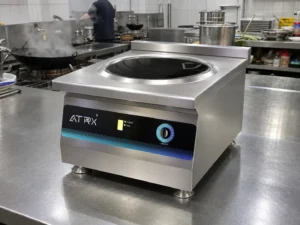
Standard commercial induction wok stoves are built for small to mid-sized restaurants and light-duty kitchens. The 3.5 kW and 5 kW models run on single-phase 220V and make up the largest share of commercial induction wok equipment on the market. At this power tier, the electrical conversion chain—rectification, filtering, LC resonance, and power drive—stays relatively simple. The IGBT modules are consumer-grade or light-commercial spec, which is enough for intermittent, moderate-load stir-fry work.
The 8 kW model steps up to three-phase 380V, but its control platform still follows the standard commercial framework. IGBT specs and cooling headroom have not reached industrial grade.
2. Industrial Units: Three-Phase 380V, Fully Industrial-Grade Electrical Platform
Once output climbs to 15 kW—let alone 30 kW—everything changes, even if the supply is still three-phase 380V. The sustained current, thermal density, and system complexity are in a different league from an 8 kW unit. The entire power conversion and control system has to be rebuilt from scratch.
Three-phase rectifier modules must handle synchronous conversion of three AC waveforms at far higher sustained loads. Power factor correction gets more complex. The resonant inverter must hold stable high-frequency oscillation at currents several times higher than in an 8 kW model.
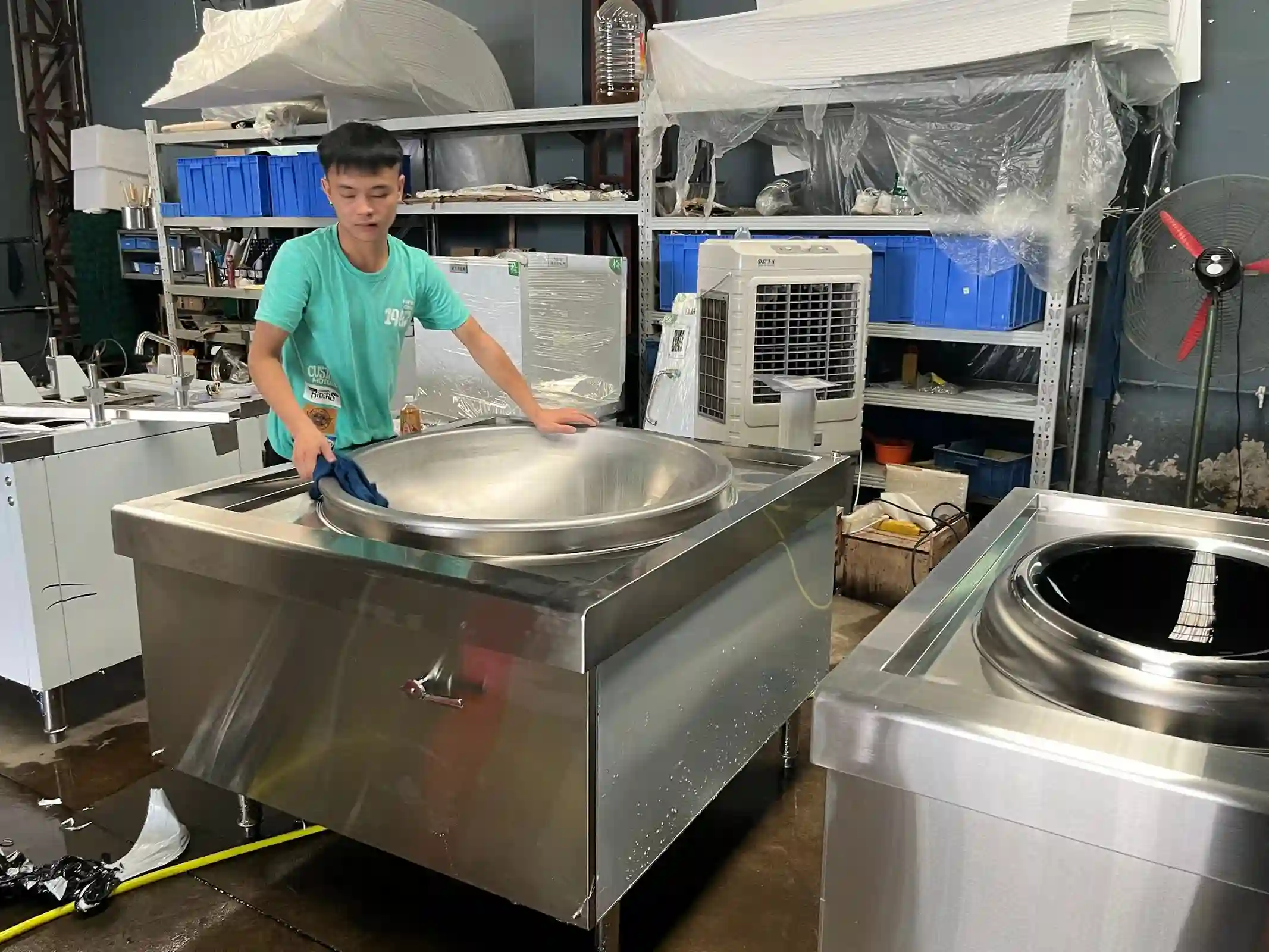
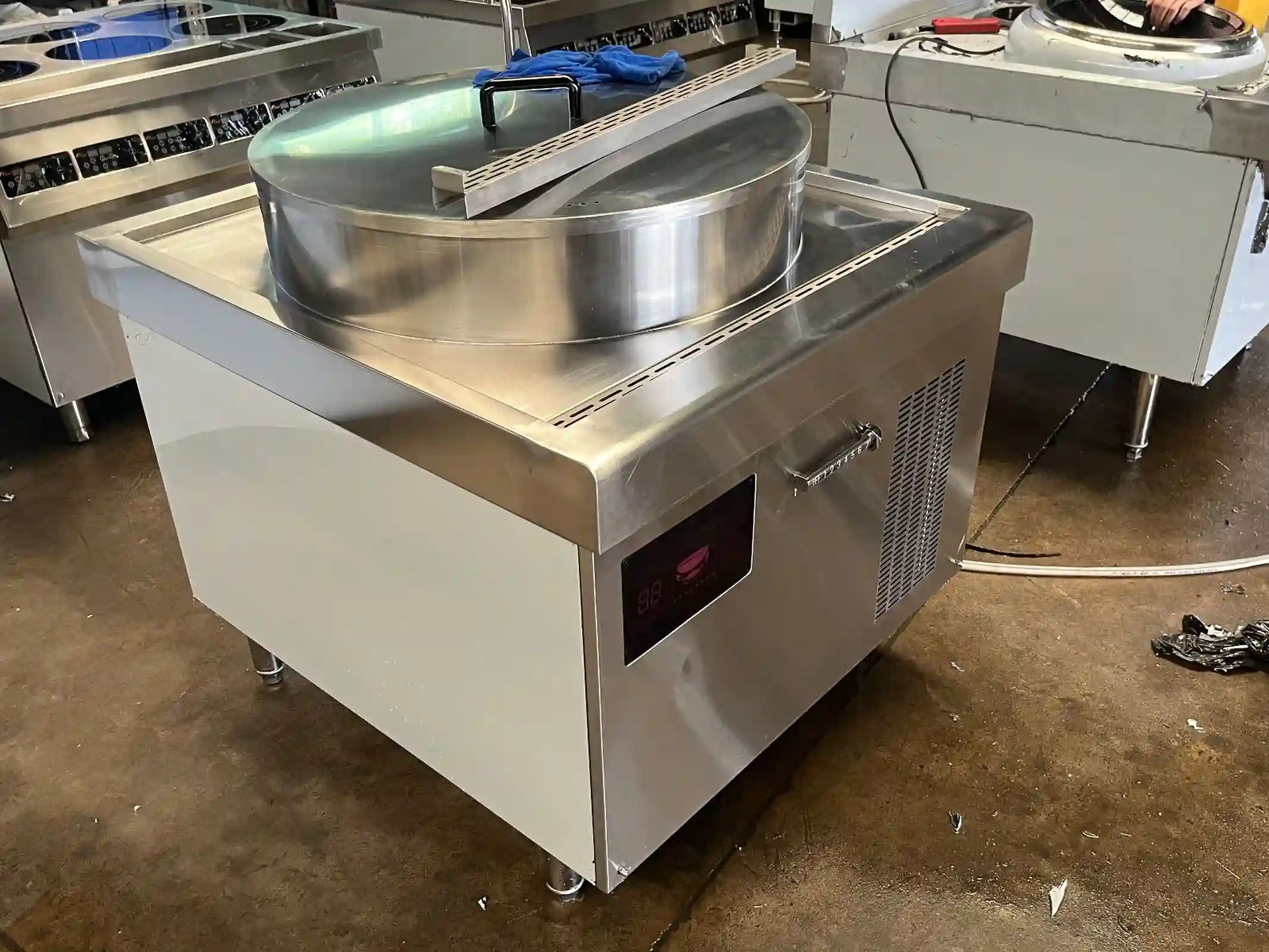
To handle that intensity, 15–30 kW industrial units use industrial-grade IGBT power modules—such as the Infineon EconoPIM three-phase series—rated at 1,200V, with lower conduction losses and longer thermal cycling life. These modules run reliably under sustained high-temperature, high-current conditions.
3. Not a Linear Upgrade—a Category Boundary
Going from 8 kW to 15 kW is not just “turning the power knob a few notches higher.” The control platform of a standard commercial burner—whether a 220V 3.5–5 kW model or a 380V 8 kW model—cannot support sustained full-load output above 15 kW through simple modification. Drive circuits, overcurrent protection, and cooling all need a simultaneous upgrade to industrial standards.
During an early product validation phase, the ATRX engineering team ran a side-by-side teardown: an 8 kW commercial mainboard next to a 20 kW industrial induction wok station mainboard. The differences in PCB layer count, copper foil thickness, IGBT package type, and heatsink area were roughly the gap between a passenger car engine and a heavy-truck powertrain. That gap is the core reason industrial units cost more and carry a higher technical threshold.
The Gap in Coil Coverage and Chassis Construction
How well electromagnetic induction works depends directly on coil coverage over the wok bottom and how well the chassis holds up under extreme conditions. Standard commercial induction wok burners typically run a coil diameter of 300–400 mm, sized for a conventional Chinese stir-fry wok and small-batch cooking.
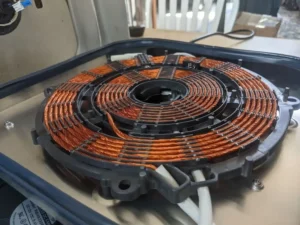
At 15–30 kW, the coil, frame, and cooling system all step up by a full tier. Here is a direct comparison:
| Construction Parameter | Standard Commercial Induction Wok Burner (3.5–8 kW) | Industrial Induction Wok Burner (15–30 kW) |
|---|---|---|
| Power Supply Type | Single-phase 220V (3.5–5 kW) / Three-phase 380V (8 kW) | Three-phase 380V (400V–480V options available) |
| Induction Coil Diameter | 300–400 mm | 600 mm (15 kW) → 1,000 mm (30 kW) |
| Thermal Output Equivalent | ≈12,000–27,000 BTU | 51,000 BTU (15 kW) → 102,000 BTU (30 kW) |
| Chassis Frame Material | 201 stainless steel / partial 304 | Fully welded 304 food-grade stainless steel |
| Ceramic Panel Load Capacity | 40–60 kg | ≥125 kg |
| Cooling Structure | Single-fan exhaust | Multi-duct active cooling (independent intake/exhaust ports) |
| Typical Dimensions | ≈600×650×800 mm | 800×950×1,200 mm (15 kW) → 1,200×1,300×1,200 mm (30 kW) |
The coil coverage area of an industrial unit can exceed six times that of a standard burner. That directly determines whether it can drive a large cast iron or carbon steel wok far beyond the standard burner’s size range. Batch volume and effective heating area are not in the same league.
Cooling matters just as much. A single-fan layout can keep an 8 kW unit thermally stable. But at 15–30 kW of sustained full power, the heat density is far more than one duct can handle. Industrial models use multi-zone independent air paths so the IGBT modules, coil assembly, and control board each stay within safe temperature limits.
None of these physical upgrades are over-engineering. They exist because the working conditions are fundamentally harder. Factory canteens, central kitchens, and large banquet operations need continuous full-load run times, large batch volumes, and oversized woks. Only a chassis that meets industrial standards in coil coverage, structural strength, and thermal management at the same time can actually deliver what the 15–30 kW power rating promises.
Performance Gaps These Hardware Differences Create in Real-World Operation
In day-to-day use, the hardware gap translates into two performance divides. The first is continuous run time: standard commercial burners frequently trigger thermal protection and cut power during high-intensity service, while 15–30 kW industrial units hold full load for 6–10 hours straight, creating a daily output gap of 3–5×. The second is heating uniformity under large woks: a standard burner’s small coil cannot cover an 800–1,200 mm wok bottom, so the center overheats and the edges stay cold—output consistency falls apart at high volume. Below is a closer look at each.
Continuous Operation Capability and the Output Capacity Dividing Line
1. What Happens When an Intermittent Design Meets Continuous High Load
Standard commercial induction wok stoves are designed around an intermittent rhythm: stir-fry for a few minutes, pause to prep or plate, then go again. Daily capacity tops out at roughly 200 meals. In that “sprint and rest” pattern, the machine gets enough cooling time to stay thermally balanced.
Push the same burner into continuous high-intensity service—a group-meal rush or a central kitchen production line—and the cooling system falls behind. Heat stacks up. The machine triggers thermal protection, forces a power cut, or shuts down briefly. Meanwhile, the IGBT modules age faster from repeated temperature spikes near their limits, and service life drops.
2. The Continuous Operation Baseline of Industrial Units
A 15–30 kW heavy duty induction wok range starts from a different design premise: 6–10 hours of sustained full-load output, no frequency reduction. High-capacity cooling and industrial IGBT modules keep power delivery flat across the entire shift. That means 500–1,000+ meals per day with no mid-shift slowdowns.
3. Where the Real Output Ceiling Bottleneck Lies
Both types can be called “commercial induction wok burners.” But whether either one can actually keep up with your service pace is the sharpest dividing line. One group catering operation running about 800 meals per day found that their 5 kW commercial burners started cutting power less than two hours into the lunch rush. The kitchen had to rotate units offline for cooling, and real output capacity dropped by nearly a third. After switching to 20 kW industrial models, they went through the entire lunch peak without a single thermal shutdown.
For any kitchen above two to three hundred meals a day with concentrated peak-hour output, this is the line that decides whether your capacity ceiling is set by equipment or by demand.
Heating Uniformity and Output Consistency Under Large-Diameter Woks
When production reaches industrial scale, wok sizes grow to 800–1,200 mm to handle bigger batches per cook. At that diameter, a standard burner’s small coil shows its limit: the electromagnetic field clusters at the center of the wok bottom, leaving the edges noticeably cooler.
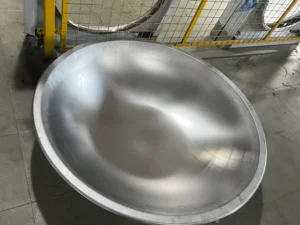
The result is uneven cooking in the same wok. The center may already be overcooked or scorched while the edges are still underdone. Doneness, color, and texture become hard to keep consistent.
A large-diameter coil disc on an industrial-grade induction wok station is purpose-built to spread the electromagnetic field evenly across 800 mm or more of wok bottom. Bigger coil diameter plus optimized winding layout keeps the center-to-edge temperature gap narrow. Large batches cook under near-uniform conditions—exactly what group catering and central kitchens need when every wok must hit the same quality standard.
At small scale, this difference is easy to miss. But when daily output reaches hundreds or thousands of meals, uneven heating creates quality drift that compounds wok by wok, day by day. It stops being a taste issue. It becomes a pass-rate issue, a complaint-rate issue, and ultimately a question of whether your kitchen can hold its quality line under load.
| Comparison Dimension | Standard Commercial Induction Wok Burner (3–5 kW) | Industrial Induction Wok Burner (15–30 kW) |
|---|---|---|
| Typical Coil Coverage Diameter | 300–400 mm | 600–900 mm |
| Compatible Wok Diameter | 400–600 mm | 800–1,200 mm |
| Center-to-Edge Temperature Differential | Significant; edges noticeably cooler | Minimal; overall distribution is uniform |
| Per-Wok Processing Volume | Suited for small-portion stir-frying | Supports large-batch single-cook processing |
| Impact on Output Consistency | Acceptable at low volume; quality fluctuates noticeably at scale | Maintains stable output standards even at high volume |
How to Determine Which Level of Induction Wok Burner You Actually Need
Picking the right induction wok power level starts with your kitchen’s actual working conditions—not just total daily meal count. Under 200 meals a day with a light stir-fry menu? A 3.5–8 kW standard commercial burner covers it. Between 200 and 500 meals with concentrated high-heat wok demand? Match a 15–20 kW industrial model. Above 500 meals on a central kitchen or group catering line? You need 25–30 kW to sustain continuous full-load output. The sections below walk through the matching logic for each tier and the misjudgments that most often lead to wrong choices.
Power-Matching Logic for Different Output Scales
1. Under 200 Meals Per Day—Standard Commercial Burners (3.5–8 kW) Are Sufficient
Small standalone restaurants or unit canteens doing mostly light stir-fry—vegetables, fried rice, fried noodles—work in a natural intermittent rhythm. Finish one wok, pause, start the next. The equipment has plenty of cooling time between loads. A 3.5–8 kW output paired with 400–500 mm woks handles daily service at reasonable energy cost, with no reason to step up to industrial specs.
2. 200–500 Meals Per Day—15–20 kW Hits the Sweet Spot
When the menu is heavy on Chinese dishes that need sustained fierce heat—mid-sized Chinese restaurant lunch and dinner rushes, or a hotel kitchen juggling banquets and à la carte at the same time—a 15–20 kW high power induction wok can drive 600–800 mm woks and keep the bottom temperature stable through continuous operation. Temperature recovery after each ingredient load stays fast enough to protect both speed and food quality through peak hours.
3. 500–1,000+ Meals Per Day—25–30 kW with Large Woks
Central kitchens, large group caterers, and food processing facilities typically run 900–1,200 mm woks, handling far more per cook than a restaurant. They need higher instantaneous power density and stronger sustained output to keep ingredients evenly heated while tossing in a large wok. At this scale, insufficient power is not just an efficiency problem—it directly damages finished product quality.
ATRX’s field team saw this firsthand during a project for a group caterer producing roughly 800 meals per day. Their existing 15 kW units showed a noticeable wok-bottom temperature drop after about 40 minutes of continuous lunch-rush operation. After upgrading the line to 25 kW high power induction wok cooktops, temperature held steady through the full service window.
For a deeper look at which dishes each power tier from 3.5 kW to 30 kW can handle, how wok hei performs at each level, and how to set a power floor based on your menu, see the Induction Wok Range Power Level Cooking Guide.
Common Causes of Choosing the Wrong Power Level—Misjudging the “Differences”
Choosing the wrong power usually is not about missing a spec sheet. It is about misjudging the real-world gap between the two equipment types discussed above. Many buyers default to “total daily meal count” as the only input—”We do 300 meals a day, and a standard commercial burner seems to cover that”—without factoring in one critical reality: meal output in food service is never spread evenly across the day.
Lunch and dinner rushes, roughly two hours each, are where equipment limits actually get tested. A 300-meal kitchen may need to plate 80–100 dishes per hour at peak, with almost zero downtime between woks. That actual intensity can blow past the intermittent design ceiling of a standard burner’s “cook one, rest one” cycle.
This is exactly where the question of industrial vs commercial induction wok matters most—and gets overlooked most often. A 3.5–8 kW commercial induction wok stove works perfectly for intermittent use. But its cooling, IGBT modules, and electrical architecture were not designed for nonstop full-load operation. Running it that way triggers overheating protection and accelerates component wear.
Units at 15 kW and above are designed around sustained full-power output from day one, with reinforced airflow paths and module redundancy to match. So the right question is not “does the daily total fit?”—it is “does peak-hour continuous demand cross the design boundary of a standard commercial burner?”
The table below sums up two common misjudgments and the correct way to think about each:
| Common Misjudgment | Selection Result Caused by the Misjudgment | Correct Decision Criteria |
|---|---|---|
| Selecting based solely on total daily meal count, ignoring lunch/dinner peak concentration | Choosing a 3.5–8 kW standard commercial burner that “appears sufficient on paper” | Use peak-period hourly continuous output as the baseline to evaluate whether an industrial unit’s sustained full-load capability is needed |
| Believing the power rating number is the only difference, ignoring the fundamental distinction in operating modes | Choosing a model with similar power but still based on standard commercial architecture | Evaluate cooling design, IGBT module specs, and sustained output stability to confirm the equipment is truly engineered for continuous operation |
Getting clear on your kitchen’s peak operating intensity is step one. For a full walkthrough covering power, dimensions, electrical infrastructure, and durability, see the Complete Buying Guide for Commercial Induction Wok Stoves—it covers the entire decision path from needs analysis to installation. For a tailored power-matching assessment, reach out to the ATRX technical team directly.
If you already know the power level and specs your kitchen needs, browse the full range of ATRX commercial induction wok cookers, from 8 kW to 30 kW. Custom voltage, size, and power configurations are available for distributors and kitchen engineering projects.
Common Questions People Ask
My kitchen only produces about 300 meals a day. Does that mean I definitely don’t need an industrial induction wok burner?
Total daily count is not the whole picture. What matters is how concentrated your output is during peak hours. If more than 60% of those 300 meals go out continuously within a two-hour window, with almost no pause between woks, a standard burner’s intermittent cooling design may already be maxed out. It is still worth evaluating whether a 15–20 kW industrial model fits your peak-hour reality.
I’m using an 8 kW three-phase commercial burner now. Can I retrofit it to reach 15 kW industrial performance?
Not recommended. The 8 kW unit uses three-phase power, but its control board, IGBT modules, cooling ducts, and chassis are all sized for standard commercial duty. Swapping a single part will not get you industrial-grade sustained output. Forcing the upgrade risks constant thermal shutdowns and electrical safety issues. These are two different product platforms, not two versions of the same one.
What types of kitchens typically use an industrial induction wok burner?
Central kitchens producing 500–1,000+ meals per day, factory and corporate canteens, military and institutional mess halls, large banquet operations, and food processing plants where batch cooking in 800–1,200 mm woks runs continuously through service windows. Any operation where the equipment must hold full power for hours without interruption is a candidate for an industrial induction wok burner.
How much does an industrial induction wok burner cost compared to a commercial model?
A standard commercial induction wok burner in the 3.5–8 kW range typically costs a few hundred to around one thousand dollars. An industrial induction wok burner at 15–30 kW ranges from roughly $1,500 to $5,000+ depending on power tier, coil size, chassis configuration, and whether it includes custom voltage or multi-burner setups. The price gap reflects the difference in IGBT modules, cooling systems, structural steel, and engineering that continuous industrial operation demands. For exact pricing on ATRX industrial models, contact the ATRX team directly.
About the author
ATRX Team| 18 Years Commercial
Induction Cooker Manufacturer in China
Induction Cooker Manufacturer in China
Related Posts
Best Commercial Induction Cooktop: Types &Buying Guide
10/09/2026
Commercial Double Hob Induction Cooker | Types, Power, and Installation Guide
10/05/2026
Commercial Induction Cooker 3500W: Model Selection, Commercial Power and Installation
09/29/2026
How to Install a Built-In Induction Cooktop: A Step-by-Step Guide
09/17/2026
How to Clean a Commercial Deep Fryer: A Step-by-Step Guide
09/13/2026
High Quality Commercial Induction Cooker Manufacturer
09/09/2026
Automatic Wok Machine: Types, Specifications, Applications and Buying Guide
08/18/2026
Commercial Induction Range: How to Choose the Right Size, Power, and Configuration for a Commercial Kitchen
08/15/2026
What Is a Commercial Induction Cooker and How Does It Work
08/13/2026
Commercial Induction Range for Hotel Kitchens: How to Choose the Right Model
08/11/2026