

Home vs. Commercial Induction Cooker: What’s the Real Difference?
07/18/2026
Estimated reading time: 2 minutes
They both have “induction cooker” in the name. But the gap between a home unit and a commercial one goes way beyond the price tag. If you’re trying to figure out which type to buy — or just want to know what those extra dollars actually get you — this article is for you. We’re not going to explain how induction works. We’re not going to talk you into switching from gas. We’re only here for one question: where exactly do these two types differ, by how much, and does it matter for your situation?
IN THIS ARTICLE
What’s Actually Different Inside a Home vs. Commercial Induction Cooker?
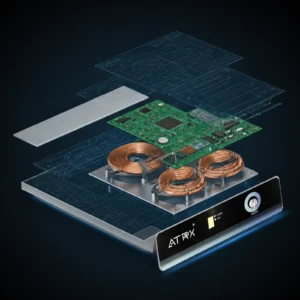
The hardware gap comes down to three things: power architecture, cooling system, and build materials. These three together decide how much heat a cooker can put out, how long it can keep running, and how much daily wear it can take.
From the outside, both types look similar. A flat surface, a coil underneath, plug it in and it heats up. But open the housing, and what’s inside is almost a different species.
Power and Heating Architecture
A home induction cooker’s power ceiling isn’t set by the manufacturer. It’s set by your home’s wiring. A standard North American outlet delivers 120V/15A. That caps you at about 1,800W. Every top-selling home induction cooker on the market hits right around that number.
Commercial induction cookers start at 3,500W. Most mainstream models run between 5,000W and 8,000W. On a 208V–240V supply, high-end units push past 12,000W.
But wattage is just the surface. The real gap is in how that power gets delivered.
A home unit usually has one IGBT power switch inside. That single component carries the entire heating load. A commercial unit uses multiple IGBTs in parallel — some models run four of them, so each one only handles a quarter of the thermal stress. This isn’t “a bit more power.” The entire circuit is designed differently from the ground up.
Put it this way: a home unit is one person doing all the heavy lifting. A commercial unit is four people splitting the job. Run them both for a full day, and it’s obvious who wears out first.
| Comparison | Home Induction Cooker | Commercial Induction Cooker |
|---|---|---|
| Typical Power Range | 1,000W – 1,800W | 3,500W – 8,000W (high-end: 12,000W+) |
| IGBT Count | Usually 1 | 2–4 in parallel |
| Power Supply | 120V / 15A household outlet | 208V–240V dedicated line (some need 3-phase 380V) |
| Design Goal | Everyday home cooking | High-intensity, continuous commercial service |
Cooling and Continuous Runtime
High power is one thing. Keeping that power steady is another. And on this front, the gap is even wider than the wattage numbers suggest.
Home induction cookers have basic cooling — plastic housing, sleeve-bearing fans, no dedicated airflow channels. For daily meals — a quick stir-fry, a pot of noodles — that’s more than enough. But run one at high power for over two to three hours, and many home units will trigger thermal protection. They’ll either throttle power on their own or shut down completely.
Many home models also have built-in auto-shutoff timers. They cut power after a set time, whether or not your food is done. In a home setting, that’s a smart safety feature. It works well for typical household cooking.
Commercial induction cookers are built on a completely different cooling philosophy. Ball-bearing fans rated for 50,000+ hours. Separate intake and exhaust airflow channels. Conformal-coated circuit boards that keep oil mist and moisture out. All of it exists for one reason: run all day, no shutdowns, no power drops.
One chef on a foodservice forum shared his experience. He used a home induction cooker for high-volume meal prep. After about 90 minutes of nonstop heavy cooking, it overheated and shut down. He switched to an entry-level commercial unit. Same workload, ran all day, zero interruptions. The home unit wasn’t broken — it just wasn’t built for that kind of use. A home cooker assumes you’ll take breaks. A commercial cooker assumes you won’t.
Housing and Panel Materials
Pick up a home induction cooker in one hand and a commercial one in the other. You’ll feel the difference before you see it.
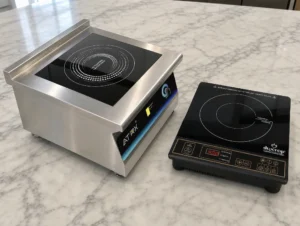
Home units are mostly plastic bodies with tempered glass tops. Light, affordable, and they look fine on a kitchen counter. Tempered glass holds up well day to day, but under sustained high heat it can bow slightly. It also picks up scratches more easily. A plastic base tends to slide around when you drag a heavy pot across it.
Commercial units use 304 stainless steel housings and ceramic glass panels. The steel body is heavier — and that’s actually a plus, because it stays put. It also resists corrosion and long-term grease buildup. Ceramic glass handles much higher temperatures than tempered glass and stands up far better to impact and scratching.
One Reddit user who’d used both types mentioned a detail that stuck with me: his home unit would slide across the counter when he moved a heavy stockpot, and once nearly went off the edge — pot, soup, and all. After switching to a commercial unit, the weight and rubber feet solved that completely. For normal-sized cookware, a home unit’s stability is perfectly fine. This issue only shows up with large, heavy pots.
If you want to see the specific build quality and specs of commercial induction cookers up close, you can check the full ATRX commercial induction cooker product range and compare against the table above.
| Comparison | Home Induction Cooker | Commercial Induction Cooker |
|---|---|---|
| Housing Material | Primarily plastic | 304 stainless steel (1.2–1.5 mm thick) |
| Panel Material | Tempered glass | Ceramic glass (glass-ceramic) |
| Weight | Light (2–4 kg / 4.4–8.8 lbs) | Heavy (6–15 kg / 13–33 lbs) |
| Scratch Resistance | Fine for daily use; scratches under heavy use | Strong; holds up under prolonged heavy-duty use |
| High-Temperature Stability | Good at normal temps; may warp under sustained high heat | No warping under prolonged high temperatures |

How Much More Precise Is a Commercial Induction Cooker’s Temperature Control?
Temperature control is where you feel the biggest difference in actual cooking. It shows up in two ways: how fine the power settings are, and how steadily the cooker delivers that power.
How Many Settings Do They Each Have?
Home induction cookers usually offer around 10 power levels. Some go up to 20. The lowest controllable temperature is typically around 100°F (about 38°C). Quick math: an 1,800W unit with 10 levels means a 180W jump between each step.
Mainstream commercial induction cookers offer 8 to 20 levels. Take a 3,500W unit with 8 levels — level 1 starts at 450W, then goes up in roughly 430W steps. The number of levels looks similar, sometimes even fewer. But the key is the much higher power ceiling.
Each level on a commercial unit spans a wider absolute power band. The low end starts lower. The usable range in the low-to-mid zone is significantly broader. And some high-end commercial models offer up to 100 levels — close to truly stepless control.
When does this matter? For everyday high-heat stir-frying — barely at all. Both do the job. But when you need precision — melting chocolate without scorching, holding a constant low temperature for hours, reducing a sauce at just the right evaporation rate — coarse steps become a real problem. The heat you want sits right between two settings. One up is too much. One down is too little. A commercial unit’s wider range and finer steps give you a clear edge here.
For real-world test data on how home induction cooker settings compare in precision, see Serious Eats’ test of 17 portable induction cooktops.
How Much Does the Temperature Actually Swing?
Most people don’t know this, but it directly affects how your food turns out. And the gap between home and commercial units is significant.
At medium and low settings, a home induction cooker doesn’t actually output a steady, reduced wattage. It cycles — full power on for a few seconds, off for a few seconds, on again. It’s using rapid on/off pulses to hit an average. The result: the pan bottom temperature keeps swinging. It shoots up during the “on” phase and drops right back during the “off” phase.
Commercial induction cookers use their parallel IGBT setup to deliver true continuous output. You set 2,000W, you get 2,000W — steady, no pulsing. The temperature swing at the pan bottom is far smaller.
Two quick examples of what this means in practice. Searing a steak: a home unit’s pulsing makes the pan surface temperature bounce up and down, so the crust browns unevenly. A commercial unit’s steady output keeps the whole surface at one temperature, giving you an even sear.
Reducing a sauce: with pulsing, the sauce alternates between a rolling boil and a dead stop. Hard to judge thickness that way. With steady output, evaporation is predictable and you can control the reduction precisely.
Consumer Reports’ induction cooktop review confirms that induction generally beats gas and traditional electric in temperature response speed — but also notes that precision varies a lot between models.

To be clear: for most everyday cooking, pulsed power modulation isn’t a problem. These differences only show up when you’re doing precision work that demands steady, consistent heat.
How Do They Compare in Real Cooking Scenarios?
Specs and theory are done. Now the practical question: how much of this do you actually feel when you’re cooking? It depends on your use case. At different intensity levels, the gap between the two changes completely.
Everyday Home Cooking
Boil water for pasta. Stir-fry some vegetables. Fry a couple of eggs. Reheat soup. This is what most households do every day. At this intensity, an 1,800W home induction cooker doesn’t just get by — it works well.
The precision gap? Almost invisible when you’re blasting on high heat or boiling water. The pulsed-power temperature swings get masked the moment you toss food in the pan. Cooling limits? Not even close. A typical home meal takes 30 to 40 minutes start to finish — nowhere near a thermal protection threshold.
If everyday home cooking is all you need, a home induction cooker is the right pick. In this scenario, the spec-sheet differences between the two never get a chance to show. Spending several times more on a commercial unit won’t give you several times the cooking experience.
Extended Continuous Cooking
The dividing line hits after two to three hours of nonstop use.
When the workload goes up — a big pot of stock simmering for four hours, high-volume meal prep for a party, a small private kitchen pushing out 20–30 covers a day — the gap between the two becomes real.
First: auto-shutoff. Many home induction cookers have built-in timers that kill the power after two to three hours. A useful safety feature for home use — but a roadblock when you need to keep cooking. You have to remember to restart it, and your stock cools down in the meantime.
Then: thermal throttling. Even without a timer, running at high power for a long stretch pushes a home unit’s cooling to its limit. It quietly dials back the output to protect its electronics. You’ve got it set to max, but actual power may have dropped to 70% or less without you knowing.
Commercial induction cookers don’t have these constraints. They’re built for 8, 12, or more hours of continuous operation. No auto-shutoff. Cooling designed for round-the-clock use. Power output stays flat from morning to night.
Here’s the bottom line: if you never cook for more than an hour or two straight, the two types feel almost the same. But cross that line, and the difference isn’t subtle. It’s the line between “works” and “doesn’t work.”
Can You Use a Commercial Induction Cooker at Home?
It comes down to one thing: can your wiring handle it?
A standard North American outlet is 120V/15A — 1,800W max. That’s just enough for a home induction cooker at full power. But a commercial induction cooker starts at 3,500W. A regular outlet can’t run it. You need a 240V dedicated circuit with the right outlet and its own breaker.
The good news: many North American kitchens already have a 240V line — the big outlet for the electric oven or range. If yours does, plugging in an entry-level 3,500W–5,000W commercial unit is electrically doable. If it doesn’t, you’ll need an electrician to run a new line. That means extra cost.
Beyond wiring, two practical things to think about. Commercial units are heavier — a single-burner model can weigh 6 to 15 kg (13 to 33 lbs). Make sure your countertop can handle it.
Then there’s noise. Commercial cooling fans move a lot more air than home ones. They’re louder. If your kitchen is open to the living or dining area, you’ll notice the difference. Worth checking the decibel specs or hearing one in person before you commit.
Short answer: most homes can’t run a commercial induction cooker without an electrical upgrade. But if you have a 240V circuit, a solid countertop, and you’re fine with fan noise, an entry-level commercial unit works at home. On the other hand, if your needs are everyday cooking, a home unit already does the job well. Not everyone needs a commercial machine.
Common Questions People Ask
Q1: My restaurant only does about 50 covers a day. Can a home induction cooker handle that?
Focus on runtime, not cover count. If each cooking session stays under an hour or two with breaks in between, a home unit can manage. But if lunch and dinner rushes run back-to-back and the cooker never stops, thermal protection and auto-shutoff will keep interrupting you.
Fifty covers isn’t heavy volume. The real question is whether your service is packed into one peak or spread through the day. If it’s concentrated, go straight to an entry-level commercial unit.
Q2: Does a commercial induction cooker use way more electricity? How much more will I pay per month?
For the same dish, a commercial unit doesn’t necessarily use more power. A 5,000W cooker stir-frying at 2,000W for 3 minutes may use less total energy than an 1,800W home unit running full blast for 5 minutes. What drives the electricity bill is how long you run it, not the rated wattage.
For a small kitchen with modest daily volume, the monthly cost difference is usually negligible.
Q3: Will my commercial cookware work on a home induction cooker? What about the other way around?
The pots and pans themselves are interchangeable — as long as the bottom is ferromagnetic (cast iron, carbon steel, magnetic stainless steel). Both types of cookers will heat them. But watch the size match. Commercial cookware usually has a bigger, thicker base. A home induction cooker’s coil is typically only 4 to 5 inches across. Put an oversized pot on it, and the heat concentrates in the center — the edges stay cold.
Commercial units have wider coils that cover more of the pan bottom. So the cookware works either way, but heating performance may suffer on a smaller coil. When choosing between a commercial induction cooktop vs household model, coil size matters just as much as the pot you’re using.
Q4: What’s the simplest way to sum up the home induction vs commercial induction cooker choice?
If you cook at home for your family and rarely go past an hour of continuous use, a home unit is all you need — and it does the job well. If you regularly cook for hours on end, need rock-steady power, or run any kind of food operation, a commercial unit earns its price. It’s not about better or worse. It’s about matching the tool to your actual workload.
About the author
ATRX Team| 18 Years Commercial
Induction Cooker Manufacturer in China
Induction Cooker Manufacturer in China
Related Posts

Best Commercial Induction Cooktop: Types &Buying Guide
10/09/2026
Commercial Double Hob Induction Cooker | Types, Power, and Installation Guide
10/05/2026
Commercial Induction Cooker 3500W: Model Selection, Commercial Power and Installation
09/29/2026
How to Install a Built-In Induction Cooktop: A Step-by-Step Guide
09/17/2026
How to Clean a Commercial Deep Fryer: A Step-by-Step Guide
09/13/2026
High Quality Commercial Induction Cooker Manufacturer
09/09/2026
Automatic Wok Machine: Types, Specifications, Applications and Buying Guide
08/18/2026
Commercial Induction Range: How to Choose the Right Size, Power, and Configuration for a Commercial Kitchen
08/15/2026
What Is a Commercial Induction Cooker and How Does It Work
08/13/2026
Commercial Induction Range for Hotel Kitchens: How to Choose the Right Model
08/11/2026