

PRODUCT HIGHLIGHTS
18kW×2 Double Induction Wok Cooker for Recipe Consistency
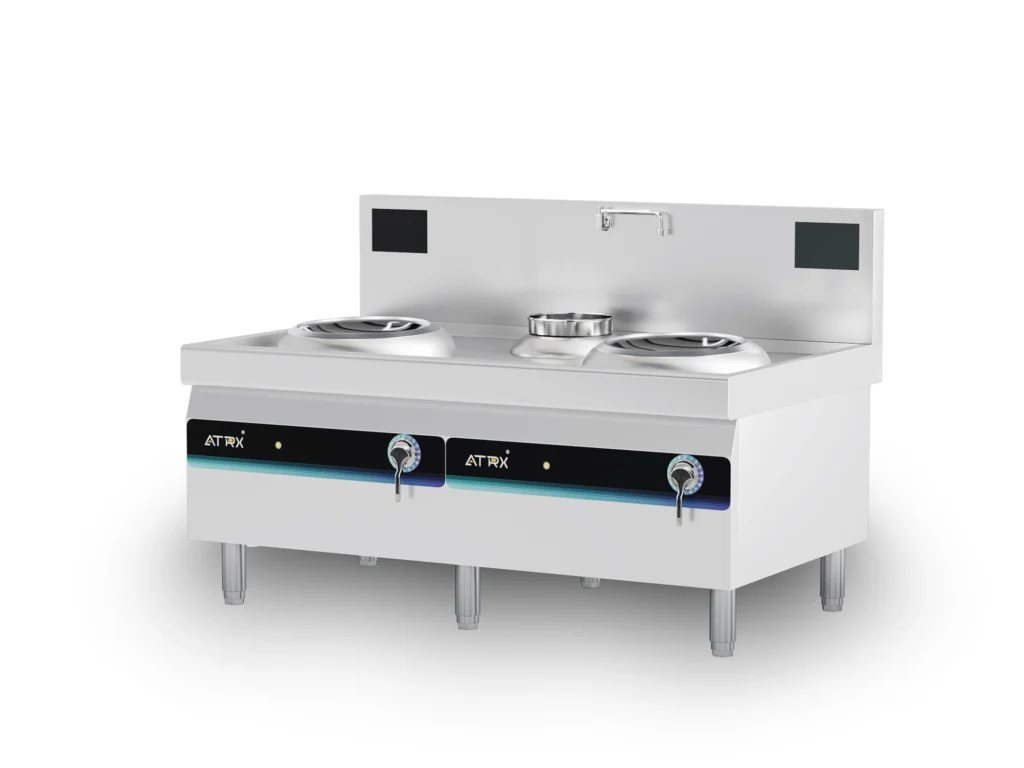
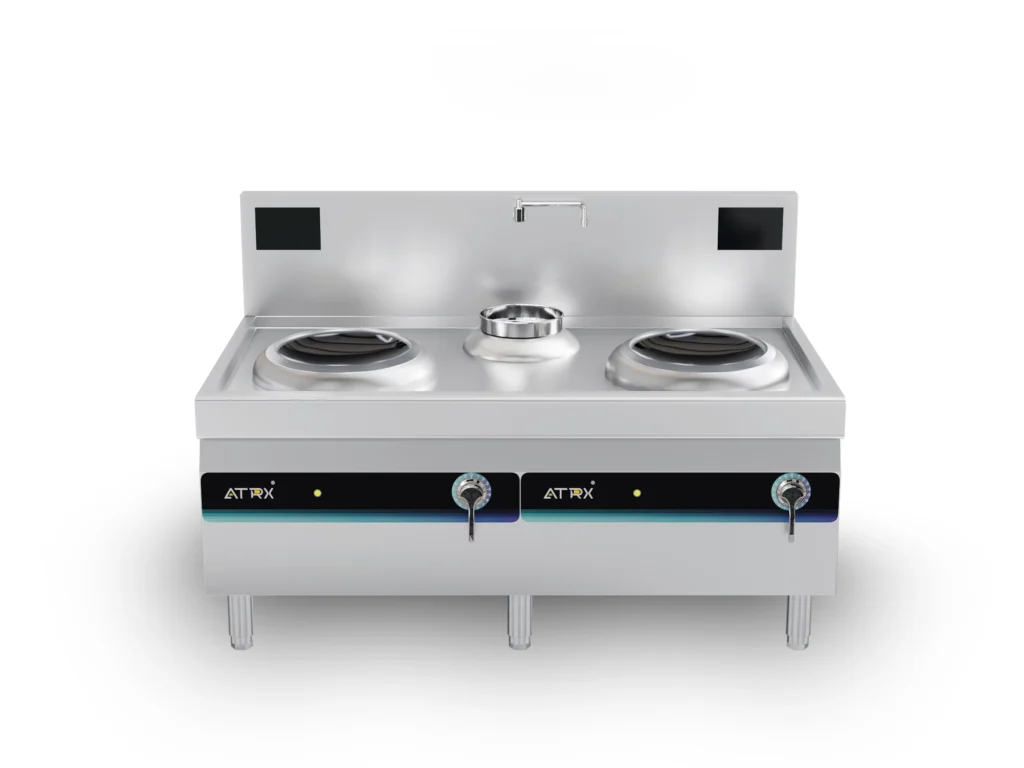
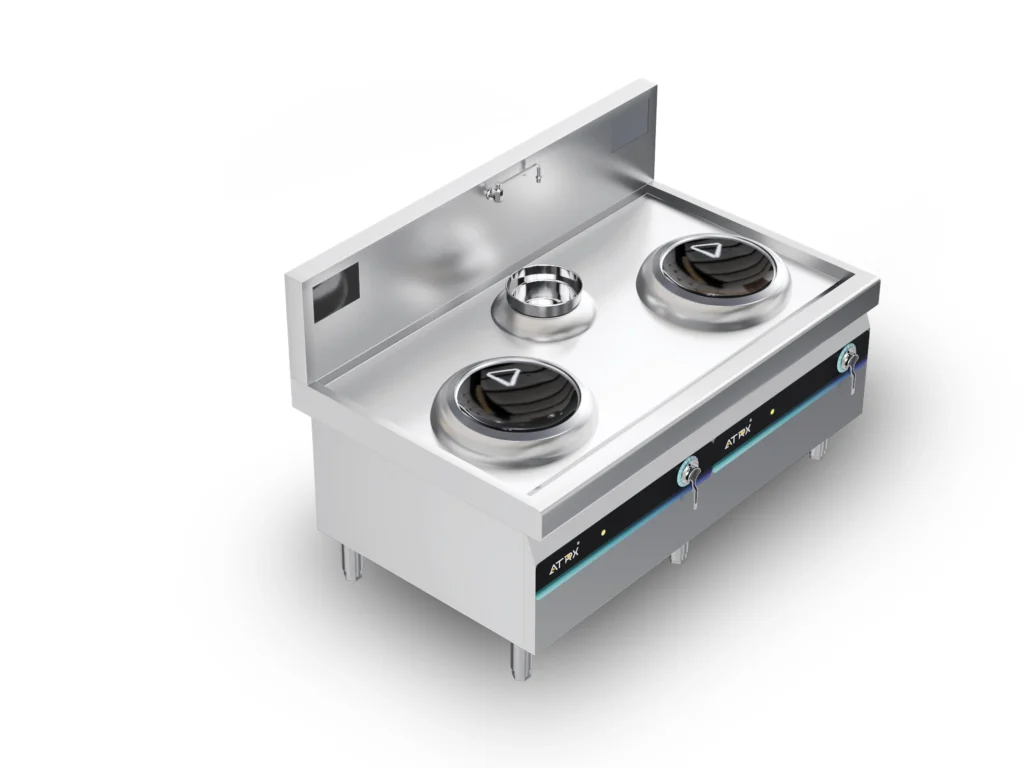
Floor Induction Double Wok Cooker With sink | 18KW*2
Value of the 220V Front-to-Back 2-Burner Induction Cooktop
Power Becomes a Setting, Making Dishes Easier to Reproduce
18kW×2 double concave burners, each burner can be independently adjusted between 1-8 levels. Induction heating acts directly on the wok body, and the heat input is more stable when the power level is fixed. The headquarters writes the power level, cutting sequence and frying time into the operation card, and the store has a set of heat standards that can be followed.
Independent Dual-Station Control for Peak-Time Output
The two burners can set the heat output separately. One wok will stir-fry quickly at high temperature, while the other wok will cook at medium heat to reduce the sauce. There is no need to wait for each other to cook. There is a built-in sink in the middle. When changing dishes, the woks can be rinsed at the original station, which reduces odor transfer and walking back and forth. It also makes it easier to unify the production order during peak periods.
Standardized Woks and Steps Keep Locations Consistent
To copy the practices of one store to another, equipment is only the first step. Stores also need to unify the wok size, wok base shape, input amount and frying time; the equipment is responsible for stabilizing the heat output input, and the operation card is responsible for unifying the actions. Only by working together can the temperature and taste of the woks in different stores be closer.
Inquiry UsView Specifications
01 / SPECIFICATIONS
Product Specification
Product Name
Product Model
Power(Kw)
Voltage(V)
Product Size
Product Material
Hs Code
AT-FLWK08II-008
8kw*2
380V/3Phase
L1600*W1000*H800+400mm
SS304 Stainless Steel
8419810000
8KW Electric Requirement (One Burner,One Wire)-(8L)-Glass:300mm
- Rated at: 12.2A
- Voltage: 380V (Three-phase)
- Wire: 2.5mm² Copper Cable
- Breaker: 16A RCD (Residual Current Device)
AT-FLWK17II-012
12kw*2
380V/3Phase
L1800*W1100*H800+400mm
SS304 Stainless Steel
8419810000
12KW Electric Requirement (One Burner,One Wire)-(17L)-Glass:400mm
- Rated at: 18.2A
- Voltage: 380V (Three-phase)
- Wire: 4mm² Copper Cable
- Breaker: 25A RCD (Residual Current Device)
AT-FLWK17II-015
15kw*2
380V/3Phase
L1800*W1100*H800+400mm
SS304 Stainless Steel
8419810000
15KW Electric Requirement (One Burner,One Wire)-(17L)-Glass:400mm
- Rated at: 22.8A
- Voltage: 380V (Three-phase)
- Wire: 6mm² Copper Cable
- Breaker: 32A RCD (Residual Current Device)
AT-FLWK29II-018
18kw*2
380V/3Phase
L2000*W1200*H800+400mm
SS304 Stainless Steel
8419810000
18KW Electric Requirement (One Burner,One Wire)-(29L)-Glass:500mm
- Rated at: 27.4A
- Voltage: 380V (Three-phase)
- Wire: 6mm² Copper Cable
- Breaker: 40A RCD (Residual Current Device)
AT-FLWK29II-020
20kw*2
380V/3Phase
L2000*W1200*H800+400mm
SS304 Stainless Steel
8419810000
20KW Electric Requirement (One Burner,One Wire)-(29L)-Glass:500mm
- Rated at: 30.4A
- Voltage: 380V (Three-phase)
- Wire: 10mm² Copper Cable
- Breaker: 40A RCD (Residual Current Device)
02 / GETTING STARTED
How To Operate This Machine
Step 1
Place your commercial induction cooker in position and connect the power cable based on the required voltage. Make sure all wiring is done correctly before turning on the unit.
Step 2
Once powered on, place your induction cookware on the commercial induction cooker, prepare your ingredients, and get ready to start cooking.
Step 3
Turn the knob from 0 to your desired setting to begin cooking. During the cooking process, simply adjust the knob between levels 1 to 8 to control the heat output to your needs.
Step 4
Once cooking complete,then turn the knob back to 0 to power off the unit. Wipe down and clean the surface of your commercial induction cooker to keep it in top condition.
03 / QUALITY ASSURANCE
Double Induction Wok Cooker for Chains: Six Factory Tests Standardize Heat
01
Key Parts Verified by Model, Then Performance Rechecked
When key parts arrive, ATRX compares the order, bill of materials, supplier labels and physical identification before sampling capacitors and other electrical components. A part with the right shape but the wrong parameter can make the two stations deliver different heat at the same setting, which breaks recipe replication across stores.
02
Coils and Glass Aligned So Heat Stays Centered
The automatic winder uses the machine model and power to set turns, wire spacing and tension, after which dimensions and electrical parameters are checked. During assembly, the team confirms coil centre, direction, insulation and support, and inspects the incoming concave glass for thickness, flatness and edge cracks.
03
Every Power Level Tested, Not Just Basic Heating
After final assembly, we power on each unit and check the display, buttons and indicators before stepping through every heat level. The control response must match the actual heating change, not merely switch on a lamp. A continuous loaded run then monitors power, temperature, fan status and protection.
04
Cooling Path Installed Correctly to Hold Heat Through Service
During assembly, the team checks fan direction, inlet and exhaust openings, heat-sink contact and harness spacing. A recirculating air path or a blocked fan can cause power reduction during continuous service, making the same recipe behave differently from one store to the next. The loaded run checks fan operation, temperature and protection together.
05
Sink Station Verified Separately for Electrical Safety
The sink is useful for washing woks, but it is not a washdown surface for the whole machine. We trace the internal wiring to the model drawing, keep harnesses clear of sharp edges, heat sources and fan blades, and confirm insulation withstand, grounding and leakage after final assembly. That separation protects the electrical area while staff use the sink through service.
06
First model confirm the Standard for the Whole Batch
Before mass production, ATRX builds and approves a first article for structure, function and wok fit, then applies the approved components and processes to the batch. Problems found in production are located by the engineering team and corrected across the affected units. A repair return is rechecked against the original fault and related items, not just switched on and released.
All results above are from our own factory. See related pages below.
Production Line Center Manufacturing Machines PCB Assembly Center04 / COOKING APPLICATIONS
Double Induction Wok Cooker for Chain Stir-Fry, Quick Service, and Test Kitchens
Own factory
CE certified
OEM available
Chain Stir-Fry: Same Dish, Same Setting
Suitable for chain stores whose menus focus on freshly stir-fried dishes such as Kung Pao chicken, shredded pork with green peppers, and dry-fried beef ho fun. One station handles high-heat rapid stir-frying while the other reduces sauce or starts the next dish. Each store follows the power level, loading sequence, and frying time set by headquarters, keeping the same heat and service rhythm for the same dish through lunch and dinner peaks.
Noodle and Rice Quick Service: Peak-Time Reproduction
Suitable for rice noodles, fried rice, rice bowls, fried fast food and other fast-paced restaurants. One wok station continuously stir-fries the main ingredients, while the other handles toppings, sauces or side dishes in small woks. The middle sink allows wok changing and cleaning to be left at the original station. The kitchen does not need to run back and forth, and more orders can be accepted in a limited space.
Brand Test Kitchens: Recipe Calibration
This wok suits chain brands running new-product sampling, recipe finalization, and store training. Headquarters can test different heat levels, wok sizes, and frying times on one unit, and the two stations can compare two methods side by side; confirmed parameters are then written into the operation card and copied to stores. This also creates a common practical standard for training.
FAQs
Frequently Asked Questions
We've gathered the most common questions buyers ask before placing their first order — browse through and find the answers that matter most to you.
Can a Dish Taste the Same at Another Location?
The 18kW×2 model can reproduce the same starting conditions, but equipment alone cannot guarantee an identical dish. Each of its two stations has eight heat levels, and heat input at a given level is stable enough for head office to record the best power level, loading sequence and frying time on an operation card. Stores that use the same equipment, wok specification and procedure can then follow a common heat standard, which also supports new-product rollouts and supervision.
Can the Two Burners Be Controlled Separately?
Yes; each burner has its own knob and heat setting, so one can stir-fry at high heat while the other reduces sauce, and changing one does not alter the other. The stations are wired separately so both can be reserved and run in parallel, which lets main dishes and sauces move together at peak.
Does Power Drop During Continuous Service?
No, the station should not lose power naturally when installation, heat dissipation and cleaning are correct. Every unit is run under load before dispatch to observe power, temperature, fan status and abnormal protection, and the air inlet and exhaust must stay clear during service. With that airflow maintained, the output remains steady enough for the operation card to hold through afternoon and evening peaks.
Can Existing Wiring and Woks Be Used Directly?
Yes, if the existing three-phase capacity, circuit wiring and wok bases meet the 18kW×2 requirements. Each head is rated 27.4A at 380V, with 6mm² copper cable and a 40A leakage-protection switch on an independent circuit. Existing woks can stay only if a magnet grips the base and they fit the station; the store’s distribution and wok dimensions should be checked before ordering.
How Long Until New Staff Are Productive?
Most new staff can handle routine dishes in the first induction session because there is no flame to read. The workflow is limited to selecting the wok, setting levels 1–8, loading ingredients, following the timer on the operation card and turning the level down at the end. Trainees can start with one dish, then work under supervision before taking a full dish independently. Supervised practice on the actual wok is still the sensible boundary for dishes whose browning or sauce reduction depends on timing.
——07 / Factory quote & RFQ
Partner with a Trusted Commercial Induction Cooker Manufacturer
Whether you need wholesale commercial induction cookers, an OEM product line or a commercial kitchen project configuration, send a focused commercial brief. An ATRX team member can review the product, power, certification and customization requirements before quotation.
Useful information to include:
Target country · Product category · Application · Voltage / phase · Estimated quantity · Required certifications · OEM / branding needs