

How to Open a Hot Pot Restaurant in a Mall: Fire Code, Equipment & No Open Flame Solutions
07/24/2026
Estimated reading time: 2 minutes

This guide solves one problem: how to open a hot pot restaurant inside a shopping mall and get through fire inspections, choose the right flameless heating equipment, and pass your final acceptance review without getting rejected. It connects three critical workstreams—mall hot pot restaurant fire code compliance, no open flame restaurant equipment selection, and inspection readiness—so you can align every key milestone before you sign the lease or break ground. The goal is simple: stop you from wasting money and losing opening-day revenue on avoidable inspection failures.
IN THIS ARTICLE
What Fire Code and No-Open-Flame Rules Apply to Mall Hot Pot Restaurants?
Opening a hot pot restaurant in a mall means meeting three hard requirements on the fire-safety side. First, the kitchen’s open-flame cooking zone must be separated by fire-rated partitions with at least a 2-hour fire-resistance rating. Second, an independent mechanical exhaust system that meets code standards must be installed. Third, automatic sprinkler systems and combustible-gas alarms must be in place. On top of that, virtually every mall bans any heating method that produces a visible flame in the dining area—gas burners, alcohol stoves, and charcoal all count as open flame. Only electric heating devices like induction cooktops and ceramic cooktops qualify as “no open flame.” The following sections break down the mall hot pot restaurant fire code requirements one by one so you can verify each item before signing your lease.
Fire Regulations Malls Typically Impose on Hot Pot Restaurants
Before you sign the lease, go through the mall’s fire-safety clauses line by line. Most malls spell out fire-protection requirements for food-and-beverage tenants either in the main lease or in a separate tenant fit-out manual. The underlying regulations typically include the Code for Fire Protection Design of Buildings (GB 50016), the Design Standard for Dining Buildings, and the Fire Safety Management Rules for Large Commercial Complexes issued by the Ministry of Emergency Management. For a hot pot restaurant, the items below are the most directly relevant—and the easiest to trip over.
1. Fire compartments and fire separation. Once a food-and-beverage outlet opens inside a mall’s retail floor, the fire compartment area can no longer follow the lenient standards for ordinary retail units. It must be recalculated according to general civil-building requirements. There is an even more practical rule: any kitchen zone with open-flame cooking must be separated by fire-rated walls with a fire-resistance rating of no less than 2 hours. All doors and windows on those walls must be replaced with Class-B fire-rated doors and windows.
But here’s the flip side. If your hot pot restaurant uses electric heating throughout with no open flame, an open-plan show kitchen is not subject to this requirement. That single difference can significantly change your renovation design and budget. One more point: open-flame cooking zones must sit against the building’s exterior walls. They cannot be buried deep inside the mall interior.
2. Exhaust and ventilation standards. The code is explicit: in a row of mall restaurants, cooking ranges must not face the public corridor, and each unit must have its own independent mechanical exhaust system. A hot pot restaurant doesn’t produce as much cooking oil fume as a stir-fry kitchen. But once the broth starts boiling, steam and odors rise nonstop. If exhaust capacity falls short, the entire floor smells like hot pot. Understanding shopping mall hotpot kitchen fire safety means recognizing that ventilation is just as critical as flame prevention.
Here’s a detail most people miss: although the mall pre-installs exhaust ducts during construction, duct capacity varies a lot between floors. Basement levels and mid-level floors often have limited capacity. The top floor—closest to the rooftop exhaust outlet—usually has the best conditions. Before choosing a unit, ask property management directly for the exhaust duct drawings and available exhaust volume data for that specific location. Don’t just take the leasing manager’s word that “it’ll be fine.” Get the data and verify it yourself.
3. Fire-suppression equipment. Once a mall’s food-and-beverage area reaches a certain size, an automatic sprinkler system is standard. If piped natural gas is used, the cooking-range zone also needs a combustible-gas leak detector and an automatic shut-off valve. Fire extinguishers follow their own rules too: the kitchen is rated as a “severe hazard” zone, and the dining area as “medium hazard.”
Every single item gets checked during inspection. Miss one and you fail. One operator in eastern China opened a hot pot restaurant in a Wanda Plaza and didn’t carefully read the lease appendix clauses about kitchen fire-suppression systems. The entire renovation was done. Then the fire inspector showed up and said the range-hood duct needed an automatic fire-suppression device linked to the gas-line shut-off valve. That one remediation item cost roughly $3,000 extra and pushed the opening back almost three weeks. The lesson: build these systems into your budget and timeline from day one. Don’t leave them for last-minute scrambling.
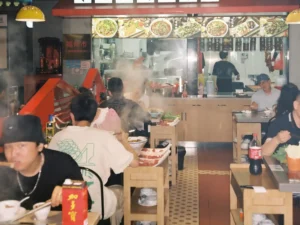
Which Heating Methods Count as Open Flame—and Which Do Not
The short answer: if there’s a visible flame, it’s open flame. A gas burner produces a visible flame when ignited—open flame, no debate. An alcohol stove, whether liquid or solid fuel, is open combustion of a fuel source and counts as open flame too. Don’t assume solid alcohol’s small flame gives you a gray area. Any visible flame will fail inspection. Charcoal—wood charcoal, machine-pressed charcoal—same thing. Unambiguously open flame.
An induction cooktop uses electromagnetic induction to heat the pot itself. No flame, no combustion at any point—so it’s not open flame. A ceramic cooktop’s panel glows red during use, which can look like fire. But that glow comes from a resistance heating element radiating heat, not from combustion. It doesn’t count as open flame either.
The table below categorizes common hot pot heating methods at a glance so you can instantly tell whether your setup will pass.
| Heating Method | Open Flame? | Allowed for Mall Hot Pot Tabletop Use? | Key Restrictions |
|---|---|---|---|
| Piped natural gas burner | Yes | Generally no (open flame banned in dining area) | Back kitchen only; must be against exterior wall with fire-rated separation; banned in large underground venues |
| Bottled LPG burner | Yes | No | Strictly prohibited in all mall premises |
| Liquid alcohol stove | Yes | No | Open combustion; open flame with spill risk |
| Solid alcohol stove | Yes | No | Small flame is still open flame |
| Charcoal (wood/pressed) | Yes | No | Open flame; also fails mall environmental exhaust requirements |
| Induction cooktop | No | Yes | No flame, no combustion; not restricted by “no open flame” clauses |
| Ceramic cooktop | No | Yes | Resistive radiant heat, not combustion; panel temperature is high—tabletop insulation required |
| Commercial electric hot pot | No | Yes | Electrically heated; must confirm that the mall’s power supply can handle the load |
A UBC research report on restaurant cooking-method transitions backs up this classification. Induction cooktops, by completely eliminating open flame, are explicitly categorized as low fire-risk equipment.

One important reminder: “no open flame” does not mean “zero requirements.” Even when all-electric flameless cooking equipment is used in a mall restaurant, walls and countertops next to the cooking station must be Class-A non-combustible materials. Electrical wiring must still meet the mall’s electrical safety standards. That said, for a hot pot restaurant in a mall, tabletop heating is essentially limited to electric options. Fire regulations and mall management rules have already locked in this range.
The question now becomes: how do you choose between induction cooktops, ceramic cooktops, and electric hot pots—and which type fits your actual operating scenario best? That’s what the next section covers.
How to Choose Flameless Heating Equipment for a Mall Hot Pot Restaurant
The three main flameless heating equipment options for a hot pot restaurant are induction cooktops, ceramic cooktops, and infrared cooktops. Induction cooktops deliver the highest thermal efficiency and fastest heat-up—ideal for standardized hot pot service and high-turnover scenarios. Ceramic cooktops accept any pot material, making them the go-to for specialty cookware like clay pots and copper pots. Infrared cooktops win on silence, suiting mid-to-high-end positioning. Beyond the heating method itself, you also need to calculate the mall’s electrical load ceiling, long-term energy costs, and supplier after-sales response speed. These three areas are where first-time owners most often get caught off guard.
Below, each option is broken down so you can match equipment strengths and weaknesses to your business model and target clientele.
Which Operating Scenarios Suit Induction, Ceramic, and Infrared Cooktops
1. Induction cooktop—the top pick for standardized hot pot operations. The induction cooktop is the most widely used device in mall hot pot restaurants. The principle is straightforward: an electric current generates a magnetic field that heats the pot bottom directly. No wasted thermal energy in between. Thermal efficiency hits 85%–90%. Power-on to a rolling boil usually takes two to three minutes. The catch is pot compatibility—iron and stainless-steel pots work fine, but clay pots, glass pots, and aluminum pots won’t heat at all.
If you run a standardized operation with uniform stainless-steel split pots on every table, a commercial induction cooktop in a hot pot restaurant is close to the optimal setup. Wattage is straightforward to choose: 800 W–1,500 W for individual mini hot pots, 2,000 W for two-to-four-person pots, 2,500 W–3,000 W for six-plus-person pots. You also get precise temperature control, timer functions, quick staff onboarding, and fast peak-hour table turns.
2. Ceramic cooktop—the companion for specialty cookware and slow-simmer scenarios. The biggest advantage of a ceramic cooktop is universal pot compatibility. A resistance element heats the ceramic glass panel first, then the panel transfers heat to the pot. Iron, clay, ceramic, glass—almost anything works. If your concept revolves around clay-pot congee-base hot pot, copper-pot lamb, or any other distinctive cookware, this type of electric cooktop for hot pot restaurant use is practically your only option.
Heating is relatively even, too. No scalding center with lukewarm edges. Slow simmering and low-fire warming are both stable. The downside is straightforward: it’s slow. Power-on to boil takes three to five minutes or more. Thermal efficiency runs about 60%–70%—a clear step below induction. In a high-turnover restaurant, customers feel that wait.
3. Infrared cooktop—a silent alternative for specific scenarios. An infrared cooktop uses infrared electromagnetic waves to heat the pot bottom. Heat-up speed falls between induction and ceramic. Pot compatibility is also in between—more flexible than induction, but not as universally accepting as ceramic. With metal flat-bottom pots, heat-transfer efficiency is solid. One real-world advantage: no high-frequency electrical hum. The dining environment stays noticeably quieter. Mid-to-high-end concepts tend to care about this.
That said, infrared cooktops have limited traction in the commercial hot pot market. Fewer brands, harder-to-find spare parts, less convenient repairs compared to induction. If supply-chain maturity and low-hassle maintenance matter to you, induction and ceramic come first. But if your clientele is especially sensitive to a quiet ambiance, the infrared cooktop deserves a spot on your comparison shortlist.
The core specs of all three are laid out side by side below for quick comparison.
| Comparison Dimension | Induction Cooktop | Ceramic Cooktop | Infrared Cooktop |
|---|---|---|---|
| Heating principle | Electromagnetic induction directly heats pot bottom | Resistance element heats ceramic panel, then conducts to pot | Infrared electromagnetic wave radiation heating |
| Thermal efficiency | 85%–90% | 60%–70% | ~75%–85% |
| Heat-up speed | Fast (~2–3 min to boil) | Slow (~3–5+ min) | Medium |
| Pot compatibility | Ferromagnetic materials only (iron, stainless steel) | Nearly all materials | Primarily metal; some heat-resistant glass |
| Operating noise | Some high-frequency electrical hum | Silent | Silent |
| Typical power range | 800 W–3,000 W | 1,000 W–2,500 W | 1,000 W–2,200 W |
| Best-fit scenario | Standardized hot pot, individual mini pots, split pots | Clay-pot hot pot, congee-base pots, copper-pot lamb hot pot | Mid-to-high-end concepts valuing quiet ambiance |
| After-sales & parts maturity | High—most established brand and supply-chain ecosystem | Medium | Low—limited market options |
The table above helps you lock in a direction fast. If you’re still torn between induction and ceramic, this technical comparison of commercial induction vs. ceramic cooktops quantifies the performance gap using lab data on heating principles, measured energy efficiency, and safety differences. It’s more useful than spec sheets alone.

Power Rating, Energy Costs, and After-Sales: Where Newcomers Get Tripped Up
1. Calculate total electrical capacity first, then pick equipment wattage. Many first-time owners focus only on “is the heat powerful enough” and overlook a hard prerequisite: the mall assigns a fixed electrical capacity ceiling to each unit. A quick example—30 tables, each running a 2,000 W induction cooker for commercial hot pot simultaneously, equals 60 kW. That’s before back-kitchen equipment, HVAC, lighting, and the exhaust system are even factored in. Some older malls have already maxed out their overall electrical load at the design ceiling, and power audits for new tenants can be very strict.
So before picking equipment, do one thing first: confirm with property management the total available electrical capacity for your unit. Then work backward to figure out how much wattage each table can realistically draw. In practice, equipment rated around 2,800 W often fits a mall environment better than 3,500 W units. Total load stays more controllable, devices avoid running flat-out for hours, component aging slows down, and service life gets longer. Higher wattage doesn’t equal better—adequate and stable is what you want.
If you need voltage matching, wire gauge selection, and breaker configuration details sorted in one go, this guide to commercial induction cooktop electrical installation requirements breaks down the full wiring logic from distribution panel to equipment terminal, organized by power tier.
2. Energy-efficiency differences add up—don’t ignore long-term costs. Most people never seriously calculate daily electricity costs before opening. Induction cooktops run at 85%–90% thermal efficiency, and in practice they don’t hit full power the whole time. Real consumption typically comes in 20%–40% below rated wattage. Ceramic cooktops at 60%–70% efficiency use noticeably more electricity to boil the same pot of broth.
In a real operating context: 30 tables, eight hours a day, even a 10% energy-efficiency gap between devices creates a clear electricity-bill difference after one month. We helped a client in Hangzhou switch a 30-table venue from standard ceramic cooktops to high-efficiency induction units. The result: monthly electricity costs dropped by close to 30%. This is math few people do before signing a lease, but once the restaurant is running, the gap shows up on every bill. Don’t choose equipment based on heating performance alone—energy-efficiency ratios belong in the comparison too.
3. Slow after-sales response means every idle table is lost revenue. A home induction cooktop breaks? You can deal with it tomorrow. Not in commercial use. Hot pot restaurant equipment runs continuously for eight-plus hours a day. Broth splashing, constant temperature adjustments, sustained high-temperature operation—all routine. The coil disc, IGBT power module, and cooling fan wear out far faster than in a home kitchen. Failures starting around the three-month mark are common, especially on budget models that cut corners on materials.
When a unit goes down, that table is out of service. The revenue you lose from idle tables during the dinner rush far exceeds the repair cost of a single device. When purchasing, confirm the manufacturer’s after-sales coverage area and response time. Prioritize brands that offer on-site repair within 48 hours or direct unit-swap replacements. One more practical tip: keep one or two spare units of the same model in-store. When something breaks, swap it out immediately—no disruption to service. Equipment failure can’t be eliminated, but its impact on the business can be kept to a minimum.
How to Pass the Mall Fire Inspection After Equipment Installation
Passing a hot pot restaurant fire inspection smoothly comes down to two things: documents ready, common pitfalls handled in advance. On the paperwork side, equipment safety certifications, electrical load test reports, and exhaust system commissioning records are all mandatory. On the physical-site side, fire extinguisher placement, emergency exit signage, and evacuation plans must be fully in place. The three areas where hot pot restaurants get rejected most often—non-compliant exhaust duct connections, missing heating-equipment certifications, and insufficient electrical circuit capacity—should be resolved during construction, not patched up the week before inspection.
Documentation and Hardware to Prepare Before the Inspection
Fire inspection is not something you start thinking about the day the inspector arrives. It examines the compliance of your entire process from design through construction. Before submitting the application, paperwork and on-site hardware must both be in order. Fall short on either side and you won’t pass. Here’s a category-by-category breakdown.
1. Submission documents. The basics most people remember: business license originals and copies, fire-safety inspection application form (or commitment letter), floor plan layout, and fire-protection facility floor plan. What gets overlooked: quality certification documents for fire-protection products like extinguishers, emergency lights, and fire-rated doors; fire-performance test reports or factory conformity certificates for renovation materials; commissioning and acceptance records for the exhaust system post-installation; and electrical safety certification documents for the heating equipment.
If you’re using commercial induction cooktops, pay close attention here. “No open flame” doesn’t mean you can skip certifications. CCC, UL—whatever applies in your market must be on file.
2. Fire-safety management documents. A fire-safety protocol and a fire-suppression and emergency evacuation plan must be written in advance. Content must cover fire-safety responsibility assignments for each job level. Documents alone aren’t enough—all employees must complete fire-safety training before the inspection and must have participated in at least one evacuation drill. Keep training records and photos or video from the drill on hand. The inspector will ask for them on the spot.
3. On-site hardware setup. When the inspection team walks in, the first thing they do is compare your submitted drawings against the physical installation, item by item. Fire extinguishers are the baseline: at least one 4 kg or larger ABC dry-powder extinguisher per 50 square meters. Portable units must be mounted with the top no higher than 1.5 meters and the bottom no lower than 0.08 meters from the floor. Add fire blankets in the kitchen area. Emergency lighting and evacuation signs must all be installed, functional, and able to hold illumination for at least 30 minutes after a power cut.
Exit signs must be visible at a glance. Evacuation routes can’t be blocked by tables, chairs, or clutter. Width must handle at least two-way foot traffic—no narrower than 1.1 meters. Getting your hot pot shop fire compliance equipment checked against these physical requirements ahead of time is the single most effective way to avoid a rejection.
Put all three categories into a checklist and go through it before submitting your application. Many hot pot restaurants fail their first inspection not over a serious safety issue, but because a certificate was missing, a sign was overlooked, or the evacuation plan wasn’t complete. A rejection means re-entering the queue—one week at best, half a month at worst—and the opening date and cash-flow timeline both slide with it.
The Most Common Rejection Points for Hot Pot Restaurants—and How to Avoid Them
Among mall food-and-beverage tenants, hot pot restaurants consistently face a higher rejection rate than other formats. The reason isn’t complicated: high exhaust volume, heavy electrical draw, and tabletop heating devices. These three traits land directly on the three areas fire inspectors watch most closely. First-time applicants who don’t address these during construction often lose two to three weeks to remediation and re-inspection.
Fixing these issues during the build-out phase costs far less than ripping things out after a failed review. This principle is backed by NFPA’s guidance on restaurant fire protection—all commercial cooking equipment producing grease-laden vapors must carry a UL 300–compliant fire-suppression system, and exhaust duct design and fire-clearance distances have explicit quantitative requirements.
The table below lays out the three most common rejection categories, what the problems look like, and what to do during construction to prevent them.
| Rejection Area | Common Specific Issues | Preventive Measures During Construction |
|---|---|---|
| Non-compliant exhaust duct connections | No fire damper at the branch-to-main duct junction; duct made of non-noncombustible materials; poor joint sealing causing smoke leakage; no airflow volume test after installation | Before construction, have the exhaust contractor produce a connection plan reviewed by the mall’s property management; install fire dampers rated ≥150 °C at all branch-to-main junctions; use noncombustible materials for all ductwork; after completion, hire a certified agency for an airflow volume test and keep the report on file |
| Missing heating-equipment certifications | Induction cooktop is flameless but safety certifications were never requested; model number on the cert doesn’t match the installed unit; supplier gave an in-house report instead of third-party certification | When placing the order, request CCC, UL, or ETL third-party certification copies from the supplier; verify the certified model matches your actual purchase exactly; prioritize brands with complete certification coverage |
| Insufficient electrical circuit capacity | Wire gauge too thin for all cooktops at full power simultaneously; too many devices on one circuit; no spare circuits in the distribution panel for future additions | Have a licensed electrical engineer size wiring to 1.2× the total rated equipment power (20% headroom); specify load per circuit, feeder wire gauge, and spare circuit count on drawings; after construction, get a qualified third-party electrical safety inspection report |
These three problems keep coming back because they share one root cause: none falls within a standard renovation contractor’s scope. Exhaust duct connections need coordination with the mall’s property management. Equipment certifications must be locked down during procurement. Electrical planning needs custom calculations tailored to a hot pot restaurant’s high-load profile.
Push all three to after the renovation and you’re almost guaranteed to stumble at inspection. The safest approach: add exhaust plan confirmation, equipment certification collection, and dedicated electrical load design to your project schedule before construction starts. Run them in parallel with the renovation. Trying to patch everything together right before the inspection deadline doesn’t leave enough time.
If you’ve confirmed the mall’s electrical conditions and fire-safety requirements and decided that induction is the right path, the next step is looking at specific equipment. ATRX is a commercial induction cooker manufacturer covering the 3 KW–40 KW power range. The built-in model for hot pot projects is rated at 2.5 KW with output adjustable from 500 W to 2,500 W—enough for everything from a gentle simmer to a full rolling boil. Tabletop portable models are available here: portable commercial induction cooktop product line. The full line is CE-certified and supports OEM customization and sample orders.
Frequently Asked Questions
Q1: I already signed the lease and then discovered the exhaust capacity is insufficient. Is there a fix?
The standard approach is to apply to property management for an independent exhaust duct or supplementary fans to make up the airflow. But this depends on two things: whether the building structure has physical space for a new duct run, and whether property management approves the modification.
In older malls, retrofitting ducts means long approval cycles and high costs. Some floors simply can’t accommodate it. The most practical advice: get the unit’s exhaust duct drawings and available airflow data before you sign. Confirm the capacity is enough, then sign. That way you’re never stuck reacting.
Q2: If a hot pot restaurant uses induction cooktops exclusively, does it skip the fire-safety review entirely?
No. Going flameless only removes the specific requirement for fire-rated separation of open-flame cooking zones. The review process itself can’t be skipped at all. Renovation material fire ratings, extinguisher and emergency lighting placement, evacuation route width, electrical wiring safety—none of these depend on whether you use open flame. All get checked regardless.
On top of that, the induction cooktop’s CCC or UL certification must be submitted during inspection. A missing document means a rejection. Going flameless lowers your fire-risk classification. It does not lower the compliance bar.
About the author
ATRX Team| 18 Years Commercial
Induction Cooker Manufacturer in China
Induction Cooker Manufacturer in China
Related Posts
What Is a Commercial Induction Cooker and How Does It Work
08/13/2026
Commercial Induction Range for Hotel Kitchens: How to Choose the Right Model
08/11/2026

Reliable Commercial Induction Cooktop Manufacturer in China | OEM & ODM Solutions | ATRX
08/09/2026
10 Best Commercial Induction Cooker Manufacturers & Supplier Selection Guide [2026]
08/07/2026
Tilting Skillet & Bratt Pan: How to Choose the Right One for Your Commercial Kitchen
08/06/2026

Commercial Induction Cooker for School Cafeteria: How to Pick the Right High-Power Unit
08/04/2026
Ghost Kitchen Equipment List: Checklist & Buying Guide for Delivery-Only Kitchens
08/02/2026
Gas vs Infrared vs Induction: Commercial Wok Range Comparison for Chinese Restaurants
07/31/2026
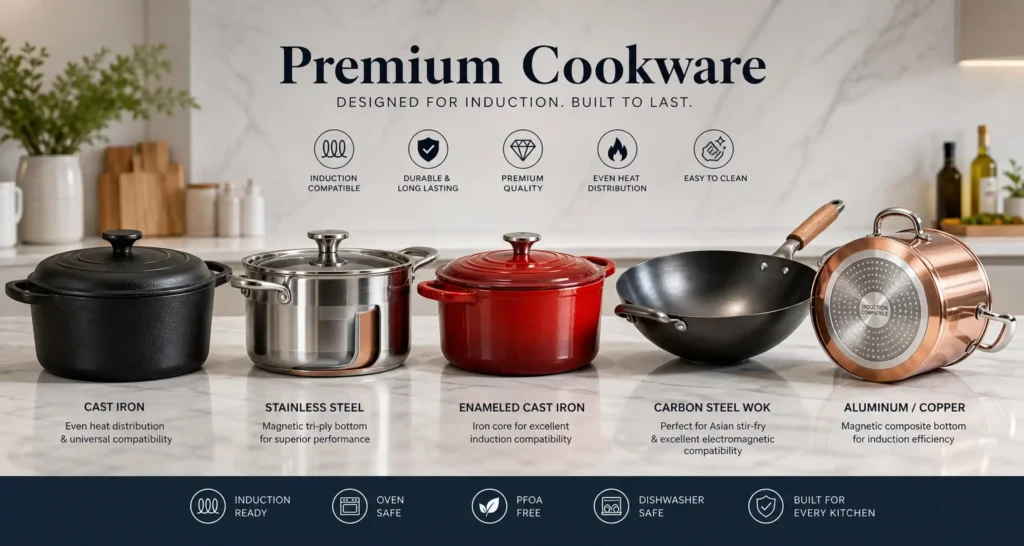
What Cookware Works on Induction? Compatibility Guide & Best Materials Explained
07/28/2026

Best Commercial Induction Cooktop for Restaurant: Types, Specs & Buying Guide (2026)
07/26/2026