
10 Best Commercial Induction Cooker Manufacturers & Supplier Selection Guide [2026]
08/07/2026
Estimated reading time: 2 minutes
We’ve been making commercial induction cookers in China for close to 19 years. Every year, we field hundreds of sourcing inquiries from all over the world. And one thing keeps coming up — buyers don’t struggle to find commercial induction cooker manufacturers. What they struggle with is figuring out which ones are actually worth working with.
This applies to distributors, OEM brand owners, and project contractors alike. There’s no shortage of options. The real challenge is telling the reliable ones from the rest.
This article is built on what we’ve learned from inside the industry. We’ve put together a list of 10 commercial induction cooker manufacturers worth watching in 2026 — spanning China, the United States, Canada, Sweden/Switzerland, and Germany. We also share hands-on sourcing advice covering materials, certifications, customization, and how to evaluate suppliers before committing.
The rankings below are in no particular order. We’ve grouped them by product line, manufacturing capability, and market coverage so you can quickly find what fits your needs.
IN THIS ARTICLE
- Top 10 Commercial Induction Cooker Manufacturers in 2026
- 4 Things to Check When Choosing a Commercial Induction Cooker Manufacturer
- OEM/ODM Customization & Bulk Purchasing: What You Need to Know
- How to Tell If a Supplier Is Reliable — Before You Place an Order
- Commercial Induction Cooker Purchasing FAQ
Top 10 Commercial Induction Cooker Manufacturers in 2026
The most noteworthy commercial induction cooker manufacturers in 2026 include: AT Cooker, Lestov, ATRX, and MEIKONG from China — strong on cost-effectiveness, OEM customization, and factory-direct supply. From the US, there’s Vollrath and CookTek, focused on high-end countertop and buffet equipment. Garland out of Canada handles heavy-duty commercial gear. And at the top-tier premium end, you’ll find Electrolux Professional (Sweden), INDUCS (Switzerland), and Berner (Germany).
The Chinese manufacturers on this list all support OEM/ODM private labeling with flexible MOQs. The Western manufacturers command brand premiums, offer mature after-sales networks, but don’t do private labeling. If you’re specifically looking for the best commercial induction cooker manufacturer China has to offer, the four Chinese entries here are the place to start.
#1 AT Cooker (China)
AT Cooker is a brand manufacturer worth a close look in the Chinese commercial induction cooker space. Its product line centers on multi-burner freestanding units, with power output from 5kW all the way up to 60kW. For context — you can count the factories in this industry capable of hitting 60kW on one hand.
This company goes for value, but not the “cheap means junk” kind. Their website has a detailed annual cost comparison between induction cookers and gas stoves. The benchmark: heating 55 kg of water from 25°C to boiling. Induction comes in at roughly $6,382/year. Gas runs about $15,709. That’s a gap of nearly $9,327 per year. For B2B buyers building a cost case to present internally, this kind of data is gold.
AT Cooker holds CE certification and supports OEM/ODM. They also keep local inventory in the US, Germany, France, and the UK — which gives them a real edge on delivery speed.
The downsides: brand recognition still trails Vollrath and Lestov. And if you mainly need 3.5kW portable countertop units, the options here are limited.
Best for: Wholesalers, restaurant chain buyers, and project contractors who need mid-to-high power commercial induction cookers and care about cost-effectiveness and fast delivery.
| Item | Details |
|---|---|
| Origin | China |
| Power Range | 5kW–60kW |
| Certifications | CE / CCC / ISO |
| OEM/ODM | Supported |
| Overseas Inventory | US, Germany, France, UK, etc. |
#2 Lestov (China · Guangdong)
Lestov belongs to Guangdong Qinxin Technology Co., Ltd. Founded in 2003, it has over 20 years focused solely on commercial induction cooker manufacturing. That makes it one of the most veteran brands in the Chinese market.
Product line breadth is Lestov’s biggest competitive edge. Countertop, freestanding, large wok ranges, soup cookers, steamer cabinets, fryers — nearly every commercial induction cooker category is covered. Power ranges from 3.5kW to well above 40kW. If you’re a large distributor or project contractor who needs one supplier to handle everything, Lestov’s full-category coverage cuts a lot of supplier management overhead.
On certifications, they hold CE, CCC, and ISO. Products ship to over 75 countries, and Lestov has solid brand recognition in overseas B2B markets. Their website content is strong too — search Google for commercial induction cooker topics and you’ll likely land on their blog. OEM/ODM is supported.
The downside: pricing runs on the higher side among Chinese manufacturers. Flexibility on small orders is average. If your budget is tight, or your first order is just a few dozen units to test the waters, Lestov may not be the most accommodating choice.
Best for: Large distributors and project contractors who need full-category, one-stop sourcing.
| Item | Details |
|---|---|
| Origin | China · Guangdong |
| Year Established | 2003 |
| Power Range | 3.5kW–40kW+ |
| Certifications | CE / CCC / ISO |
| OEM/ODM | Supported |
| Export Markets | 75+ countries |
#3 ATRX (China · Dongguan)
This one’s about us. We’re not going to pretend otherwise — but we’ll stick to facts and data.
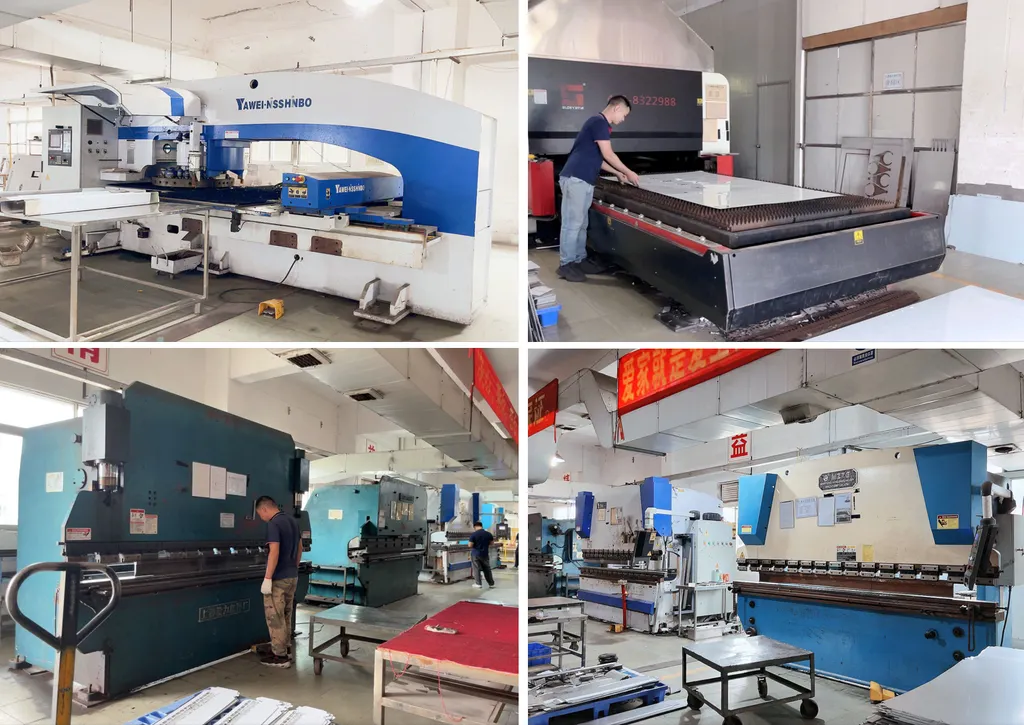
ATRX was founded in 2007. Close to 19 years in, we’ve done nothing but commercial induction cooker manufacturing. Our factory is in Dongguan — 20,000 ㎡ of owned space, monthly capacity over 3,000 units.
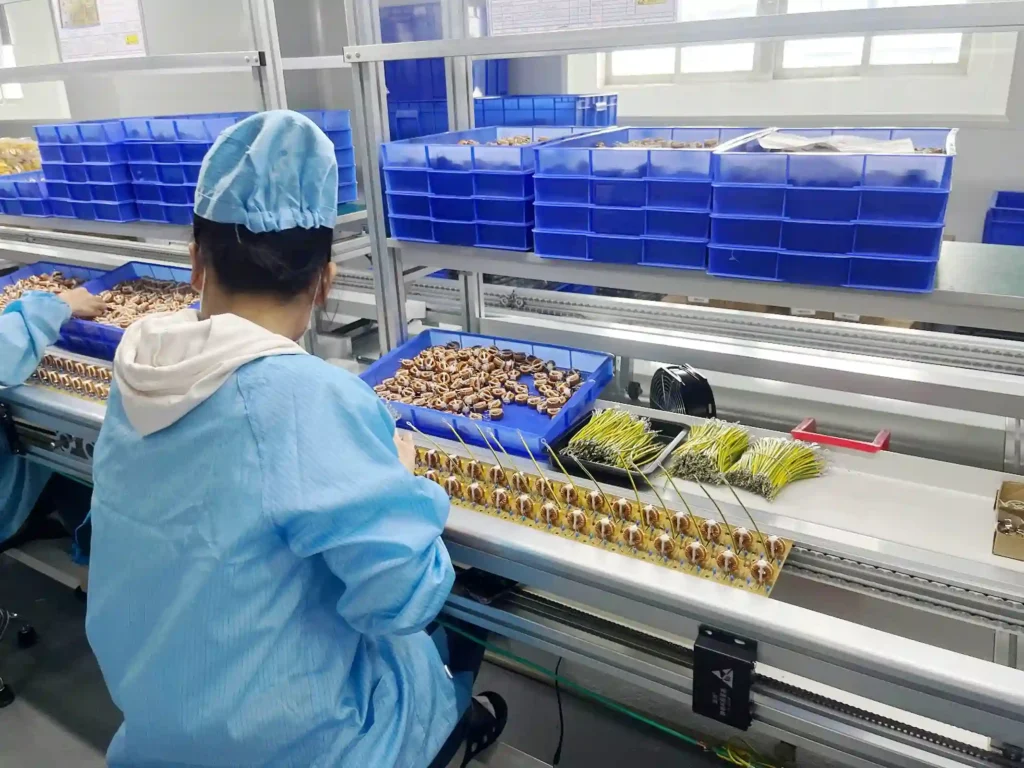
Where we stand out isn’t product line breadth. It’s how we build. One detail: our PCB assembly happens in a dust-free workshop kept below 100 particles per cubic foot. Every board gets inspected at every assembly station. Every finished unit runs a full-power burn-in test before it ships. This level of process control is rare in small and mid-sized factories — not because they can’t do it, but because it’s expensive, and most choose to skip it.
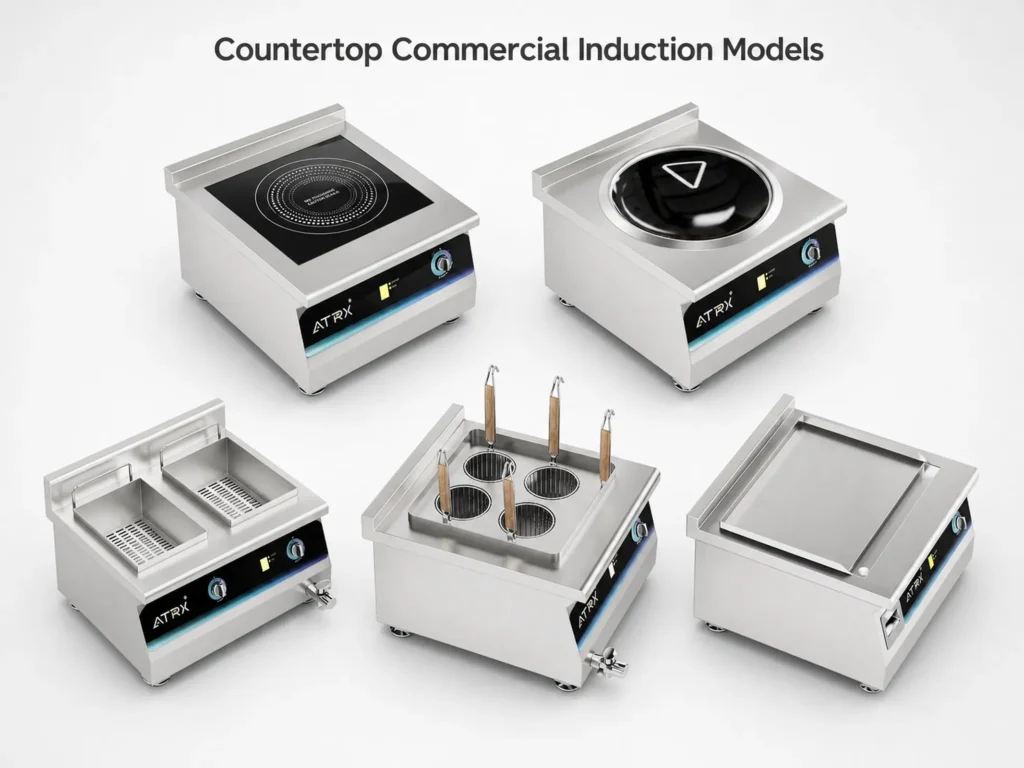
Our product line covers countertop flat cookers, concave wok ranges, fryers, soup cookers, steamer cabinets, and built-in models — power from 3.5kW to 15kW and above. CE certified. Exports to 50+ countries. We support OEM private labeling and full customization of appearance, functions, and power output.
The weakness: our overseas brand visibility is still catching up. Our marketing spend trails some competitors. Search our name and you may not find us on page one of Google. But clients who’ve seen the factory and tested samples? Our conversion rate with them has always been strong.
Best for: OEM brand owners, distributors, chain restaurants, and hotel project buyers who put product reliability and low failure rates first.
| Item | Details |
|---|---|
| Origin | China · Dongguan |
| Year Established | 2007 |
| Factory Area | 20,000 ㎡ |
| Monthly Capacity | 3,000+ units |
| Power Range | 3.5kW–15kW+ |
| Certifications | CE / CCC / ISO |
| OEM/ODM | Supported (private label + appearance + function + power fully customizable) |
| Export Markets | 50+ countries |
Want more details on our product line, OEM models, or factory capacity? Check our commercial induction cooker manufacturer homepage — it covers product categories and the full partnership process.
#4 Vollrath (United States)
Vollrath was founded in 1874 in Wisconsin. It’s a genuine century-old brand in North American commercial kitchen equipment, with 10 factories worldwide across the US, Europe, and China.
When it comes to commercial portable induction cookers, the Mirage Pro series is a benchmark. 100-level power adjustment (50W–1800W), stainless steel body, temperature range from 80°F to 450°F, and unlimited run time. Temperature control precision is what this unit is most known for. InductIQ, Vollrath’s latest platform, pushes the temperature algorithm even further.
But Vollrath isn’t for everyone. A single Mirage Pro starts around $750. The product line is countertop-only — no high-power freestanding wok ranges. And Vollrath doesn’t do OEM. Purchasing goes through the North American dealer network. If you’re based in Asia or the Middle East, the procurement path gets long.
Best for: North American end users, and high-end restaurants and hotels that demand extreme temperature control precision.
| Item | Details |
|---|---|
| Origin | United States · Wisconsin |
| Year Established | 1874 |
| Flagship Product | Mirage Pro Series |
| Power Range | 50W–1800W (portable countertop) |
| Certifications | NSF, cETLus |
| OEM/ODM | Not supported |
| Price Positioning | Premium ($750+/unit) |
#5 CookTek (United States)
CookTek is headquartered in Carrollton, Texas. Founded in 1994, it’s known in the industry for tech-driven innovation. What sets CookTek apart is that its products go beyond standard countertop units. The Charger series handles induction-heated buffet equipment, and they also make front-of-house display cooking gear. In buffet and live-cooking scenarios, that’s a niche most manufacturers don’t touch.
The MC3500 is CookTek’s flagship 240V countertop model — 3500W output, 22 temperature settings plus 20 power levels, stainless steel body, NSF and cETLus certified.
Downsides: premium pricing, no OEM/ODM. Sales are concentrated in the North American dealer network, with limited reach in Asia and Europe. If your target market is Asia-Pacific, CookTek’s channel and after-sales support may fall short.
Best for: North American hotels and high-end food service operators who need buffet induction heating or front-of-house live cooking equipment.
| Item | Details |
|---|---|
| Origin | United States · Texas |
| Year Established | 1994 |
| Flagship Products | MC3500, Charger Series |
| Certifications | NSF, cETLus |
| OEM/ODM | Not supported |
| Price Positioning | Premium |
#6 MEIKONG (China · Shenzhen)
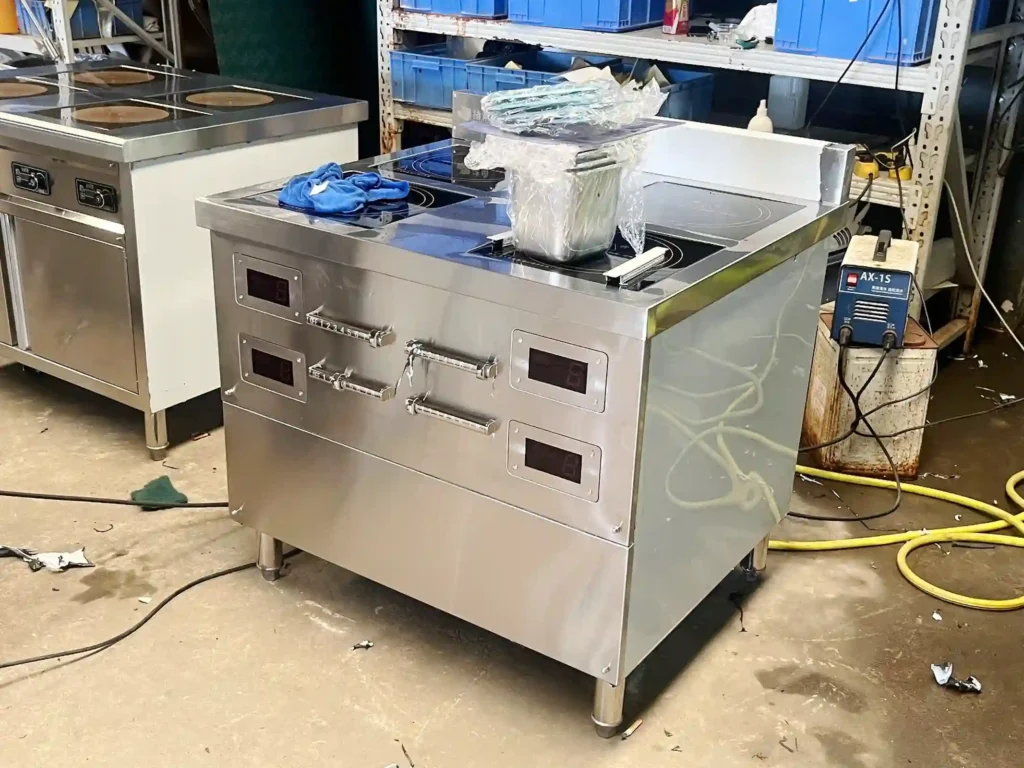
Shenzhen Meikong Technology Co., Ltd. has 15+ years making commercial induction cookers. Their specialty is mid-to-high power freestanding multi-burner units. The four-burner model is the star of the line.
On materials, MEIKONG uses SUS304 stainless steel with high-grade ceramic glass panels. They have an in-house R&D team and support OEM/ODM — appearance, power, and control panel customization included. The product line focuses on modular commercial kitchen cooking systems. If your project is a full kitchen buildout, their modular approach is worth a look.
Downsides: the lineup is heavy on high-power multi-burner units. Countertop portable options are limited. Overseas brand awareness is low, and international market expansion is still early-stage. Website content sticks mostly to product specs, with little industry-level content.
Best for: OEM brand owners and project buyers who need high-power multi-burner commercial induction cookers with customization.
| Item | Details |
|---|---|
| Origin | China · Shenzhen |
| Core Products | Mid-to-high power freestanding multi-burner cookers, modular cooking systems |
| Materials | SUS304 stainless steel + ceramic glass panels |
| OEM/ODM | Supported |
| Price Positioning | Mid-range |
#7 Garland (Canada)
Garland sits under Ali Group, which absorbed it after acquiring Welbilt in 2022. The factory is in Mississauga, Ontario. The brand itself dates back to the 19th century. It’s a legacy commercial kitchen equipment manufacturer in North America, covering ranges, ovens, griddles, and induction cookers.
Garland’s commercial induction products are built heavy-duty — designed for high-volume commercial kitchens. One detail worth knowing: Garland and INDUCS are both part of Ali Group (via Welbilt), so they share induction technology within the group. That means Garland’s induction cookers carry Swiss INDUCS technology DNA under the hood.
The North American channel is mature. Dealer coverage is wide. After-sales is well-established. For end-user buyers in that market, these are real, tangible advantages.
Downsides: high prices, no OEM services, and the product line is aimed almost entirely at North America. If you’re buying from Asia, the Middle East, or other emerging markets, procurement and after-sales logistics get inconvenient.
Best for: End-user purchasing for large North American restaurant chains, hotel groups, and institutional kitchens.
| Item | Details |
|---|---|
| Origin | Canada · Mississauga |
| Parent Group | Ali Group (formerly Welbilt brand) |
| Product Positioning | Heavy-duty commercial |
| OEM/ODM | Not supported |
| Price Positioning | Premium |
#8 Electrolux Professional (Sweden/Switzerland)
Electrolux Professional is one of the world’s largest professional kitchen equipment makers. Headquartered in Sweden, but its commercial induction cooker production is based in Sursee, Switzerland and Seurre, France (formerly Adventys).
The flagship line is thermaline. In this industry, that name means top-tier. It includes modular induction cooktops (Modular 80/85/90) and Free-zone Induction technology — representing the highest technical standard in commercial induction. The thermaline design tradition traces back to 1871 in Switzerland. 2021 marked its 150th anniversary.
In 2024, Electrolux Professional acquired Adventys, a French induction cooker specialist founded in 1999 with around 40 employees — many of them in R&D. The deal was worth roughly 260 million Swedish kronor (about €22.1 million). This bolstered their tech depth and production capacity in induction even further.
Globally, the company runs 13 factories, works with about 3,300 suppliers, and sells in 160+ countries.
Downsides: pricing sits at the absolute top of the industry. No OEM/ODM. Procurement goes through regional authorized dealers. Getting direct factory access is difficult, making things unfriendly for small and mid-sized buyers.
Best for: Global hotel chains, large food service companies, institutional kitchen projects, and operators who need top-tier brand backing.
| Item | Details |
|---|---|
| Headquarters | Sweden |
| Core Production Bases | Sursee, Switzerland; Seurre, France |
| Flagship Products | thermaline Series (Modular 80/85/90, Free-zone Induction) |
| Global Factories | 13 |
| OEM/ODM | Not supported |
| Price Positioning | Top-tier |
#9 INDUCS (Switzerland)
INDUCS was founded in 1998 in Herisau, Switzerland. In 2013, Ali Group — one of the world’s largest commercial kitchen equipment conglomerates — acquired it. That move alone says a lot about what INDUCS brings to the table in induction technology.
Products are professional-grade, built for high-end hotels and Michelin-starred restaurants. With 25+ years of deep focus on commercial induction, the brand is known for temperature precision and long-term operational stability. Its tech collaboration with Garland (both under Ali Group/Welbilt) is another sign of its industry-leading position.
Downsides: very high prices, a product line aimed strictly at the premium segment, and no OEM/ODM. If you’re price-sensitive, INDUCS isn’t in your consideration set.
Best for: High-end European hotels, Michelin-starred restaurants, and buyers with the highest quality and brand standards.
| Item | Details |
|---|---|
| Origin | Switzerland · Herisau |
| Year Established | 1998 |
| Parent Group | Ali Group |
| Product Positioning | Professional-grade / Premium |
| OEM/ODM | Not supported |
| Price Positioning | Top-tier |
#10 Berner (Germany)
Berner was founded in 2000. Factory is in Durach, Bavaria. It’s one of the most recognized commercial induction cooker specialists in Europe — everything Made in Germany, designed and built entirely on German soil.
In high-end European hotels, Michelin-starred kitchens, and cruise ship galleys, Berner’s install rate is remarkably high. The System 45 series countertop unit is the flagship — energy efficiency up to 92%, extremely fast heat-up, virtually zero residual heat loss. The line also includes built-in cooktops and modular cooking systems. Enclosures are 18/10 chromium-nickel stainless steel (DIN 1.4301 standard). Quality control is exceptionally tight.
Downsides: expensive — a single countertop unit starts at €5,000. Distribution runs through the European dealer network. No OEM/ODM. Channel coverage in Asia and North America is thin, so procurement and after-sales are inconvenient for non-European buyers.
Best for: High-end European hotels, Michelin-starred restaurants, and cruise ship kitchen projects with the strictest equipment quality demands.
| Item | Details |
|---|---|
| Origin | Germany · Bavaria, Durach |
| Year Established | 2000 |
| Flagship Product | System 45 Series |
| Energy Efficiency | Up to 92% |
| OEM/ODM | Not supported |
| Price Positioning | Top-tier (€5,000+/unit) |
Top 10 Manufacturers — Side-by-Side Comparison
| Brand | Origin | Est. | Core Products | Power Range | Key Certs | OEM/ODM | Factory Direct | Price Tier |
|---|---|---|---|---|---|---|---|---|
| AT Cooker | China | — | Multi-burner freestanding, high-power wok ranges | 5kW–60kW | CE | Yes | Yes | Mid |
| Lestov | China · Guangdong | 2003 | Full category (countertop / freestanding / wok / steamer, etc.) | 3.5kW–40kW+ | CE/CCC/ISO | Yes | Yes | Mid-high |
| ATRX | China · Dongguan | 2007 | Full category (countertop / wok / fryer / steamer, etc.) | 3.5kW–15kW+ | CE | Yes | Yes | Mid |
| Vollrath | United States | 1874 | Portable countertop induction cookers | 50W–1800W | NSF/cETLus | No | No (dealers) | Premium |
| CookTek | United States · Texas | 1994 | Countertop / built-in / buffet equipment | Up to 3500W | NSF/cETLus | No | No (dealers) | Premium |
| MEIKONG | China · Shenzhen | — | Mid-to-high power multi-burner freestanding, modular systems | Mid-high power | — | Yes | Yes | Mid |
| Garland | Canada | 19th c. | Heavy-duty commercial induction cookers | High power | — | No | No (dealers) | Premium |
| Electrolux Professional | Sweden/Switzerland | 1871 | Modular cooktops, free-zone induction | High power | — | No | No (auth. dealers) | Top-tier |
| INDUCS | Switzerland | 1998 | Professional-grade built-in / countertop | Professional | — | No | No (dealers) | Top-tier |
| Berner | Germany | 2000 | Countertop / built-in / modular cooking systems | Mid-high power | — | No | No (dealers) | Top-tier |
As people who work in this industry every day, our advice is simple: don’t pick a supplier based on price or brand name alone. Below, we break down what to look for across four dimensions — materials, heat dissipation and panels, certifications, and product line coverage — based on what we’ve learned from years of production and export.
4 Things to Check When Choosing a Commercial Induction Cooker Manufacturer
Four indicators matter most when evaluating a commercial induction cooker supplier: stainless steel grade (SUS304 vs. 201), heat dissipation design and panel material (dual-fan + ceramic glass), certification compliance for your target market (CE/UL/ETL/NSF/ISO), and product line coverage. Material grade sets durability and food safety. Heat dissipation determines IGBT module lifespan. Certifications decide whether your goods clear customs. Product line breadth decides whether one-stop sourcing is possible. Any supplier with abnormally low pricing or unverifiable certifications should be ruled out immediately.
Material Grade — How to Tell 304 Stainless Steel from 201
Our factory uses SUS304 stainless steel across the board. But we know the industry. Passing off 201 as 304 happens more than it should.
Why does it matter? 304 is corrosion-resistant, food-grade safe, and lasts. It also costs 30%–40% more than 201. Grade 201 has high manganese and low nickel — its corrosion resistance is significantly worse. In the high-heat, high-humidity environment of a commercial kitchen, 201 rusts faster and can leach harmful substances. And here’s the problem: you can’t tell them apart by looking.
A peer-reviewed study from the NIH National Library of Medicine backs this up. It found that AISI 304L stainless steel — 18% chromium, 8% nickel — offers strong resistance to pitting and crevice corrosion in food processing environments, making it the go-to material for food equipment. (Source: Study of the Corrosion Behavior of Stainless Steel in Food Industry – PMC/NIH)
Material quality is the first test of a manufacturer’s honesty. If a quote seems abnormally low and the supplier still claims full 304 — be very skeptical.
Three ways to verify. First, ask for an SGS or equivalent material test report. Any legitimate manufacturer keeps incoming raw material inspection records. If they can’t provide one, either they haven’t tested or the material is questionable.
Second, test samples yourself with a stainless steel testing solution. You can buy one on Amazon for a few dollars. Drop it on the surface — 304 and 201 produce clearly different color reactions. Cheapest and most straightforward check there is.
Third, look at the product surface or nameplate. If SUS304 is clearly marked, the manufacturer is at least confident enough to put it in writing.
Heat Dissipation and Panel Material — They Decide How Long the Unit Lasts
From our customer feedback, the two parts that fail most are the IGBT module (overheating burnout) and the panel (cracking). Both problems trace back to the same root cause: poor heat dissipation, or substandard panel material.
A properly built commercial induction cooker needs dual-fan or multi-channel airflow cooling. Single-fan setups barely cut it for small countertop units. At 5kW and above, insufficient cooling lets the IGBT module temperature climb until it burns out. The IGBT is one of the most expensive components in the machine — replacing one often costs more than a third of the whole unit.
Panel material matters just as much. Ceramic glass panels handle thermal shock and impact far better than standard ceramic. Standard ceramic cracks under rapid heat-cool cycles. In a commercial kitchen, that’s not just broken equipment — it’s a safety hazard.
We ran an internal comparison test: same 5kW unit, one fitted with a standard ceramic panel, the other with ceramic glass. Both ran full-power cycles — heat 10 minutes, power off, cool naturally, repeat. The ceramic panel cracked visibly at the 1,100th cycle. The ceramic glass panel went 3,000 cycles with zero cracks, zero deformation.
That dataset became our most effective tool for convincing clients to go with ceramic glass. No theory — just numbers. For a deeper look at how panels, coils, and IGBT modules are assembled and tested on the production line, see this full production process breakdown for commercial induction cookers.
CE, UL, NSF — Which Certification Does Your Market Need, and How to Check If It’s Real
Certification isn’t a nice-to-have. It’s mandatory. Without it, your shipment gets stuck at customs.
Europe requires CE. North America requires UL or ETL — and the food service sector may also need NSF sanitary certification. Large engineering projects usually require ISO 9001 from the supplier.
A real story worth telling. We once took over an order from a European buyer. His previous supplier had given him a forged CE certificate. The entire shipment was seized at European customs. He lost the cost of the goods, plus port storage fees and breach-of-contract penalties to his own end customers. This kind of thing isn’t a one-off. It happens in this industry.
How to verify — three steps. First, request scanned originals and check every detail. Make sure the product model, manufacturer name, and validity dates on the certificate match what you’re actually buying. Sounds basic. But many buyers get caught on this the first time.
Second, go to the issuing body’s website and look up the certificate number. TÜV, SGS, Intertek — they all have online verification tools. Enter the number, confirm it’s real.
Third, ask for the third-party test report — not just the certificate. A certificate can be issued based on paperwork alone. The test report is proof the product was physically tested in a lab. Those are two different things.
Product Line Coverage — Can One Supplier Handle All Your Categories?
This one is especially relevant if you’re a distributor or multi-category buyer.
How broad a manufacturer’s product line is determines how deep the partnership can go. Do they have both countertop and freestanding? How far does the power range extend from 3.5kW? Are wok ranges, fryers, soup cookers, and steamer cabinets all covered?
One supplier for everything means unified quality standards, one after-sales channel, one logistics arrangement — and far less overhead from managing multiple vendors. Two suppliers need two workflows. Five need five. That management cost is invisible, but it eats margin.
Of course, if you only deal in one category — say, countertop portable units — then breadth matters less. Focus instead on model variety, power range depth, and appearance options within that category.
Our own line runs from countertop flat cookers to freestanding multi-burner ranges, wok cookers, fryers, and steamer cabinets. In practice, many distributor partners start with one category as a trial, then expand across the full line once things go well. One-stop supply is one of those benefits you really feel after you’ve lived it.
OEM/ODM Customization & Bulk Purchasing: What You Need to Know
OEM/ODM customization for commercial induction cookers breaks into three levels: pure private labeling (logo + packaging swap, MOQ 50–100 units, 15–30 day lead time), appearance customization (panel/body/control panel changes requiring molds, MOQ 200–500 units), and functional customization (special power/voltage/smart controls requiring R&D, MOQ 500+ units). The three most common traps in bulk orders are: mold fees buried in the unit price, lead times that only count production and skip everything before it, and low first-order pricing followed by reorder markups. Contracts should require line-item pricing and cap reorder increases.
Private Label, Custom Look, Custom Function — Three Levels of Customization and What Each Costs
“Customization” in B2B covers a lot of ground. In practice, there are at least three tiers — each with very different cost and complexity.
Level 1: Pure OEM private labeling. Your logo on an existing product, your packaging. No mold tooling needed. MOQ is usually 50–100 units. Lead time is the fastest — typically 15–30 days. Most Chinese commercial induction cooker manufacturers can handle this. It’s the lowest-barrier way to start a partnership.
Level 2: ODM appearance customization. Change the panel color, body size, or control panel layout. This requires mold tooling. Mold costs run from a few hundred to several thousand dollars, depending on scope. MOQ is usually 200–500 units so the mold cost can be amortized reasonably. Lead time: 30–60 days.
Level 3: Functional customization. Special power output, country-specific voltage, smart controls, etc. This needs the supplier to have its own R&D team — not every factory can do it. MOQ usually starts at 500 units. Lead time: 45–90 days.
We recently finished a functional customization project for a European client — dedicated voltage adaptation plus a custom control panel. From first conversation to delivery: 45 days. Projects like this test more than just production capacity. They test how fast the engineering team understands what you need and turns it into a working solution.
MOQ, Lead Time, and Pricing — 3 Traps to Avoid Before Placing an OEM Order
Three traps. We see clients fall into each one repeatedly.
The MOQ trap: Low MOQ quote, mold fees hidden in the unit price. A supplier says MOQ is 100 units — but doesn’t mention that mold costs are baked into each unit. Your real per-unit cost is significantly higher than what you expected. Fix: demand line-item pricing. Mold fee — how much? Unit price — how much? Packaging — how much? Every item on its own line.
The lead time trap: “30 days” — but only counting production. That 30 days starts when manufacturing begins. Sample confirmation, material sourcing, tooling (if any) — those are extra, and they could add 30–60 more days. You expected delivery in a month; the actual timeline is two to three months. Fix: the contract should state the total number of days from order confirmation to FOB shipment.
The pricing trap: Cheap first order, expensive reorder. It’s not rare. The first order comes at an attractive price. Once you’re locked in, the second order jumps — blamed on raw materials, exchange rates, or some other hard-to-verify reason. Fix: cap the reorder price in your contract. Or agree on a price adjustment formula tied to something verifiable, like copper or stainless steel futures.
How we handle it: mold fees, unit prices, and reorder conditions are all spelled out from day one. Black and white. The time you spend negotiating terms upfront is always less than the time you’d spend on disputes later.
If you’re evaluating OEM partners right now, you can visit the ATRX website for details on our supported customization scope and online inquiry form.
How to Tell If a Supplier Is Reliable — Before You Place an Order
Judging whether a commercial induction cooker supplier is reliable takes three steps before any money changes hands. During the inquiry phase, use 5 key questions to screen fast — factory vs. trading company, export history, sampling willingness, after-sales terms, and payment methods. During the sample phase, test continuous-run stability and temperature accuracy in real conditions. During the audit phase, verify production capability through an on-site visit or a third-party inspection (SGS/TÜV). If a supplier quotes 20%+ below market, won’t show certification originals, refuses to sample, or demands full prepayment on large orders — walk away.
5 Questions to Ask in Your First Inquiry Email
The goal at this stage is simple: spend as little time as possible filtering out the bad options. These five questions can go straight into your inquiry email.
① “Are you a factory or a trading company? How big is your facility? What’s your monthly/annual capacity?” Factory-direct pricing is typically 15%–30% lower than a trading company’s. And quality is traceable. Trading companies aren’t always a bad choice — but you need to know who you’re actually dealing with. Pricing structure, quality control chain, and after-sales accountability all look different.
② “Which countries have you exported to? Can you share 2–3 overseas client references?” Suppliers with real export experience handle certification, packaging standards, and logistics with far less friction. A supplier willing to share references trusts their own product and service.
③ “Can I get a sample? What’s the cost and timeline?” Willingness to sample means confidence in the product. A supplier that refuses? Cross them off the list. Sample fees are usually a few hundred dollars and typically get credited against a future order.
④ “What’s the warranty? How do you handle in-warranty failures? How are spare parts supplied?” Vague after-sales terms almost guarantee disputes later. A solid manufacturer should clearly answer: whole-unit warranty length, core component warranty length, response time commitment, and parts supply method.
⑤ “What payment terms do you accept? Do you take LCs or third-party guarantees?” Full prepayment on a small trial order — fine. But a supplier that demands 100% upfront on a large order and refuses all third-party guarantees or letters of credit? That’s elevated financial risk. Proceed with caution.
We’re always open to factory visits in Dongguan and support third-party audits from SGS or TÜV. Clients who’ve walked our production floor convert at a noticeably higher rate — and we’ve got the numbers to show it.
Sampling, Factory Audits, and After-Sales — Three Checkpoints Before the Big Order
You’ve passed the initial screening. Don’t jump to a bulk order yet. Set up three checkpoints first.
Checkpoint 1: Sample testing.
Buy one unit. Spend a few hundred dollars. Test it in real conditions. Focus on three things. First, run it continuously for 8–12 hours. Watch for power derating, error codes, or shutdowns. A commercial kitchen runs at an intensity far beyond residential use. If a unit can’t survive lunch and dinner service back-to-back, there’s nothing left to talk about.
Second, check the gap between the set temperature and the actual reading. Temperature accuracy matters most in frying and sauces. Third, inspect workmanship. Are welds smooth? Screws tight? Internal wiring neat? Sloppy build quality usually means hidden reliability issues.
A few hundred dollars on a sample is cheap insurance — far cheaper than finding out after 500 units land.
Checkpoint 2: Factory audit.
If you can, visit in person. Look at production equipment condition, how workers follow procedures, how the warehouse is managed, and general workshop cleanliness. These details tell you things that no quote sheet ever will.
Can’t go yourself? Hire a third-party audit firm — SGS, TÜV, or Bureau Veritas. Cost is usually $300–$700. They’ll deliver a full report covering factory size, equipment, QMS, workforce conditions, and more. That money pays for itself.
Checkpoint 3: Lock after-sales terms into the contract.
Warranty duration for the whole unit and for core components. What’s covered and what isn’t. Response time commitments. Spare parts delivery method — ship parts or replace the unit? Who pays shipping? All of it goes into the purchase contract. In writing.
Verbal promises mean nothing when something breaks. This isn’t about distrust. It’s protection for both sides.
Every client who orders a sample from us gets a full test report — continuous-run data and temperature curves included. Buyers need hard data to convince their own customers and their own management. Data beats promises every time.
Red Flags That Mean You Should Switch Suppliers — Now
Here’s a red flag checklist. Any one of these should put you on high alert — or send you straight to the exit.
Quotes more than 20% below market average. They’re either cutting corners on materials (201 dressed up as 304) or baiting you with a low price they plan to raise later. No manufacturer runs at a loss for long. If the price looks too good, something is off.
Won’t provide original certification documents or third-party test reports. The cert is most likely forged or expired. A manufacturer with valid certificates has zero reason to hold them back.
Won’t provide samples, or charges an abnormally high sample fee. Possible sign they don’t have their own production line and are outsourcing on the fly. For any factory with its own facility, sampling is routine. They won’t gatekeep it.
Your contact person changes frequently, or email replies take 48+ hours consistently. Internal management is chaotic, or they don’t consider you a priority. If communication is rough before you’ve even placed an order, it only gets worse after.
Only accepts 100% prepayment — no LC, no third-party guarantee. For small trial orders, full prepayment is normal. For large orders worth tens of thousands of dollars, refusing all forms of payment security is a serious red flag.
Can’t explain the after-sales process clearly. This means they don’t have a real after-sales system. Equipment failure is a when, not an if. Without a system to handle it, a probable issue becomes a guaranteed headache.
Bottom line: switching suppliers costs time and money. But it costs far less than staying stuck with a bad one. Cut losses early. It’s always the smarter move.
We’ve inherited more than a few clients who came to us after their previous supplier let them down. The most common story: first order was fine, reorder quality dropped noticeably. The reason is simple — some factories use good materials for the first order to make it a showcase, then quietly downgrade on the next. That saves cost short-term. Long-term, it always costs them the client.
Commercial Induction Cooker Purchasing FAQ
Which Brand of Commercial Induction Cooker Is the Best?
There’s no single “best.” There’s only “best fit.” When evaluating top commercial induction cooker brands, the right pick depends entirely on your situation.
Big budget, targeting North American end users? Look at Vollrath and Garland — mature channels, strong after-sales.
You’re a distributor or brand owner who needs OEM and cares about price and flexibility? Chinese manufacturers like ATRX, Lestov, and AT Cooker offer better value and more adaptable partnership models.
Going after the European premium market? INDUCS (Switzerland) and Berner (Germany) give you stronger brand positioning and regulatory credentials.
Go back to the comparison table above. Filter by your order volume, target market, and budget. Don’t chase “best.” Chase “best match.”
What Does a Commercial Induction Cooker Cost at Factory Price?
Here’s a ballpark to set expectations:
| Product Type | Power Range | Factory Price Reference (FOB) |
|---|---|---|
| Countertop / Portable (single burner) | 3.5kW–5kW | $80–$300 |
| Freestanding multi-burner (2–4 burners) | 8kW–15kW | $500–$3,000 |
| High-power wok range / soup cooker | 15kW–30kW+ | $1,000–$5,000+ |
Main price drivers: power output, material grade (304 vs. 201), certification costs (CE/UL-certified products cost more to make), brand markup, and any custom tooling.
One important note: factory price isn’t landed cost. Add international shipping, customs duty, and clearance fees. If a supplier quotes well below these ranges, verify their material grade and certification carefully. Abnormally low pricing almost always means shortcuts — downgraded steel, skipped certifications, or no burn-in testing.
Can I Put My Own Brand on It?
Yes. Most Chinese commercial induction cooker manufacturers support OEM private labeling — including ATRX, Lestov, AT Cooker, and MEIKONG.
MOQ is typically 50–100 units. Scope covers logo silk-screening or laser engraving, custom packaging, and custom user manuals. Some suppliers include design services free; others charge a few hundred dollars.
Note: Western manufacturers like Vollrath, CookTek, Garland, INDUCS, and Berner generally don’t offer private labeling. They only sell under their own brands.
State your private-label needs upfront during the inquiry stage. Ask for examples of past OEM work. For a deeper dive into customization options, refer to the OEM/ODM section above.
What Cookware Works with Commercial Induction Cookers?
Commercial induction cookers only work with ferromagnetic cookware.
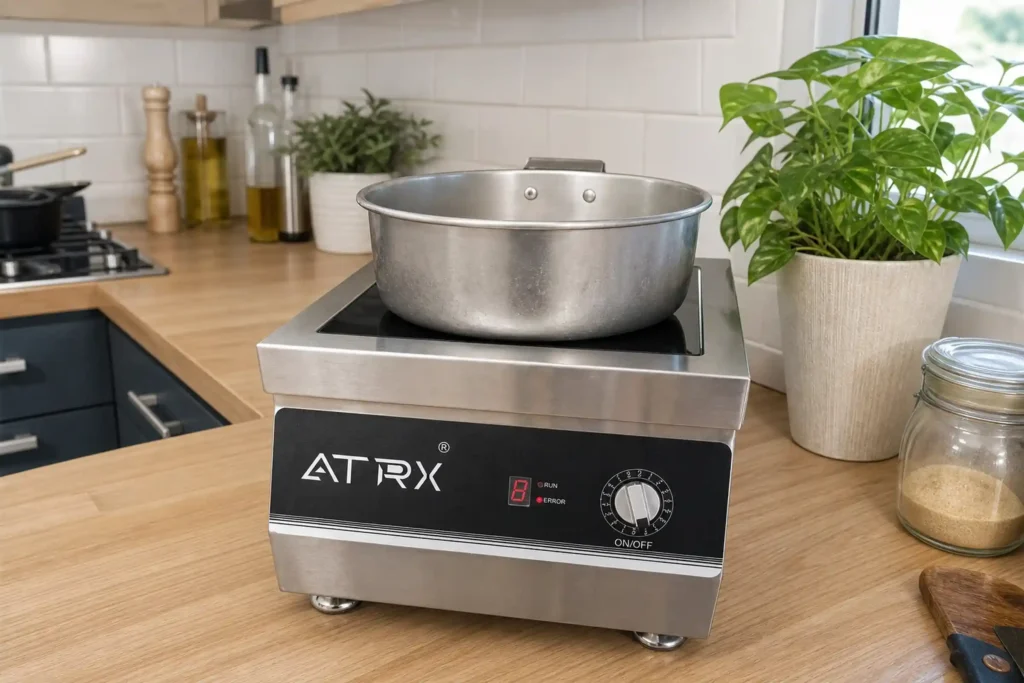
Compatible: cast iron, magnetic stainless steel (magnet sticks to the bottom), and enamel. Not compatible: aluminum, pure copper, glass, and standard ceramic — unless the bottom has a ferromagnetic layer added.
Easiest test: hold a magnet to the bottom of the pot. Sticks firmly? It works. Doesn’t stick? It won’t.
When you buy induction cookers, confirm the manufacturer’s recommended pot specs — minimum/maximum bottom diameter, thickness, and material. Some manufacturers can package matching cookware with the units. That saves you from sourcing and compatibility-matching separately.
This matters even more on bulk projects. Buying cookers and cookware as a set prevents the wave of after-sales complaints that hits when end users grab whatever pots they already have — and find out the hard way they’re incompatible.
About the author
ATRX Team| 18 Years Commercial
Induction Cooker Manufacturer in China
Induction Cooker Manufacturer in China
Related Posts
Commercial Induction Cooker 3500W: Model Selection, Commercial Power and Installation
09/29/2026
How to Install a Built-In Induction Cooktop: A Step-by-Step Guide
09/17/2026
How to Clean a Commercial Deep Fryer: A Step-by-Step Guide
09/13/2026
High Quality Commercial Induction Cooker Manufacturer
09/09/2026
Automatic Wok Machine: Types, Specifications, Applications and Buying Guide
08/18/2026
Commercial Induction Range: How to Choose the Right Size, Power, and Configuration for a Commercial Kitchen
08/15/2026
What Is a Commercial Induction Cooker and How Does It Work
08/13/2026
Commercial Induction Range for Hotel Kitchens: How to Choose the Right Model
08/11/2026
China Commercial Induction Cooker Manufacturer
08/09/2026
10 Best Commercial Induction Cooker Manufacturers & Supplier Selection Guide [2026]
08/07/2026