

Which Induction Is Better? 3.5KW or 5KW
05/11/2026
Estimated reading time: 2 minutes

3.5KW and 5KW are the two most common power levels for commercial induction cooktops. Which one you pick comes down to your menu, how fast you need to push out dishes, and whether your kitchen’s wiring can handle it. This article won’t explain how induction works. It won’t try to talk you into switching from gas, either—you’ve already made that call. Right now you just need to answer one question: between 3.5KW and 5KW, which one actually fits your kitchen?
Below, we break down the real differences across four areas: specs, heating performance, cooking-task fit, and business-type match.
IN THIS ARTICLE
3.5KW vs. 5KW — Key Specs Side by Side
Big picture first, details after. This table puts the core numbers next to each other so you can get an initial read in 30 seconds.
| Comparison | 3.5KW | 5KW |
|---|---|---|
| Rated Power | 3,500W | 5,000W (about 43% higher) |
| Rated Current (220V) | ≈16A | ≈23A |
| Time to Boil 10L of Cold Water | About 7–8 min | About 5–6 min |
| Best-Suited Tasks | Simmering sauces, boiling noodles, slow braising, light sautéing | High-heat stir-frying, deep frying, rapid large-pot boiling, high-throughput primary stations |
| Electrical Requirements | 20A breaker, 2.5mm² dedicated line | 30A breaker, 4mm² dedicated line |
| Equipment Price Range (FOB) | $150–$200 | $180–$250 |
| Daily Energy Profile | Runs at medium-low (800–2,000W) most of the time; lower energy cost | When high-heat tasks dominate, higher output per hour makes overall efficiency better |
One-line takeaway: 3.5KW is not a “budget version,” and 5KW is not “overkill.” They serve different jobs. If you’re also looking at power levels beyond these two—anywhere from 3KW to 40KW—check out our full guide to commercial induction cooktop power selection first. Everything below focuses only on 3.5KW vs. 5KW, so you can figure out which side your kitchen lands on.
How Much Slower Is 3.5KW Than 5KW at Boiling and Reheating?
The power gap is 43%. But what does that mean in real cooking? Let’s look at two everyday scenarios: boiling from cold, and recovering temperature after adding ingredients.
Boiling the Same Pot of Water — How Many Minutes Apart?
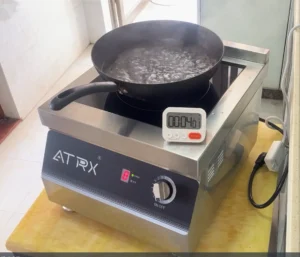
10 liters of cold water starting at 20°C (68°F). A 3.5KW unit takes roughly 7–8 minutes to hit a rolling boil. A 5KW unit gets there in about 4–5 minutes. That’s close to a 40% difference.
On its own, “3 fewer minutes” doesn’t sound like a big deal. Put it in a peak-hour context and it adds up fast. On the same station, a 5KW can run 2–3 more boiling cycles per hour than a 3.5KW.
For noodle shops, congee stalls, or any kitchen doing repeated large-pot boiling, that’s not “a bit quicker.” It’s the difference between serving a few extra tables every rush.
The Frontier Energy analysis published through the U.S. DOE’s Better Buildings program backs this up: in the 2.5KW–5KW range, higher power shows a clear production-efficiency edge on large-volume boiling tasks.
That said, if your daily routine is simmering sauces, warming soup, or low-temp cooking—jobs that don’t need rapid boiling—7–8 minutes on a 3.5KW is perfectly fine.
Cold Ingredients Go In — How Fast Does Oil Temperature Come Back?
This is called “temperature recovery speed.” During back-to-back service, it matters even more than boil time.
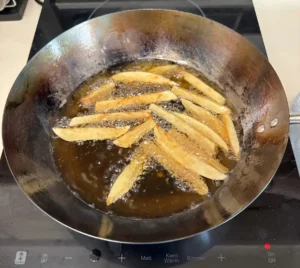
Here’s the scenario: oil is at 350°F (about 175°C). You drop in a batch of frozen fries or frozen chicken. A 5KW unit pulls the oil back to set point in 15–20 seconds. A 3.5KW unit takes 60–90 seconds.
That’s not just a longer wait. When oil temperature drops too far and recovers too slowly, fried food soaks up oil and the crust goes soft. Same thing with stir-frying—if pan heat doesn’t bounce back fast after you add ingredients, vegetables sweat, meat toughens, and the whole plate looks grey and limp.
Which Dishes Work on 3.5KW, and Which Ones Need 5KW?
Numbers and heat-up times are useful. But what really settles the decision is the food you cook every day.
What 3.5KW Handles Well
These tasks have one thing in common: they don’t need sustained high heat output.
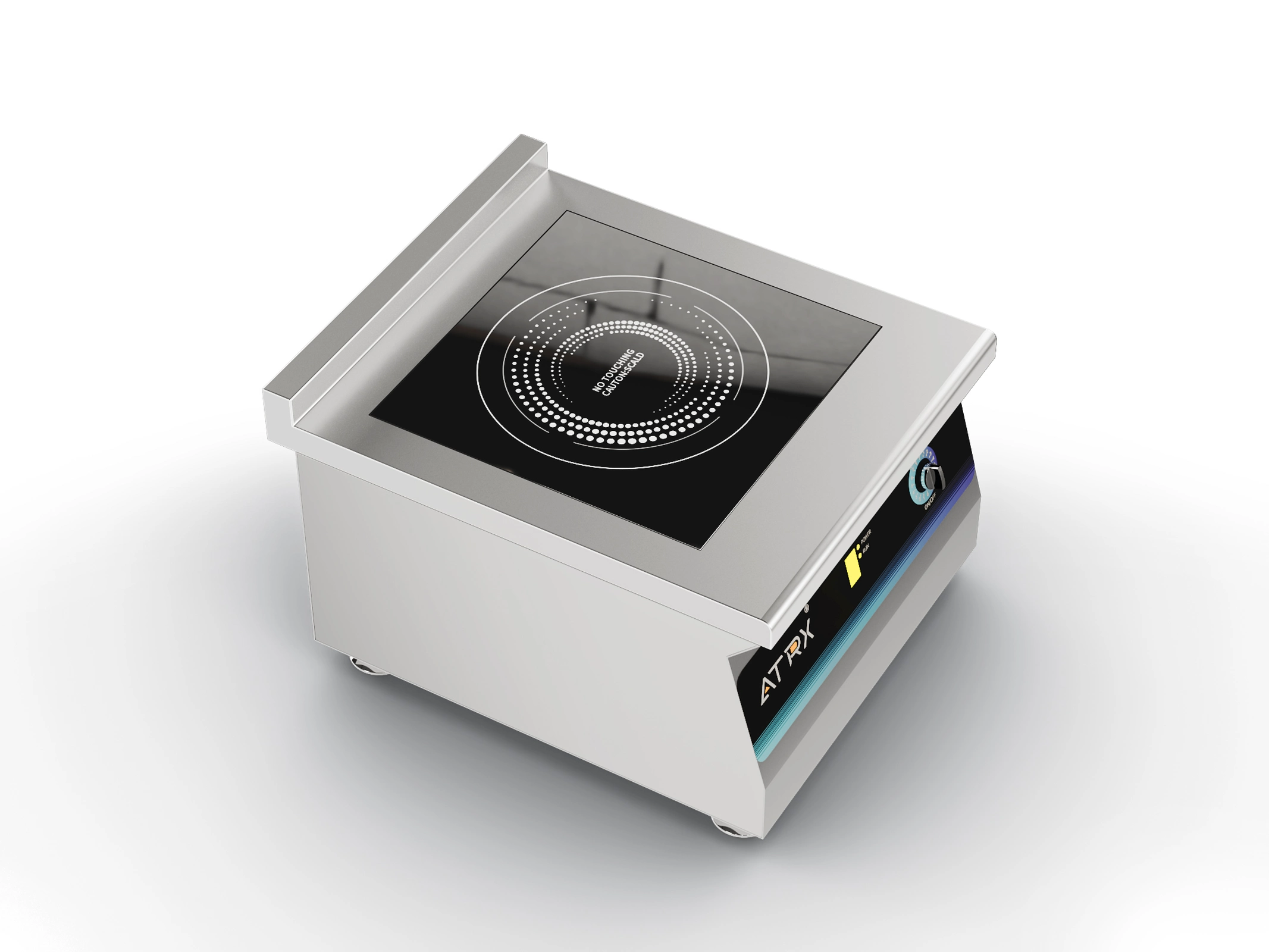
- Simmering sauces and stock — Bring it to a boil, drop to medium-low, hold it there. Actual running power is usually 800–1,500W. A 3.5KW unit has plenty of headroom.
- Boiling noodles, blanching, pasta — The pot stays at a rolling boil the whole time. 3.5KW holds that easily—unless your pot is over 20 liters.
- Low-temp braising and holding — Power demand is even lower. For this kind of work, 3.5KW is almost more than you need.
- Light pan work — Eggs, pancakes, small-batch skillet sautés. 3.5KW is more than enough.
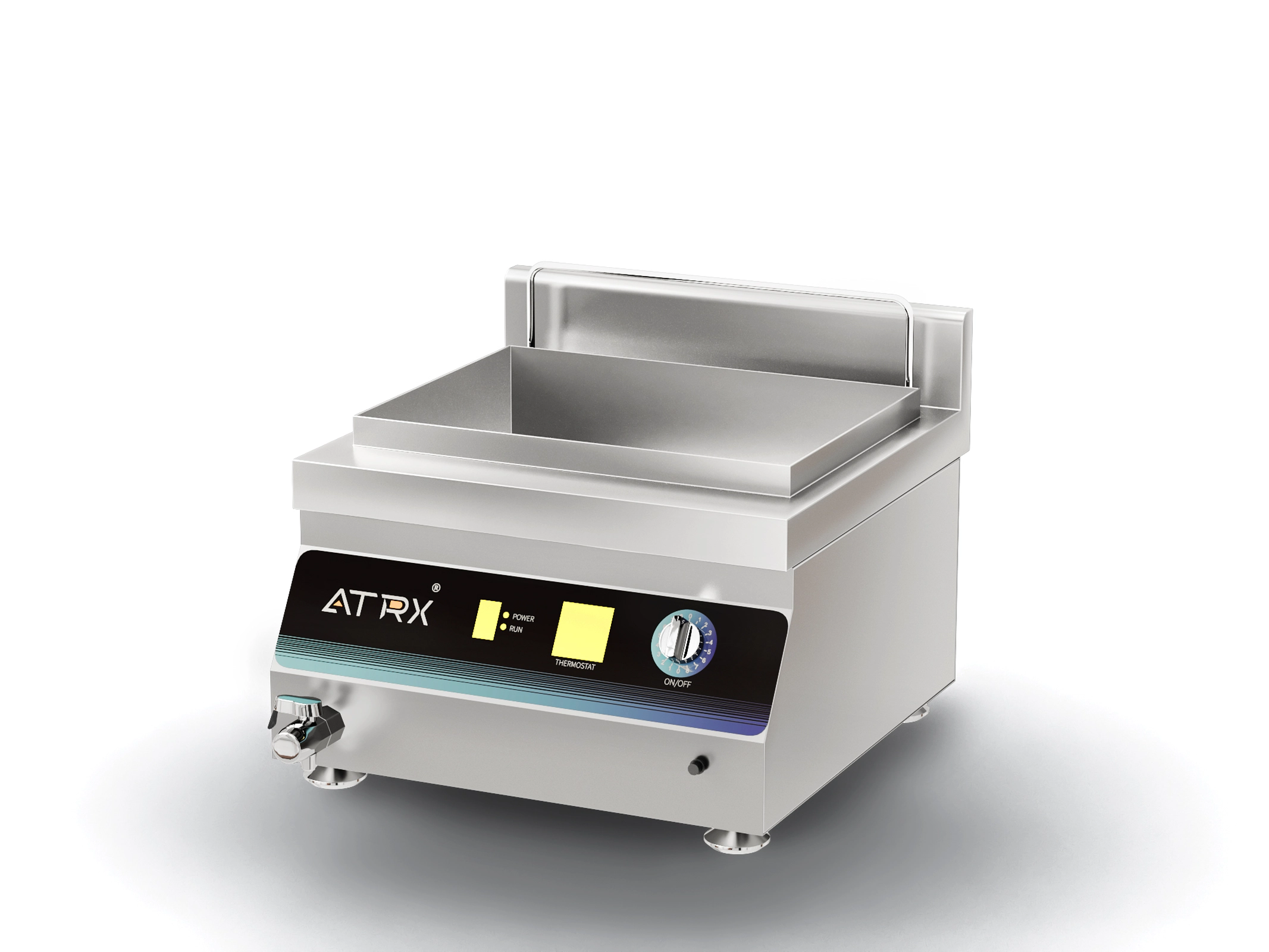
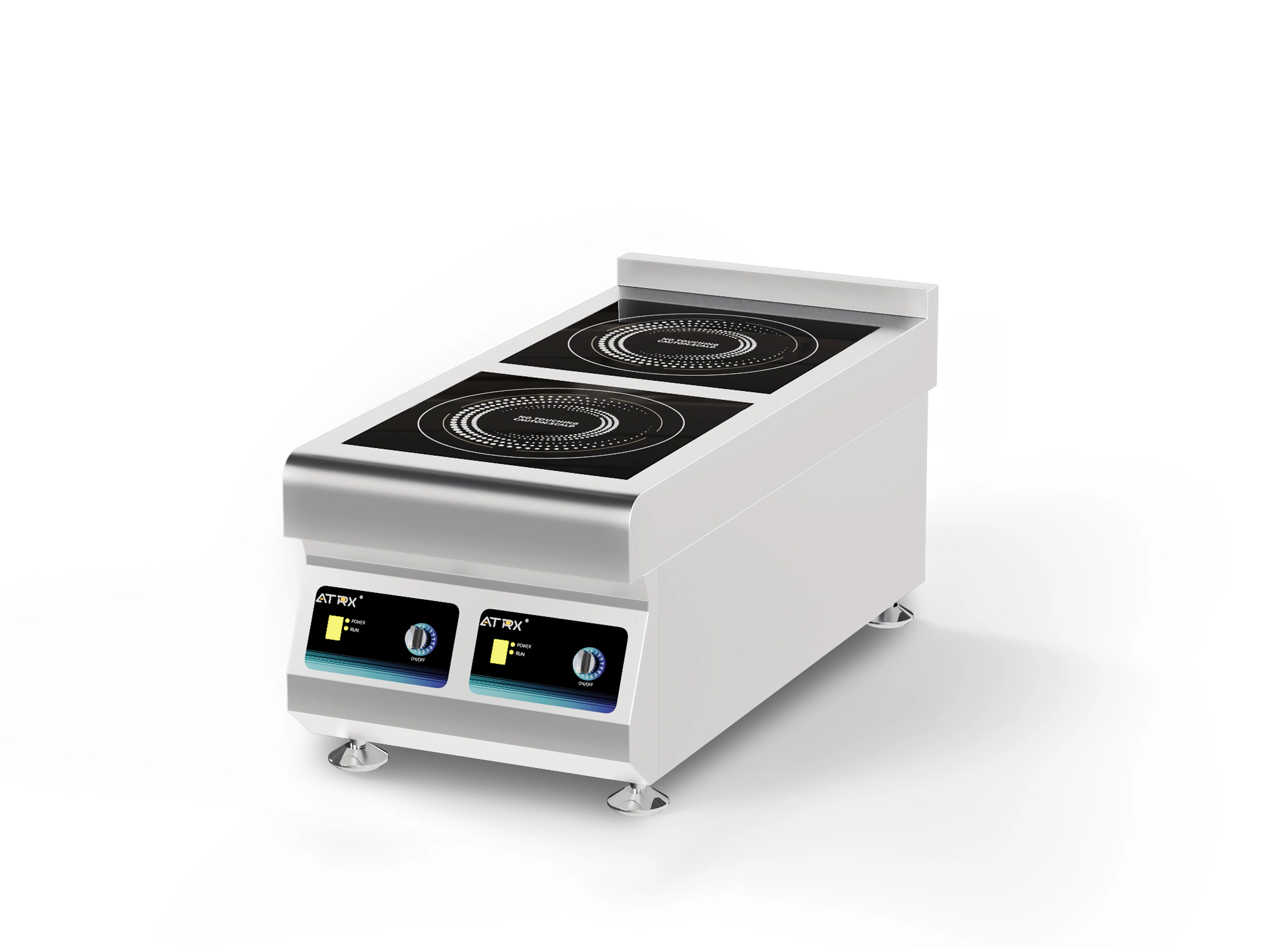
Blue Seal’s Waldorf commercial induction line puts it simply in their product notes: “À la carte kitchens—cooking to order, one portion at a time—do well with 3.5KW.”
Where 5KW Is Non-Negotiable
These tasks are the opposite: they need a big burst of heat in a short time, or they need to replace the heat that cold ingredients pull out—fast.
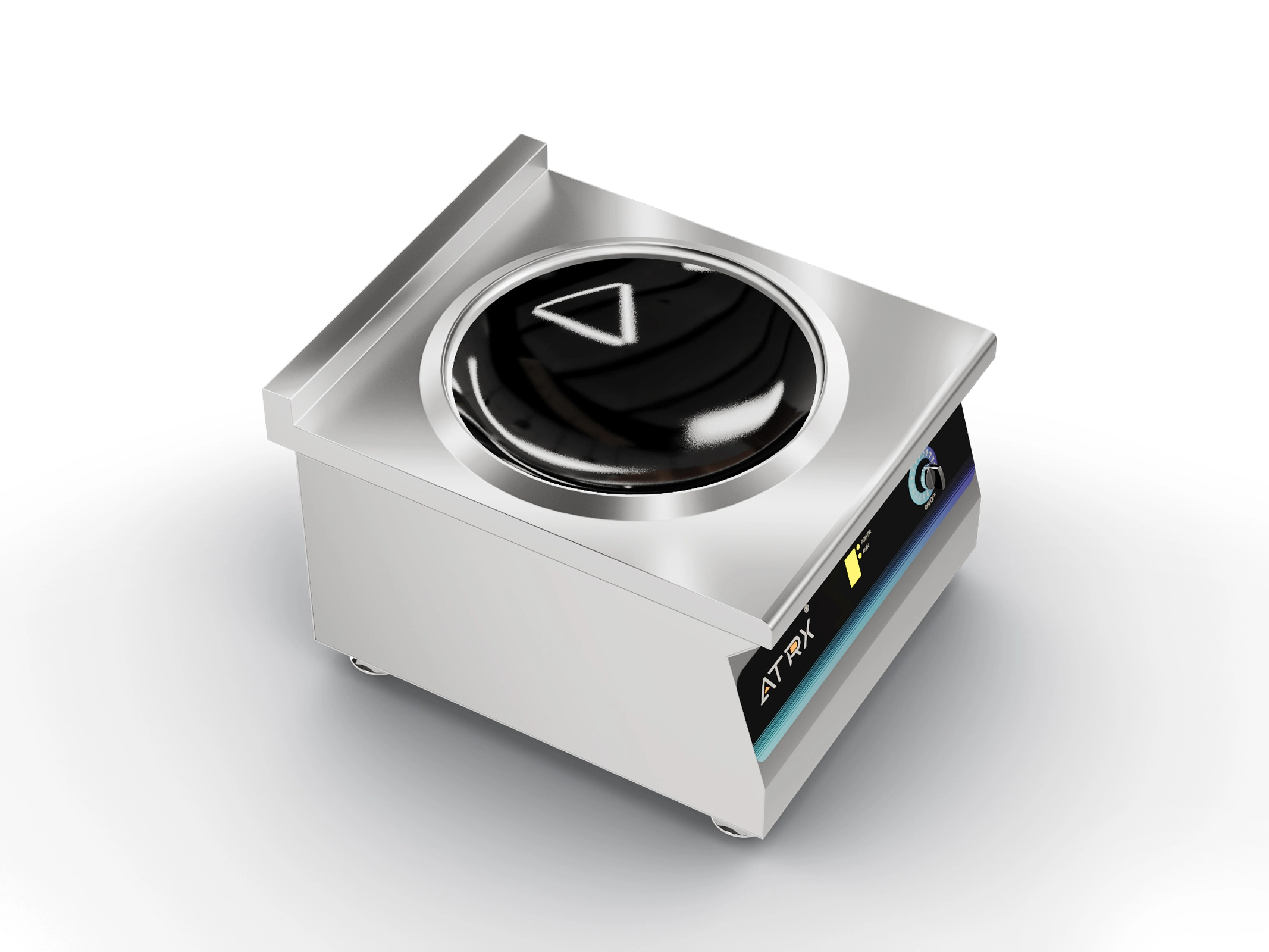
- Rapid large-pot boiling (20+ liters) — Cafeteria and central-kitchen batches of congee or soup. A 3.5KW can get there, but it’s too slow and backs up your prep schedule.
- Commercial deep frying — Frozen items crash the oil temperature. A 3.5KW recovers too slowly, and the food comes out greasy with a soft crust. A 5KW holds oil steady at 350°F.
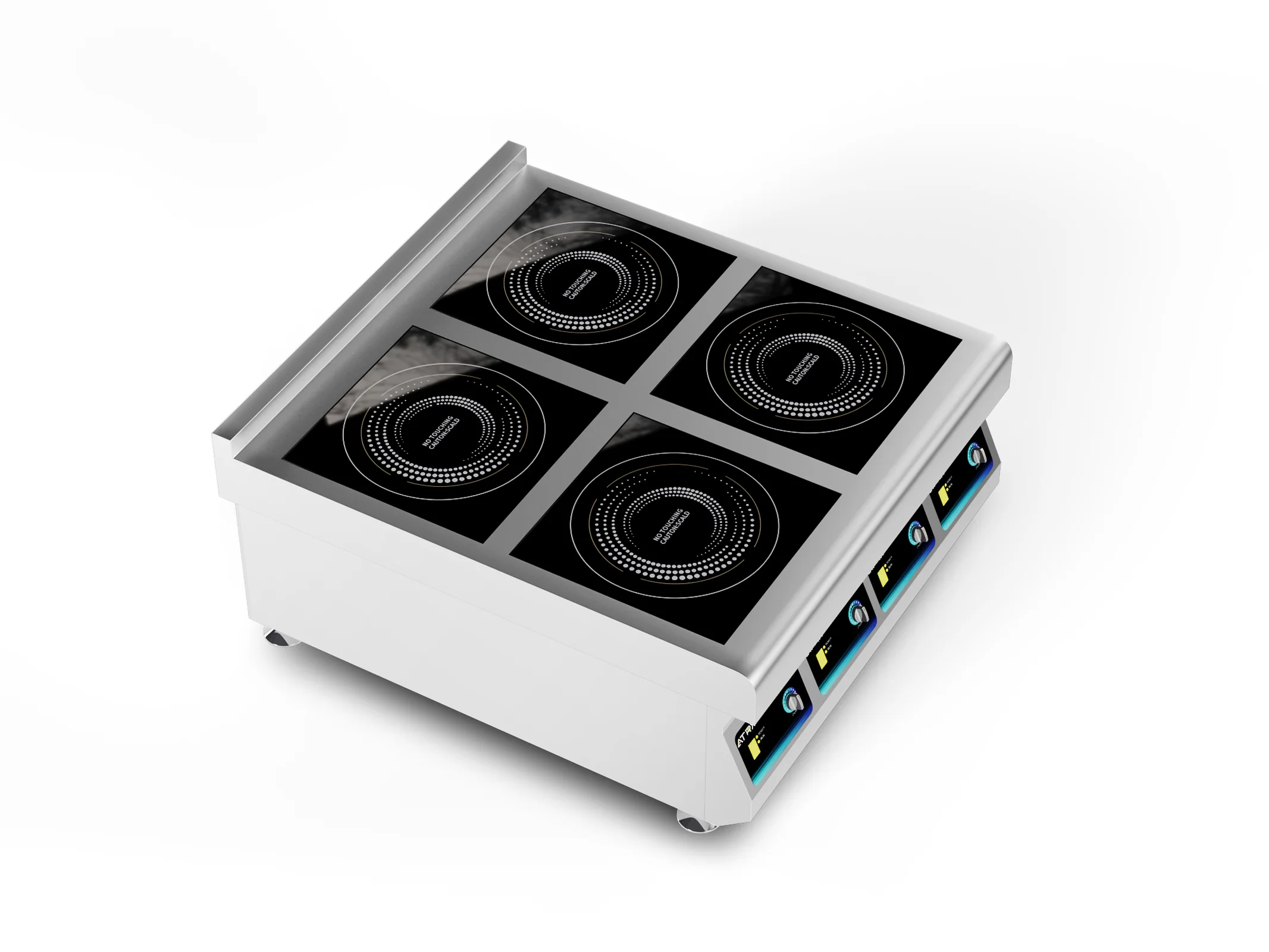
- High-volume stir-frying — Big wok, heavy load, constant tossing. Every time food hits the pan it pulls heat away. If the power isn’t there, you can’t get the sear you need.
All three share a hard requirement for peak heat output and fast heat recovery. A 3.5KW can technically do these jobs. But the quality takes a hit—and your customers can taste the difference.
Should You Go 3.5KW, 5KW, or Mix Both?
You now know how these two power levels differ in speed, task fit, and wok performance. Last step: match all of that to your type of business.
Cafés and Light-Dining — 3.5KW Makes More Sense
If your menu is mostly light fare, 3.5KW is the smarter buy. In these kitchens, throughput comes from streamlined workflow—not burner power.
Typical profile: no heavy stir-frying or deep frying, moderate use per station, and a limited electrical budget where running 30A dedicated circuits isn’t worth it.
3.5KW shines here. Lower unit cost. Plugs into a standard 20A circuit. Energy bills stay low because daily operation sits in the medium-to-low range. The money you save on hardware goes to menu development or front-of-house.
ENERGY STAR certification for commercial cooktops requires a minimum 80% cooking efficiency. Certified models save roughly 5% more than standard electric stoves. For a light-dining setup cruising at medium-low power most of the day, the long-term savings add up quickly.

Chinese Restaurants and High-Heat Cuisines — Go with 5KW
When the menu is built around stir-frying, deep frying, and large-batch stock, 5KW is the safer call. During rush hour, every station needs to keep firing without gaps.
Blue Seal calls this a “Production Kitchen” in its specs and recommends 5KW outright. The reason is simple: these kitchens have a hard floor for “dishes per hour per station,” and that floor is set by how fast each station heats up and recovers.
Picking 5KW here doesn’t mean buying “more expensive gear.” It means buying throughput that doesn’t drop off when the rush hits. The extra $100–$150 per unit pays back fast once you’re plating a few more dishes per day.

Mixing Both Power Levels — The Setup That Saves the Most
Not every station in your kitchen does the same job. Some handle stir-frying all day. Others just simmer stock or hold temperature. So why give every station the same power?
A setup that works: 5KW on the main stir-fry and frying stations, 3.5KW on the simmering and holding stations. A six-burner kitchen, for example, could run four 3.5KW units and two 5KW units.
That gets you three wins. Electrical costs go down—only two stations need 30A/4mm² lines; the other four run on 20A/2.5mm². Equipment spend drops because you’re not paying 5KW prices across the board. And performance stays where it needs to be—high power where the work demands it, right-sized power everywhere else.
For most mid-sized kitchens, this mix isn’t a “compromise.” It’s the best answer. You don’t have to pick one power level for every station. Once you’ve nailed down the right split, visit our portable commercial induction cooktop product page to see the exact models and specs in both 3.5KW and 5KW.
There’s no “better” power level—only the one that fits your kitchen better. Go back to the comparison table at the top, hold it up against your menu, your daily volume, and your wiring, and the answer is already there.
Common Questions People Ask
Q1: Can I buy 3.5KW now and upgrade to 5KW later?
The equipment itself can be swapped anytime. The wiring might not be ready. A 3.5KW runs on a 20A breaker with 2.5mm² cable. A 5KW needs a 30A breaker with 4mm² cable.
If you originally wired for 3.5KW, upgrading means pulling new cable and swapping the breaker. That construction cost can end up higher than the price gap between the two units. Our advice: even if you buy 3.5KW today, wire the circuit to 30A/4mm² specs now. When you move to 5KW later, just plug it in. No wall work.
Q2: If 3.5KW can’t keep up during rush hour, do I have to replace every unit with 5KW?
Usually not. First figure out whether every station is falling behind, or just one or two. Most of the time, the bottleneck is the stir-fry or frying station. The simmering and holding spots are still fine at 3.5KW.
Upgrading only the bottleneck stations to 5KW saves more than half the cost of a full swap—with almost the same boost in throughput.
Q3: Are the 3.5KW and 5KW units the same size? Can I just swap one in?
Most commercial countertop induction cooktops use the same body for the 3.5KW and 5KW versions. Cutout size and counter footprint are basically identical, so a straight physical swap works.
Two things to watch, though. First, 5KW units usually have a bigger cooling fan and run a little louder. Second, 5KW is pickier about pot-bottom thickness—pots thinner than 3mm may trip the overheat protection and shut off. Before you swap, make sure your wiring and your pots both check out.
About the author

ATRX Team| 18 Years Commercial
Induction Cooker Manufacturer in China
Induction Cooker Manufacturer in China
Related Posts
Commercial Induction Cooker 3500W: Model Selection, Commercial Power and Installation
09/29/2026
How to Install a Built-In Induction Cooktop: A Step-by-Step Guide
09/17/2026
How to Clean a Commercial Deep Fryer: A Step-by-Step Guide
09/13/2026
High Quality Commercial Induction Cooker Manufacturer
09/09/2026
Automatic Wok Machine: Types, Specifications, Applications and Buying Guide
08/18/2026
Commercial Induction Range: How to Choose the Right Size, Power, and Configuration for a Commercial Kitchen
08/15/2026
What Is a Commercial Induction Cooker and How Does It Work
08/13/2026
Commercial Induction Range for Hotel Kitchens: How to Choose the Right Model
08/11/2026
China Commercial Induction Cooker Manufacturer
08/09/2026
10 Best Commercial Induction Cooker Manufacturers & Supplier Selection Guide [2026]
08/07/2026