

Commercial Induction Steamer Buying Guide: How to Choose Between Rice Steamers and Seafood Steamers
06/30/2026
Estimated reading time: 2 minutes

This guide walks you through everything you need to know about picking, using, and looking after a commercial induction steamer — the differences between rice steamers and seafood steamers, how to match power and tray count to your actual serving volume, and the maintenance habits that keep your equipment running for years. No wasted budget, no surprises, just the right machine doing the right job from day one.
IN THIS ARTICLE
- What Are Induction Rice Steamers and Seafood Steamers?
- Why Are Induction Steamers Better Than Gas and Electric-Heating Steamers?
- What Are the Differences Between Rice Steamers and Seafood Steamers — and Which One Should You Choose?
- How to Choose the Right Power, Capacity, and Size Without Getting It Wrong
- How to Use and Maintain Your Steamer After Purchase
What Are Induction Rice Steamers and Seafood Steamers?
In commercial kitchens, the induction rice steamer and the induction seafood steamer are the two most common types of commercial steamer cabinet. Both use electromagnetic heating to produce steam, but they look different and do different jobs. Before you spend any money, it pays to know what each one is built for.
Induction Rice Steamer: The Workhorse for Steaming Hundreds of Servings at Once
Form Factor and Structure
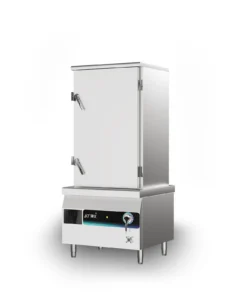
An induction rice steamer is a large, freestanding stainless-steel cabinet with a boxy, no-nonsense build. Inside, multiple tray rack layers sit one above the other, each holding standard GN steam trays horizontally. An electromagnetic heating unit at the base brings the water tank to a boil. The steam then travels through a channeling system and fills the entire cabinet evenly, cooking everything on every tray at the same time.
Depending on capacity, the most common rice steamers come in single-door and double-door versions. Single-door models typically hold 6 or 12 trays — a good fit for small to mid-sized restaurants and canteens. Double-door models can handle 24 or even 36-plus trays, built for high-volume dining halls. Open the door and you see neat rows of steam trays — simple and straightforward.
Core Function
The primary job of this commercial electric steamer for restaurant kitchens is batch-producing staple foods and pastries. Rice, steamed buns, mantou, dumplings, cornbread — anything your kitchen needs in large quantities and on a tight schedule. A double-door 24-tray unit can turn out enough rice for over 200 people in a single run. That kind of throughput is why it’s a daily essential in school cafeterias, corporate dining halls, central kitchens, and chain restaurant back-of-house operations.
In One Sentence
If you see a big, boxy stainless-steel cabinet in a kitchen — open the door and there are rows of steam trays loaded with rice or buns, all billowing with steam — that’s an induction rice steamer. Procurement managers sometimes mix up rice steamers and seafood steamers. Just remember: “whole-cabinet steaming, built for staples.” That alone will keep you on the right track.
Induction Seafood Steamer: Three Independent Layers, Purpose-Built for Seafood and Multiple Dishes
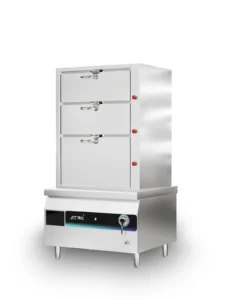
The easiest way to tell a seafood steamer apart from a rice steamer is the door layout. Instead of one large door, a seafood steamer has three separate compartments — top, middle, and bottom — each with its own door that opens and closes on its own. The body is still stainless-steel upright, but the front shows three doors stacked vertically. Many models also come with double-layer tempered glass windows so chefs can check each layer without opening anything up.
The three compartments are divided by solid panels, and each one gets steam from its own dedicated pipe — no crossover between layers. This “three-layer independent” layout solves one specific problem: flavor transfer. Put crabs on top, prawns in the middle, and clams on the bottom. All three steam at the same time, but each keeps its own clean flavor. No mixing, no muddying.
A Cantonese restaurant owner once told us that when he used a single-cavity steamer for fish and crab together, the fish always picked up an unwanted crabby taste. After switching to a three-compartment induction seafood steamer, the problem disappeared entirely — and that is the single most common piece of feedback we hear from clients who make the switch.
Because of this design, these units show up most often in seafood restaurants, Cantonese kitchens, steam-seafood themed venues, and large banquet kitchens — anywhere “steam it fresh, serve it fast” is the standard and preserving each ingredient’s natural flavor really matters.
The table below gives you a quick side-by-side look at the key differences between the two types:
| Comparison | Induction Rice Steamer | Induction Seafood Steamer |
|---|---|---|
| Door Configuration | Single or double door; one or two large shared compartments | Three independent doors; top, middle, and bottom independent compartments |
| Internal Structure | Multi-layer tray racks (6–36 trays) sharing one steam space | Three independent compartments separated by dividers, each with its own steam supply |
| Typical Appearance | Boxy cabinet; open the door to see rows of steam trays | Three doors stacked vertically on the front; often equipped with glass observation windows |
| Primary Steaming Targets | Rice, steamed buns, mantou, dumplings, and other staple foods and pastries | Crabs, shrimp, shellfish, steamed fish, and various steamed dishes |
| Core Use Scenarios | School cafeterias, corporate dining halls, central kitchens, chain restaurants | Seafood restaurants, Cantonese restaurants, steam-seafood themed venues, banquet kitchens |
| Defining Feature | Large capacity, high batch-output efficiency | Three independent layers prevent flavor crossover, preserving each ingredient’s natural taste |
Why Are Induction Steamers Better Than Gas and Electric-Heating Steamers?
The best way to answer this is to put all three types side by side and compare them on two things that matter most: cost and working conditions. An industrial induction steamer uses electromagnetic induction — the pot itself heats up and produces steam. A gas steamer burns natural gas. A traditional electric-heating steamer runs on resistance coils. The heating method alone creates huge differences in both your energy bills and your kitchen environment.
Real-World Energy Consumption Comparison: How Much Can an Induction Steamer Save Per Year?
The efficiency gap is where the savings come from. A commercial induction food steamer generates heat directly inside the pot body through an electromagnetic field. Almost nothing is wasted in the process. Real-world tested thermal efficiency hits 90%–95%. Gas steamers rely on open-flame combustion, and a big chunk of that heat escapes through exhaust and radiation — typical thermal efficiency sits at just 55%–70%. Traditional electric-heating steamers also use electricity, but the heating elements have to get red-hot first before passing heat to the water, landing at roughly 70%–80% efficiency. Put simply, for every $1 of energy you burn, an induction steamer turns over 90 cents into useful steam. A gas steamer? Barely over 50 cents.
On the actual bill, the gap is hard to miss. Bringing 55 kg (about 120 lbs) of room-temperature water to a boil costs roughly $0.98 on an induction steamer and $2.42 on a gas steamer — nearly 1.5 times more. Run a steamer 6 hours a day, 365 days a year, and the induction unit saves you around $9,000 annually compared to gas. Even against a traditional electric-heating steamer — which also runs on electricity — the induction model’s higher conversion efficiency shaves 20%–30% off the yearly power bill.
The higher sticker price pays for itself fast. A commercial induction steam cooker typically costs more upfront than a gas or electric-heating model. But energy savings alone usually cover the price difference within 12–18 months. After that, every dollar saved is straight margin.
Real numbers back this up. During a kitchen energy audit conducted for a Southeast Asian fast-food chain, the operator shared six months of utility bills from before and after replacing three gas steamers with induction units at a single location. Monthly energy costs dropped from $2,850 to $1,220 — a 57% reduction that tracked almost exactly with efficiency-based projections. When multiple steamers run side by side, those savings stack up even faster.
This isn’t just theory, either. A side-by-side boiling test — 3.5 kW induction cooktop versus a 7 kW gas burner, same pot of water — showed the induction unit matching the gas burner’s speed at half the wattage, while costing far less to run. You can see the results in our ATRX real-world test video: Gas VS Induction Cooktop Test. The test uses a tabletop cooktop and a gas burner, but the electromagnetic heating principle is identical to what powers a full-size steamer — it makes the efficiency advantage very easy to see.
Safety and Kitchen Environment Comparison: Induction Steamers Make the Back-of-House Cooler and Safer
The biggest safety win with an induction steamer boils down to three things it simply doesn’t have: no open flame, no gas piping, no combustion. That means the root causes of gas leaks and fire incidents are gone from the start. On top of that, the unit comes with layered protection built in. Over-temperature protection cuts power if the pot gets abnormally hot. Low-water protection stops heating the moment the tank drops below a safe level. Over-voltage and under-voltage protection disconnects the circuit when the grid fluctuates. Any fault triggers an automatic shutdown and alarm — no one needs to babysit the machine.
Now look at the kitchen itself. Gas steamers burn fuel nonstop while running, pumping exhaust (including CO₂ and CO) and waves of heat into the back-of-house. The result is a hot, stuffy workspace where chefs tire out fast. Traditional electric-heating steamers skip the exhaust, but their exposed elements run extremely hot — a real burn risk during loading and unloading — and the radiant heat still pushes room temperature up.
Induction steamers have no combustion and no exposed high-temperature elements. They release almost no excess heat into the room. The difference in how the kitchen feels is immediate and obvious.
| Comparison Dimension | Induction Steamer | Gas Steamer | Traditional Electric-Heating Steamer |
|---|---|---|---|
| Open-Flame Risk | No open flame; zero fire hazard | Open flame present; fire risk exists | No open flame |
| Gas Leak Risk | No gas piping connected; no possibility of leaks | Leaks possible from pipe aging or improper installation | No gas involved |
| Equipment Protection | Over-temp / low-water / over-voltage & under-voltage / phase-loss protection; auto-shutdown on any fault | Typically only basic flame-out protection | Some models have dry-burn protection, but coverage is incomplete |
| Burn Risk | Low exterior surface temperature; minimal burn risk | High temperatures around the unit; burn risk present | Extremely high heating element surface temperature; significant burn hazard |
| Exhaust Emissions | Zero emissions; no additional exhaust system needed | Produces CO₂, CO, and other exhaust; requires exhaust piping | No exhaust emissions |
| Kitchen Temperature Impact | Virtually no residual heat; kitchen feels noticeably cooler | Large amounts of residual heat; obviously hot and stuffy | Moderate radiant heat; some temperature increase |
| Venue Restrictions | Suitable for shopping malls, basements, hotel central kitchens, and other no-open-flame venues | Prohibited in some shopping malls and underground spaces | Usable in most venues, but electrical circuit capacity must be verified |
For restaurant operators, safer equipment means lower insurance costs and fewer compliance headaches. A cooler back-of-house means better productivity and less staff turnover. In shopping mall storefronts that ban open flames, underground restaurants, and hotel central kitchens with strict fire codes, a commercial induction steamer is often the only option that checks both the safety box and the output box at the same time.
What Are the Differences Between Rice Steamers and Seafood Steamers — and Which One Should You Choose?
Rice steamers and seafood steamers are the two categories buyers compare most. Both cook with steam, but their design thinking and best-fit scenarios are completely different. Getting clear on the differences is the first step toward choosing the right commercial steam cooker for your kitchen.
The Core Design Differences Between the Two Types Are Immediately Obvious
Completely different compartment structures. A rice steamer is one big enclosed cabinet — single-door or double-door. Open it up and you find a single continuous steam space. Multiple tray layers sit top to bottom inside that one cavity, all fed by the same steam generator at the base. A seafood steamer splits the cabinet into three sealed compartments — top, middle, bottom — each with its own door, its own steam generator, and its own temperature control. Every layer is a self-contained mini steam box.
Opposite steam logic. A rice steamer runs on “shared steam.” Every tray sits in the same temperature and humidity environment, and the goal is uniform results across a large batch — dozens of trays of rice all heated identically. A seafood steamer runs on “steam isolation.” The three compartments don’t connect at all. Each one makes its own steam and holds its own temperature, so different ingredients can cook side by side without swapping flavors.
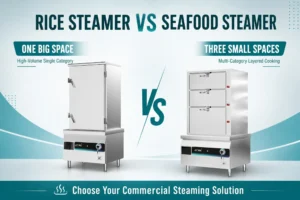
The essential difference in one sentence. A rice steamer is “one big space steaming one thing,” built for high-volume output of a single category. A seafood steamer is “three small spaces steaming three things at once,” built for multi-category, layered, independent cooking. Once you have that mental model, every sizing and purchasing decision that follows gets a lot simpler.
Match Your Restaurant Type to the Right Steamer — No More Second-Guessing
You don’t need to dig into spec sheets. Just ask yourself: “What does my kitchen mainly steam, and how much of it?” The answer points you straight to the right machine. The table below maps common scenarios to a clear recommendation:
| Restaurant / Scenario Type | Daily Steaming Needs | Recommended Steamer Type |
|---|---|---|
| School cafeterias, factory canteens, corporate catering | Primarily rice, mantou, and large-batch dishes; limited variety but high volume | Rice Steamer |
| Seafood restaurants, Cantonese restaurants, live-steam seafood venues | “One ingredient, one pure flavor” — multiple seafood types must be steamed separately to prevent flavor crossover | Seafood Steamer |
| Full-service Chinese restaurants | Need large quantities of rice at peak hours, plus steamed fish, ribs, dim sum, and other multi-category items | Rice Steamer + Seafood Steamer (used together) |
| Hotel banquet kitchens | High volume and wide variety — a single banquet may need hundreds of rice servings plus a dozen different steamed dishes | Rice Steamer + Seafood Steamer (used together) |
Full-service Chinese restaurants and hotel banquet kitchens are the trickier cases. One steamer type alone can’t cover everything. The practical move is to let the rice steamer handle staples and large-batch items while the seafood steamer takes care of dishes that need their own dedicated space. Each unit does what it’s best at.
The real question isn’t which steamer is more advanced. It’s which one fits your actual service pattern. Pin down your core steaming needs first, check the table, and the answer is usually obvious.
How to Choose the Right Power, Capacity, and Size Without Getting It Wrong
Two things go wrong most often when buying a commercial steamer cabinet: picking one that’s too small and struggling through every rush, or picking one that’s too big and paying for space and power you’ll never use. This section sticks to the two questions that matter most — “How big?” and “Will it fit?” Get your serving numbers and your tape measure ready, and you’ll dodge the most common mistakes.
Match Power and Tray Count to Your Daily Serving Volume — One Table Tells All
Step one isn’t price or brand — it’s answering a simple question: how many meals does your kitchen need to push out every day? Power and tray count set the ceiling on what a steamer can produce. Go too small and you’re scrambling at peak hour. Go too big and you’re burning electricity for trays that sit empty.
Across the industry, commercial induction food steamer products follow a very similar power-and-tray structure — the tier breakdowns below apply to the vast majority of brands on the market. Where products really differ is in the quality of internal components like electromagnetic modules and temperature sensors, not in the sizing logic itself. Here’s how the tiers break down:
100–300 meals/day (small restaurants, fast-casual outlets): go with 12–15 KW. That means a single-door 12-tray rice steamer or a 12 KW three-door seafood steamer. A neighborhood restaurant doing 200 covers a day — about 100 at lunch, 100 at dinner — can handle the full staple-food demand in one cycle. Each tray holds roughly 5 kg of rice. Twelve trays at capacity covers around 300 servings. Plenty of headroom, no wasted energy.
300–600 meals/day (mid-sized restaurants, chain outlets): go with 20–30 KW. For rice steamers, that’s a double-door 24-tray model. For seafood steamers, a 20–25 KW three-door unit. Double doors let you run both compartments at once — rice on one side, buns or dishes on the other — and your output doubles. Especially useful for corporate cafeterias and chain fast-food spots where the lunch crunch hits hard.
600+ meals/day (school cafeterias, central kitchens): go with 35–40 KW. Rice steamers at this tier are double-door 36-tray models. Seafood steamers run 30–35 KW with three doors. The goal here is maximum output per cycle. Thirty-six full trays can feed over a thousand people in one run, cutting down on reloads so the line keeps moving at mealtime.
One corporate catering operator originally picked a single-door 12-tray rice steamer for a kitchen that needed to serve over 400 meals a day. The result: three back-to-back steaming cycles every lunch rush, and a kitchen in constant chaos. After upgrading to a double-door 24-tray model, the same volume got done in about a cycle and a half, and peak-hour flow smoothed out right away. The sizing rule is simple: count your daily meals first, then match the tier. Don’t guess.
(Note: The table below uses ATRX’s AT-FLRT rice steamer series and AT-FLSF seafood steamer series as reference examples. These models follow the same industry-standard power and tray-count tiers described above.)
| Daily Serving Volume | Recommended Power | Rice Steamer Selection (AT-FLRT Series) | Seafood Steamer Selection (AT-FLSF Series) |
|---|---|---|---|
| 100–300 meals | 12–15 KW | Single-door 12-tray rice steamer | 12 KW three-door seafood steamer |
| 300–600 meals | 20–30 KW | Double-door 24-tray rice steamer | 20–25 KW three-door seafood steamer |
| 600+ meals | 35–40 KW | Double-door 36-tray rice steamer | 30–35 KW three-door seafood steamer |
Measure Your Kitchen Before You Order — Don’t Buy Equipment That Won’t Fit
Once power and tray count are settled, do the one thing most buyers skip: grab a tape measure and check the actual space where the steamer will go. These are not countertop appliances. Size differences between models are big — a double-door 36-tray rice steamer runs 1.5 meters long and over 1.1 meters deep. If you don’t measure ahead of time and the unit won’t clear the hallway or fit its slot after delivery, you’re stuck.
The table below lists external dimensions for common models. Use it to compare directly against your kitchen’s available
| Equipment Type | Model Specification | External Dimensions (L × W × H) |
|---|---|---|
| Rice Steamer (Single-door 12-tray) | AT-FLRT Series | 900 × 800 × 1870 mm |
| Rice Steamer (Double-door 24-tray) | AT-FLRT Series | 1100 × 900 × 1870 mm |
| Rice Steamer (Double-door 36-tray) | AT-FLRT Series | 1500 × 1100 × 1670 mm |
| Seafood Steamer (All models) | AT-FLSF Series | 950 × 900 × 1870 mm |
Beyond the footprint itself, two details are easy to overlook. First, leave room for operation and airflow. Steamers release large volumes of steam and heat while running. Keep at least 10–15 cm clear behind and on both sides for ventilation. In front, you need enough space to open the door and pull trays — 60 cm minimum for single-door models, 80 cm or more for double-door. Otherwise, two people pulling trays at the same time during a rush becomes a tight squeeze.
Second, check your power supply. Every commercial induction steamer model listed above runs on 380V three-phase electricity — completely different from a standard 220V household outlet. Before you order, confirm your kitchen already has 380V three-phase service and that the existing capacity can handle the unit’s rated wattage. If it can’t, you’ll need to apply for a capacity upgrade through your building management or utility provider. That process usually takes one to two weeks — don’t wait until the steamer shows up to find out you can’t plug it in.
Two steps, in short: measure the space with a tape, then check the breaker panel for capacity. Once both check out, place your order with confidence. If you already know your power and tray requirements and want to browse specific models, head over to our commercial induction steamer product page for full specs on both rice steamers and seafood steamers.
How to Use and Maintain Your Steamer After Purchase
Steaming Time and Heat Settings Reference for Different Ingredients
First thing to sort out once your new unit is in place: how much heat and how long for each type of food. The ATRX engineering team tested hundreds of batches across different ingredients on the same steamer during factory trials, logging the best heat level and timing for each. The numbers below come straight from those tests and work as a solid baseline for most industrial induction steamer models:
| Ingredient Category | Recommended Heat | Reference Duration | Key Tips |
|---|---|---|---|
| Rice | Medium | 30–40 minutes | Get the water-to-rice ratio right; once the water is absorbed, let it sit for 5 minutes — the texture evens out |
| Steamed buns (baozi) / Mantou | Medium-High | 10–15 minutes | Too-low heat makes the skin gummy; too-high heat cracks the surface |
| Shrimp / Crab / Shellfish | High | 8–12 minutes | High heat and quick timing lock in the fresh flavor; go too long and the meat turns rubbery |
| Vegetables (leafy greens, gourds) | Medium | 3–5 minutes | Oversteaming turns them yellow and mushy — shorter is better |
You can fine-tune based on batch size and your unit’s power output, but the table above gives you a tested, reliable starting point.
A few operational details also make a real difference in results. Keep enough space between trays so steam flows freely through the whole compartment. If the gaps are too tight, the top layer cooks through while the bottom stays underdone. Inside each tray, don’t pile food too high or pack it too tight. Leave room between pieces so steam can reach every surface evenly.
Most commercial steamer cabinets include a built-in timer and adjustable heat levels. Start using them from the first day. When time’s up, the unit stops heating or sounds a reminder automatically. That prevents oversteaming, saves energy, and frees your team to handle other prep instead of standing by the machine. Small habits like these keep output quality steady and push overall kitchen efficiency up a clear notch.
Daily Cleaning and Regular Descaling — Do This to Add Years of Service Life to Your Equipment
Looking after a commercial electric steamer for restaurant use isn’t hard. The key is breaking the work into daily, weekly, and monthly tasks so nothing falls through the cracks. Here’s a practical checklist by frequency:
Daily (after closing)
- Wipe all exterior surfaces with a damp cloth to remove grease and water marks. Left alone, that grime slowly eats into the finish.
- Pull out every tray and wash them individually with a mild detergent. Then rinse the inside of the steamer cavity with clean water to flush out food scraps and condensation — this stops odors and bacteria before they start.
Every 1–4 weeks (depending on usage intensity and water hardness)
- Run a deep clean on the water tank and steam generator with a food-grade descaling agent. Scale builds up on the heating surface and inside the pipes. A thick layer drags down heating efficiency, pushes energy costs up, and can eventually burn out the steam generator altogether.
- If you can, fill the tank with filtered or softened water day to day. It cuts scale formation dramatically at the source and makes every descaling session faster and easier.
Monthly
- Check the door seal gaskets for warping, aging, or cracks. Replace right away if you spot a problem — leaking steam means lost heat and longer cook times.
- Inspect power cables and connectors for looseness or wear. Tighten or swap out anything that looks off. Electrical issues are easier (and cheaper) to fix before they become emergencies.
Two hard rules to live by. First, never let the unit run with an empty water tank. Dry-burning destroys the heating element, and that kind of damage is almost never covered under warranty — the repair bill stings. Second, don’t overload the trays. Too much weight throws off steaming consistency and puts extra strain on the tray supports and cabinet frame. Over time, things start to warp.
Stick to those two non-negotiables, keep up with the cleaning schedule above, and your commercial induction food steamer will run reliably for years without giving you trouble.
About the author

ATRX Team| 18 Years Commercial
Induction Cooker Manufacturer in China
Induction Cooker Manufacturer in China
Related Posts
Best Commercial Induction Cooktop: Types &Buying Guide
10/09/2026
Commercial Double Hob Induction Cooker | Types, Power, and Installation Guide
10/05/2026
Commercial Induction Cooker 3500W: Model Selection, Commercial Power and Installation
09/29/2026
How to Install a Built-In Induction Cooktop: A Step-by-Step Guide
09/17/2026
How to Clean a Commercial Deep Fryer: A Step-by-Step Guide
09/13/2026
High Quality Commercial Induction Cooker Manufacturer
09/09/2026
Automatic Wok Machine: Types, Specifications, Applications and Buying Guide
08/18/2026
Commercial Induction Range: How to Choose the Right Size, Power, and Configuration for a Commercial Kitchen
08/15/2026
What Is a Commercial Induction Cooker and How Does It Work
08/13/2026
Commercial Induction Range for Hotel Kitchens: How to Choose the Right Model
08/11/2026