

Commercial Induction Cooker vs Gas Stove: Which Performs Better in Long-Term Operation?
05/12/2026
Estimated reading time: 2 minutes

The choice of cooking stoves in commercial kitchens is quietly changing with the iteration of operational concepts. Perhaps you have noticed that more and more chain brands and central kitchens around you have begun to favor induction cookers, while many restaurants and established shops that stick to traditional cooking still have a soft spot for gas stoves. When evaluating commercial induction cooker vs gas, it is not about one type of equipment being superior to the other, but a natural choice under different operational needs — after all, the core demand of a kitchen has never been to “choose the best one”, but to “choose the one that fits you best”.
Have you ever had such experiences: after cooking for two hours, some kitchen staff still feel refreshed, while others are sweating profusely due to the high temperature around the stove? When calculating monthly costs, why is the energy expenditure of some kitchens always stable, while that of others fluctuates wildly and is difficult to control? Behind these subtle differences lie the most essential differences between the two types of stoves, especially when comparing induction vs gas for commercial kitchen scenarios.
Heat Efficiency Compared: Induction Magnetic Heating vs Gas Open Flame
In commercial kitchens, “efficiency” is often equated with “firepower”, but what really affects the long-term use experience may be an easily overlooked question: how exactly does heat reach the ingredients? This is a core part of understanding induction vs gas efficiency in practical use.
You can try a small observation: when an induction cooker is turned on, the cooktop still feels cool, and only the bottom of the pot slowly heats up after placing the pot; when a gas stove is ignited, the air around the flame heats up rapidly, and even without a pot, the cooktop becomes hot to the touch. This is an intuitive reflection of the heating principles of the two stoves, and a key point in analyzing induction heating vs gas flame characteristics.
The heating logic of induction cookers contains an ingenuity of “only exerting force on the target”. When alternating current passes through the coil under the cooktop, an invisible high-frequency magnetic field is formed. This magnetic field is like an invisible hand that only acts on the ferromagnetic material at the bottom of the pot — it does not heat the air, nor the cooktop, and does not even affect the side walls of the pot, but only forms closed eddy currents inside the bottom of the pot. These eddy currents flow at high speed in the metal and generate heat due to resistance. Simply put: heat is not “sent in from the outside”, but “generated by the bottom of the pot itself”.
The path of heat transfer is so short that there are almost no redundant links: electrical energy is converted into magnetic energy, magnetic energy is directly converted into thermal energy of the pot body, and then thermal energy is transferred to the ingredients. Have you ever noticed that when cooking with an induction cooker, even if you are boiling soup, the edge of the cooktop will not be hot, and the seasoning bottles placed next to it remain at room temperature? This is because the heat is firmly “locked” inside the pot, with almost no chance to diffuse outward.
The heating method of gas stoves has an “open” characteristic. It first needs to complete the mixing of gas and air, and form an open flame after ignition. This flame first heats the surrounding air, and then transfers heat to the bottom of the pot through three ways: conduction where the flame directly contacts the bottom of the pot, convection where hot air rises and wraps around the bottom of the pot, and heat radiation from the flame itself.
You can take a close look at the state of a gas stove when it is working: the blue flame licks the bottom of the pot, and there is a faint shadow on the outer edge of the flame, which is the unused heat diffusing into the air; the air around the stove becomes dry and hot, and you can even feel the hot air flowing upward — these surging hot air currents are actually the energy being lost. An engineer once described this phenomenon in straightforward language in an experimental discussion on LinkedIn: “Gas cooking is about 40% efficient”, and added: “When cooking with gas, more heat is going into the kitchen than goes into the food.” An article on Linkedin mentioned it,you can read for more details if you interest.
If we imagine the two heating methods as “heat maps”, the difference will be clearer: the heat of induction cookers is gathered inward, slowly penetrating from the center of the pot bottom to the depth of the ingredients; the heat of gas stoves is dispersed outward, spreading from the flame to all around, and only a part of it can be absorbed by the pot.
Why is this difference particularly obvious in commercial scenarios? You may feel that a home kitchen is only used for an hour or two a day, and even if there is heat loss, it will not be felt intuitively; but the stoves in commercial kitchens work continuously for eight or nine hours a day, and even run non-stop during peak hours. The tiny heat loss of each heating will accumulate over time and become an undeniable difference when assessing induction vs gas for commercial kitchen performance.

Energy Efficiency Compared: Induction (~90%) vs Gas (~60%)
If the heating principle is the “cause”, then energy utilization efficiency is the natural “effect”. This set of frequently mentioned data — about 90% effective utilization rate for induction cookers and about 60% for gas stoves — is actually an inevitable result of the two heating methods, and is the core data for measuring induction vs gas efficiency.

The approximately 90% energy utilization rate of induction cookers does not come out of thin air, but stems from its “direct to the core” heating method. You can try to associate: when you cook noodles with an induction cooker, electrical energy is converted into a magnetic field through the coil, and the magnetic field only generates heat at the bottom of the pot, with almost no energy consumption outside the pot body. This characteristic of “not wasting a single extra bit of energy” makes its efficiency advantage very tangible. Also, because the heat is highly concentrated and the response speed is fast, in commercial scenarios with high-frequency meal preparation and limited space, commercial induction cookers — including portable cooktops — have gradually become a common configuration for many catering stores to supplement positions, separate stoves or for quick cooking procedures — no complicated installation is required, and the required firepower can also be stably output.
The Public Broadcasting Service (PBS) explained this efficiency advantage in a popular science video: “Using electromagnetic technology, induction heats your food with 90% energy efficiency.” You may also feel this difference in actual use — it usually takes an induction cooker a few minutes less than a gas stove to boil 5 liters of water, and the area around the stove will not become stuffy and hot. This is an intuitive reflection of the 90% utilization rate.
The approximately 60% effective utilization rate of gas stoves is also closely related to their heating logic. When gas burns, part of the heat is consumed by the flame itself, part diffuses into the air, part is extracted by the exhaust system, and finally only about 60% is transferred to the bottom of the pot. This is not a problem with the equipment itself, but an inevitable situation of the open combustion structure.
Have you ever encountered such a situation: after using a gas stove for a period of time, the tiles around the burner turn yellow and hot? This is the result of long-term baking by unused heat. The heat emitted into the environment not only does not participate in cooking, but also requires additional ventilation equipment to cool down, indirectly increasing operational costs.
It is worth mentioning that the efficiency of induction cookers is almost not affected by the external environment. Whether it is an open kitchen with strong ventilation or a back kitchen with compact space, as long as the pot matches the equipment, its energy efficiency performance can remain highly consistent. They are usually directly integrated into the overall operation countertop, and planned together with the exhaust, moving lines and power system, reducing the uncertainty caused by efficiency fluctuations from the source. Whether it is an open kitchen with strong ventilation or a corner of a small back kitchen, as long as the pot meets the requirements, its utilization rate can remain at a similar level; the efficiency of gas stoves, however, is affected by many factors — the fit between the pot and the burner, the ventilation volume of the kitchen, and even the wind direction during cooking may cause fluctuations in the actual utilization rate.
You may think that an efficiency difference of 10% or 20% is not a big deal, but for commercial kitchens that are used frequently every day, this difference will be infinitely amplified. Assuming that 100 units of energy are needed per day, an induction cooker only needs 100 units to complete the work, while a gas stove may need more than 150 units to achieve the same effect. In the long run, the gap in energy expenditure will become obvious when comparing commercial induction cooker vs gas operational costs.

Maintenance Compared: Low Maintenance Induction vs Gas Parts Replacement
The differences between stoves often only gradually become apparent with day-to-day use. Many kitchen operators may find that when they first start using them, there seems to be no big difference between the two stoves, but after half a year or a year of use, the level of trouble in maintenance widens the gap, which is a key aspect of induction cooker maintenance vs gas assessments.
The key behind this is still related to the generation and transfer of heat.
Almost no heat from the induction cooker stays on the equipment itself. You can touch the cooktop of a working induction cooker — except for the area in contact with the bottom of the pot, the rest is still cool. This characteristic makes its daily maintenance extremely simple: after cooking, wait for the cooktop to cool down slightly, wipe it gently with a damp cloth, and the oil stains and soup marks on the ceramic glass surface will fall off easily, without even needing to use a cleaning agent.
Even with long-term high-frequency use, the internal structure of the induction cooker rarely has problems. Its core components — the coil and the circuit board — are sealed inside the stove body, away from oil fume and high temperature, and will not have carbon deposition or blockage. All you need to do is occasionally check the air inlet and outlet to ensure there is no dust blockage and keep the heat dissipation unobstructed, which only takes a few minutes to complete.
Maintenance of gas stoves, however, is more cumbersome. When gas burns, the flame will carry oil fume, food residues and combustion residues, which will inevitably adhere to the burner, fire holes and ignition needle. You can disassemble the burner of the gas stove and take a look: after using it for a period of time, the fire holes will be filled with black carbon deposits. These carbon deposits will cause the flame to become small, flicker, or even fail to ignite, and need to be carefully unclogged with a thin needle.
In addition to cleaning, gas stoves also have some regular consumables that need to be replaced periodically. The ignition needle will fail due to high-temperature oxidation after long-term use, the nozzle will be blocked by carbon deposits, and the seals and gas hoses will age and crack with the increase of service time — these are not occasional failures, but normal wear and tear closely related to the intensity of use. Perhaps you have also had such an experience: during the peak cooking period, the gas stove suddenly fails to ignite, and you have to replace the ignition needle temporarily, which not only affects the meal preparation rhythm, but also makes you flustered.
The Associated Press (AP News) mentioned in a report on stove technology: “Induction stoves are about 90% efficient, compared with about 40% for gas.”Although this sentence does not directly talk about maintenance, it exactly explains the root cause of the maintenance difference: the higher the thermal efficiency, the smaller the thermal load borne by the equipment itself, and the lighter the erosion; on the contrary, a large amount of dissipated heat will continuously bake the stove body, accelerate the aging of components, and naturally require more frequent maintenance, a key point in induction cooker maintenance vs gas comparisons.
When we shift our perspective from “one-time purchase” to “long-term operation”, the impact of this maintenance difference will be more prominent. Induction cookers almost do not require additional maintenance costs, and rarely stop working due to faults; the cleaning and replacement of consumables for gas stoves not only cost time and money, but also may affect normal operations — for commercial kitchens pursuing stability, this may be a point to weigh.
Technical Comparison Table
| Core Dimension | Induction Cooker | Gas Stove |
|---|---|---|
| Heating Principle | Alternating magnetic field generates eddy currents at the bottom of the pot to produce heat, with heat concentrated inside the pot (core of induction heating vs gas flame difference) | Gas combustion forms an open flame, transferring heat to the bottom of the pot through conduction, convection and radiation (core of induction heating vs gas flame difference) |
| Energy Efficiency Level | About 90% (Verified by PBS Popular Science ) | About 60% (Long-term industry practice average statistics) |
| Heat Transfer Path | Electrical energy → Magnetic energy → Thermal energy of pot body → Ingredients, short path with no obvious spillover | Gas → Flame → Hot air → Bottom of pot → Ingredients, long path with many loss points |
| Maintenance Requirement | Extremely low, only need to wipe the cooktop daily and clean dust at air inlets and outlets regularly (part of induction cooker maintenance vs gas assessment) | Relatively frequent, need to clean the burner, unclog fire holes and handle carbon deposits regularly (part of induction cooker maintenance vs gas assessment) |
| Type of Consumables | Almost no regular consumables, only the damaged cooktop may be replaced in extreme cases | Regular consumables include ignition needles, nozzles, seals, gas hoses, etc. |
| Preheating Time | Instant preheating, heat is generated immediately after placing the pot, no waiting required | Need to ignite the flame and heat the air first, preheating takes about 30 seconds – 1 minute |
| Energy Consumption When Idle | The magnetic field is automatically cut off when the pot is removed from the cooktop, stopping energy consumption | The open flame continues to burn, consuming gas continuously even without a pot |
| Environmental Impact | No open flame, no exhaust gas emission, and the temperature around the stove body is relatively low | A small amount of exhaust gas is produced during combustion, and the temperature around the stove body rises significantly |
Buying Guide by Use Case: Induction for Efficiency, Gas for Traditional Cooking
There is no absolute “good” or “bad” for stoves, only “suitable” or “unsuitable”. Different operational focuses of kitchens lead to completely different demands for stoves, which is the core of induction vs gas for commercial kitchen selection. Perhaps we can find a more suitable answer from several common scenarios.
Scenario 1: Chain Fast Food Stores
If you operate a chain fast food store that needs to cope with concentrated meal preparation during peak hours and has frequent staff turnover, then an induction cooker may be a more worry-free choice when considering commercial induction cooker vs gas options.
Chain fast food stores value standardization and stability most — no matter which store or which chef operates, the taste and meal preparation time of the dishes must remain consistent. The heating power of induction cookers is stable and the heating is uniform, which can easily achieve this standardization: the same serving of fried rice will have the same heating time and firepower on induction cookers in different stores, without differences due to the chef’s operating habits.
Moreover, for teams with frequent staff turnover, the ease of operation and low maintenance of induction cookers are also practical. New employees do not need to spend much time learning operating skills or mastering complex maintenance methods, and can get started after simple training; daily cleaning only requires wiping the cooktop, which does not take up much operational time. As catering practitioners in the Reddit community r/KitchenConfidential mentioned in the discussion, the advantages of induction cookers lie in “super fast, reliable, even heat distribution, super easy to clean and keep clean”, and these characteristics exactly meet the operational needs of chain fast food stores.
Scenario 2: High-End Chinese Cuisine Restaurants
If your kitchen focuses on traditional Chinese cuisine, has many senior chefs, and the dish style relies on the “wok qi” (the unique aroma from high-temperature stir-frying with an open flame) and flexible fire control of open flames, then a gas stove may be more in line with your needs when evaluating induction vs gas for commercial kitchen suitability.
Many senior chefs have become accustomed to judging the firepower by the shape of the flame through long-term practice — the size, color and beating state of the flame can all be the basis for them to adjust the cooking rhythm. For example, when stir-frying pork kidneys, an instant high temperature is needed to lock in the freshness and tenderness of the ingredients. Chefs will quickly adjust the gas volume by observing the state of the flame wrapping around the bottom of the pot. This instant feedback operation experience is a unique advantage of gas stoves. However, in some Chinese cuisine kitchens that rely heavily on open flames but face pressure on energy efficiency and compliance, Chinese commercial induction wok cookers are being introduced as a compromise solution — through high-power coils and special pot body structures, they try to restore the instantaneous thermal response required for stir-frying, while avoiding the continuous heat spillover caused by open flames.
Furthermore, the “wok qi” of traditional Chinese cuisine largely depends on the rapid reaction between open flames and ingredients. The high temperature generated when the flame licks the bottom of the pot can quickly char the surface of the ingredients, forming a unique aroma, which is crucial for high-end Chinese cuisine. If your kitchen is already equipped with a complete gas system and the team is familiar with the operation of gas stoves, continuing to use them will undoubtedly reduce adaptation costs and maintain the stability of dish styles.
Scenario 3: Central Kitchens
For central kitchens that need mass production and long-term high-intensity operation, the energy efficiency and low maintenance characteristics of induction cookers may be more attractive when comparing commercial induction cooker vs gas long-term performance.
Central kitchens handle a huge amount of ingredients every day, and the stoves often run for more than 10 hours a day, so energy consumption is a significant expense. The approximately 90% energy efficiency of induction cookers can save a lot of energy costs in long-term use — calculated on the basis of processing 1000 servings of ingredients per day, a considerable amount can be saved in energy expenditure alone in a year.
At the same time, central kitchens have extremely high requirements for equipment stability. Once the equipment breaks down and stops working, it may affect the entire distribution chain. The sealed structure of induction cookers makes them rarely break down even with high-frequency use, and almost no downtime for maintenance is needed; in addition, they have no open flames and no risk of gas leakage, which can also bring higher safety in the environment of central kitchens with dense personnel and concentrated ingredients.
Scenario 4: Community Breakfast Shops
The operation of community breakfast shops often balances cost and flexibility. If your breakfast shop mainly serves slow-cooked and heat-preserved dishes such as porridge, noodles and steamed buns, then an induction cooker may be more suitable; if it focuses on high-temperature fried foods such as fried dough sticks and fried buns, a gas stove may be more appropriate when considering induction heating vs gas flame performance for different cooking needs.
For breakfast shops mainly engaged in slow cooking, the low energy consumption and safety of induction cookers are very advantageous. When boiling a pot of porridge, the induction cooker can provide stable heat continuously, and the cooktop is not hot to the touch, so there is no need to worry about operators being accidentally scalded; daily cleaning is simple, and it can be cleaned in a few minutes after the morning peak, without affecting subsequent use. For high-temperature fried foods, the open flame of gas stoves can quickly provide high temperature, making the ingredients shape and color quickly, ensuring taste and flavor; in addition, the one-time purchase cost of gas is relatively low, which is suitable for small stores with limited budgets.
Scenario 5: Large Group Meal Distribution Centers
If your kitchen needs to complete the cooking and heat preservation of hundreds or even thousands of meals within a specified time, and has extremely high requirements for temperature control and stability, then an induction cooker may be a more reliable choice when assessing induction vs gas for commercial kitchen in large-scale meal preparation scenarios.
Group meal distribution values consistent meal temperature and uniform taste most. Induction cookers can accurately set the heating temperature and time, for example, fixing the heat preservation temperature at 60℃, so that all meals can maintain the same temperature without some being overheated and others being too cold; in addition, its heating is uniform, and when cooking in batches, each meal is heated uniformly to ensure consistent taste.
In addition, the stoves in group meal distribution centers are used for a long time, so maintenance costs and downtime losses need to be considered. The low maintenance characteristics of induction cookers can reduce the risk of downtime caused by equipment failures; the characteristics of no open flame and no exhaust gas emission can also improve the kitchen environment, reduce the operating pressure of the ventilation system, and indirectly save operational costs.
Conclusion
The choice of stoves for commercial kitchens is more like an “adaptation test” — testing your operational focus, cooking categories, team habits, and long-term cost planning, which is the essence of commercial induction cooker vs gas decision-making.
The advantages of induction cookers lie in high efficiency (a key factor in induction vs gas efficiency), worry-free use and stability, making them suitable for kitchens pursuing standardization, large-scale operation and low maintenance (core of induction cooker maintenance vs gas); the charm of gas stoves lies in tradition, flexibility and the smell of fireworks (related to induction heating vs gas flame characteristics), making them suitable for scenarios that value cooking skills, flavor characteristics and operating habits. There is no absolute superiority or inferiority between them, but they show different values under different needs when considering induction vs gas for commercial kitchen use cases.
Perhaps you can try to ask yourself a few questions: How long does my kitchen run every day? What kind of operation method is my team more inclined to? In long-term operation, do I care more about energy costs, maintenance costs, or the traditional flavor of dishes? Once you figure out these questions, the choice will naturally become clear.
After all, the best stove is never the “best one” in others’ mouths, but the one that fits perfectly with your kitchen operation, making you have less trouble and more peace of mind in day-to-day use.
About the author

ATRX Team| 18 Years Commercial
Induction Cooker Manufacturer in China
Induction Cooker Manufacturer in China
Related Posts
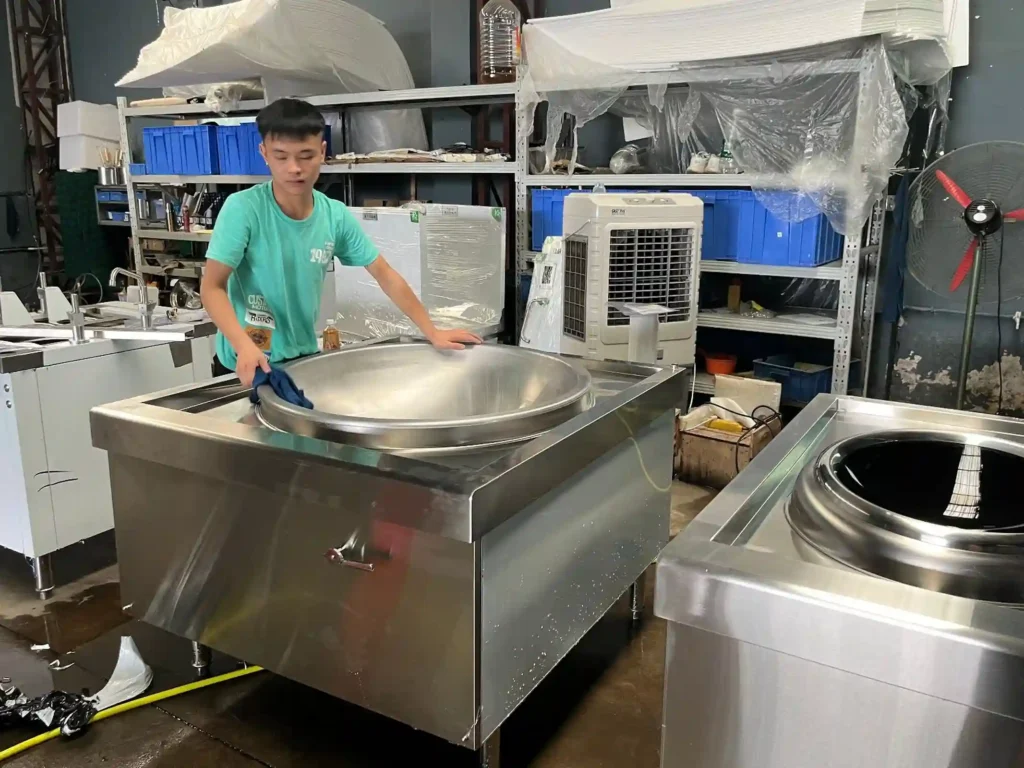
Industrial Induction Wok Burners (15 kW–30 kW): How They Differ from Standard Commercial Models
07/07/2026
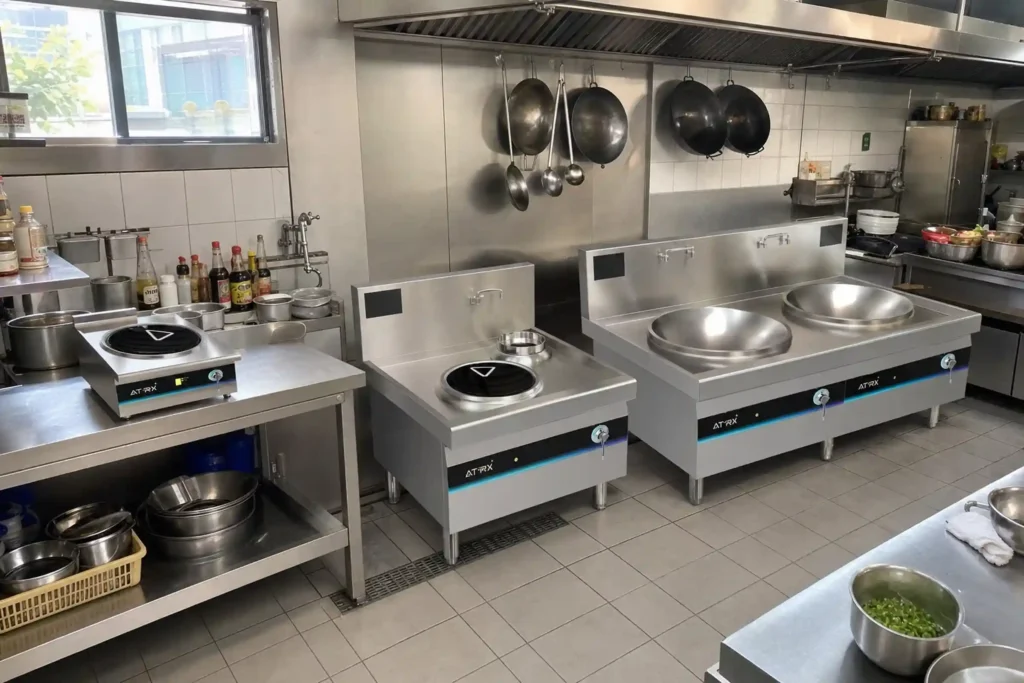
Commercial Induction Wok Burners: Countertop vs. Built-In vs. Freestanding — Which Fits Your Kitchen layout?
07/06/2026
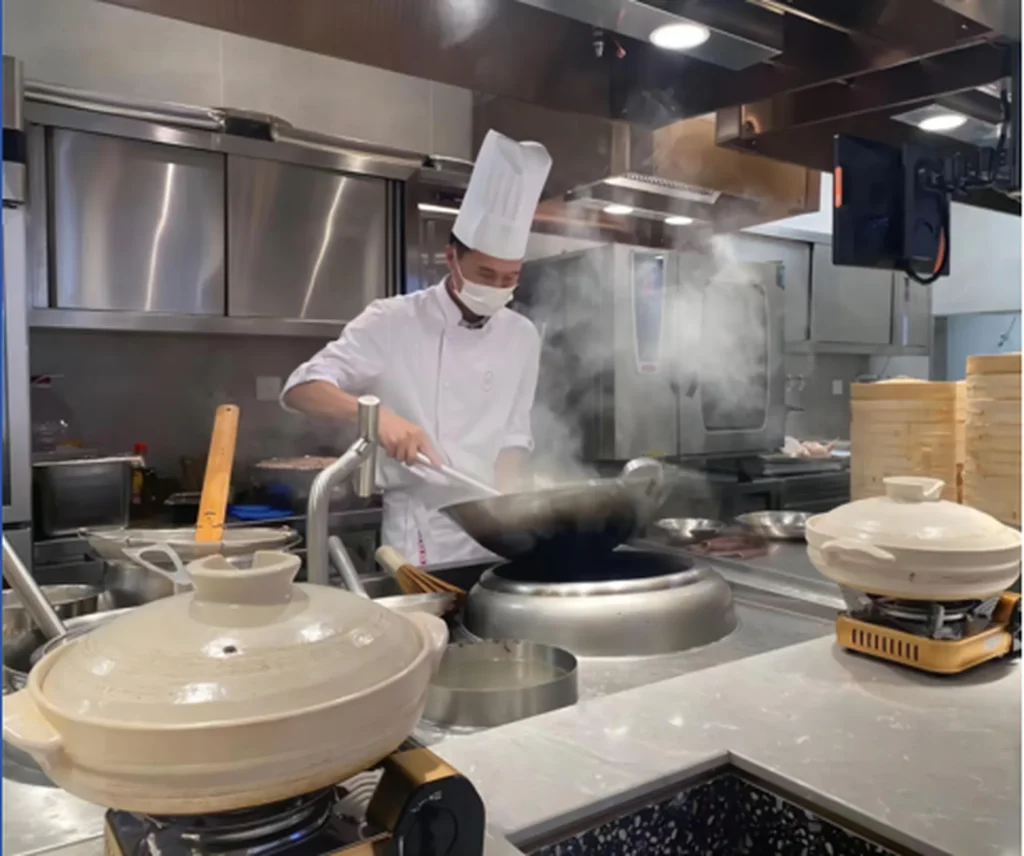
Commercial Induction Wok Range: What to Cook at Every Power Level (3.5 kW–30 kW)
07/05/2026

How to Choose the Best Commercial Induction Cooktop for Food Truck | 3-Step Guide
07/04/2026

Generator Can’t Power Commercial Induction Cooktop on Food Truck? — How To Fix It
07/03/2026
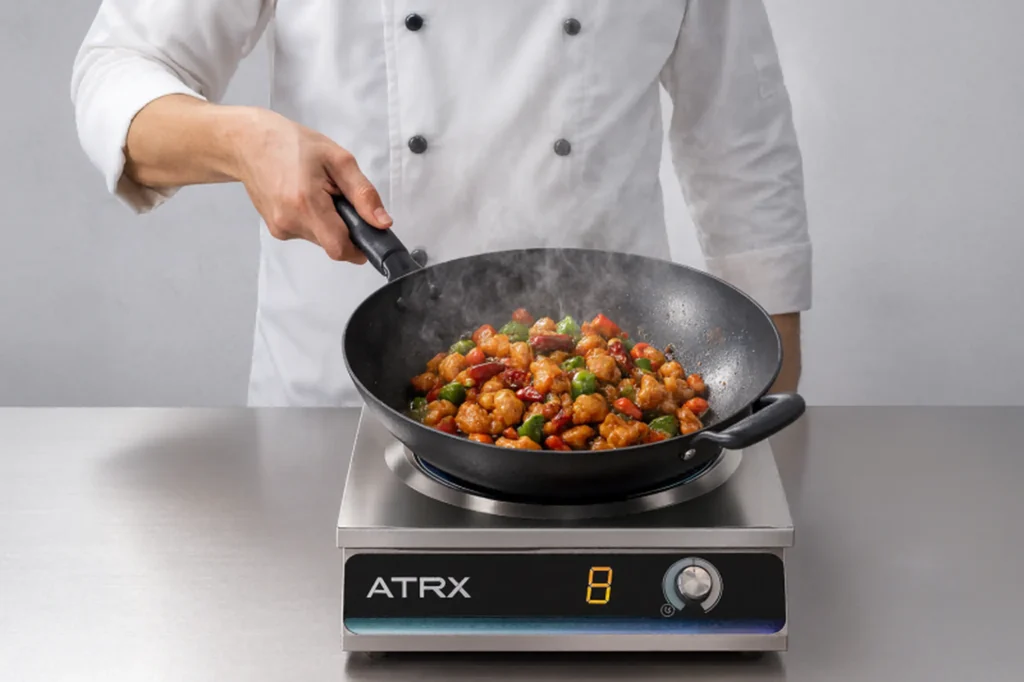
Commercial Induction Cooktop Operating Instructions: A Complete Guide for Professional Kitchens
07/02/2026
How to Choose a Commercial Induction Soup Cooker — A Buying Guide for Restaurant Owners
07/02/2026
Commercial Induction Pasta Cooker: The Ultimate Buying Guide
07/01/2026
Commercial Induction Steamer Buying Guide: How to Choose Between Rice Steamers and Seafood Steamers
06/30/2026
Commercial Induction Built-in Cooker: The Complete Guide to Seamless Kitchen Integration
06/29/2026