

What Foods Can a Commercial Induction Fryer Cook
05/12/2026
Estimated reading time: 2 minutes

⚡short note: Commercial induction fryers handle almost all standard fried menu categories.
- Meat & seafood: Produces consistent fried results for chicken, shrimp and fish with stable temperature control
- Starchy foods: Keeps fries and rice cakes crisp through quick oil temperature recovery after loading
- Veg & soy: Heats vegetables and tofu evenly within the 170-180°C temperature range
- Desserts & snacks: Maintains texture of dough treats and frozen snacks with steady thermal output
Quick Reference: Frying Temperature Guide by Food Category
| Food Category | Representative Items | Recommended Oil Temperature | Key Requirement |
|---|---|---|---|
| Chicken & poultry | Wings, nuggets, cutlets, legs | 170–180°C (338–356°F) | Fast surface seal to lock moisture; stable recovery for consecutive batches |
| Beef & pork | Beef strips, pork chops, pork belly | 180–190°C (356–374°F) | Immediate high heat for crust formation; even heating to prevent drying |
| Shrimp & small seafood | Tempura shrimp, squid rings, baby octopus | 175–185°C (347–365°F) | Fastest recovery speed; short frying window before overcooking |
| Fish fillets & whole fish | Battered fillets, whole fried fish | 170–180°C (338–356°F) | Stable narrow temperature range; gentle handling to maintain structure |
| French fries & potato products | Thin fries, wedges, hash browns | 175–185°C (347–365°F) | Instant surface crust; fast recovery after frozen batch loading |
| Noodle & rice products | Fried noodle nests, rice cakes, glutinous rice cakes | 170–180°C (338–356°F) | Precise window control; too cool = sticking, too hot = splitting |
| Vegetables (battered) | Eggplant, broccoli, mushrooms | 170–180°C (338–356°F) | Batter must set immediately on contact; even heat prevents oil absorption |
| Tofu & soy products | Fried tofu, yuba, dried tofu, tofu puffs | 170–180°C (338–356°F) | Uniform internal structure heats evenly; forgiving for new operators |
| Dough desserts | Donuts, fried dough sticks, churros | 165–175°C (329–347°F) | Even puffing and browning; heat drift causes greasy patches |
| Frozen semi-finished snacks | Cheese balls, mini sweet balls, frozen meatballs | 175–185°C (347–365°F) | Maximum temperature crash on loading; recovery speed is everything |
Meat and Seafood for a Commercial Induction Deep Fryer
Meat and seafood dominate fried menus in most commercial kitchens, and how a fryer handles them shapes everything from ticket speed to plate consistency. Commercial induction deep fryers bring something traditional electric units struggle to match: oil temperature that holds steady batch after batch, not just at startup. Before committing to equipment, it’s worth checking whether the fryer fits your kitchen’s actual volume and menu — the commercial induction fryer buying guide covers ingredient compatibility in detail.
Here’s how induction deep fryers handle specific proteins in real commercial settings.
- Chicken (the most common high-frequency product)Chicken is unforgiving when oil temperature drops — breading goes soft, absorbs grease, or peels away entirely.Legs, wings, and nuggets run nonstop during service, and every load pulls heat from the oil. Induction deep fryers recover that heat fast, pulling temperature back to target before the next batch goes in. The result is the same crunch from the first order of the day to the last, without the common drift in quality that hits traditional units midway through a rush.
- Beef and Pork (emphasizing juice locking and structure control)These cuts need a hard sear the moment they hit oil — slow or uneven heat dries them out before the crust forms.Beef strips, pork chops, and pork belly all depend on that instant surface lock to hold moisture inside. Induction deep fryers hit temperature fast and stay there, so the outer seal forms immediately. Less oil absorption, lighter finish — details that matter when guests are coming back for the same dish week after week.
- Shrimp (highest requirement for temperature recovery ability)With shrimp, the frying time isn’t the variable — recovery speed is.A full batch of tempura or fried shrimp draws a lot of heat at once. If the oil doesn’t bounce back quickly, the coating turns soggy and the shrimp loses its snap. Induction deep fryers restore temperature in seconds, so kitchens can keep loading through a peak without slowing down or watching quality slide between batches.
- Fish (relying on stable temperature zone to maintain structural integrity)Fish is more fragile than most proteins — it needs the oil to stay consistent, not just get hot.Fillets and whole fish fall apart, soak through, or turn mushy the moment heat fluctuates. Induction deep fryers hold a steady range, forming a firm outer layer fast enough to protect the fish through the rest of the cook. For restaurants plating standardized fried fish, that consistency isn’t optional.
- Squid and small seafood (relying on rapid high-temperature setting ability)Small seafood doesn’t need time — it needs immediate heat.Squid rings and baby octopus go tough fast if they sit too long in oil that’s not hot enough. Induction deep fryers deliver instant high heat so the exterior sets right away. For snack bars and night markets where turnover is the whole operation, that speed makes a real difference.
During a mixed rush — fried chicken, shrimp, and fish fillets all going at once — traditional fryers force the kitchen to slow down and wait. Induction units hold steady through continuous loading, letting each protein cook where it needs to be on the temperature curve. That’s not just faster heating; it’s a different way of running a kitchen. The mechanics behind it are worth understanding — how a commercial induction fryer works goes into the heating design and temperature logic in full.
Noodles and Starchy Foods for an Induction Frying Machine
Starchy foods look simple on the menu, but they’re the items most likely to expose a fryer’s weaknesses. French fries, fried noodles, rice cakes, frozen prepped goods — they’re top sellers precisely because guests expect them to be identical every time. And they’re the first to suffer when oil temperature drifts.
Here’s which noodles and starchy ingredients work with induction frying machines, and what makes them a natural fit.
- Potato products (French fries, potato wedges, potato chunks)A good fry isn’t slow-cooked — it’s set in an instant. Induction frying machines reach target temperature fast and hold it there, forming that crisp outer shell the moment potatoes hit the oil. Through continuous service, fast heat recovery means every load sets properly, even after the tenth batch in a row. Potato products are the real test of whether a fryer can deliver consistent heat nonstop.
- Noodle products (fried dough nests, instant noodle shapes, snack noodle cakes)Noodles need even structure more than fries do. Heat swings cause sagging, uneven puffing, or scorching before the interior cooks through. Induction frying machines set noodles the moment they enter the oil, producing a uniform puff across every piece. That moves the kitchen from “mostly good” to genuinely consistent — batch after batch.
- Rice products (rice cakes, glutinous rice cakes, rice sticks)Too cool and they stick. Too hot and they split. Rice products need a fryer that holds a tight window and doesn’t wander.Induction frying machines keep oil temperature precise enough for rice cakes to puff evenly without cracking. The practical upside: less waste, cleaner oil, fewer changes — and a kitchen that runs more smoothly through a full shift.
- Frozen starchy semi-finished products (frozen French fries, frozen meatballs, pre-made pasta)Bulk frozen loads are the toughest test for any fryer. A full basket crashes oil temperature immediately, and slow recovery means those items sit in underheated oil — coming out greasy and soft.Induction frying machines recover fast, pulling temperature back before it affects the batch. Operators don’t need to pace themselves or pause between loads; the equipment keeps up with high-volume nonstop service without requiring adjustment.
For kitchens built around high-volume, continuous loading, that recovery performance isn’t a bonus — it’s the baseline. The fast heating commercial induction fryer category covers equipment built specifically for this kind of demand. The difference between electromagnetic and restaurant electric fryer performance shows up most clearly when starchy foods are running nonstop.
Every item in this category shares the same requirement: structure sets with instant heat, not slow cooking. Equipment that can’t deliver that consistently will show it in the finished product, every single batch.
Vegetables and Soy-Based Foods for a Commercial Deep Fat Fryer
Watch any dinner rush and vegetables and soy products are what keep the kitchen moving when the meat orders stack up. They’re not filler — they’re reliable, fast, and steady even when the line is slammed.
For kitchen teams, the real question isn’t whether these ingredients fry — it’s whether they hold up batch after batch without drifting. Commercial deep fat fryers handle vegetables and soy products well when the heat stays where it needs to be.
Here’s a practical filter for which vegetables and soy products suit commercial induction deep fryers:
- Vegetables that can quickly form a crispy surface shellAfter a heavy load, oil temperature dips briefly — but broccoli, mushrooms, and similar vegetables handle it well. They shed moisture fast and form a crisp crust that limits oil absorption, making them less sensitive to those short temperature swings. That tolerance is exactly what makes them workable in commercial kitchens where loading never really stops.
- Vegetables that need batter to stabilize the structurePlain fried eggplant soaks through and goes soft almost immediately, but batter changes that. It creates a protective layer — and with steady heat from an induction fryer, that layer sets the moment the vegetable hits the oil. Less absorption, more predictable cook times, and what was once a tricky item becomes a consistent, repeatable menu staple.
- Soy products with uniform internal structure and consistent heatingTofu and thousand-layer tofu are all-day workhorses in fast casual and chain kitchens. Their uniform texture means they heat through evenly without hot spots — unlike most proteins — and they form a clean, crisp crust at 170-180°C. That forgiving profile means new staff can turn out consistent results quickly, which matters at locations that need to get people up to speed fast.
- Soybean processed products suitable for batch servingYuba, dried tofu, and tofu puffs are made for rush hour — no prep, straight into the fryer. With the steady heat and fast recovery of commercial induction deep fryers, they batch-fry nonstop without slowing the line. They function as a natural buffer, keeping the rest of the kitchen running even when the main proteins are backed up.
Across every service scenario, the pattern holds: vegetables and soy products work with commercial induction deep fryers because their structure, heat requirements, and prep flow all line up with what the equipment actually does well.
Desserts and Snacks for a Restaurant Fryer
Desserts and snacks aren’t an afterthought — they’re often the most demanding items during a peak. Run them alongside chicken and fries, and even a small temperature shift shows up immediately in color, texture, and what lands on the table.
A restaurant fryer handles desserts and snacks well when it’s built to hold steady across these four categories:
- Fried dough desserts (such as donuts, fried dough sticks, fried dough balls)
- Breaded or wrapped structure desserts (such as fried ice cream, fried bananas)
- Frozen semi-finished snacks (such as cheese balls, mini sweet balls)
- High-sugar or nut snacks (such as sugar-coated peanuts, sweet nuts)
The point isn’t that these items can be fried — it’s why stable equipment matters so much when they’re running in a real restaurant setting.
Donuts and fried dough need to puff and brown at the same rate. During an afternoon tea rush, heat drift creates uneven color and greasy patches between batches. Induction fryers recover fast after continuous loading, so every batch of dough cooks in the same thermal environment — no variance, no guesswork.
Fried ice cream and battered bananas need the shell to set instantly. A temperature drop at loading breaks it open and the item is ruined. Induction fryers hold heat steady through the load, forming the crust immediately and keeping every dessert intact through service.
Cheese balls and sweet mini balls run all night in high-turnover spots. Traditional fryers bleed heat over repeated batches, and later orders come out soft and greasy compared to early ones. Induction fryers replenish heat after every load, so the last batch of the night matches the first — which is what chain locations need to stay consistent.
Sugar-coated and nut-based snacks need controlled, even heat for caramelization that doesn’t burn. Uneven temperature scorches the outside before the inside warms through. Induction fryers hold a tight range, making the process predictable and keeping the results clean rather than bitter.
More than any other category, desserts and snacks reveal equipment weaknesses during a peak — there’s nowhere to hide.
Consistent oil temperature, fast heat recovery, and batch-to-batch uniformity are what turn these items into reliable, profitable menu staples rather than liabilities. Professional kitchen fryer delivers the stable thermal performance that dessert and snack frying actually demands in commercial settings.
Technical Comparison: Commercial Induction Fryer vs Traditional Electric Fryer
| Performance Indicator | Commercial Induction Fryer | Traditional Electric Fryer |
|---|---|---|
| Temperature Recovery Speed (after feeding) | Fast (can return to set temperature within 10-15 seconds) | Slow (takes 30-45 seconds or more to recover) |
| Oil Temperature Stability (continuous production) | ±2°C fluctuation range, stable heat output | ±5-8°C fluctuation range, heat output is unstable |
| Heat Efficiency | 85-90%, direct electromagnetic heating with less heat loss | 55-60%, heat loss through heating tube and shell |
| Suitability for Batch Continuous Production | Highly suitable, no need to wait for temperature recovery between batches | Low suitability, requires waiting for temperature rise after each batch |
| Control Precision of Critical Temperature (e.g., 170-180°C for tofu) | Precise control within ±1°C, meets critical temperature requirements | Poor precision, temperature deviation up to ±4°C, easy to cause ingredient damage |
Temperature ranges above are guidelines for induction fryers operating under normal commercial conditions.
Actual optimal temperatures may vary by 3–5°C depending on batch size, ingredient moisture content, and ambient kitchen temperature. For a detailed explanation of how induction heating maintains these narrow temperature windows through electromagnetic power adjustment, see how a commercial induction fryer works.
Frequently Asked Questions (FAQ)
Q1: Can a commercial induction fryer maintain consistent oil temperature when frying multiple types of ingredients continuously?
A1: Yes — this is where induction fryers genuinely outperform traditional electric units. Instead of significant temperature drops after each load, induction fryers recover fast and hold steady, keeping oil temperature fluctuation within ±2°C even when rotating between chicken, shrimp, and fish fillets. Every batch cooks in the right range, and the consistency shows in both taste and texture.
Q2: Are starchy foods like rice cakes and frozen French fries more suitable for induction fryers than traditional electric fryers?
A2: Definitely. Starchy foods need immediate high heat to complete their structural changes — dehydration, puffing, shape locking. Traditional electric fryers lose temperature when frozen starchy items go in, and slow recovery leaves the finished product soft and oil-heavy. Induction fryers restore the set temperature quickly, so every batch forms a uniform crispy shell and holds its structure — which is exactly what standardized commercial production requires.
Continue Reading: Related Guides
Knowing which foods work best on an induction fryer is the first step. The next step is choosing the right equipment for your kitchen:
If you are comparing induction fryers against gas and electric models to decide which type matches your menu and budget, read our induction vs gas vs electric commercial deep fryer comparison.
If you have already decided on induction and want specific model recommendations sorted by kitchen size, daily output, and budget, see the best commercial induction fryers for restaurants in 2026.
About the author

ATRX Team| 18 Years Commercial
Induction Cooker Manufacturer in China
Induction Cooker Manufacturer in China
Related Posts
Best Commercial Induction Cooktop: Types &Buying Guide
10/09/2026
Commercial Double Hob Induction Cooker | Types, Power, and Installation Guide
10/05/2026
Commercial Induction Cooker 3500W: Model Selection, Commercial Power and Installation
09/29/2026
How to Install a Built-In Induction Cooktop: A Step-by-Step Guide
09/17/2026
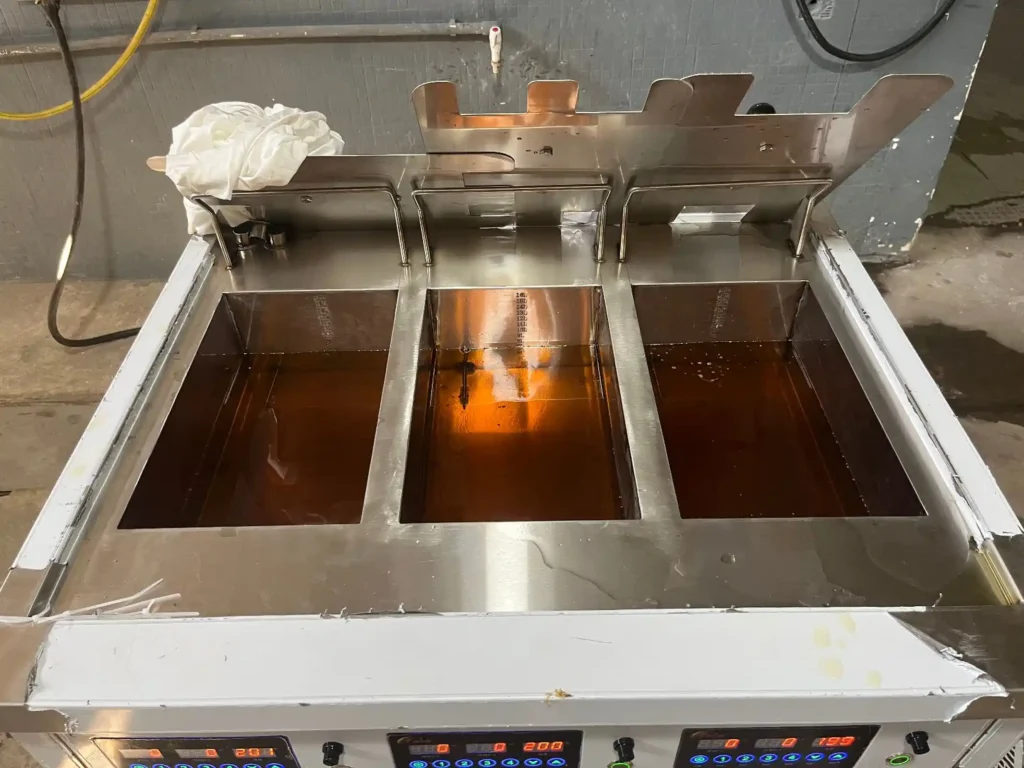
How to Clean a Commercial Deep Fryer: A Step-by-Step Guide
09/13/2026
High Quality Commercial Induction Cooker Manufacturer
09/09/2026
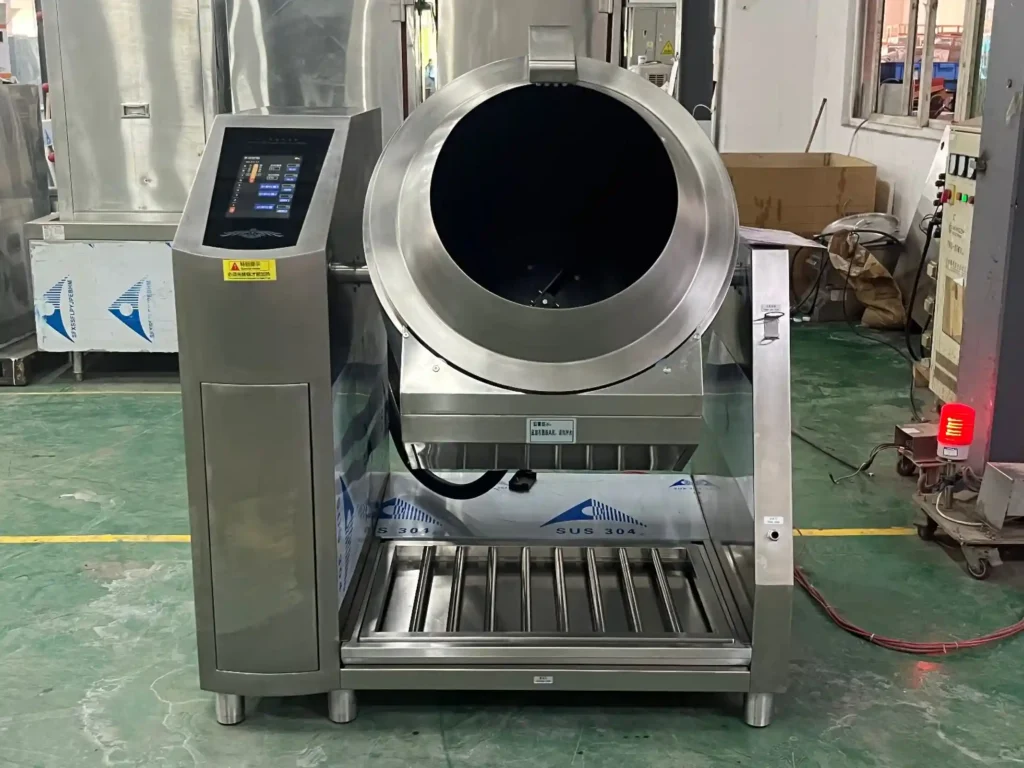
Automatic Wok Machine: Types, Specifications, Applications and Buying Guide
08/18/2026
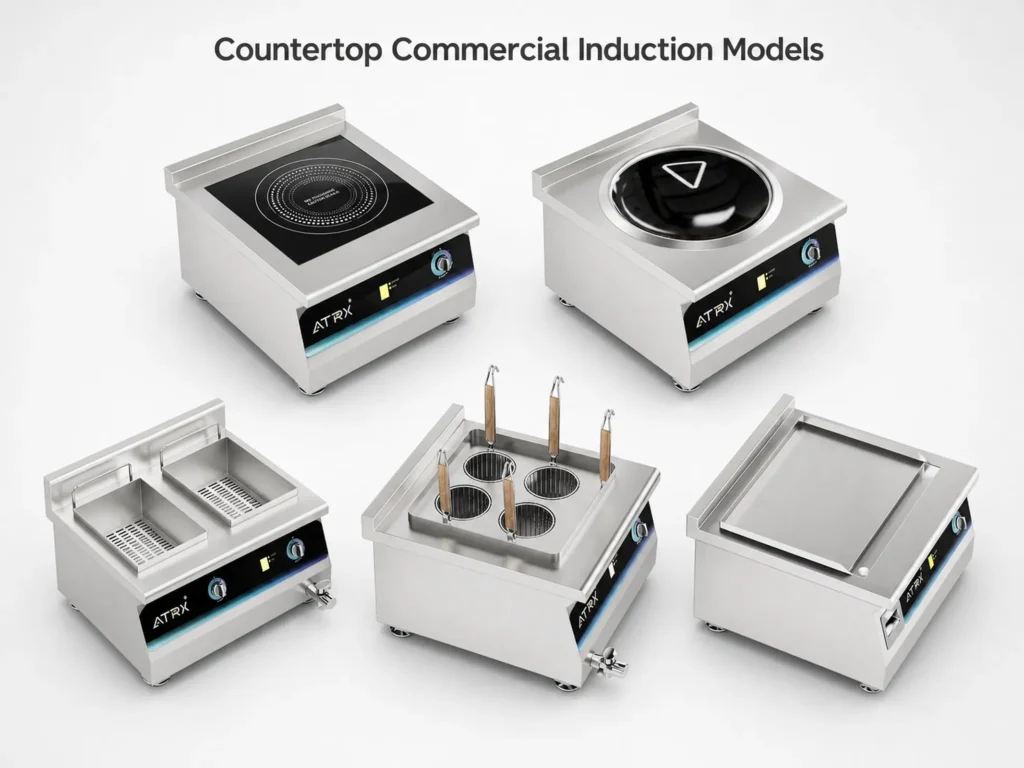
Commercial Induction Range: How to Choose the Right Size, Power, and Configuration for a Commercial Kitchen
08/15/2026
What Is a Commercial Induction Cooker and How Does It Work
08/13/2026
Commercial Induction Range for Hotel Kitchens: How to Choose the Right Model
08/11/2026