

Why Are Hot Pot Restaurants Switching to Commercial Induction Cookers?
05/23/2026
Estimated reading time: 2 minutes

IN THIS ARTICLE
How a Hot Pot Induction Cooker Installed in a Table Heats Food — And How Commercial Units Differ from Household Ones
The Heating Process Is Actually Pretty Simple
-
- Electricity generates a magnetic field
You switch the cooker on. The copper coil inside starts working and produces a high-frequency alternating magnetic field. That field passes straight through the glass surface and hits the pot bottom. - The pot heats itself
When the magnetic field hits the metal base of the pot, the metal molecules start vibrating hard. Heat is “born” right there in the pot. No flame. No conduction. The pot bottom is the heat source. - The tabletop stays cool
Heat only happens at the pot bottom. The cooktop surface and the table don’t get involved at all. You can touch the table — it’s cool. Meanwhile, the beef tallow inside the pot is already at a rolling boil. - A quick way to think about it
Gas stove: flame roasts the pot. Heat path = flame → pot → broth.
Induction cooker: skip the flame. The pot bottom becomes the heat source directly. Path = pot → broth. Shorter. More direct.
- Electricity generates a magnetic field
There’s one practical catch you only find out when you actually use it, though. The pot must be a ferromagnetic material. Cast iron works. 430 stainless steel works. Aluminum? Doesn’t work. The magnetic field passes through aluminum just fine, but it can’t form eddy currents in it. Put an aluminum pot on, and nothing happens — zero heat.
We run into this all the time on first deliveries. Clients bring an old aluminum pot from their gas stove days and ask, “Why won’t it heat?” Simple answer — swap the pot. Sort this out before you buy the cooker. Otherwise the equipment arrives, you still need a whole new batch of cookware, and you’ve wasted days for nothing.
Why Can’t Hot Pot Restaurants Just Use a Home Induction Cooker?
One sentence: a home unit can’t take the beating. Here’s where the gap shows up:
| Comparison | Household Induction Cooker | Commercial Hot Pot Induction Cooker |
|---|---|---|
| Designed for | Boiling noodles, reheating leftovers at home | All-day, non-stop restaurant service |
| Power range | 1200W–2200W | 800W–3500W, adjustable |
| Continuous run time | Triggers overheat protection after 1–2 hours | 8+ hours, no power drop |
| Cooling system | One small fan, narrow air duct | Wide air duct + high-speed blower |
| Installation | Sits loose on a countertop | Built flush into the hot pot table cutout |
| Waterproofing | Basically none | Fully sealed — spilled broth can’t reach the mainboard |
| Lifespan under heavy use | Issues start in 3–6 months | 3–5 years, stable |
The row that matters most is “continuous run time.” Home machines set the overheat cutoff low. Run one too long and it throttles power — or just shuts off. For a home cook, that’s a safety net. For a hot pot restaurant, it’s a nightmare.
Lunch rush, dinner rush, back to back. Power drops mid-service. The broth stops rolling. Customer dips their sliced beef — still raw after ten seconds. Experience ruined, just like that.
A commercial unit isn’t simply “a home cooker with higher wattage.” The entire thermal management system is rebuilt for restaurant rhythm. Wider ducts. Faster fans. Bigger heat-sink area. That’s how it holds full power for eight hours straight without fading. And the flush-mount form factor is cut to fit standard hot pot table openings — no wobble, no gap for broth to seep in.
Bottom line: home units are for occasional use. A hot pot restaurant pounds them 8+ hours a day. They don’t survive. Going with a commercial induction cooker for hot pot restaurant use means you stop cycling through dead machines, stop pulling tables offline, and stop bleeding turnover money.
What Pain Points Does Switching to an Induction Cooker for Restaurant Use Actually Solve?
No Open Flame — Fire Inspections and Daily Safety Management Get Way Easier
1. Mall locations no longer get stuck at gas approval
If your hot pot shop is inside a mall, an office-building podium, or a mixed-use complex, you already know the pain. Gas approval is brutal — pipeline routing review, exhaust system retrofit, annual re-inspection. One step fails, you can’t open.
Switch to a hot pot table built-in induction cooker and you skip the gas hookup entirely. “Open flame” disappears from the fire-safety checklist. Your options for where to open just got a lot wider.
One of our chain-brand clients came out to the factory and told us this story: he’d signed a lease in a certain mall, spent three months going back and forth on gas approval, still no pass. Changed the whole plan to induction built into the tables. Fire inspection cleared in two weeks.
2. An entire category of daily safety headaches — gone
A gas-powered hot pot restaurant means: staff checking every valve at closing, monthly cylinder swaps, periodic pipeline inspections. That eats way more time and attention than people think.
Switch to induction, and all those routines vanish. No cylinder storage risk. No aging hose that might leak. No training staff over and over on “close gas first, then valve.”
A restaurant manager in Chongqing put it bluntly in our customer WeChat group: “I used to lie awake worrying the night-shift kid forgot to close the gas. Now I kill the main breaker and walk out. I actually sleep.”
3. Peak hours — dozens of tables going at once, zero open flame
Dinner rush is when things go wrong. The place is packed, plates are flying, tabletops are cluttered. Gas means an open flame at every table. Sleeves brush past. Napkins drift. Takeaway bags pile up. Kids reach for things.
With induction, all heat stays inside the pot bottom. No flame is exposed on the table surface. Even if a curious kid touches the cooktop, there’s no instant burn the way there is with fire. This alone is why many hot pot brands went all-in on induction. Not to save money — to kill the biggest safety risk at the source.
Temperature Stays Steady — Less Burnt Broth, and Customers Stop Yelling for a Server to Fix the Heat
Gas flame output wobbles with gas pressure and air-shutter position. Temperature never sits still. With beef tallow broth, it’s painfully obvious. Fire too high — the pot wall scorches. Fire too low — food won’t cook. Halfway through the meal, hands go up: “Can someone turn this down?”
During peak hours, one server covers eight to ten tables. If half of those calls are just “adjust my flame,” that eats 15–20% of their working time. The stuff that actually matters — refilling broth, clearing tables, seating new guests — gets neglected.
The way a commercial induction cooker vs gas burner handles temperature is fundamentally different. Set a power level, and the controller holds it there. No fluctuation from outside factors. The broth keeps a steady gentle simmer. It won’t splash all over the table, and it won’t suddenly go cold.
We ran a side-by-side test in our factory. Same beef tallow base, same duration. Gas side: visible scorch marks on the pot wall after 40 minutes. Induction side: not a trace of burning at end of service. The gap is obvious once temperatures stay flat.
This lines up with third-party data, too. The Food Service Technology Center (FSTC) at Frontier Energy tested induction versus gas following ASTM protocols. Their results showed induction significantly outperforms gas on both how fast it responds to temperature changes and how tightly it holds a set temperature.
For customers, the difference is felt immediately. No guessing at fire levels. No flagging someone down mid-meal. The broth stays at that perfect slow roll. They control the pace.
For servers, “go adjust the flame” is simply removed from their task list. That’s real, measurable time freed up. Here’s a comparison based on what our partner restaurants actually reported:
| Comparison | Gas Burner Hot Pot Table | Commercial Induction Hot Pot Table |
|---|---|---|
| Broth temperature swing | ±30°C+, depends on gas pressure / air shutter | Within ±5°C, held by program control |
| Beef tallow base scorching | Starts around 40 minutes in peak service | Essentially no scorching through full service |
| Customer calls to adjust heat | 2–3 times per table per meal, average | Near zero |
| Broth splashing onto the table | Frequent, especially at full boil | Rare — broth holds a gentle simmer |
| Server time spent on heat adjustment | ~15–20% of workload during rush | Effectively zero |
Basic Requirements Before Installing a Hot Pot Table Built-in Induction Cooker
Principles make sense now. Next question: can your shop actually support the install? Induction cookers do great things — but if your venue’s infrastructure can’t keep up, the equipment just collects dust. Two things to confirm before you buy.
Can Your Electrical System Handle It? Check This Before Anything Else
Calculate total power first — don’t eyeball it
One hot pot induction cooker pulls about 2,000 to 3,000 watts. Sounds manageable, right? But you don’t have one — you have twenty. All running at the same time, that’s 40 to 60 kW in induction alone. Stack air conditioning, exhaust fans, fridges, and lighting on top, and the total is serious.
Don’t panic and size everything at 100% load, though. In real life, not every table hits peak power at the same second. We’ve pulled backend usage data from chain hot pot brands we supply. With 20 cookers installed, actual simultaneous peak lands around 70–80% of total nameplate capacity. There are always a few tables waiting for dishes, switching broth, or paying the bill. Use that multiplier. It’s closer to reality, and it keeps you from over-buying capacity and paying unnecessary base charges to the power company.
Older spaces almost certainly can’t handle the load
Many commercial units get handed over with wiring sized only for lights and AC. Total capacity might be 30 to 50 kW. Now shove a few dozen induction cookers in there — the wiring won’t cope.
Best case: breaker trips. During dinner rush. Full restaurant sits in the dark waiting for you to reset. Worst case: wires overheat. That’s a fire risk.
One more trap people miss. The total capacity in your property contract “looks like enough.” But you didn’t factor in real-world summer AC draw. In southern China, actual midsummer AC consumption blows past nameplate ratings. The leftover headroom for induction may be far less than you assumed. Pull your meter’s peak-load record from the hottest month. Base decisions on real numbers, not paper figures in a contract.
Talk to property management before you order — if it’s short, expand early
Simple process. Before buying cookers, ask your property management or local power utility three numbers: total incoming capacity, current usage, remaining headroom for induction. If it’s not enough, apply for expansion now — rewiring, a new sub-panel, whatever it takes. Get it done during the buildout phase.
Watch the timeline here. Fast approvals take one to two weeks. Slow ones stretch past a month. Start early. Don’t let equipment sit in your warehouse while the electrical paperwork drags on.
Will Your Existing Pots Work? Don’t Find Out After Installation
Induction cookers are picky about pots. Not every material heats up. The pot bottom needs to be ferromagnetic — something the magnetic field can grab onto. Wrong pot? The cooker just sits there doing nothing. This table tells you instantly whether your current pots pass or fail:
| Pot Material | Works on Induction? | How to Tell |
|---|---|---|
| Cast iron | ✅ Yes | Magnet sticks firmly to the bottom |
| Ferromagnetic stainless steel (e.g. 430 SS) | ✅ Yes | Magnet sticks noticeably |
| Pure aluminum | ❌ No | Magnet slides right off — no pull at all |
| Pure copper | ❌ No | Magnet slides right off — no pull at all |
| Ceramic / clay pot | ❌ No | Magnet slides right off — no pull at all |
| 304 stainless steel (varies by batch) | ⚠️ Test it | Might attract weakly, might not at all |
Rule of thumb: grab a magnet, stick it on the pot bottom. If it holds, you’re good. If it slides off, swap the pot.
But one material needs extra attention — 304 stainless steel. It’s everywhere in hot pot. Yin-yang split pots, clear broth pots — most of them are 304. The catch: whether a 304 pot is magnetic depends heavily on how it was manufactured. Two pots from different brands, both stamped “304,” can behave completely differently.
We’ve seen this in our own factory testing. Same purchasing batch, two brands of yin-yang pots, both labeled 304. Brand A was stretch-formed and came out with weak magnetism — heated fine. Brand B had zero magnetism — the cooker threw an error code and refused to start. So if you’re running 304 pots, ignore what the label says. Put the actual pot on the cooker, power it on, and see what happens. That’s the only test that counts.
If your pots don’t work, it’s not a crisis. Just replace them ahead of time. Pots have short lead times and low cost. Have the new set ready before installation day. Equipment goes in, you test-fire immediately — no delays, no scrambling.
Common Questions People Ask
Q1: My shop only has 10 tables and turnover isn’t high. Do I really need to switch to a commercial induction cooker for hot pot restaurant use?
If you’re not in a mall, not blocked by gas approval, only turning tables twice a day, your current gas gear is still in decent shape, and nobody’s filed safety complaints — then no, the rush isn’t there right now. Spend your money where it matters most today. When your equipment naturally hits end-of-life, that’s the smart time to make the switch.
Q2: I just signed a two-year gas supply contract. Isn’t switching now a waste?
A live contract doesn’t stop you from adding induction — the two can run side by side. But if you’re holding off purely to “not waste the contract,” run the other math: fire re-inspection costs over those two years, broth-base losses from scorching, staff time spent babysitting valves. Those often add up to more than whatever’s left on the gas deal. Compare real numbers, then decide.
Q3: Summer is dead, winter is my peak. The cookers sit idle for months. Won’t payback take forever?
Seasonality matters — factor the idle months in. But payback isn’t just “gas savings.” It also includes lower fire-inspection fees, less broth wasted to burning, and freed-up server time. Those add up quietly. Even counting only four to five months of full-load winter operation, most operators hit payback within two years. That’s still reasonable.
Ready to see what’s available? Browse our full range of commercial induction cookers — with specs, power options, and built-in form factors designed specifically for hot pot restaurant tables.
About the author
ATRX Team| 18 Years Commercial
Induction Cooker Manufacturer in China
Induction Cooker Manufacturer in China
Related Posts
What Is a Commercial Induction Cooker and How Does It Work
08/13/2026
Commercial Induction Range for Hotel Kitchens: How to Choose the Right Model
08/11/2026
Reliable Commercial Induction Cooktop Manufacturer in China | OEM & ODM Solutions | ATRX
08/09/2026
10 Best Commercial Induction Cooker Manufacturers & Supplier Selection Guide [2026]
08/07/2026
Tilting Skillet & Bratt Pan: How to Choose the Right One for Your Commercial Kitchen
08/06/2026

Commercial Induction Cooker for School Cafeteria: How to Pick the Right High-Power Unit
08/04/2026
Ghost Kitchen Equipment List: Checklist & Buying Guide for Delivery-Only Kitchens
08/02/2026
Gas vs Infrared vs Induction: Commercial Wok Range Comparison for Chinese Restaurants
07/31/2026
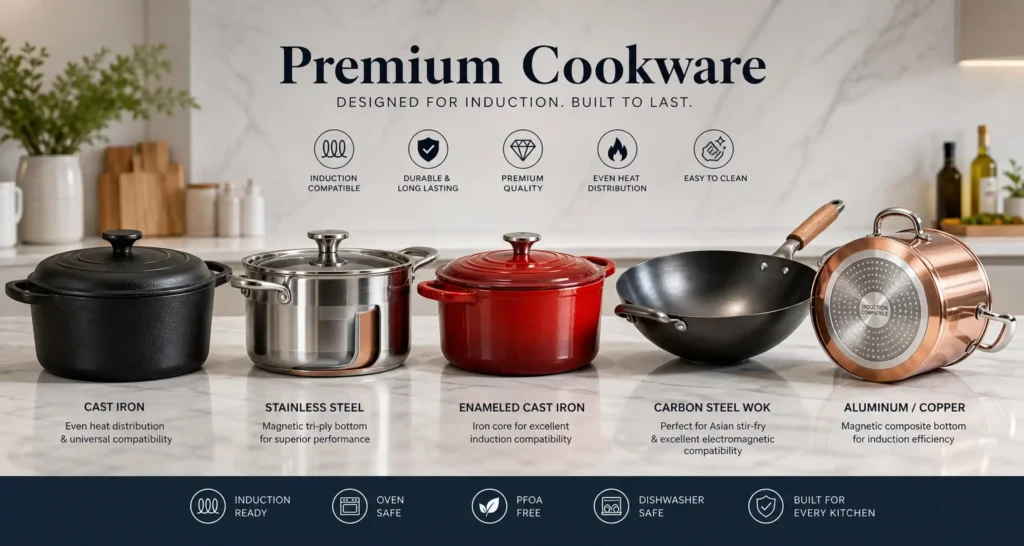
What Cookware Works on Induction? Compatibility Guide & Best Materials Explained
07/28/2026
Best Commercial Induction Cooktop for Restaurant: Types, Specs & Buying Guide (2026)
07/26/2026