

How ATRX Mass-Produces 3–40kW Commercial Induction Cookers
06/15/2026
Estimated reading time: 3 minutes

TL;DR: This article shows you exactly how ATRX handles commercial induction cooker mass production across a 3–40kW range on a single line — modular design compresses model-switching to under 15 minutes, automation locks every precision-critical step, and 100% individual testing (no sampling) uses power-tier-specific pass/fail criteria. You’ll get a clear picture of how batch delivery actually works, so you can judge production reliability before placing an order.
IN THIS ARTICLE
Key Production Steps in Mass-Producing 3–40kW Commercial Induction Cookers
How many steps does it take to turn a steel plate into a finished commercial induction cooker? More than most people think. If you want the full picture of how a single unit is designed — from coil heating principles to structural layout — start with how a commercial induction cooker is made. This article zooms in on what happens at the batch production stage.
The line splits the whole process into independent stages. Each stage’s output feeds directly into the next. The sequence is fixed — you can’t skip steps or swap the order. What follows is a walk-through of how a 3–40kW unit moves through this 3-40kW induction cooker factory, from the first SMD component hitting a board to final sealing and labeling.
From PCB SMT to Final Assembly: How the Production Line Is Segmented
Five core stages. One after another. Sequence locked.
Why can’t it be rearranged? A Middle Eastern client asked exactly this during a factory audit — could some steps run in parallel to shorten lead time? The line supervisor pulled up comparison photos right there: IGBT modules need thermal paste before the heatsink gets pressed on. Fan angles must match the air duct exactly. A 1mm gap error between coil and panel drops heating efficiency. Every step depends on the one before it.
Swap the order, and best case you get heat dissipation problems. Worst case, components burn out early. The client looked at the photos and said: “Quality comes first.” He never mentioned rushing again.
Here are the five stages in production sequence:
- PCB SMT Soldering Stage
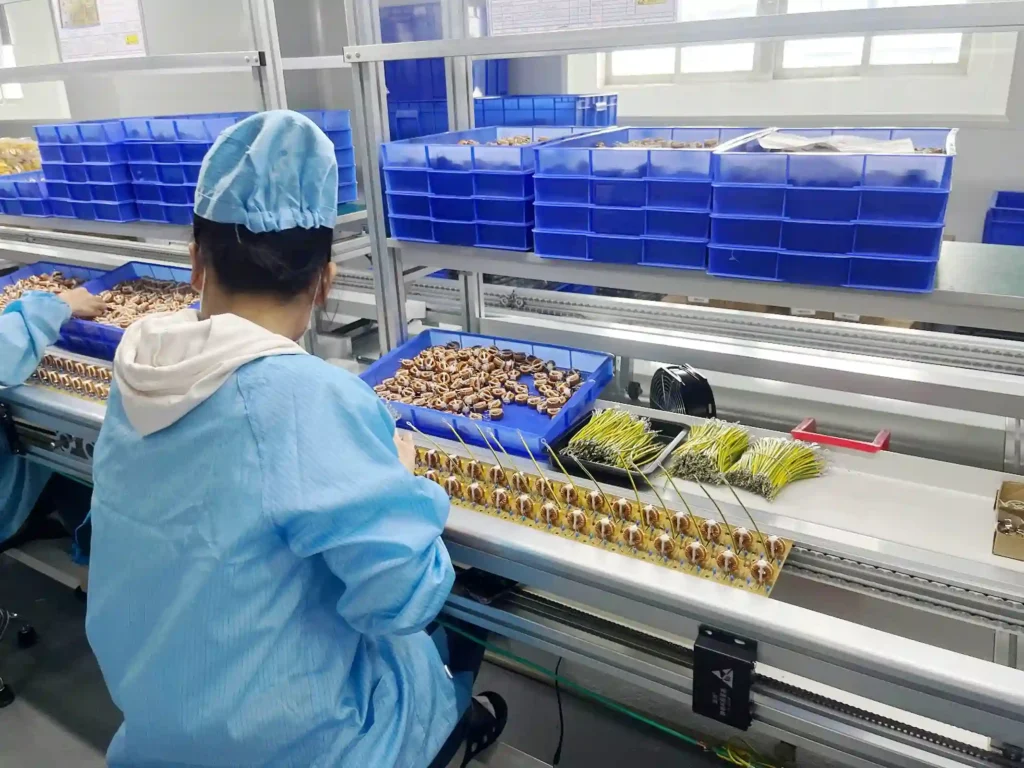
Resistors, capacitors, and driver ICs land at high speed on the SMT line, then pass through a reflow oven to form solder joints. Next come the big through-hole parts — IGBT modules, filter capacitors, relays — inserted manually at DIP stations following placement diagrams. Wave soldering finishes all through-hole joints in one pass. Then AOI optical inspection scans every single board. Cold joints, solder bridges — anything off gets caught and pulled right there. - Coil Winding Stage
A winding machine wraps litz wire turn by turn into a flat heating coil. Turn count, wire diameter, winding density — all calculated for the target power output. Nobody winds by feel. After winding, epoxy resin gets poured and cured. That locks the coil permanently — no loosening or unraveling, even after thousands of hours of continuous use. - Sheet Metal Casing Stage
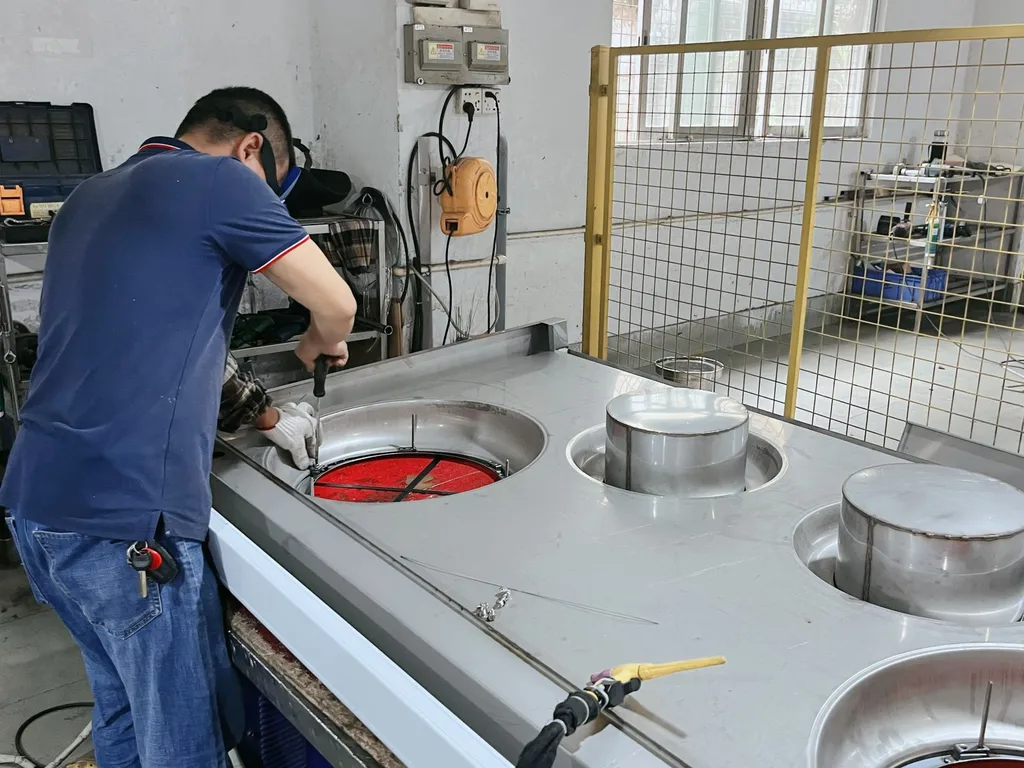
304 stainless steel sheets get laser-cut into panel profiles, CNC-bent into 3D shapes, welded into complete frames, then ground and polished. Plate thickness: 1.5–2mm — much thicker than residential units. That’s not random. In the early years, a trial batch with 1.2mm plate shipped to Southeast Asia. Three months later, frame deformation complaints came in. Engineering did a full post-mortem, then raised the minimum to 1.5mm across all lines, with extra reinforcement at stress points. The issue disappeared for good. - Final Assembly Stage
Coil positioned and installed into the casing. IGBT bonded to heatsink. Main control board secured away from the heat zone. High-voltage and low-voltage wiring routed separately. Fans mounted at the exact angle matching the air duct. All internal cables zip-tied along fixed paths. One step at a time — no skipping, no combining. - Sealing and Shipping Stage
Ceramic glass panel bonded and sealed. Frame gaps compressed to within 0.3mm. Silicone sealing blocks oil and water. But sealed doesn’t mean shipped — every unit still has to pass full-power burn-in and electrical safety testing. Only then does it get labeled and boxed. Fails? Back to rework from scratch.
What Automation Equipment Runs at Each Critical Stage
Process structure covered. Now let’s talk machines.
A long-term Australian distributor kept asking the same thing every peak season: “Can you actually deliver on time?” No explanation needed — the team sent a real production line video instead. Key processes all run on equipment. Workers handle loading and monitoring. He watched it and never asked again.
Batch capacity doesn’t come from adding people. It comes from machines locking down every variable that matters. Here’s what runs at each stage:
| Process Stage | Core Equipment | What It Does / Precision |
|---|---|---|
| PCB SMT Soldering | High-speed SMT pick-and-place + 10-zone nitrogen reflow oven + inline AOI | Auto-grabs and places components. Oven oxygen below 1000ppm to cut oxidation voids. AOI scans every board — nothing slips through. |
| DIP Insertion & Wave Soldering | Fully automatic wave soldering line | Solder pot temperature and wave height tracked in real time. Deviation triggers alarm and auto-stop. Same parameters every board — no batch-to-batch drift. |
| Coil Winding | Program-controlled automatic winding machine | Turn count, spacing, tension — all program-locked. Inductance values come out nearly identical. Manual winding can’t match this. |
| Sheet Metal Cutting | Fiber laser cutter + automatic nesting software | Cutting precision at 0.1mm. Clean edges, no burrs, no secondary trimming. Nesting software auto-calculates best layout to save material. |
| Sheet Metal Bending & Punching | CNC press brake + YAWEI CNC turret punch | Bending accuracy ±0.1mm, angle tolerance ±0.5°. Punch positioning 0.03mm. Each model has a locked program — operators just call up the code and run. Shift changes don’t matter. |
| Final Assembly | Preset-torque electric tools + station process-lock system | Torque preset, can’t be overridden. Assembly sequence locked by system — steps can’t be skipped. |
What does this add up to? Solder temperature, winding specs, cut dimensions, bend angles, fastening torque — every variable that affects performance is locked by equipment programs. Not by someone’s judgment call. That’s why every unit comes out the same in batch runs.
Numbers back it up. Before robotic welding came in at the sheet metal stage, manual welding defect rate sat around 1.2%. After the switch to automation: below 0.15%. Workers aren’t unskilled — they just get tired. Morning energy isn’t the same as 3pm energy. That shows up in welds. Machines erase that fluctuation entirely.
How One Line Covers a 3–40kW Power Range Through Modular Design
A 3kW countertop stir-fry unit and a 40kW floor-standing stock pot cooker. Power span over ten-fold. Traditional approach: separate line for each tier. Separate equipment, separate crew, separate tooling. Expensive — and capacity often sits half-empty.
Last year a Malaysian client asked flat-out during an audit: “You really produce 3kW to 40kW all on one line?” He didn’t buy it. After walking the full modular induction cooker production line, he did. Countertop low-power and floor-standing high-power units came off the same line back-to-back. No stoppage. No reconfiguration in between.
Two steps make this work. Step one: unify products at the design stage. Step two: compress switching actions at the production stage. Shrink differences at the source first. Then make switching the leftover differences cost almost nothing.
How Modular Design Unifies Production Across Power Tiers
One master control platform for all power tiers
3kW or 40kW — same main control board. Same operator interface. Same communication ports. Same chassis frame standard. When the line assembles these shared parts, the process stays identical, tooling stays identical, test programs stay identical. This shared platform covers over 60% of total assembly steps. Most workstations literally can’t tell what wattage they’re building.
Differences squeezed into three swappable modules
All hardware differences between power tiers boil down to three things: the power module (IGBT driver board + heatsink), the cooling assembly (duct and fan specs), and the coil (wire diameter, turn count, coil diameter). Three modules. Unified interfaces. Stations just swap materials.
A 2023 internal efficiency review confirmed it: because differences are down to just these three points, process repetition across all power tiers hits 82% in mixed scheduling. With a traditional dedicated-line-per-tier setup, that number isn’t possible.
Redundancy killed at the R&D stage
The rule is set during development: every differentiated module across every power tier must fit the same assembly station and the same fastening method. Result — the line never needs extra equipment for a specific tier, and layout never changes.
A long-term Turkish distributor brought an end client to verify this. They compared a 5kW and a 30kW unit station by station. Apart from three module swaps, every single operation was the same. That distributor then placed one order covering multiple power tiers. His words: “Since the line makes no distinction, I don’t need to split orders and wait separately.”
How the Line Adjusts When Switching Power Tiers
Switching from 5kW to 20kW — what actually changes? Three things. No more, no less. Because modular design already compresses differences to a minimum, all three adjustments together take under 15 minutes. Here’s what happens:
| What Changes | What Operators Do | Time |
|---|---|---|
| Tooling & Fixtures | Coil positioning fixtures and IGBT jigs use quick-release clips. Hand-swap — no screws, no recalibration. | ≤3 min per station |
| Material Delivery | Warehouse pre-sorts the new tier’s BOM (power modules, coils, fans). Materials arrive lineside before the previous batch’s last unit is even off. Each bin tagged with station number and tier code. | Parallel to production — zero line time used |
| Operator Guidance | Scheduling system switches batch → electronic displays at every station refresh instantly. Assembly diagrams, torque values — all updated. No paper, no announcements. | Instant |
Last month, Saudi client representatives visiting the factory asked to watch a live switchover. No rehearsal — just the day’s real scheduled change from 8kW to 25kW. They timed it themselves. Last 8kW unit off the line to first 25kW unit on: 12 minutes. Three minutes faster than the stated 15.
Simple logic: when front-end design makes differences small enough, the back-end change is just “swap materials, not swap lines.” Mixed scheduling across tiers runs at full speed. No compromise.
How Every Unit Passes Commercial Induction Cooker Quality Control Before Shipping
Biggest fear in mass production? Losing consistency. Same batch — some units hit full power, others run weak. Some last six months fine, others need repair in three. Usually isn’t a design problem. It’s that the process didn’t control every single unit.
ATRX locks consistency through two things: 100% individual testing at end-of-line, plus separate pass/fail criteria for each power tier. Both are non-negotiable.
A Southeast Asian chain restaurant’s procurement head stood at the end of the line for two straight hours once, watching every unit go through. His comment afterward: “My last supplier did sampling. About 5% of deliveries needed rework. With unit-by-unit testing like this, I don’t need a re-inspection team at my warehouse.” That’s the confidence behind letting clients skip secondary checks — every machine’s status is already confirmed individually before it ships.
The Four Tests Every Unit Must Pass Before Leaving the Line
No sampling at end-of-line. Every assembled unit goes through these four checks in order. Miss one, it doesn’t ship:
Dielectric Withstand Test
Test voltage applied above normal operating level for a set duration. Checks whether insulation breaks down. Checks whether leakage current exceeds limits. Fail here and nothing else matters — this is gate one. Directly tied to user safety.
Power Output Verification
Output power measured under standard load, then compared against the allowable deviation for that specific power tier. The quality team once caught a batch of IGBT modules with slight variation — about 3% of units came in 0.8% below target power.
Industry-standard tolerance? Still within range. Internal baseline? Exceeded. Entire batch pulled back for rework. Not released. If sampling had been used, those units would’ve shipped.
Continuous Burn-In
Each unit runs at near-full load for several hours straight. Purpose: flush out early-failure components and verify the cooling system holds up under sustained high load. Abnormal alarm, sudden temperature spike, power degradation — any of these, and the unit gets pulled immediately.
Final Visual Inspection
Dedicated inspectors check panel flatness, print clarity, connector fit, and casing gaps one unit at a time. Commercial induction cookers are workhorses — but hotel and chain restaurant clients still check appearance during acceptance.
Bottom line: whether 50 or 500 units are scheduled that day, every machine reaching a customer has been verified individually. Not probability-based. Confirmed one by one.
Why Different Power Tiers Need Different Pass/Fail Standards
Can you measure a 3kW claypot cooker and a 40kW wok burner with the same yardstick? No. Current levels are different. Thermal stress is different. Internal layout is completely different. One standard for all tiers creates two problems: too loose, and low-power issues slip through. Too strict, and high-power units get falsely rejected for their naturally higher thermal rise.
Each power tier gets its own acceptance baseline. Power deviation allowance, max temperature rise at critical points, minimum efficiency ratio — all set individually for that tier’s real-world operating conditions.
Low-power tiers (3–5kW) mostly go into claypot cookers, beverage heating, precision temperature work. Power accuracy tolerance is tightest here — what the chef dials must match actual heat output. High-power tiers (20–40kW) face big-wok, high-flame stir-fry. Cooling capacity is the lifespan bottleneck, so temperature rise limits get the highest priority.
A long-term domestic distributor who buys from ATRX shared a telling detail: he also sells another factory’s product, where 3kW and 8kW share one pass/fail line. Result — his 3kW units from that other factory arrive with nearly double the deviation. That’s the real cost of one-size-fits-all at low power.
| What’s Measured | Low Power (3–8kW) | Mid Power (8–20kW) | High Power (20–40kW) |
|---|---|---|---|
| Power Deviation Allowed | Extremely tight (precision control scenarios) | Moderate | Slightly wider (high-flame use tolerates more) |
| Temperature Rise Limit | Standard | Stricter | Strictest (high current = thermal bottleneck) |
| Efficiency Floor | High (small power = efficiency-sensitive) | High | Focus on absolute power output stability |
When mixed-power units run on the same line, the test system auto-loads the matching tier’s criteria. Pass what should pass. Block what should be blocked. No problem units sneak through. No good units get wrongly killed.
Conclusion
ATRX breaks commercial induction cooker mass production across the 3–40kW range into five locked stages. Modular design compresses tier differences into three swappable modules. 100% individual testing replaces sampling and closes the consistency gap. One line, all power tiers, switchovers under 15 minutes, every unit traceable at shipment.
If you’re evaluating batch suppliers, this is the system behind stable lead times and controllable quality. Next step: deciding whether a factory deserves a long-term partnership. If you’re comparing options, check out how to choose a reliable commercial induction cooker manufacturer — three verifiable criteria that filter out “looks professional, can’t deliver” suppliers in round one.
Common Questions People Ask
Q1: What’s the minimum order quantity? Can small-batch custom orders run on the same line?
Standard MOQ varies by power tier. Regular models typically support batch runs from 50 units. Custom orders — special voltage, non-standard panel size — also run on the main line, but need module compatibility confirmed and scheduling arranged in advance. Best practice: align with the engineering team before ordering. That way non-standard part lead times don’t stretch your delivery window.
Q2: What’s the typical lead time? Does peak season volume affect delivery?
Standard batch orders ship within 25–35 working days from confirmation. Exact timing depends on power tier mix and quantity. Peak-season flexibility comes from equipment utilization, not hiring surges — high automation means capacity doesn’t dip when labor markets tighten.
The scheduling system locks materials and station slots in advance. Historical on-time rate: above 96%. As a standard practice at this ATRX induction cooker manufacturer facility, locking orders 60 days before peak season secures priority scheduling.
About the author
Kristen | 18-Year Experience | China
Commercial Induction Cookers Industry
Commercial Induction Cookers Industry
Related Posts
How ATRX Mass-Produces 3–40kW Commercial Induction Cookers
06/15/2026
Can Aluminum Containers Be Used on Induction Cooktops?
06/14/2026
How Commercial Induction Cookers Are Made — ATRX Full Manufacturing Process
06/13/2026
Is Induction Cooktop Radiation Dangerous to Your Health?
06/12/2026
How to Choose a Commercial Induction Cooker Manufacturer — Why ATRX Is Trustworthy
06/11/2026
Why Open Kitchens Keep Choosing Induction Over Gas and Ceramic Cooktops
06/09/2026
Commercial Induction Cooker Power Consumption: Real Data Cost
06/08/2026

LPG vs Induction Cooker Efficiency: Which Is Better for Cooking?
06/07/2026
Countertop vs. Built-in vs. Floor-Standing Commercial Induction Cooktops – How to Choose by Manufacturing Structure
06/06/2026
What Core Components Are Used in Commercial Induction Cooker Manufacturing? A Basic Guide for Buyers
06/05/2026