

Induction Cooker Radiation: Is It Harmful or Safe for Your Health?
06/12/2026
Estimated reading time: 2 minutes

Induction cookers emit radiation — that’s a fact, not a debate. The real question is: can this radiation actually affect your health?When most people first hear about induction cooker radiation, the gut reaction is worry. That makes total sense. The word “radiation” comes loaded with dread. It pulls up images of nuclear meltdowns, X-rays, and cancer. But here’s the thing — not all radiation is dangerous.
This article won’t tell you whether an induction cooker is worth buying or how well it cooks. It answers one question only: is the radiation from an induction cooker harmful or safe for your body?We’ll walk through real-world measurement data, conclusions from authoritative institutions, and actual usage scenarios. After reading, you can judge for yourself.
IN THIS ARTICLE
- What Type of Radiation Does an Induction Cooker Produce?
- How Much Radiation Does an Induction Cooker Actually Emit?
- Can This Radiation Harm the Human Body?
- What Do WHO and Other Authorities Say About It?
- Should Pregnant Women and Pacemaker Users Be Concerned?
- How to Reduce Radiation Exposure When Using an Induction Cooker
- Common Questions People Ask
What Type of Radiation Does an Induction Cooker Produce?
Induction cookers produce non-ionizing radiation. That’s a completely different thing from X-rays or nuclear radiation.
Here’s how it works. A coil beneath the cooking surface generates an intermediate-frequency electromagnetic field through alternating current, typically in the 20 kHz to 100 kHz range. This magnetic field creates eddy currents in the ferromagnetic material at the bottom of the cookware. Those eddy currents generate heat — and that’s how the pot gets hot. The induction cooktop electromagnetic radiation released throughout this entire process is classified as non-ionizing.
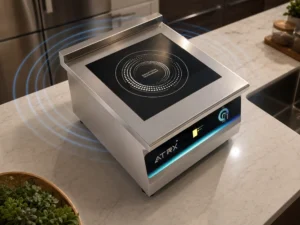
So what’s the difference between non-ionizing and ionizing radiation? It boils down to one key point. Ionizing radiation — like X-rays and gamma rays — carries photon energy high enough to knock electrons out of atoms. That directly damages DNA molecular structures. That’s why you wear a lead apron during X-rays and why nuclear plants have exclusion zones. The electromagnetic field at an induction cooker’s operating frequency, however, carries photon energy that doesn’t even come close to the threshold needed to break a single chemical bond. Both have “radiation” in their names. They are fundamentally worlds apart.
Put simply: the radiation from an induction cooker belongs to the same broad category as radiation from your cellphone, Wi-Fi router, and hair dryer — all non-ionizing radiation.
How Much Radiation Does an Induction Cooker Actually Emit?
Measured data shows that at a normal usage distance of 30 cm, the magnetic field strength of an induction cooker is approximately 0.23 microtesla (μT). This figure comes from a Japanese study published in an academic journal, where the research team measured more than 70 induction cookers under real-world conditions. It’s some of the most reliable data on induction cooker radiation levels available today.
What does 0.23 μT mean in context? Here’s a quick comparison:
| Source | Magnetic Field Strength |
|---|---|
| Induction cooker (at 30 cm) | Approx. 0.23 μT |
| Earth’s natural magnetic field | 25–65 μT |
| Hospital MRI machine (internal) | 1,500,000–3,000,000 μT |
At normal usage distance, the magnetic field from an induction cooker is less than one-hundredth of the Earth’s own background magnetic field.
There’s another critical fact: electromagnetic field strength drops off extremely fast with distance. At 30 cm it’s already very small. By 50 cm it’s practically negligible. (This study — covering over 70 induction cookers measured in real household environments — was published in the International Journal of Environmental Research and Public Health (IJERPH).)
Can This Radiation Harm the Human Body?
Does Induction Cooker Radiation Damage Cells or DNA?
No. Induction cookers operate in the intermediate-frequency range of 20–100 kHz. At this frequency, each photon in the electromagnetic field carries extremely low energy — it physically cannot damage cells or break DNA strands.
This isn’t a matter of “the dose is small, so there’s no harm for now.” The energy level simply doesn’t reach the threshold needed to cause damage in the first place.
Lab data backs this up. Multiple animal experiments and in vitro cell studies targeting intermediate-frequency electromagnetic fields have reached the same result: at the operating frequency and normal exposure levels of induction cookers, no genotoxicity, chromosomal abnormalities, or cellular structural damage has been observed. So is induction cooker radiation dangerous at the cellular level? The evidence consistently says no.
Based on all current evidence: induction cooker radiation does not damage your cells, and it does not destroy your DNA.
Does Induction Cooker Radiation Cause Cancer?
There is currently no scientific evidence establishing a causal link between induction cooker EMF radiation and cancer.
You may have seen claims online that “IARC classified electromagnetic fields as a Group 2B carcinogen.” That statement is technically accurate. But it’s important to understand what 2B actually means. The International Agency for Research on Cancer (IARC) defines Group 2B as “possibly carcinogenic to humans — limited evidence, can neither confirm nor rule out.” What else shares this category? Pickled vegetables and aloe vera extract.
In other words, Group 2B does not mean “causes cancer.” It means “current research can neither prove a connection nor completely rule one out.” This is standard scientific language that leaves room for uncertainty — it is not a risk warning.
What’s more, IARC’s classification targets the broad category of extremely low-frequency electromagnetic fields as a whole. It was not an assessment specifically directed at induction cookers. To date, no epidemiological study has found evidence of increased cancer incidence among induction cooker users. On this point, multiple international authorities have reached a consistent conclusion. (For more on electromagnetic fields and cancer, the U.S. National Cancer Institute (NCI) provides a detailed Electromagnetic Fields and Cancer Fact Sheet, covering the conclusions of all major studies to date.)
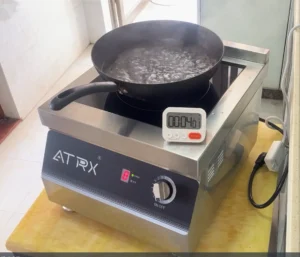
What Do WHO and Other Authorities Say About It?
Four major international authorities share a consistent position: induction cooker radiation safety is well established. Exposure under normal use is far below safety limits, and there is no known health risk.
The World Health Organization (WHO) has clearly stated that at normal exposure levels, low-frequency and intermediate-frequency electromagnetic fields do not pose a known threat to public health. Its assessment of electromagnetic fields from household appliances concluded that there is no evidence to warrant concern. (WHO established the International EMF Project in 1996 to continuously assess the health effects of electromagnetic fields.)
The International Commission on Non-Ionizing Radiation Protection (ICNIRP) is the global authority that sets electromagnetic field safety standards. ICNIRP has established clear exposure limits for intermediate-frequency electromagnetic fields. Remember the real-world measurement data from earlier?
| Item | Value |
|---|---|
| Induction cooker measured value (30 cm) | 0.23 μT |
| ICNIRP public safety limit | 27 μT |
| Measured value as percentage of safety limit | Less than 1% |
The U.S. National Cancer Institute (NCI) states in its official fact sheet that non-ionizing electromagnetic fields do not damage DNA and do not directly cause cellular damage. NCI has not listed induction cookers as a cancer risk source at any level.
Should Pregnant Women and Pacemaker Users Be Concerned?
The conclusions above apply to the general population. But two specific groups deserve a more targeted answer.
Does Using an Induction Cooker Affect a Fetus During Pregnancy?
There is currently no scientific evidence showing that, under normal usage conditions, the intermediate-frequency electromagnetic field of an induction cooker causes adverse effects on fetal development.
Researchers have specifically evaluated the electromagnetic field exposure levels of pregnant women while using induction cookers. The conclusion: at normal cooking distances, the actual exposure level falls well within the safe range — far below the limits ICNIRP sets for the general public.
The advice for pregnant women is straightforward: just stand and cook normally. There’s no need to deliberately increase your distance, and there’s no need to wear so-called “anti-radiation clothing.” Your usual cooking posture and habits are already safe enough.
Of course, being cautious about any health concern during pregnancy is entirely reasonable. If you still feel uneasy, you can stand a bit farther back while cooking, or use a traditional resistive electric stove as an alternative. But based on existing evidence, these extra precautions aren’t necessary.

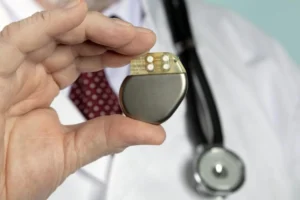
Can Pacemaker Users Use Induction Cookers?
In most cases, yes — but consult your cardiologist first. This is the only risk advisory in this entire article that warrants serious attention.
The alternating magnetic field from an induction cooker, at extremely close range (when the body is nearly touching the cooking surface), could potentially cause electromagnetic interference with certain types of implanted cardiac pacemakers. The models most at risk are primarily those using unipolar sensing mode, particularly when implanted on the left side of the body.
However, there’s a big gap between “possible interference” and “guaranteed problems.” Published research findings on induction cooker radiation and pacemaker users are not uniform:
| Study Conditions | Conclusion |
|---|---|
| Body pressed against cooking surface + unipolar pacemaker | Interference signals detected |
| Normal standing distance + unipolar pacemaker | No significant interference detected |
| Any distance + bipolar pacemaker | No interference detected |
Modern pacemakers have significantly better electromagnetic interference resistance than earlier models. At normal standing cooking distance, the risk is extremely low.
That said, here’s the responsible recommendation: if you have a cardiac pacemaker, please consult your cardiologist before purchasing or using an induction cooker. Your doctor can give the most accurate advice based on your pacemaker model, polarity settings, and implant location. This step cannot be skipped.
How to Reduce Radiation Exposure When Using an Induction Cooker
Under normal use, the radiation from an induction cooker is far below safety standards. But if you still want to minimize your exposure, these simple practices can help:
- Keep at least 30 centimeters of body distance. Electromagnetic field strength drops off extremely fast with distance. At 30 cm, the level is already negligible. You don’t need to stand far away on purpose — your normal standing posture is enough.
- Use cookware that matches the size of the cooking zone. When the pot bottom fully covers the heating zone, the magnetic field energy gets absorbed by the cookware effectively, and the amount of EMF leaking outward is minimized. If the pot is too small or placed off-center, leakage goes up.
- Don’t heat an empty pot. When there’s no pot on the surface — or when the pot is empty — the magnetic field energy can’t be absorbed properly. That causes more electromagnetic field to disperse into the surrounding area.
- Choose products with proper safety certifications. Make sure the induction cooker you purchase complies with the IEC 62233 standard or has passed ICNIRP exposure limit testing. Reputable manufacturers run electromagnetic compatibility testing before shipment, and certified products have basic radiation control safeguards built in.
All four tips require zero changes to your normal cooking habits. Just cook the way you always have.
Common Questions People Ask
Q1: Does the radiation from an induction cooker stay in the food?
No. An induction cooker works by using the magnetic field to heat the cookware itself. The food is heated by the pot’s thermal energy, not by the electromagnetic field directly. The moment you turn the cooker off, the magnetic field vanishes instantly. Nothing stays behind in the food.
This is different from how a microwave oven works. Microwaves act directly on water molecules in food. An induction cooker’s magnetic field only acts on the ferromagnetic metal at the bottom of the pot. The food itself never comes into contact with the electromagnetic field at any point.
Q2: Does standing next to an induction cooker for a long time cause radiation to build up in your body?
Non-ionizing radiation from induction cookers does not accumulate. This is different from ionizing radiation (like X-rays), where damage can stack up at the cellular level over repeated exposures. With non-ionizing radiation, once you step away from the magnetic field, it stops having any effect on your body.
There’s no scenario where “a little exposure today, a little more tomorrow” gradually pushes you past a safe limit. Each use is independent, and the exposure level stays far below safety thresholds every single time. When people ask whether induction cooker radiation is harmful over time, the science is clear: non-ionizing radiation simply doesn’t work that way.
Q3: If I’m worried about radiation, is a ceramic (radiant) cooker safer than an induction cooker?
A ceramic cooker heats through resistive heating elements directly. It doesn’t produce an intermediate-frequency alternating magnetic field, so it doesn’t have the same type of EMF exposure as an induction cooker. But that doesn’t mean induction cookers are “unsafe” — the two just use different heating methods.
An induction cooker’s EMF exposure at normal usage distance is less than 1% of the ICNIRP safety limit. That already puts it well within the safe range. A ceramic cooker eliminates the EMF topic entirely, but the trade-off is lower heating efficiency and higher energy consumption. This isn’t a safety issue — it’s a matter of trade-offs.
About the author

ATRX Team| 18 Years Commercial
Induction Cooker Manufacturer in China
Induction Cooker Manufacturer in China
Related Posts

Best Commercial Induction Cooktop: Types &Buying Guide
10/09/2026
Commercial Double Hob Induction Cooker | Types, Power, and Installation Guide
10/05/2026
Commercial Induction Cooker 3500W: Model Selection, Commercial Power and Installation
09/29/2026
How to Install a Built-In Induction Cooktop: A Step-by-Step Guide
09/17/2026
How to Clean a Commercial Deep Fryer: A Step-by-Step Guide
09/13/2026
High Quality Commercial Induction Cooker Manufacturer
09/09/2026
Automatic Wok Machine: Types, Specifications, Applications and Buying Guide
08/18/2026
Commercial Induction Range: How to Choose the Right Size, Power, and Configuration for a Commercial Kitchen
08/15/2026
What Is a Commercial Induction Cooker and How Does It Work
08/13/2026
Commercial Induction Range for Hotel Kitchens: How to Choose the Right Model
08/11/2026