

Commercial Induction Griddles Worth Buying
06/25/2026
Estimated reading time: 2 minutes

Worth BuyingCommercial Induction Griddles to Buy
Buying a commercial induction griddle is stressful for one reason: every model looks the same on paper until you plug it in. Not enough power — food stalls. Plate too small — you can’t keep up at peak. Temperature swings ±50 °F — your eggs go from golden to burnt in the same batch. Any one of those mistakes costs real money.
We pulled specs from the models that show up most often in professional kitchens, then scored them on five things that actually matter: power output, heated surface area, preheat speed, temperature-control precision, and price. Below are the strongest performers in the countertop and freestanding categories, broken down one by one.
Countertop Commercial Induction Griddles
The countertop induction griddle is the form factor most kitchens buy first. It installs fast, fits almost anywhere, and works in everything from a hotel breakfast bar to a mid-size back-of-house line. These three models came out on top in our commercial induction griddle review.
1. Hatco IGRID-2418 — The Gold Standard for Full-Surface Heat Uniformity
Most commercial induction flat top griddles run 2 to 4 coils under the plate. The Hatco IGRID-2418 uses 12. That’s 12 coil groups spread beneath a polished steel surface measuring 24″ × 18″ (610 mm × 457 mm), split into two independent heating zones. The payoff: temperature stays virtually the same from edge to center, corner to corner.
Total output is 7.2 kW. Each zone has four dedicated temperature sensors and its own control knob. Max surface temperature hits 550 °F (288 °C). Preheat to 350 °F takes about 12 minutes. It carries UL and NSF certifications. Retail pricing usually lands between $6,700 and $7,200.
If your top priority is “every square inch of the plate cooks identically,” this is the machine to beat. The 12-minute preheat is slower than some competitors, but what you get in return is the most even cooking surface in this class. For high-volume pancake, egg, or crêpe production where visual consistency drives customer perception, that tradeoff makes sense.
2. Equipex GLP6000 — Blazing Preheat, Pinpoint Temperature Control
A typical gas griddle needs 30 to 45 minutes to preheat. The Equipex GLP6000 does it in 2 minutes to 400 °F. Two minutes. It runs on French-engineered Adventys induction technology, sold in North America under the Equipex label (a Spring USA brand). Total power is 6 kW, dual-zone, with a multi-layer composite cooking surface.
The capacitive-touch panel gives you 12 temperature steps from 122 °F to 475 °F. Temperature accuracy is rated ±1 °F — traditional griddles typically drift ±25 °F to ±50 °F, so the gap is massive. Cooking area is roughly 25″ × 12.5″. The unit weighs about 105 lbs and runs on 208/240 V single-phase. Retail price: $9,700 – $10,000.
Not cheap. But if your kitchen opens for a breakfast rush and needs to fire food the second the doors unlock, zero preheat wait is worth every dollar. The Equipex also has the strongest temperature-control precision in the entire lineup — if your menu demands tight thermal management across delicate proteins, this is the unit to look at first.
3. ATRX AT-CTG Series — A Factory-Direct Option from China
The two models above are European and American brands with pricing to match. For buyers where acquisition cost is a primary constraint, the AT-CTG series from ATRX offers a different value equation. The company has manufactured commercial electric induction griddle equipment in Dongguan, China since 2007, exporting to over 50 countries.
The AT-CTG comes in 3.5 kW and 5 kW versions with a cast-iron cooking surface. Cast iron holds heat better than standard steel — an advantage for sustained searing — though it also requires more care to prevent surface oxidation compared to polished steel or chrome. Controls are an 8-position rotary knob with a live LED readout. The chassis is 304 stainless steel, the power module uses German Infineon IGBT chips, and CE certification is in place.
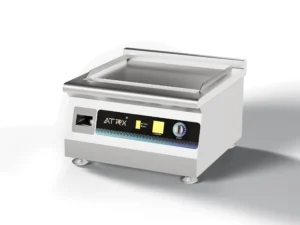
A few things to weigh honestly. The AT-CTG is single-zone only — no independent dual-temperature cooking. It doesn’t carry UL or NSF certification, which some North American health departments require. And the after-sales network is factory-direct rather than a local dealer you can call for same-day service. For kitchens where those factors aren’t dealbreakers — particularly operations outside North America, or projects with volume-driven budgets — the price-to-performance ratio is strong. OEM/ODM customization of power, voltage, plate size, and branding is also available.
Countertop Models — Side-by-Side Spec Summary
| Spec | Hatco IGRID-2418 | Equipex GLP6000 | ATRX AT-CTG Series |
|---|---|---|---|
| Power | 7.2 kW | 6 kW | 3.5 kW / 5 kW selectable |
| Heated Surface | 24″ × 18″ (610 × 457 mm) | 25″ × 12.5″ | 418 × 398 mm |
| Heating Zones | Dual-zone independent | Dual-zone independent | Single zone |
| Max Temperature | 550 °F (288 °C) | 475 °F (246 °C) | Adjustable (8 positions) |
| Preheat Speed | 12 min to 350 °F | 2 min to 400 °F | Rapid preheat |
| Temp-Control Precision | Digital display + 4 sensors/zone | ±1 °F, 12-position touch | Real-time display, 8-position knob |
| Plate Material | Polished steel | Multi-layer composite | Cast iron |
| Certifications | UL / NSF | — | CE |
| OEM Customization | No | No | Yes |
| Reference Price | $6,700 – $7,200 | $9,700 – $10,000 | Below Western brands (factory-direct) |
| Origin | USA | France | China |
Freestanding Commercial Induction Griddles
A countertop unit covers most small and mid-size kitchens. But when daily output is high and the griddle station runs continuously for hours, countertop models hit a ceiling. The plate isn’t big enough. The power can’t keep up. The chassis wasn’t built for all-day, full-load punishment.
That’s where freestanding induction griddles earn their place. Larger surface means more product on the plate at once. Higher wattage means temperature doesn’t sag during bulk service. Heavier construction means 12-hour shifts don’t cause performance drop-off.
1. CookTek PL362 Series (36″ Freestanding Plancha) — The North American Benchmark
CookTek has been in the induction heating business for over 25 years. The PL362 is the top of their freestanding line. Two independent 7 kW zones add up to 14 kW total. The cooking surface measures 30″ × 23″ (762 mm × 584 mm) — room for a dozen-plus steaks at once. Plate options include polished steel, chrome, and a half-grooved version. Temperature range: 325 °F to 525 °F.
Preheat is solid: under 5 minutes to 350 °F, under 9 minutes to 500 °F. A wraparound grease channel drains into dual slide-out drip trays, so cleanup is fast. It supports 208/240 V and 380/415 V three-phase and weighs 160 lbs.
What really sets this commercial induction plancha apart is temperature recovery. Cold product hits the plate, the surface dips — how fast it bounces back determines whether every plate coming off the line looks the same. The PL362 recovers faster than anything else in its class. If you’re running a high-volume North American kitchen and need a freestanding induction griddle you can trust through a 500-cover lunch, this is the safest bet in the category.
2. Garland Instinct GIIC-DG10.0 — Patented Temp Control, Stand-Mountable
On paper, the Garland GIIC-DG10.0 is a countertop unit. In practice, its 10 kW dual-zone layout, 24″ × 22″ (≈ 617 mm × 570 mm) stainless-steel plate, and 150-lb weight — paired with Garland’s dedicated equipment stand — make it fully capable as a freestanding station.
The standout feature is Garland’s patented RTCSmp system. It monitors the plate surface in real time and automatically compensates for even tiny temperature fluctuations. Range covers 120 °F to 450 °F. Each zone has 12 power levels plus a hold/warm function. Preheat to 392 °F takes about 3.5 minutes. UL and NSF certified. Retail price: roughly $12,600 – $12,800.
That’s the highest sticker price in this roundup. But Garland backs it with one of the most sophisticated temperature-compensation systems on the market, full UL/NSF compliance, and deep integration with the broader Garland equipment line. If your kitchen already runs Garland gear, this commercial induction flat top slots in without compatibility headaches.
3. ATRX AT-FLG Series — High-Power Freestanding at a Lower Price Point
CookTek’s 14 kW unit runs well over ten thousand dollars. Garland’s 10 kW exceeds twelve thousand. For chain operations, institutional canteens, and banquet kitchens buying in volume, that per-unit cost stacks up fast. The AT-FLG series competes in this power class at a lower entry point.
Four power levels are available: 8 kW, 10 kW, 12 kW, and 15 kW. The cooking surface is 620 mm × 490 mm. A heavy-duty pedestal rated at 500 kg sets the working height at 800 mm, with an optional 150 mm riser. Power runs on German Infineon IGBT modules. Voltage options span 220 V / 380 V / 400 V / 415 V three-phase. Over-temperature, dry-fire, under/over-voltage protection, and automatic fault detection all come standard. CE certified.
The honest tradeoffs: no UL or NSF listing, which matters if your jurisdiction requires them. The after-sales model is factory-direct — responsive, but not the same as having a local tech on call. And while CE covers European safety requirements, kitchens in North America or Australia may face additional compliance steps. Where the AT-FLG series makes the most sense is high-volume procurement for markets where CE is the accepted standard — think Middle East, Southeast Asia, Latin America, or European institutional projects where the price gap against Western brands becomes significant at scale.
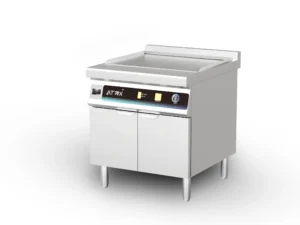
Core Spec Comparison of the Commercial Induction Griddles
You’ve seen the shortlist. Now we put every model on the same table and measure them with the same ruler. Two sets of hard numbers below: heating and temperature-control performance first, then pricing and long-term ownership cost. No theory — just data. Where each unit leads and where it trails shows up immediately.
If you still have open questions about how to pick the right wattage, match voltage, or choose a plate material, read this complete commercial induction griddle buying guide first. It walks through principles, specs, and installation requirements. Come back here to compare models afterward — the numbers will make a lot more sense.
Heating Performance and Temperature Control — Model by Model
Holding the line during peak service comes down to two questions. Is there enough heat? Is the control tight enough? Below, we break out six specifics: power output, preheat speed, max temperature, zone count, control interface, and sensors.
Power Range and Throughput Ceiling
Power in this group spans 3.5 kW to 7.2 kW — nearly a 2× gap. If you cook two items at different temperatures at the same time — eggs on one side, bacon on the other — you need dual zones. The Hatco IGRID-2418-FS tops out at 6.24 – 7.2 kW, the highest total in the group and the deepest thermal-recovery reserve under sustained load. Equipex GLP6000 gives you 6 kW across two zones. Spring USA SM-251GRD splits into 2 × 2.5 kW for 5 kW total.
Flip side: if you run a single product at volume — smash burgers, teppanyaki — a single-zone unit is actually more efficient. Equipex BGIC3600 (3.6 kW), Garland GIIC-SG5.0 (5 kW three-phase), and the AT-CTG line (3.5 – 5 kW) all put their full power on one plate with no inter-zone cold spots. Thermal recovery can actually be faster.
Preheat Speed: How Fast Can You Start Selling?
This is where the gap gets dramatic. Both Equipex models hit 400 °F in 2 minutes — fastest in the group. Walk in, power on, start cooking. The AT-CTG follows at 3 – 5 minutes to working temperature. Plenty fast for small- and mid-scale foodservice or mobile catering.
Hatco’s IGRID-2418-FS takes 12 minutes to reach 350 °F. Looks slow. But there’s a reason. Underneath that plate sit 12 coils and 8 sensors (4 per zone). Hatco isn’t chasing startup speed — it’s optimizing for surface uniformity once it gets there. When every pancake and every fried egg needs to come off the plate looking identical, that’s where the 12-coil design pays off. Garland and Spring USA don’t publish official preheat times; real-world performance is mid-range.
Temperature-Control Precision and Interface
Each control style solves a different problem. Hatco gives you 1 °F step adjustment through a knob-plus-digital-display setup. For fine-grained control, it’s the most capable here. Spring USA goes a different route: SmartScan detects cookware size and type automatically, matches power across 20 temperature settings, and cuts down on operator mistakes.
Both Equipex units use capacitive-touch panels with 12 positions. No seams, easy to wipe, fast response. The AT-CTG keeps it simplest: rotary knob, LED readout showing power and temperature at the same time, 8 steps. Training takes minutes. It also packs triple auto-shutoff — over-temperature, dry-fire, voltage anomaly. In buffet or outdoor-event settings where nobody is watching the griddle full-time, those safeguards matter.
Heating Performance Comparison Table
| Model | Power | Preheat Time | Max Temp | Zones | Control Interface | Temp Sensors |
|---|---|---|---|---|---|---|
| Equipex BGIC3600 | 3.6 kW | 2 min to 400 °F | 536 °F (280 °C) | 1 | Capacitive touch, 12 settings | Built-in thermistor |
| Equipex GLP6000 | 6 kW | 2 min to 400 °F | 536 °F (280 °C) | 2 | Capacitive touch, 12 settings + 4-digit display | Dual-zone independent sensors |
| Hatco IGRID-2418-FS | 6.24 – 7.2 kW | 12 min to 350 °F | 550 °F (288 °C) | 2 | Knob + digital display, 1 °F step | 4 per zone, 8 total |
| Garland GIIC-SG5.0 | 5 kW (3-phase) | Not published | 450 °F (232 °C) | 1 | Thermostat knob | Built-in thermistor |
| Spring USA SM-251GRD | 5 kW (2 × 2.5 kW) | Not published | 400 °F (204 °C) | 2 | SmartScan digital, 20 settings | SmartScan auto-detection |
| ATRX AT-CTG | 3.5 – 5 kW | 3 – 5 min to working temp | ≈ 430 °C (plate surface) | 1 | Knob + LED dual readout (power/temp), 8 positions | Thermistor + over-temp protection |
Price and Long-Term Cost of Ownership — Model by Model
Performance tells you if a unit can do the job. Price and running cost tell you how long you can afford to keep it doing the job. The sticker is just the first payment. Energy-efficiency gaps add up on every electric bill. Warranty length shapes your repair budget. Parts availability determines how long you’re down when something breaks. Add those three together and you get the real five-year cost.
Purchase Price: $3,100 to $12,000 — Nearly a 4× Spread
Spring USA SM-251GRD enters at roughly $3,100 – $4,100. That’s the lowest among dual-zone units here, and it comes with Energy Star certification — a plus for buyers watching utility costs. Hatco and Equipex dual-zone models fall in the $9,700 – $12,000 range. The extra money buys higher power density, more advanced temperature hardware, and a more established North American service network.
The Chinese-manufactured options from the AT-CTG and AT-FLG lines use a factory-direct model with no multi-layer distributor markup. In the 3.5 kW and 5 kW brackets, their specs closely match the Equipex BGIC3600 and Garland GIIC-SG5.0, but acquisition cost is lower. That said, the saving comes with trade-offs: no local service depots in most Western markets, no UL/NSF stamps, and warranty claims route through the factory rather than a regional dealer. For single-unit buyers in North America who value next-day service calls, Hatco or Garland’s support infrastructure may be worth the premium. For multi-unit procurement in CE-standard markets, the cost gap at scale is hard to ignore.
Price and Ownership Comparison Table
| Model | Market Price (USD) | Rated Efficiency | Warranty | Parts & Service Channel |
|---|---|---|---|---|
| Equipex BGIC3600 | $5,400 – $5,830 | > 90% | 2-year limited (parts + labor) | Spring USA North American dealer network |
| Equipex GLP6000 | $9,700 – $12,060 | > 90% | 2-year limited (parts + labor) | Spring USA North American dealer network |
| Hatco IGRID-2418-FS | $9,800 – $11,460 | High (12-coil uniform-heat design) | 2-year parts + labor, 24/7 support | Hatco in-house parts center, broad North American coverage |
| Garland GIIC-SG5.0 | $5,960 – $6,950 | High (induction thermostat) | 2-year on-site parts + labor (US & Canada only) | Welbilt group dealer network |
| Spring USA SM-251GRD | $3,100 – $4,100 | Energy Star certified | 1-year overnight exchange warranty | Spring USA direct service |
| ATRX AT-CTG / AT-FLG | Factory-direct (below Western brands at comparable specs) | 90% – 95% | 5-year warranty / 2-year free replacement / 1-year returns | Factory-direct, global inventory |
Commercial Induction Griddle for Different Kitchen Scenarios
The biggest selection mistake is “spec-sheet thinking” — higher wattage must be better, bigger plate must be right. It doesn’t work that way. A powerhouse that runs perfectly in a chain QSR back-of-house might not physically fit behind a café counter. A sleek countertop unit dropped into a hotel banquet kitchen will buckle the first time peak service hits.
“Best” depends on the kitchen. Its scenario, its pace, its physical layout. Below, we match models from the shortlist to two of the most common commercial kitchen types.
Best Picks for High-Volume Back-of-House Kitchens
Chain fast-casual, hotel banquet, institutional canteen — these kitchens share one trait. Daily output starts at 500+ covers and the griddle doesn’t stop for hours. Breakfast means 200 strips of bacon in a row. Lunch is a continuous stream of steaks and chicken. A banquet kitchen has to push through several hundred plated mains in under two hours.
At that pace, one spec overrides everything else: power reserve. If there isn’t enough, every batch of cold product dragged onto the plate tanks the surface temperature, recovery crawls, and the whole line bogs down.
Here’s how the lineup maps to high-load kitchens:
CookTek PL362 (14 kW, 380 V three-phase) — The highest total wattage in this roundup, the fastest recovery in its class, and the most established service network for North American high-volume operations. If budget allows, this is the safest pick for a freestanding station doing 500+ covers daily. UL/NSF listed. Dual-zone. Chrome plate available for easier cleaning.
AT-FLG-012 / AT-FLG-015 (12 kW – 15 kW, 380 V three-phase) — Comparable power output at a significantly lower price point. In factory stress testing, the 15 kW unit loaded with frozen patties edge to edge — a near-worst-case condition — recovered to setpoint in under 90 seconds. The tradeoff versus CookTek: no UL/NSF, and service is factory-direct rather than through a local dealer. For operations outside North America, or multi-unit buyers in CE-standard regions, the math often tips in this direction.
Equipex GLP6000 — 6 kW is lower than the two above, but the ±1 °F temperature control is unmatched. Any induction griddle for restaurant kitchens that prioritize precision over raw throughput — upscale brunch, tasting-menu proteins — should consider this unit seriously.
Why 3.5 – 5 kW countertop models fall short here: Light-duty work is fine. But at 500+ covers per day, a small-wattage unit becomes the bottleneck. Cooks shrink batch sizes. They wait for temperature to climb back. Throughput drops. The rule is simple: high-volume, high-turnover means 12 kW or above, and make sure the electrical system supports 380 V three-phase.
If your kitchen runs 300+ covers daily for 12-plus hours straight, power isn’t the only variable. Plate durability, wiring capacity, and maintenance strategy all affect equipment lifespan and output consistency. This in-depth guide for heavy-use kitchen induction griddles goes deeper on each factor.
Best Picks for Small Kitchens and Front-of-House Display Cooking
Not every kitchen needs maximum firepower. Small restaurants, café counters, hotel breakfast buffets, teppanyaki show-cooking stations — these share one reality. Space is tight. Every inch of counter is spoken for. The bar might only be a few dozen centimeters deep.
Here, footprint and installation flexibility come first. A griddle with great specs on paper is useless if the cook can’t turn around once it’s in place.
Two models fit this scenario well. The Hatco IGRID measures just 24″ × 18″. Commercial-grade output in a compact body — it sits on a small prep station without crowding anything else out. UL/NSF certified, so compliance isn’t an issue in North America. If your station is fixed in one spot and doesn’t need to move, Hatco is a clean, low-risk choice.
The AT-CTG countertop series is smaller still at 500 mm × 470 mm, with horn-style feet that let you slide it between stations. Move it to the buffet line for eggs at breakfast, then over to the bar for lunch service. One unit, multiple positions. The tradeoff: no UL/NSF, and the single-zone design limits you to one temperature at a time. For cafés, self-service buffets, and mobile catering where flexibility and footprint matter more than dual-zone cooking, it’s a practical fit.
One common mistake: forcing a big machine into a small space just to get more power. An 800 mm-wide griddle crammed onto a tight counter eats your cutting-board space, kills the plating zone, and in a front-of-house setup the servers and cook get in each other’s way. Before looking at any spec sheet, measure the counter first.
| Comparison Item | Hatco IGRID | ATRX AT-CTG Countertop Series |
|---|---|---|
| Unit Dimensions | 24″ × 18″ (≈ 610 mm × 457 mm) | 500 mm × 470 mm |
| Minimum Counter Depth | ≥ 500 mm | ≥ 500 mm |
| Portable / Relocatable | Primarily fixed installation | Horn-style feet, freely movable between counters |
| Typical Use Cases | Hotel buffet breakfast station, fixed café prep position | Café-bistro, teppanyaki display, multi-station deployment |
| Core Advantage | Full commercial heating in a compact body | Minimal footprint + high mobility |
Small-space griddle selection always starts the same way: measure the counter, then look at specs. Get the dimensions right and the power has room to work. Reverse the order and what you’ve bought isn’t a tool — it’s an obstacle.
Not sure which size, power level, or plate material fits your kitchen? This step-by-step guide on how to choose a commercial induction griddle walks through every decision point — from measuring your counter to matching voltage — so you can lock in the right unit before you spend.
About the author
ATRX Team| 18 Years Commercial
Induction Cooker Manufacturer in China
Induction Cooker Manufacturer in China
Related Posts
Industrial Induction Wok Burners (15 kW–30 kW): How They Differ from Standard Commercial Models
07/07/2026
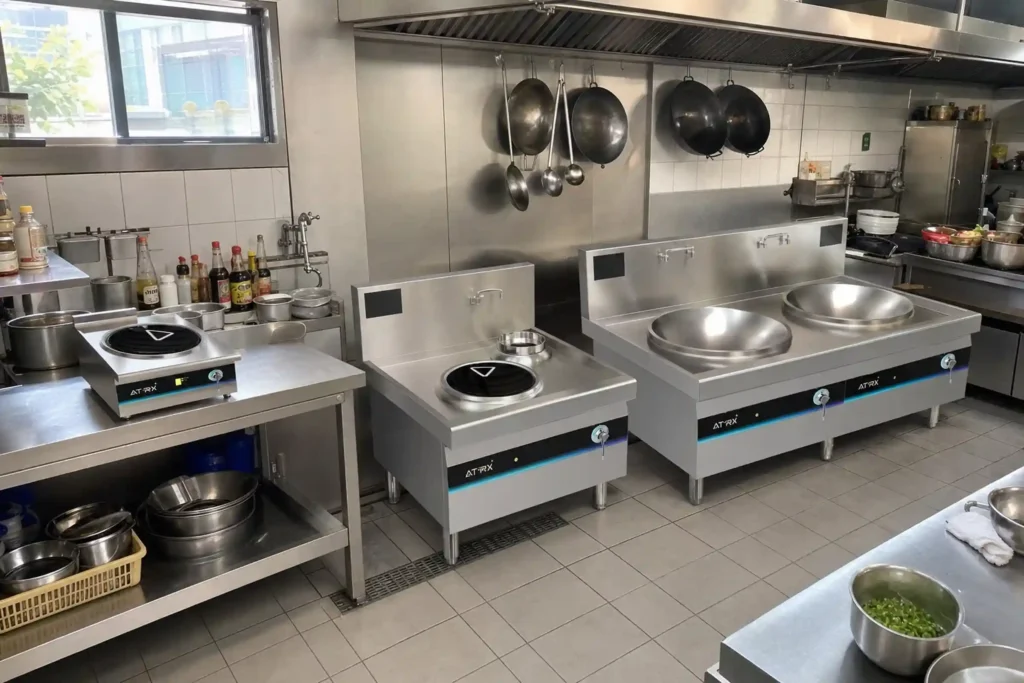
Commercial Induction Wok Burners: Countertop vs. Built-In vs. Freestanding — Which Fits Your Kitchen layout?
07/06/2026
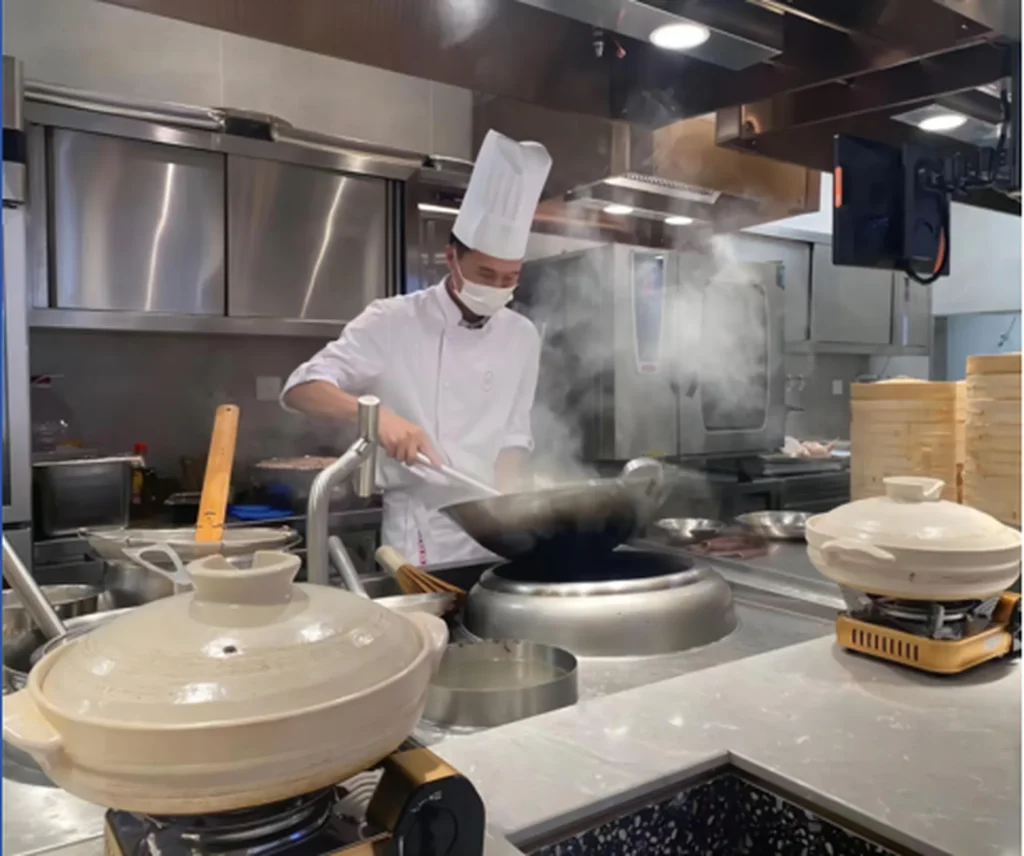
Commercial Induction Wok Range: What to Cook at Every Power Level (3.5 kW–30 kW)
07/05/2026
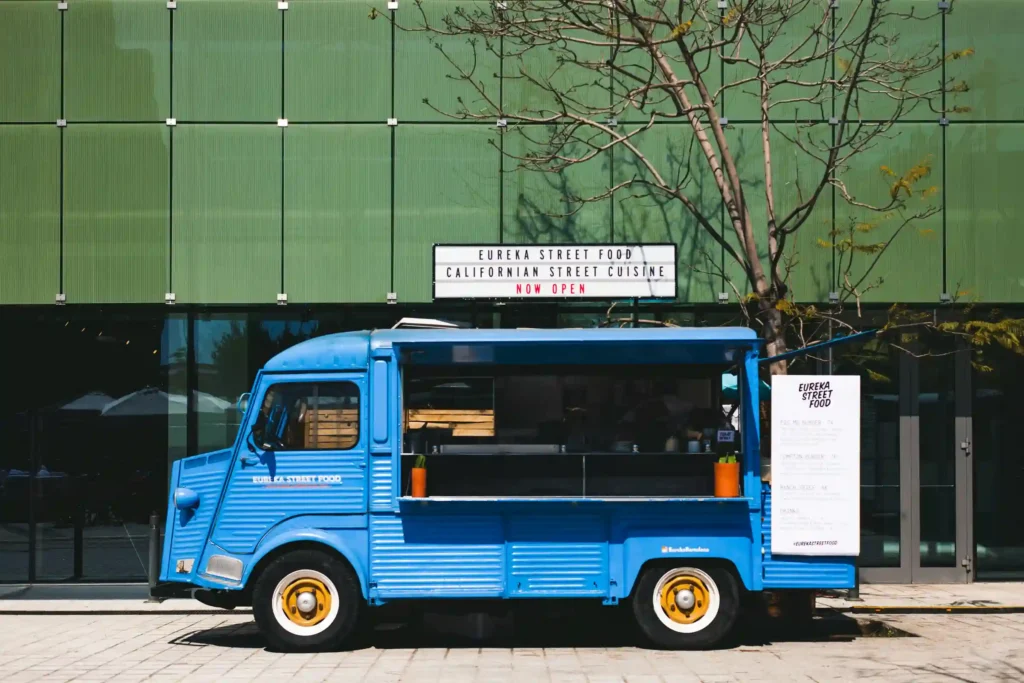
How to Choose the Best Commercial Induction Cooktop for Food Truck | 3-Step Guide
07/04/2026

Generator Can’t Power Commercial Induction Cooktop on Food Truck? — How To Fix It
07/03/2026
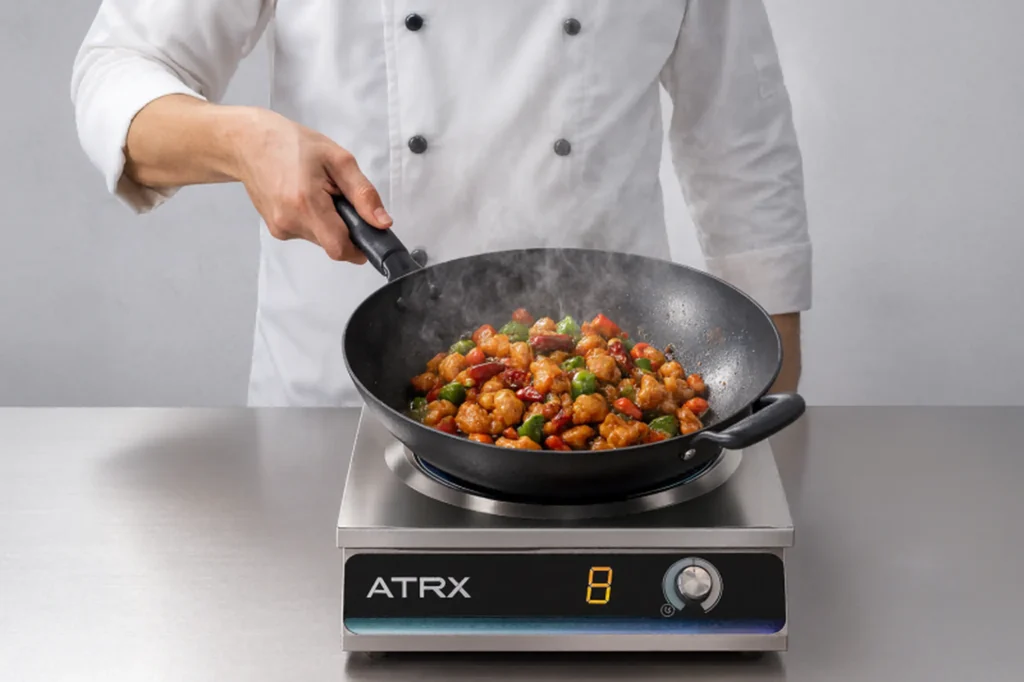
Commercial Induction Cooktop Operating Instructions: A Complete Guide for Professional Kitchens
07/02/2026
How to Choose a Commercial Induction Soup Cooker — A Buying Guide for Restaurant Owners
07/02/2026
Commercial Induction Pasta Cooker: The Ultimate Buying Guide
07/01/2026
Commercial Induction Steamer Buying Guide: How to Choose Between Rice Steamers and Seafood Steamers
06/30/2026
Commercial Induction Built-in Cooker: The Complete Guide to Seamless Kitchen Integration
06/29/2026