

How to Choose the Best Commercial Induction Griddle
06/26/2026
Estimated reading time: 2 minutes

Too many models. Too wide a price range. Spec sheets that all look the same. If you’ve been shopping for a commercial induction griddle, you already know the frustration. This guide cuts through the noise with a simple three-step method: first, use power output and cooking surface area to narrow the field; second, check the temperature-control components to weed out weak builds; third, run a hands-on test and vet the manufacturer’s credentials. By the end, you’ll have two or three solid options — and the decision will be easy.
Which Core Parameters to Check First When Choosing a Commercial Induction Griddle
Commercial electric induction griddles range from compact countertop units at a few hundred dollars to heavy-duty floor-standing machines in the thousands. (For a full overview of how commercial induction griddles work and where they’re used, see our commercial induction griddle guide.)Before comparing brands or prices, get two things straight: power paired with heating surface area, and the temperature-control system with its zone configuration.
Power and area tell you whether the griddle can keep up with your daily output. Temperature control tells you whether it can handle the cooking precision your menu demands. These two sets of numbers also become your baseline for judging value later. Nail them down, and the selection is more than half done.
How to Evaluate Power and Heating Surface Area
Power ratings on the market run from 3.5 kW to 15 kW. Don’t start by picking a brand. Start by pulling out your kitchen’s daily meal count and working backward to the wattage you need. Here’s a quick three-tier breakdown:
1. Under 100 meals per day — light-duty (3.5–5 kW countertop units). Coffee-shop breakfast service, small casual eateries, convenience-store hot-food counters — this range covers them all. Bodies are typically 320–400 mm wide. One person runs it easily, and it plugs into a standard 220 V outlet. No special electrical work, no extra kitchen space required.
2. 100–200 meals per day — mid-volume (8–10 kW mid-power units). Chain fast-food shops, corporate canteens, mid-size Western restaurants — this is the sweet spot, and the biggest segment of the commercial kitchen induction griddle market. Panel sizes usually fall between 500 × 400 mm and 620 × 490 mm. You can lay out 8–12 portions at once and keep pace through peak service without slowdowns.
3. Over 300 meals per day — heavy-duty (12–15 kW floor-standing units). Hotel buffet lines, large central kitchens, teppanyaki restaurants — they need this tier. Panels start at 800 × 500 mm. Paired with high power, they handle 16–24 portions at the same time, removing the capacity bottleneck at its root.
But power alone doesn’t tell the full story. You have to look at heating surface area right alongside it.
Take two units both rated at 8 kW. One has a 430 × 350 mm panel; the other, 620 × 490 mm. The heat density per square meter is completely different. On the smaller panel, 8 kW is packed into roughly 0.15 m². It heats up fast, runs hot, and excels at high-heat searing — steaks, teppanyaki, anything that needs a hard crust quickly.
The larger panel spreads the same wattage over about 0.30 m². Peak temperature at any single point is lower, but you can fit far more items at once — eggs on one side, bacon in the middle, pancakes on the other. During a breakfast rush, that throughput advantage is enormous.
So the goal isn’t “more power is better.” It’s getting the power-to-area ratio right for your workflow. High-heat, fast-output cooking? Go “high power + small panel.” Multi-item, simultaneous production? Go “moderate power + large panel.” And always size to your peak-hour volume, not the daily average. Build in headroom so the kitchen doesn’t stall when it’s busiest.
How to Evaluate the Temperature-Control System and Zone Configuration
Induction griddle temperature control precision is the single biggest advantage over a standard electric griddle. Electric models rely on resistance elements, and ±5–10 °C swings are normal. A well-built commercial induction flat top, thanks to the instant response of electromagnetic heating, can hold within ±1 °C. But not every machine pulls this off. The difference comes down to the control components inside.
Industrial-grade controllers — for example, solutions built on Omron modules — outperform generic parts in sensing speed, long-term drift, and component lifespan by a wide margin. During one factory visit, engineers ran a side-by-side test on the same machine body: one fitted with an industrial-grade module, the other with a generic one. Both set to 230 °C, left running for four hours straight.
The industrial-grade unit stayed between 228 °C and 232 °C the entire time. The generic one started drifting upward around the two-hour mark and ended up nearly 12 °C above the set point. The engineer’s comment was blunt: on a new machine, you barely notice the gap. But it gets wider with every month of use. Many kitchens discover after six months to a year that “the same recipe gives inconsistent results” — and the root cause traces right back to cheap temperature-control parts.
So when you’re buying, don’t just read “accuracy ±X °C” on the spec sheet and move on. Ask what brand and what grade of control components are installed. That one question saves a lot of headaches down the road.
Accuracy is one half of the equation. The other half is zone configuration — whether you can run different temperatures on different parts of the panel at the same time. The market currently offers two mainstream setups: single-zone and dual independent zones.
Single-zone means the whole panel sits at one temperature. If your kitchen runs a single product — steaks only, or fried rice only — that’s perfectly fine. Simple structure, low failure rate. But the moment you need 200 °C for eggs on one side and 250 °C for meat on the other, a single zone can’t cope.
Dual independent zones use two separate coil sets under the panel, each with its own controller. You set two different temperatures, and each side holds its own — one machine doing the work of two, without taking up an extra inch of counter space.
Not sure which fits your kitchen? This quick comparison should make the call easy:
| Comparison Dimension | Single-Zone Models | Dual Independent-Zone Models |
|---|---|---|
| Temperature Setting | Uniform across the entire panel | Two zones set independently |
| Best For | Single-category cooking (steaks, teppanyaki rice, etc.) | Multi-category simultaneous cooking (eggs + meat, pancakes + hot dishes) |
| Control Components | One module set + a few sensors | Two independent module sets + multi-point sensors (e.g., 4 per zone) |
| Cross-Zone Interference | N/A — only one zone | Quality builds achieve near-zero thermal bleed |
| Complexity & Failure Rate | Simpler, lower failure rate | More complex, higher demands on component quality |
| Typical Scenarios | Specialty counters, single-item fast food, dedicated teppanyaki stations | Western kitchens, hotel buffet stations, multi-item breakfast counters |
| Cost | Lower | Higher (typically 20–35% more) |
Diverse menu, peak-hour pressure to put out several dishes at once? Dual zones plus industrial-grade control components is the setup that actually delivers — accurate temps, flexible zoning, consistent output.
On the other hand, if your business revolves around one or two signature items and space and budget are tight, a single-zone model with quality control parts is the more practical bet.
How to Tell Apart Commercial Induction Griddles with Similar Specs
Two commercial induction flat top griddles sit side by side. The spec sheets look copy-pasted — same wattage, same voltage, nearly the same dimensions. Put them both in a real kitchen for a month, though, and the gap shows up fast. What separates good from mediocre doesn’t live on any spec sheet. It hides in the coil-winding craft, the panel material choice, and the cooling structure and component quality you only see once the housing comes off. Here’s what to look for, broken into two areas.
Coil Layout and Panel Material — The Real Differences
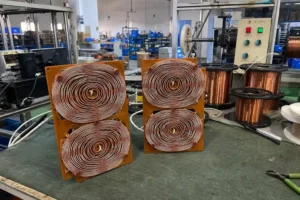
1. Winding density and coverage ratio drive heating uniformity.
Every commercial induction plancha uses a full coil disc to heat the surface — that part is universal. But even with the same disc format, two things create the gap: how tightly the wire is wound, and what percentage of the panel the coil actually covers. High density plus high coverage means the electromagnetic field blankets the entire surface. Center-to-edge temperature difference stays minimal.
Low density or poor coverage? The edges turn into cold zones. The result: in a row of items searing side by side, the ones near the edges come out noticeably lighter. No spec sheet will ever mention this.
2. Cast iron or steel? The answer depends on your menu.
Panel material is another hidden variable. Cast iron holds heat extremely well — once it’s up to temperature, it stays there. Great for searing steaks and teppanyaki, where you want strong caramelization. The trade-off is slow thermal response; changing temperature takes patience.
Steel panels are the opposite. They respond fast and switch temperatures nimbly — ideal for a breakfast rush where you’re flipping between eggs and bacon at different heats. But once the power drops, steel cools quickly too. Neither material is objectively better. It comes down to your kitchen’s main use case.
3. Skip the spec-sheet marathon. Run a hands-on test instead.
When hosting overseas buyers for factory tours, we often do something simple: cover the full griddle surface with bacon strips, cook them, and let the visitor inspect every piece for even browning. Many buyers are surprised by the result — two machines both rated at 3,500 W, yet one produces uniformly golden strips while the other leaves the edge pieces pale. Same numbers on paper; visible difference on the plate.
If you need to choose between two “similar-spec” units, don’t keep going back and forth over documents. Ask the supplier to run a full-panel sear test. The outcome will answer for you.
Ready to see how specific models stack up in real-world testing? This roundup of commercial induction griddles worth buying breaks down countertop and floor-standing units model by model.
Heat Dissipation Design and Core Component Quality — The Hidden Gap
Brand-new, two griddles with matched specs can perform almost identically. Six months later, one still runs like day one. The other is losing power and throwing error codes. The problem sits in two places: the heat-dissipation system, and the grade of core electronic components. Neither shows up on a spec sheet.
For cooling, the key is fan type. Turbine fans push high airflow through engineered ducting. They keep the machine running at full load for 12-plus hours without throttling — lunch service straight into dinner, all day long. Standard axial fans handle short runs fine, but after several hours of continuous high load, heat stacks up inside. Overheating protection kicks in, the machine shuts down, and your production line stalls right in the middle of a rush.
For electronics, look at the IGBT chip on the main PCB. Units built with Infineon (Germany) chips hold stable power output even through voltage swings and grid instability — conditions that are everyday reality in many markets. Generic chip solutions have a noticeably higher failure rate under the same conditions.
At the ATRX factory, every PCB is assembled in a dust-free workshop and put through individual full-load burn-in testing before it ships. The goal is simple: catch latent defects before the machine reaches a commercial kitchen, so it holds up under relentless daily use.
Here’s a side-by-side look at how the two build approaches compare:
| Comparison Item | High-Quality Build | Standard Build |
|---|---|---|
| Cooling Fan | Turbine fan, high airflow, optimized ducting | Standard axial fan, limited airflow |
| Continuous High-Load Run Time | 12+ hours, no throttling | Several hours before overheating protection triggers |
| IGBT Chip | Tier-one brands (e.g., Infineon) | Generic chips |
| Voltage Fluctuation Tolerance | Stable output, consistent power | Susceptible to fluctuations, higher failure rate |
| PCB Assembly & QC | Dust-free workshop + individual burn-in test | Standard workshop, spot-check or basic power-on test |
| After Six Months | Performance essentially unchanged | Possible power drop, frequent error codes |
How to Evaluate Whether a Manufacturer Is Truly Reliable
Pick the wrong household appliance and you return it. Pick the wrong commercial induction griddle and an entire production line goes down with it. The loss isn’t one meal — it’s real revenue. So before you compare specs or prices, screen the manufacturers first. Most buyers skip this step. It’s actually the most important one. Focus on two dimensions and you’ll have enough to decide.
Check Whether Certifications and Credentials Are Solid
A commercial electric induction griddle draws several thousand watts — sometimes over ten thousand. Electrical safety, electromagnetic compatibility, material heat resistance: none of these can be brushed off. The first move isn’t checking the price tag. It’s confirming the machine carries the right safety certifications for your market. Three checkpoints are enough:
CE Certification — without it, legitimate commercial kitchens are off-limits. In most markets worldwide, CE is the baseline entry requirement. It means the unit has passed independent third-party testing against EU standards for electrical safety, EMC, and material safety. No CE? A local fire or health inspection can block installation outright — fines, mandatory shutdown, or both. That cost dwarfs the price of the machine.
ISO System Certification — this checks the factory, not just one unit. CE proves a single machine is compliant. ISO quality management certification proves the factory’s processes are standardized and controlled — incoming material inspection, assembly, pre-shipment testing, all with traceable checkpoints. You’re not buying a product that got lucky once. You’re buying consistent output from a stable line. Especially relevant if you’re ordering in bulk or planning a long-term supply relationship.
Ask for the certificate number upfront. At the inquiry stage, request the original CE certificate or an online-verifiable certificate number, plus the ISO documentation. Serious manufacturers have these ready and hand them over without hesitation. Vague answers, missing certificates, blurry website screenshots? Move on. Professional buyers routinely verify CE certificate numbers in their very first email — a practice worth copying.
Examine the Factory’s Production Capabilities and After-Sales Support
A commercial induction flat top isn’t a one-and-done purchase. Once it enters your kitchen, it needs to run for years. Replacement parts, parameter tweaks, fault repairs — none of these are avoidable. If the induction griddle manufacturer’s after-sales can’t keep up, a minor issue can bench the machine for days. Downtime costs far more than any repair bill. So you need to know: can this supplier back you up long after the sale?
Start with the most basic question: does this company actually make the product, or just rebrand and resell? A manufacturer with its own factory handles everything from coil winding to final calibration in-house. They control their own parts supply and can trace any problem to its source.
Trading companies and rebranders are middlemen. If the upstream factory switches product lines or drops a model, your parts supply and tech support can vanish overnight. One Southeast Asian buyer shared exactly this story — he’d purchased from a trading company, and less than two years in, the IGBT module failed. The response: the original factory had discontinued the model. No parts available. The entire machine had to be scrapped. This isn’t a one-off. It’s a structural risk baked into the rebranding model. Confirming independent manufacturing capability isn’t a bonus — it’s the floor.
Then check the after-sales system itself. Don’t rely on promises. Use the checklist below and go item by item — one round of questions will separate the solid operations from the hollow ones:
| Verification Item | What Reliable Manufacturers Typically Offer | Warning Signs |
|---|---|---|
| Warranty Duration | 1+ year whole-machine; extended coverage for core parts (electromagnetic generator, IGBT module) | Vague “warranty” with no stated duration or scope |
| Parts Availability | Wear parts sold separately; long-term stock maintained | “Send the whole machine back” or “we’ll need to check” |
| Remote Tech Support | Video-call troubleshooting, fault-code manuals, fast remote diagnosis | Email-only support with no response-time commitment |
| Factory Verification | Open to on-site audits; can show production-line footage, export records, client references | Avoids visits; can’t produce delivery records |
| Track Record & Scale | Established manufacturers typically have 10+ years focused on the category, own their production facilities, and can show documented export history across multiple markets | Short history, no own factory, covers every product category |
These indicators can’t be faked with marketing copy. They’re built up through years of real orders and real deliveries. Before your final decision, ask for factory photos, production-line videos, or schedule an on-site visit. Request export records or client references for cross-checks. Manufacturers with real capability don’t dodge these requests — they welcome them.
To sum up the whole process: round one, match power and surface area to your output needs. Round two, run hands-on tests to see what the spec sheet hides. Round three, verify certifications and after-sales to make sure the manufacturer can back you long-term. Do all three rounds properly, and your shortlist won’t be longer than two or three machines. The final call is the easy part.
Running a kitchen that does 500+ covers daily? See our guide to the best commercial induction griddle for heavy-use kitchens for power specs, material selection, and maintenance under extreme load.
If you’ve already locked in your requirements for power, zones, and panel type, browse the ATRX CE-certified commercial induction griddle product series directly — countertop and floor-standing models both available, with OEM customization supported.
Common Questions People Ask
Q1: Budget is tight — one quality machine, or two cheaper ones?
Don’t rush to double up. Two budget machines mean two sets of failure risk, twice the maintenance cost, and one more counter slot eaten up. If a single mid-power, dual-zone unit covers your peak-hour volume, putting the whole budget into one well-built machine gives you a lower three-year total cost of ownership. Only add a second unit when one genuinely can’t keep up.
Q2: I already have a gas griddle — is switching to induction worth it?
Depends on your pain points. If your gas griddle delivers consistent results, ventilation is up to code, and fuel costs are manageable, there’s no reason to switch for the sake of switching.
But if you’re in a mall or basement where open flames are banned, if summer kitchen heat is driving staff turnover, or if gas prices keep climbing — then the induction advantage in safety compliance, kitchen comfort, and long-term energy costs is very real. Try this: add up 12 months of gas bills, exhaust-system maintenance, and any heat-related allowances. Compare that total to the projected electricity cost of an induction setup. The numbers usually speak for themselves.
About the author
ATRX Team| 18 Years Commercial
Induction Cooker Manufacturer in China
Induction Cooker Manufacturer in China
Related Posts
Industrial Induction Wok Burners (15 kW–30 kW): How They Differ from Standard Commercial Models
07/07/2026
Commercial Induction Wok Burners: Countertop vs. Built-In vs. Freestanding — Which Fits Your Kitchen layout?
07/06/2026
Commercial Induction Wok Range: What to Cook at Every Power Level (3.5 kW–30 kW)
07/05/2026
How to Choose the Best Commercial Induction Cooktop for Food Truck | 3-Step Guide
07/04/2026

Generator Can’t Power Commercial Induction Cooktop on Food Truck? — How To Fix It
07/03/2026
Commercial Induction Cooktop Operating Instructions: A Complete Guide for Professional Kitchens
07/02/2026
How to Choose a Commercial Induction Soup Cooker — A Buying Guide for Restaurant Owners
07/02/2026
Commercial Induction Pasta Cooker: The Ultimate Buying Guide
07/01/2026
Commercial Induction Steamer Buying Guide: How to Choose Between Rice Steamers and Seafood Steamers
06/30/2026
Commercial Induction Built-in Cooker: The Complete Guide to Seamless Kitchen Integration
06/29/2026