

Generator Can’t Power Commercial Induction Cooktop on Food Truck? — How To Fix It
07/03/2026
Estimated reading time: 2 minutes

This guide helps you solve the problem of a food truck generator failing to power a commercial induction cooktop — without buying a new generator. The fix comes down to two steps. First, check whether your generator’s remaining wattage can handle the induction cooktop power surge at startup. If it can’t, start at a lower power setting and stagger each unit one at a time. Second, check whether your generator outputs a pure sine wave the cooker can actually use. If it doesn’t, add a pure sine wave inverter between them to convert the waveform into one the commercial induction burner recognizes.
IN THIS ARTICLE
Generator Can’t Power a Commercial Induction Cooktop — Where to Check First
When your generator can’t power a commercial induction cooker, there are only two things to check. First, subtract the total wattage of all other equipment on your food truck from your generator’s continuous output rating. Then compare what’s left to the cooker’s startup peak draw. That tells you whether you truly have enough power. Second, if the wattage checks out but the commercial induction burner still won’t run, look at the waveform. A commercial induction stove’s control board only recognizes pure sine wave power. Wrong waveform, no startup — it’s that simple.
Below we walk through each step in detail: what to check, how to calculate, and how to tell which problem you’re dealing with.
Step One — Verify Whether Your Generator’s Wattage Actually Matches the Cooker’s Demand
A lot of food truck owners look at the number on their generator’s nameplate, compare it to the number on their commercial induction cooker, and figure they’re good if the generator’s number is bigger. It’s not that simple. The nameplate wattage is the maximum continuous output under ideal conditions. Your cooker, on the other hand, pulls far more power the instant it starts up than it does once it’s running.
Test data across different models shows the induction cooktop power surge at startup can hit 2 to 3 times the rated wattage. A 1800W commercial induction burner, for example, can spike to 4000W or even 5000W the moment you press the power button. If your food truck generator can’t handle that momentary spike, the cooker either fails to start or trips the generator’s overload protection and kills power to the whole truck.
Here’s how to figure out whether your wattage is actually enough:
- Find your generator’s “continuous output wattage.” Don’t use the maximum or peak number on the nameplate — many generators can only hold that for a few seconds. Look for the continuous or rated output spec. That’s the real number your generator can hold steady over time.
- Add up every other device running on your food truck at the same time. Refrigerator, lights, exhaust fans, POS system, phone chargers — they look small individually but add up fast. Often several hundred watts, sometimes over a thousand. List them all. Total them up.
- Subtract that total from your generator’s continuous output to get the wattage left for the cooker. Example: generator continuous output is 5500W, other equipment totals 1500W, so you have 4000W left.
- Compare what’s left to your commercial induction stove’s peak startup draw — not the rated wattage. If the cooker is rated 3500W and you estimate a 2x startup surge of 7000W, but you only have 4000W available, you’re 3000W short. That’s your answer.
If you’re not sure about the power ranges and specs for different types of commercial induction cookers, check our complete guide to commercial induction cookers first. Knowing your cooker’s exact model, voltage, and wattage before you start calculating makes the whole process faster.
A real example from the ATRX support team: a customer running a Southeast Asian food truck couldn’t figure out why his 6500W generator wouldn’t power a single 3500W commercial induction hob. We had him list every device running on the truck at the same time. Other equipment alone ate up nearly 2800W — leaving only about 3700W. That cooker’s startup surge was close to 7000W. Once we ran the numbers together, the gap was obvious.
If your calculation shows a similar shortfall, skip straight to the solutions section below. But if the math says you have plenty of power and the cooker still won’t run, keep reading — the problem is likely something else entirely.
Wattage Is Sufficient but It Still Won’t Run — It’s Probably a Waveform Issue
Some food truck owners have generators with watts to spare, yet their commercial induction stove either won’t turn on at all or runs for a few minutes and then throws error codes. Nine times out of ten this has nothing to do with power. The problem is the waveform — the shape of the electrical current coming out of the generator.
There are two types: pure sine wave and modified sine wave. Most standard open-frame portable generators output a modified sine wave. It’s stepped and jagged, not smooth. A commercial countertop induction cooktop’s control board and IGBT modules need clean, smooth power — specifically a pure sine wave that closely matches grid electricity. Feed it a modified sine wave and the board reads it as a fault. It triggers protection mode and refuses to start.

Worse, forcing a modified sine wave generator to power a commercial induction burner can cause audible buzzing. Run it that way long enough and you risk burning out the main control board.
Checking your generator’s waveform type is easy. Open the owner’s manual or look at the spec label on the machine. It will say “Pure Sine Wave” or “Modified Sine Wave.” Inverter generators almost always output a pure sine wave. Traditional open-frame generators almost always output a modified sine wave. After you’ve confirmed your generator’s type, check your commercial induction cooker’s manual for its power supply requirements. The vast majority explicitly require pure sine wave input.
This table helps you identify your generator type at a glance and see whether it’s compatible:
| Comparison | Inverter Generator | Conventional (Open-Frame) Generator |
|---|---|---|
| Output Waveform | Pure Sine Wave | Modified Sine Wave |
| Waveform Characteristics | Smooth, continuous, closely mimics grid power | Stepped, rough waveform |
| Can It Power a Commercial Induction Cooker? | Yes — runs normally | Most likely no — control board throws errors or refuses to start |
| Typical Physical Appearance | Compact body, fully enclosed housing, low noise | Large body, open metal frame, noticeably loud |
| Key Label Identifiers | Usually marked “Inverter” or “Pure Sine Wave” | Usually no such marking; may say “AVR” (Automatic Voltage Regulation) |
If the table confirms a waveform mismatch, you’ve found your root cause. Doesn’t matter how many watts your generator puts out — wrong waveform means the commercial induction hob won’t accept the power. Period. From here you have two options: replace the generator with an inverter model that outputs a pure sine wave, or install a pure sine wave inverter between your existing generator and the cooker. The next section covers both in detail.
How to Get Your Commercial Induction Stove Running Without Replacing the Generator
You don’t need a new generator. If the issue is a slight power shortfall tripping the breaker at startup, turn the commercial induction cooker’s power down one or two notches before you switch it on, and stagger multiple units 15–20 seconds apart. If the issue is a modified sine wave causing errors or preventing the cooker from recognizing power at all, install a pure sine wave inverter rated at 1.2 to 1.5 times your cooker’s wattage between the generator and the cooker. It converts the waveform into the clean sine wave the commercial induction burner needs. Problem gone.
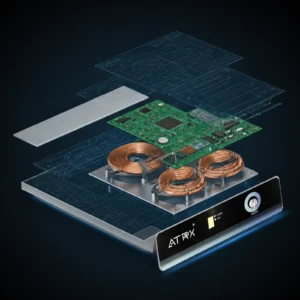
Both solutions work with your existing generator. Both keep costs low. Both can be done right on the truck. Below we break down each scenario with specific steps and sizing numbers.
When You’re Just Short on Wattage — Power Limiting and Staggered Startup Will Solve It
If your numbers from the previous section show the generator is only a few hundred watts short — runs fine once it’s going, just can’t handle the startup spike — you don’t need to buy anything. Commercial induction cookers almost always have adjustable power settings. Common commercial models offer multiple levels from 500W up to 3500W.
Turn the power down one or two notches before you hit the start button. If the cooker is rated at 3500W, set it to 2500W or even 2000W to start. Once it’s fully on and the generator’s RPM has settled, bring the power back up to whatever your cooking needs. A commercial induction stove doesn’t produce the same massive startup surge a compressor does, but starting at full power still draws noticeably more instantaneous wattage than steady-state running. Lower setting at startup = lower peak demand. That’s the whole idea.
If your truck has more than one commercial induction burner, never start them all at once. One at a time. Start the main cooker at mid-to-low power. Wait fifteen to twenty seconds. Listen for the generator to settle — no RPM dips, no sound changes. Then start the second unit, also at mid-to-low. Once everything is stable, raise each cooker to the power you actually need.
This is the staggered startup food truck method, and it works. Make it your daily routine. Here’s the step-by-step:
- Warm up the generator at idle. Start it and let it run with no load for two minutes. Let the RPM and output voltage stabilize. Don’t plug anything in the moment it fires up.
- Start the first unit at mid-to-low power. Set your main cooker to medium or medium-low. Press the power button. Watch and listen for any RPM drop or tone change from the generator.
- Wait 15–20 seconds. Make sure the generator sounds smooth and steady before you move on. This gap gives it time to recover from the transient load.
- Start the second unit at mid-to-low power. Same process. Watch, listen, confirm stability.
- Raise power levels one unit at a time. Once all cookers are running steady, dial each one up to the level your cooking requires.
The whole thing takes under a minute. Print it out and tape it next to the workstation so everyone on the truck follows the same sequence. That alone should put an end to tripped breakers.
When the Waveform Is Wrong — Add an Inverter Between Generator and Cooker
If you’ve lowered the power setting and staggered your startups but the generator still can’t drive your commercial induction hob — or the cooker starts up but hums, flickers, or throws repeated errors — the problem almost certainly isn’t wattage. It’s waveform.
Many portable gasoline generators on food trucks put out a modified sine wave instead of the pure sine wave you get from grid power. A commercial induction cooker’s control circuitry needs clean waveform quality. The stepped shape of a modified sine wave messes with the electronics. In many cases the cooker can’t even recognize the incoming power and just refuses to turn on. This has nothing to do with how many watts you have. A generator could be massively overpowered and still be useless if the waveform is wrong.
The fix: install a power-frequency pure sine wave inverter between the generator and the commercial induction stove. It takes the rough waveform from the generator, converts it internally into a standard pure sine wave, and feeds clean power to the cooker. Think of it as a waveform filter sitting in the middle. Once it’s in place, the power reaching your commercial countertop induction cooktop is virtually identical to wall power. Errors gone, buzzing gone.
You’re not touching your existing generator. You’re just adding one device in between — lowest possible cost to give the commercial induction burner the clean power it needs.
Picking an inverter is straightforward, but a few specs have to line up or the unit won’t do its job. This table lays out the key criteria. Match them to your cooker’s wattage and you’re set:
| Specification | Recommended Standard | Explanation |
|---|---|---|
| Rated Continuous Output | Cooker rated wattage × 1.2–1.5 | If the commercial induction cooker is 3500W, pick an inverter rated at least 4500W–5000W. The extra headroom keeps it from running at full load nonstop, which kills lifespan. |
| Peak (Surge) Power | ≥ Cooker rated wattage × 2 | Covers the cooker’s startup spike so the inverter doesn’t trip its own overload protection. |
| Output Waveform THD (Total Harmonic Distortion) | ≤ 3% | Lower THD = closer to grid power = more stable cooker operation. Stay away from anything above 5% for commercial induction use. |
| Installation Location | Inside the truck, near the generator’s output terminals | Bolt it to a metal bracket or truck wall so it can’t slide in transit. Leave at least 10 cm (4 in) of clearance on all sides for airflow. |
| Wiring Requirements | Input from generator; output to cooker outlet | Add a circuit breaker rated to the inverter’s amperage for protection. Use properly sized copper-core cable throughout — don’t cheap out on wire gauge. |
One thing people overlook: an inverter at full load puts out serious heat. Stuff it in a sealed corner and it’ll trigger thermal protection and shut down mid-service. Give it breathing room. Once you’ve picked the right unit from the table, bolted it in, and wired everything up, the waveform issue is done. Your existing generator will run that commercial induction hob without a hitch.
After the Fix — How to Confirm Your Commercial Induction Hob Can Handle a Full Service Day
You’ve made changes to the generator setup, the inverter, or the power settings. Now you need to prove it actually works before you’re standing in a parking lot with customers waiting. The way to do that: run a full-load test with every piece of equipment turned on at once. Run it for at least 30 to 60 minutes.
During the test, watch three things: generator sound, cooker display panel, and inverter temperature. If all three stay normal the entire time, you’re good. If power drops or error codes show up, troubleshoot in order — lower the power setting first, then adjust staggered startup timing, then try a bigger inverter. Keep adjusting until the test runs clean from start to finish. Only then should you book your first real service day.
Run a Full-Load Test Before You Hit the Street — It’s Not Done Until the Timer Runs Out
Don’t rush straight to your spot. Do a full-load dry run at home or any fixed location first. Turn the commercial induction stove to the power level you actually use during service. Switch on everything else too — lights, exhaust fan, fridge, POS. Get the truck pulling the same total load it would on a real shift.
Let it run at least 30 to 45 minutes. If you normally operate for two or three hours straight, push the test to a full hour. Short tests miss the slow-building problems — inverter thermal throttling, generator RPM drift as the engine heats up. You only catch those by running long enough.
Here’s what to watch during the test. All four must pass or it doesn’t count:
- Generator sound. It should be steady and consistent. If it suddenly gets louder, rougher, or starts vibrating, the load is at or past the generator’s limit. Stop and reassess your power allocation.
- Cooker display panel. Watch for error codes — E1, E2, or anything flagging a voltage issue. Also watch for the heat level dropping on its own. Both are self-protection responses the cooker triggers when it detects unstable power. If either shows up, the supply still isn’t clean enough.
- Inverter housing temperature. Touch the back of your hand to the casing. Warm is fine. If it’s too hot to hold your hand there for two seconds, the inverter is maxed out or overloaded. Running it that way for long risks a thermal shutdown right in the middle of service.
- Total run time. Don’t stop at fifteen minutes just because everything looks fine. An ATRX customer running a taco truck in Texas did exactly that — tested for 15 minutes, called it good, then lost his entire lunch rush when the generator overheated at the 40-minute mark. When he re-ran the test for a full 60 minutes per our recommendation, he found the inverter was boxed in with no airflow. Moved it to a ventilated spot and the problem disappeared. Your test has to cover the longest continuous stretch you’ll work on a real day.
Still Unstable During Testing? Follow This Sequence to Pinpoint the Cause
If the test breaks down partway through — the commercial induction hob drops power, throws errors, or keeps restarting — your setup needs one more round of fine-tuning. Don’t change things at random. Work through the following three checks in order. That gets you to the answer fastest.
First, check whether the commercial induction cooker’s power setting needs to come down one more notch. If the cooker ran fine for several minutes at high power and then started acting up, you’re right at the edge of what the generator can deliver. One level lower puts you back in safe territory.
Second, check your staggered usage. Is the fridge compressor kicking on at the exact moment the cooker is at full blast and the exhaust fan is running full speed? Spacing those high-draw startups even ten to fifteen seconds apart takes real pressure off the generator.
Third, if both of the above are already adjusted and it’s still unstable, the inverter is most likely undersized. You need a higher-rated unit to cover the system’s actual peak draw.
This table maps the three most common test failures to their causes and fixes. Find the symptom that matches what you’re seeing:
| Symptom During Testing | Most Likely Cause | Corrective Action |
|---|---|---|
| Cooker auto-reduces power or throws errors after several minutes of continuous operation | The commercial induction stove’s power setting is right at the generator’s output ceiling | Lower the cooker’s power one more level and retest |
| Cooker loses power or screen flickers the instant multiple devices start at once | Fridge compressor, fans, and cooker are all grabbing startup current at the same time | Stagger startup of high-draw equipment by at least 10–15 seconds |
| Cooker runs fine solo but goes unstable when all equipment runs together | Inverter rated capacity can’t cover the combined peak draw of everything | Upgrade to a higher-rated inverter (leave 20%–30% headroom above total peak load) |
Once you’ve found which step the problem sits at, go back to the matching solution earlier in this guide and make a targeted tweak. After every tweak, re-run the full-load test from scratch. It might take a couple of rounds of test-adjust-retest. But when you’re done, every instability factor is gone before you serve a single customer. That beats scrambling to troubleshoot at your location while losing business by a mile.
About the author

ATRX Team| 18 Years Commercial
Induction Cooker Manufacturer in China
Induction Cooker Manufacturer in China
Related Posts

Best Commercial Induction Cooktop: Types &Buying Guide
10/09/2026
Commercial Double Hob Induction Cooker | Types, Power, and Installation Guide
10/05/2026
Commercial Induction Cooker 3500W: Model Selection, Commercial Power and Installation
09/29/2026
How to Install a Built-In Induction Cooktop: A Step-by-Step Guide
09/17/2026
How to Clean a Commercial Deep Fryer: A Step-by-Step Guide
09/13/2026
High Quality Commercial Induction Cooker Manufacturer
09/09/2026
Automatic Wok Machine: Types, Specifications, Applications and Buying Guide
08/18/2026
Commercial Induction Range: How to Choose the Right Size, Power, and Configuration for a Commercial Kitchen
08/15/2026
What Is a Commercial Induction Cooker and How Does It Work
08/13/2026
Commercial Induction Range for Hotel Kitchens: How to Choose the Right Model
08/11/2026