

Induction Cooker vs Gas Stove for Hot Pot Restaurant: Which One Should You Choose?
05/25/2026
Estimated reading time: 2 minutes

You’re opening a hot pot restaurant — or thinking about replacing the heating equipment in your current one. The decision comes down to one thing: induction cookers on the tables, or gas stoves?
This article puts both options side by side across four dimensions — cost, safety and compliance, customer experience, and store-type fit — all within the real operating context of a hot pot restaurant. No vague “each has its pros and cons.” Just concrete evidence you can act on.
IN THIS ARTICLE
Which One Actually Saves You More Money?
Most hot pot restaurant owners compare prices the same way: they look at equipment sticker prices and stop there. That’s a blind spot. The real cost of each option splits into three separate buckets — equipment, construction, and ongoing operations. Look at just one and you’ll reach the wrong conclusion.
Initial Procurement Cost Compare
Start with equipment. A commercial built-in induction cooker for hot pot (3,000W–3,500W) runs about $110–$280 per unit, depending on brand, wattage, and panel material. A built-in tabletop gas stove with similar heat output typically costs $40–$110 per unit. On this line alone, gas is cheaper.
But equipment is just the starting point. In a hot pot restaurant, the installation and engineering work behind the equipment is what really separates the two options on total spend.
What does the gas option require beyond the stoves?
- Gas pipeline installation: Commercial food-service pipeline work typically runs $1,500–$4,000. If your space is more than 15 meters from the main gas line, each additional foot of pipe adds $6–$15. This cost has nothing to do with the stoves — it’s entirely about where your space sits relative to the gas main.
- Exhaust ventilation: Gas combustion creates waste gases and excess heat, so you need a dedicated exhaust duct. Hot pot generates less exhaust load than a stir-fry kitchen, but if the property has no existing exhaust outlet, building a compliant system from scratch still costs several thousand dollars.
- Gas leak detectors: Most cities require these in commercial food-service spaces, billed per detection point.
- Fire compartment walls: Open-flame areas need fire-resistant walls rated for at least 2 hours. In a hot pot restaurant — where every single table has a heating device — this compartment layout directly affects your renovation plan and budget.
The induction option has a different cost structure. The main work is confirming electrical capacity and upgrading circuits if needed. A 40-table hot pot restaurant with one 3,500W induction cooker per table at full load draws 140kW total. Many commercial properties can’t handle that out of the box, so you may need to apply for a capacity upgrade through the property or utility company. Costs vary by region and building, but they’re generally lower than the full gas pipeline package.
Flip the scenario. If you’re taking over a recently closed hot pot restaurant where the gas lines and exhaust are already in place and compliant, the upfront gap shrinks dramatically. Gas may even come in lower.
Monthly Spending Comparison
Energy bills after opening day are the real long-term expense. The simplest way to estimate is per table:
Daily usage hours per table × equipment power (or hourly gas use) × energy unit price × 30 days
Here’s a per-table monthly estimate using reference prices. Plug in your local commercial rates for real numbers:
| Item | Commercial Induction Cooker (3.5kW) | Gas Stove (Same Heat Output) |
|---|---|---|
| Thermal Efficiency | 85%–90% | 40%–55% |
| Daily Usage per Table | 4 hours | 4 hours |
| Hourly Energy Use | 3.5 kWh | ~0.4 m³ natural gas |
| Unit Price (Reference) | $0.08–$0.15/kWh | $0.35–$0.55/m³ |
| Monthly Cost per Table | ~$34–$63 | ~$17–$26 |
On paper, gas looks almost half the price. But there’s a variable hiding in that comparison: thermal efficiency. According to the U.S. Department of Energy, induction cookers can be up to three times more efficient than gas and produce none of the indoor air pollutants that come with gas combustion.
The numbers: induction hits 85%–90% thermal efficiency; gas sits at 40%–55%. That means nearly half the fuel a gas stove burns never reaches the pot — it escapes as waste heat into your dining room. For a full technical breakdown of how the two methods compare on efficiency, see our analysis in Gas vs Induction Cooktop: Efficiency, Cost & Performance.
There’s one more line item that belongs in this calculation: exhaust fan electricity and extra air-conditioning load. Gas combustion dumps far more waste heat into the dining space than induction. In summer this is especially obvious — your AC has to work harder just to hold a comfortable temperature.
Multiple industry sources point the same way: once you add exhaust and AC electricity to the gas column, the monthly gap between the two options shrinks by 30%–40%.
Payback Period Comparison
Short answer: on a brand-new site, induction typically reaches cumulative cost parity with gas within 12–18 months. If you’re taking over a space that already has gas infrastructure, that crossover point pushes out to 24 months or more.
Here’s the combined picture — upfront plus monthly:
| Dimension | Induction (40 Tables) | Gas (40 Tables) |
|---|---|---|
| Equipment | ~$4,400–$11,200 | ~$1,600–$4,400 |
| Engineering (Piping / Wiring / Exhaust) | ~$1,400–$4,200 | ~$4,200–$11,000 |
| Total Upfront | ~$5,800–$15,400 | ~$5,800–$15,400 |
| Monthly per Table (Incl. Exhaust & AC) | Medium-high | Lower on paper; gap narrows after exhaust & AC |
Notice: the upfront ranges actually overlap. Where you land depends on two things — how far your space is from the gas main, and whether the building’s electrical capacity is already sufficient.
On the monthly side, high table turnover (3+ turns per day) amplifies induction’s edge in clearing speed and energy control, flattening its cost curve faster. Low-turnover, slower-paced restaurants get more mileage from gas’s monthly savings.
Long-term maintenance matters too. Gas means ongoing pipeline and exhaust upkeep — annual inspections, seal testing, duct cleaning. Induction skips all of that, but circuit boards and cooling fans are wear parts that need replacing after 3–5 years. Stretch the comparison to a 5-year horizon and the maintenance totals are roughly similar.
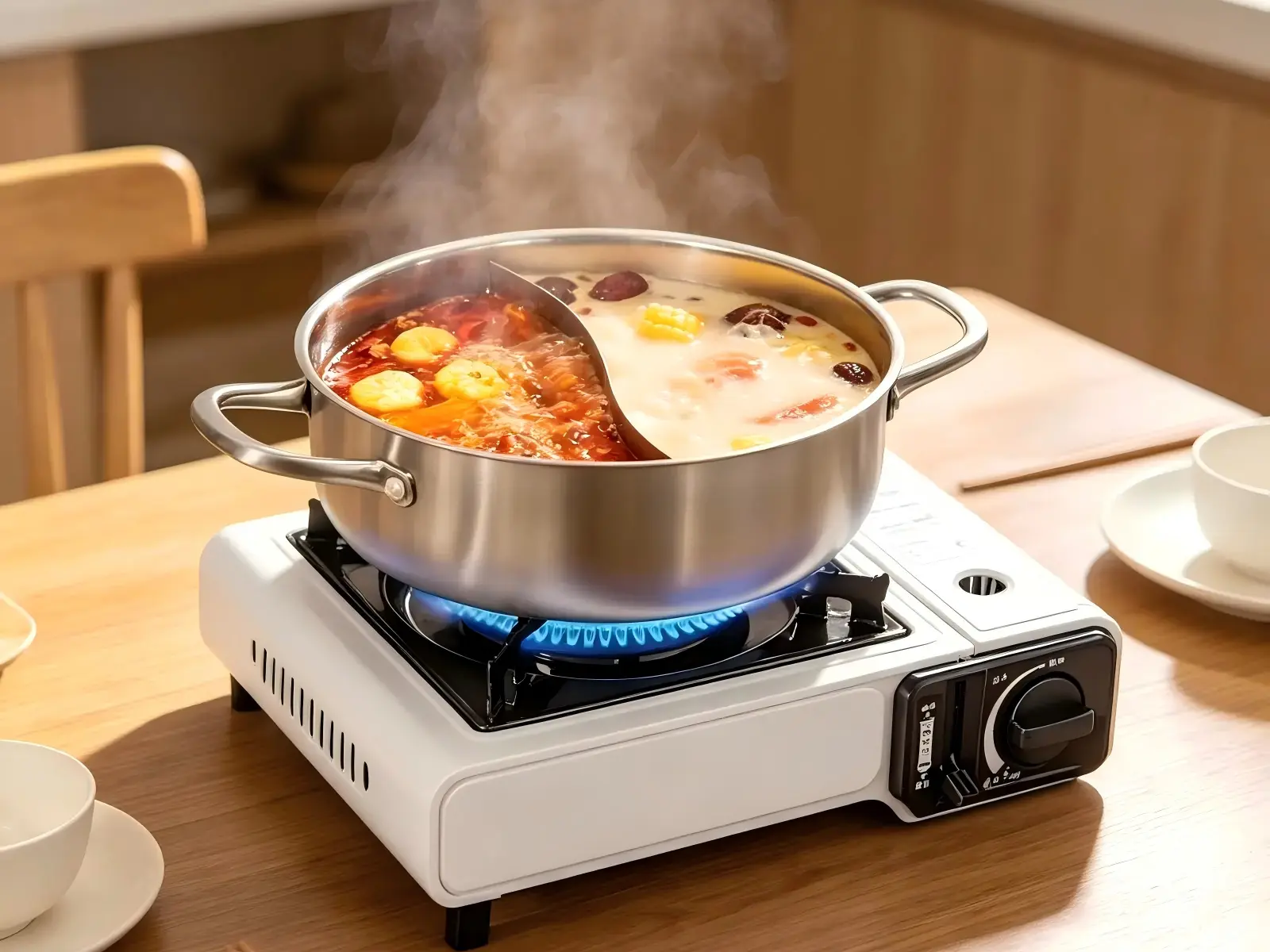
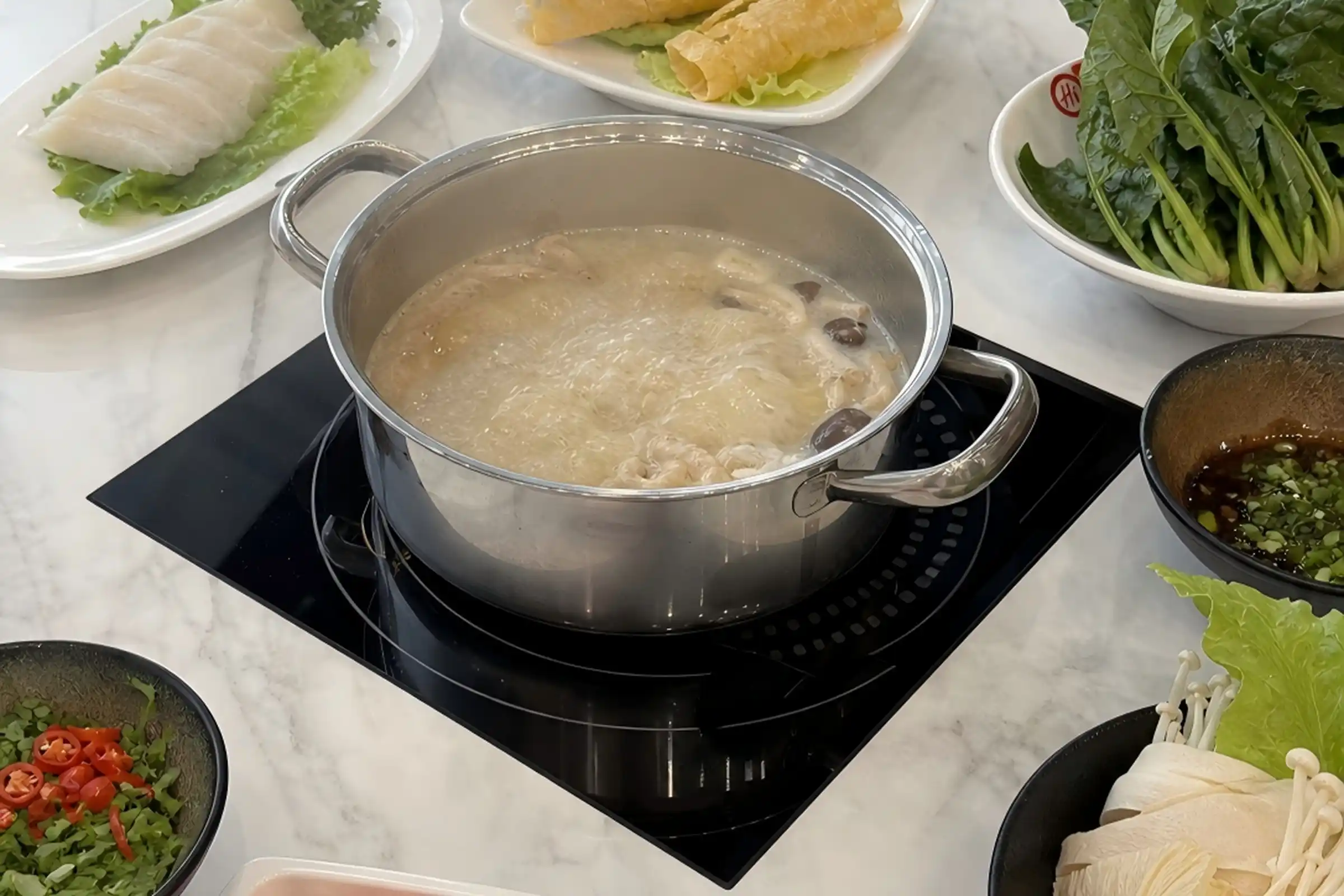
Safety Comparison and Licensing Requirements for Gas vs. Induction Stoves
After cost, the second dimension you can’t skip is safety and compliance. Hot pot restaurants are fundamentally different from other food-service formats in one way: the heating equipment isn’t in the back kitchen — it’s on the customer’s table. Diners sit inches from it, with tissues, jackets, and sauce dishes all within reach. That physical reality makes the safety gap between the two options very concrete.
An Open Flame on the Customer’s Table — How Much Risk Does That Add?
In a back kitchen, trained cooks handle open flames with fire suppression gear within arm’s reach. At a hot pot table, the person controlling the heat is the customer — maybe with kids, maybe drinking, maybe deep in conversation and not watching the stove at all.
A gas stove on every table means every table is an independent open-flame point. In hot pot’s specific environment — crowded tables, long dining sessions, mixed customer groups — the risk clusters around three scenarios:
- Gas leaks: During high-turnover periods, connectors and valves get handled constantly. Seal wear and loose fittings are more likely than with fixed back-kitchen stoves.
- Tabletop ignition: Hot pot tables are tight on space. Tissues, napkins, plates, jackets — everything sits much closer to the flame than it ever would in a kitchen.
- Child burns: The stove grate and surrounding metal get extremely hot during use. A child seated next to it can reach out and touch it in a second. In a back kitchen, this isn’t a concern. At a hot pot table, it’s a recurring risk.
Induction cookers address these risks at a structural level. No flame means nothing on the table can be ignited. Remove the pot and heating stops instantly — no dry-burning. If the broth boils dry, the unit powers off automatically without anyone needing to notice. The panel surface stays far cooler than a gas grate’s metal, so the outcome of a child’s touch is fundamentally different.
To be clear — this doesn’t mean gas stoves are “unsafe.” With solid management, regular equipment checks, and well-trained staff, gas can run safely in a hot pot restaurant. The difference is margin for error. In high-traffic stores with frequent turnover and lots of families, induction gives you a wider safety buffer. It doesn’t rely on the customer paying attention or the staff catching every issue on their rounds.
How Many Steps Does Each Option Take to Get Approved?
The two options follow very different permit paths, and the difference in timeline can directly affect when you open.
Gas approval chain:
- Apply to the gas company for a commercial hookup and pipeline installation.
- Gas company conducts an on-site inspection after construction.
- Fire department reviews whether fire compartmentalization in open-flame areas meets code (2-hour rated walls, fire doors and windows).
- Separate exhaust duct inspection.
- Some cities also require gas leak alarm installation with formal registration.
When everything goes smoothly, this takes 2–4 weeks. If the pipeline route is long or the fire department requires corrections, 1–2 months is common.
Induction approval process:
- Confirm the building’s electrical capacity is sufficient (if not, apply for an upgrade — this step can also take 2–4 weeks when the utility company is involved).
- Confirm your equipment has the certifications for your market (CCC for China, ETL/UL for North America, CE for Europe).
- Pass standard fire inspection (extinguishers, emergency lighting, evacuation routes — required no matter what heating method you use).
No gas pipeline inspection. No fire compartment requirements for open flame. No separate exhaust duct approval. Fewer steps, shorter timeline, lower chance of getting sent back to fix something.
One hard rule to check before anything else: if your space is inside a shopping mall, this decision may already be made for you. Most malls explicitly ban open-flame heating in dining areas — gas stoves, alcohol burners, charcoal, all prohibited. Only electric heating like induction is allowed on tables. We cover mall-specific fire codes and inspection procedures in a separate article.
Customer Dining Experience Comparison
Cost is calculated. Compliance is sorted. Now: how does the customer’s experience differ? This doesn’t land directly on a financial statement, but it drives repeat visits and word-of-mouth — especially for hot pot brands going after younger diners and families.
Heat, Smell, Grease, Noise — the Differences Customers Can Feel
Hot pot isn’t stir-frying. There’s no blast of wok smoke. But hours of broth steam, oil spattering as ingredients go in, and the slow buildup of seasoning smell indoors — these all land differently depending on the heat source.
Sitting next to a gas stove:
Gas combustion releases trace amounts of carbon monoxide and nitrogen oxides. Small on their own, but over a couple of hours in a semi-enclosed hot pot restaurant, the drop in air quality becomes noticeable. The more immediate feeling is warmth — over 50% of a gas stove’s heat goes into the air, not the pot. Diners sitting close will feel the area running hot, especially in summer.
Clothing absorbs more odor too. That said, some brands that lean into a traditional, “smoky street-food” vibe intentionally use open flame as part of the atmosphere. For that positioning, the visible fire adds value.
Sitting next to an induction cooker:
No combustion gases. No stray heat radiating outward. The area around the table stays noticeably cooler, and clothes pick up less smell. For diners who care about comfort — families in mall locations, younger customers — this is a difference they can feel immediately. If your restaurant has an open kitchen or semi-open layout, grease and smoke control becomes even more critical. For equipment guidance on that setup, see Best Cooktop for Open Kitchen: Gas vs Ceramic vs Induction.
Induction does have one honest weakness: noise. Some units produce a faint hum at high power — that’s the electromagnetic field vibrating the pot’s metal base (a phenomenon called magnetostriction), and it’s normal, not a defect. Good commercial units keep it under 45–55 decibels, which disappears in the natural noise of a busy hot pot restaurant. Just check the spec sheet when you buy.
A question we hear often: “No flame — does the hot pot lose its ‘wok hei’?”
Hot pot flavor comes from the broth recipe and the ingredients, not from how you heat them. “Wok hei” is the charred, smoky taste created when food hits an extremely hot wok surface — that’s a stir-fry concept. Hot pot is simmering and blanching, not searing. There’s no flavor to lose by switching to induction.
If a customer says “it tastes different,” it’s almost certainly expectation bias, not an actual taste change.
A Few Minutes Faster Per Table Clear — What’s That Worth at Peak Hours?
A hot pot restaurant’s daily revenue ceiling isn’t set by how many tables you have. It’s set by how many times each table turns over. And the turnover bottleneck usually isn’t in seating or ordering — it’s in clearing.
Here’s how clearing plays out with each equipment type:
Gas stove: Turn off flame → wait for grate to cool → remove grate → scrub grate and grease trap → wipe table → reinstall grate → check gas connection. Total: 8–12 minutes. Some simpler tabletop gas models skip the heavy grate, cutting this to 6–8 minutes — but most full-service hot pot restaurants use the standard built-in style with grates.
Induction cooker: Power off → wipe the flat glass surface → clean the table. No grate, no grease trap, no gas check. Total: 4–6 minutes.
Three to five minutes per table adds up fast during a lunch or dinner rush:
| Scenario | Induction | Gas |
|---|---|---|
| Clearing Time per Table | 4–6 min | 8–12 min |
| Extra Turns at Peak (40 Tables) | ~0.5–1 extra per table | — |
| At $17 Average Spend | +$340–$680 revenue window | — |
You won’t capture this every single day — it also depends on waitlist depth and kitchen speed. But on weekends and holidays, clearing speed is one of the hard limits on daily revenue.
The labor side matters too. Scrubbing grates is physical, repetitive work that eats into staff capacity during rush. With induction’s flat surface, one wipe and the server moves on to the next group.
Mall, Street-Front, or Chain — Which Setup Fits Your Store?
Everything above is a general framework. But hot pot restaurants operate under wildly different conditions, and the right heating setup depends on your specific store type.
Mall locations — induction is basically your only choice. Most malls explicitly ban open-flame devices in tenant dining areas. This is a property-management rule, not negotiable. Skip the debate and move straight to induction — spend your energy matching the right wattage and confirming the building’s electrical capacity.
Street-front standalone (with existing gas infrastructure) — gas delivers the best value here. If the space already has compliant gas lines and an exhaust system, your engineering costs are close to zero, and per-unit equipment prices are lower too. Monthly bills stay competitive where gas is reasonably priced.
Forcing a switch to induction under these conditions is hard to justify financially — unless a smoke-free, faster-clearing dining environment is specifically what you want, or your target customers have high comfort expectations.
Chains (3+ locations) — induction’s standardization advantages are worth a hard look. It doesn’t depend on whether each site has gas. It isn’t subject to different gas-permit rules in different cities. Parts and maintenance can be managed centrally. For multi-site operators, simplified logistics and lower compliance risk often matter more than the per-table energy difference.
If every location happens to be a street-front space with existing gas, standardizing on gas is equally logical. What matters is that the reasoning is consistent — not that every store uses the same equipment for the sake of uniformity.
Can you mix both? Yes. Sometimes that’s the smartest move. If you run a mall store and a street-front store at the same time, go induction in the mall and gas on the street — each decided by its own site conditions. The only downside is carrying two sets of spare parts, which adds a bit of management overhead. But total cost usually comes in lower than forcing every location onto one system.
To start comparing commercial induction models by wattage, size, and installation type, browse the ATRX commercial induction cooker lineup.
FAQ
Q1: Can I use a household induction cooker in a hot pot restaurant?
Not recommended. Household units run at 1,800W–2,200W and are built for short cooking sessions at home. In a hot pot restaurant, each table runs at full load for 1–2 hours straight. A household unit’s circuit board and cooling fan can’t handle that — expect frequent overheating shutoffs or a burned-out control board.
Commercial units start at 3,000W+ with internal cooling, circuit protection, and build quality designed for sustained heavy use. The money you save buying household equipment almost always gets wiped out by repairs and replacements down the line.
Q2: Does an induction cooker work with standard hot pot cookware?
Induction needs a pot with ferromagnetic material in the base. The most common hot pot vessels — yin-yang divided pots, nine-grid pots, individual mini pots — all come in induction-compatible versions now (430 stainless steel or composite base). Cast iron works directly too.
The only materials that won’t work are pure aluminum and pure copper — and neither is common in hot pot restaurants anyway. Just look for the “induction compatible” label when you buy.
Q3: What if the power goes out? Isn’t gas more reliable?
Gas stoves don’t need electricity to run (you can light the igniter with a regular lighter), and that’s a real advantage. But in urban commercial areas — especially inside malls — extended outages are rare.
If your area’s grid is genuinely unreliable, consider a hybrid setup: induction as the primary system, with one or two gas backup stations for emergencies.
About the author

ATRX Team| 18 Years Commercial
Induction Cooker Manufacturer in China
Induction Cooker Manufacturer in China
Related Posts
Best Commercial Induction Cooktop: Types &Buying Guide
10/09/2026
Commercial Double Hob Induction Cooker | Types, Power, and Installation Guide
10/05/2026
Commercial Induction Cooker 3500W: Model Selection, Commercial Power and Installation
09/29/2026
How to Install a Built-In Induction Cooktop: A Step-by-Step Guide
09/17/2026
How to Clean a Commercial Deep Fryer: A Step-by-Step Guide
09/13/2026
High Quality Commercial Induction Cooker Manufacturer
09/09/2026
Automatic Wok Machine: Types, Specifications, Applications and Buying Guide
08/18/2026
Commercial Induction Range: How to Choose the Right Size, Power, and Configuration for a Commercial Kitchen
08/15/2026
What Is a Commercial Induction Cooker and How Does It Work
08/13/2026
Commercial Induction Range for Hotel Kitchens: How to Choose the Right Model
08/11/2026