The Complete Guide to 2-Burner, 4-Burner & 6-Burner Multi-Zone Commercial Induction Hobs
This guide helps you get four of the most commonly botched decisions right before you place an order on a multi-zone commercial induction hob: burner count, power rating, electrical requirements, and cookware compatibility. Walk through the steps in order — from matching output volume and kitchen space to the right model, to checking your power supply and whether your existing pots will actually work — and you’ll dodge most of the regrets that hit after the equipment has already shipped.
Differences Between 2-Burner, 4-Burner, and 6-Burner Models
Basic Differences in Size, Power, and Number of Cooking Zones
The core differences among 2-burner, 4-burner, and 6-burner multi-zone commercial induction hobs come down to three hard specs: body dimensions, total power, and number of cooking zones. Each burner count also comes in two form factors — countertop and freestanding — with different dimensions. Here’s a model-by-model breakdown so you can get the basics in under 30 seconds.
1. 2-Burner (Countertop Only)
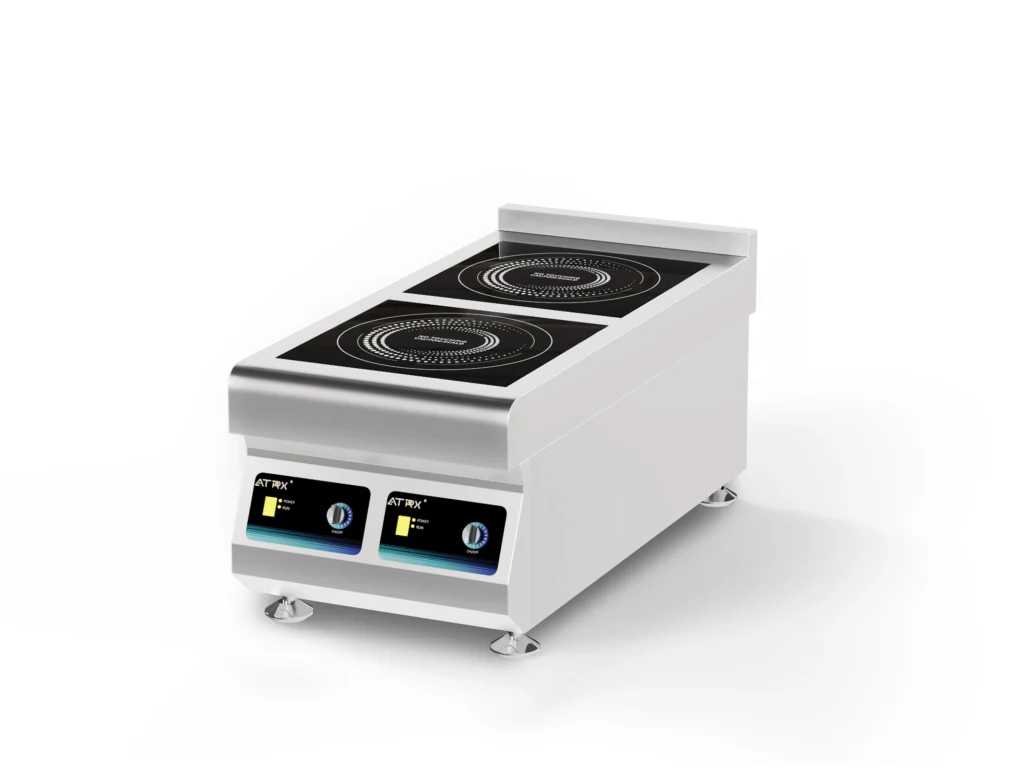
The ATRX countertop 2-burner measures L450 × W800 × H300 mm — the most compact unit in the lineup. Each zone comes in 3.5 kW or 5 kW, giving a total output of 7 kW or 10 kW. It runs on 220V single-phase power, so the demand on your kitchen circuit is the lowest of all models. Right now, the 2-burner is only available as a countertop unit. There’s no freestanding version.

2. 4-Burner (Countertop & Freestanding)
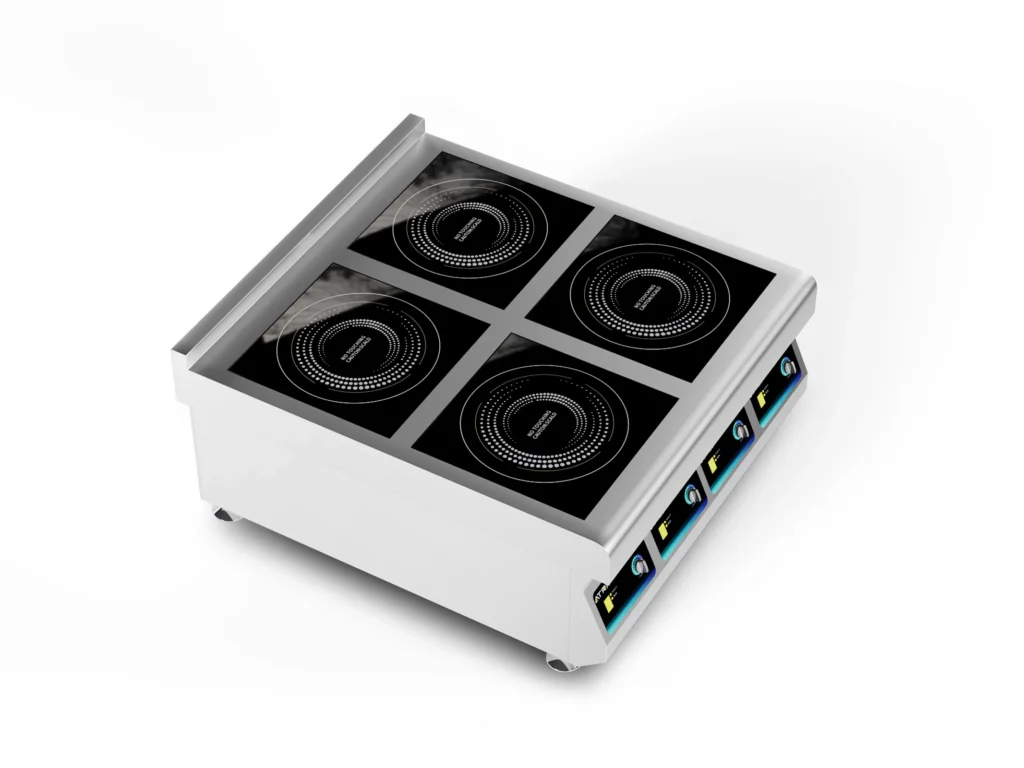
The countertop 4-burner measures L700 × W800 × H300 mm — about 250 mm longer than the 2-burner. The freestanding version shares the same L700 × W800 mm cooking surface, but with its floor frame the total height hits 950 mm (H800+150 mm), giving chefs a comfortable standing work height. Both versions offer 3.5 kW and 5 kW per zone, for a total of 14 kW or 20 kW. One key difference: the countertop runs on 220V single-phase, while the freestanding needs 380V three-phase.
3. 6-Burner (Countertop & Freestanding)
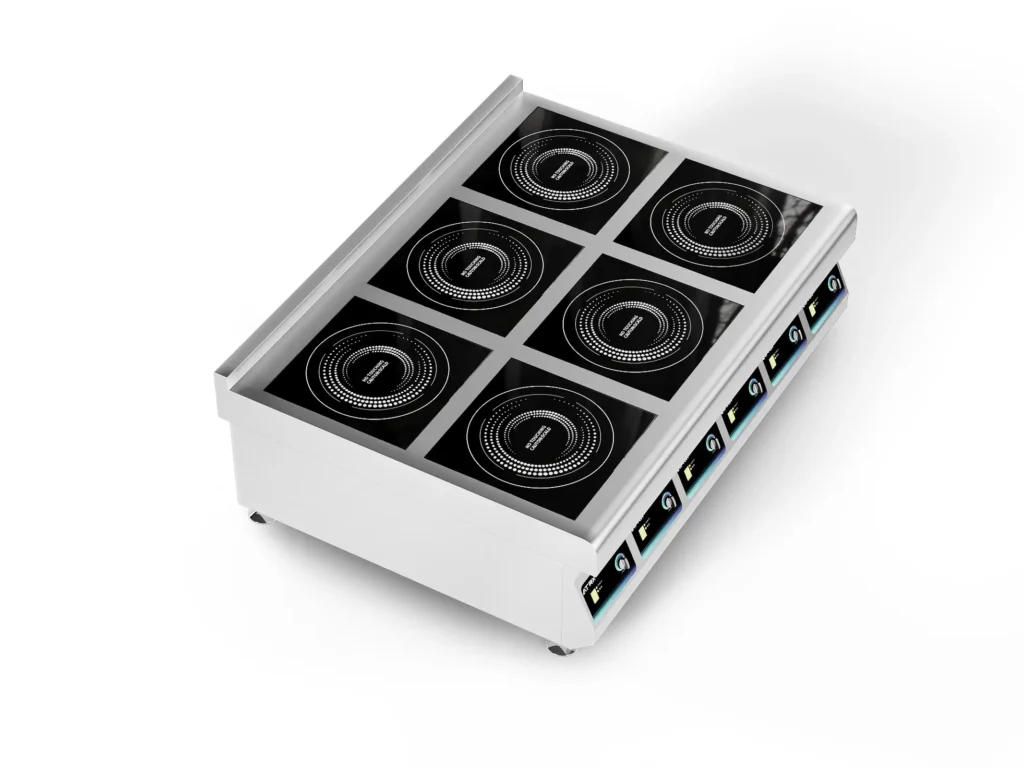
The countertop 6-burner measures L1050 × W800 × H330 mm — 30 mm taller than the smaller countertop models. The freestanding version has a cooking surface of L1100 × W800 mm, 50 mm wider than the countertop, and the same 950 mm total height with its frame. All six zones come in 3.5 kW and 5 kW, pushing full-load totals to 21 kW and 30 kW. Like the freestanding 4-burner, it requires 380V three-phase power.
One thing worth noting: every model — countertop or freestanding — shares a uniform depth of 800 mm and an SS304 stainless steel shell. That means you can line up different models along the same counter without anything sticking out front or back.
From 2-burner to 4-burner to 6-burner, each step up adds length, two more zones, and a proportional jump in total power. Keep this “size → zones → power” relationship in mind, and you can tell these three commercial induction range multi burner configurations apart at a glance.
The above uses ATRX products as an example. In reality, for any burners on the market, as long as they involve 2-burner, 4-burner, or 6-burner configurations, the burners themselves are essentially the same — the only difference is a slight variation in appearance.
How Much Does Burner Count Affect Simultaneous Output?
During slow hours, the gap between burner counts doesn’t feel dramatic. Once the lunch or dinner rush hits, though, the difference is impossible to miss. Burner count directly decides whether your kitchen can keep up with the front-of-house order flow at peak times — or fall behind and stack up tickets.
A 2-burner lets you cook two dishes at once. One chef, two hands — just enough. When orders flood in, everything else waits for a zone to open up, and that’s when complaints start piling at the pass. A 4-burner gets two to three chefs on the stove at the same time, which picks up the pace noticeably. A 6-burner lets multiple chefs push dishes in parallel — even dozens of tickets rolling in during the dinner rush won’t jam the line.
Here’s a side-by-side comparison of peak-hour output across all three models:
| Comparison Item | 2-Burner | 4-Burner | 6-Burner |
|---|---|---|---|
| Dishes cooked simultaneously | 2 | 4 | 6 |
| Chefs operating at the same time | 1 | 2–3 | 3–4 |
| Per-zone power options | 3.5 kW / 5 kW | 3.5 kW / 5 kW | 3.5 kW / 5 kW |
| Full-load total power range | 7–10 kW | 14–20 kW | 21–30 kW |
| Available form factors | Countertop | Countertop / Freestanding | Countertop / Freestanding |
| Power supply requirement | 220V / Single-phase | 220V Single-phase (CT) / 380V Three-phase (FS) | 220V Single-phase (CT) / 380V Three-phase (FS) |
| Best-fit peak-hour scenarios | Small food stalls, light meal cafés | Mid-sized restaurants, fast-food outlets | Large restaurants, institutional canteens |
| Peak-hour output rhythm | Dishes queue for open zones; easy backlog | Multi-zone parallel cooking; noticeably faster | High-density output; virtually no ticket jams |
Which Kitchen Needs How Many Burners?
When choosing a multiple-burner commercial induction cooktop, getting the burner count wrong costs more than overspending. Buy too few and you can’t keep up at rush hour. Buy too many and you waste money and floor space. This section helps you lock in the right number from two angles: daily output and kitchen size.
Matching Burner Count to Restaurant Size and Daily Output
1. Under 100 meals per day — 2-Burner
If you run a street-side food stall, small fast-food shop, or café with a light meal menu, one 2-burner unit handles the job. One zone for stir-frying, one for soup or heating sides — a two-person team or even a solo cook can keep things moving. Low investment, small footprint, and a great fit for startups or operations with steady but moderate traffic. The 2-burner is currently countertop only (AT-CTEBZ series) — compact enough to sit right on an existing prep counter.
2. 100 to 300 meals per day — 4-Burner or 6-Burner
At the level of a mid-sized neighborhood restaurant, chain fast-food outlet, or medium corporate canteen, a 2-burner starts bottlenecking during lunch and dinner rushes. This is where 4-burner and 6-burner induction cooker models earn their place — a 4-burner lets multiple chefs each own a zone, with stir-frying, boiling, pan-frying, and braising all running in parallel. The speed gain during peak hours is real, and front-of-house wait times stay in check.
This model comes in countertop (AT-CTSBZ series) and freestanding (AT-FLSBZ series). Got enough counter space? Go countertop. Want a standalone unit with storage underneath? Go freestanding.

3. Over 300 meals per day — 6-Burner
Large hotel kitchens, chain-brand central kitchens, or canteens pushing hundreds to thousands of meals a day need six burners. When we put together a solution for a corporate canteen client averaging around 600 meals daily, they first looked at combining two 2-burner units to save budget. After a video call to walk through the stove layout with our factory team, they switched to a single 6-burner. In practice, peak-hour efficiency was higher and total energy use was easier to manage.
Burner count sets the ceiling on production capacity. Only six burners let the kitchen hold the line under full peak pressure. The 6-burner comes in countertop (AT-CTLBZ series) and freestanding (AT-FLLBZ series). For large kitchens, freestanding is usually the better call — the built-in frame puts the cooking surface at an ergonomic height for long shifts on your feet.
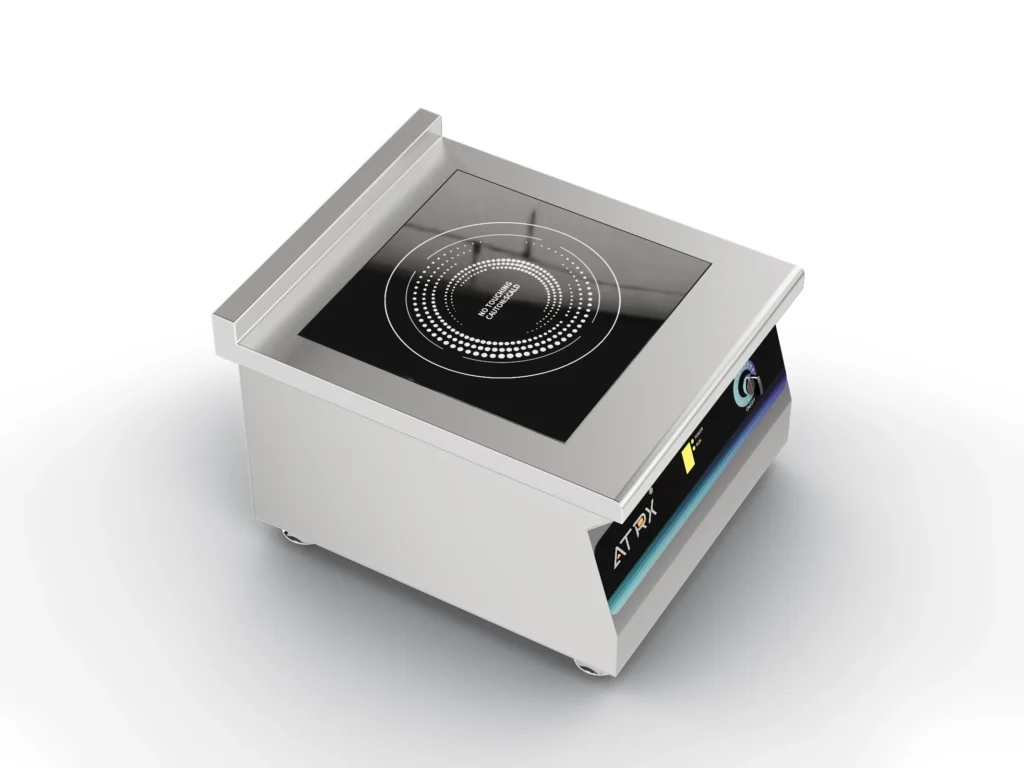
If you’ve already narrowed down your burner count based on output, visit our multi-zone commercial induction hob product page for the full 2-burner, 4-burner, and 6-burner lineup with detailed specs, side-by-side comparisons, power options, installation types, and real product photos.
If Your Kitchen Is Too Small, More Burners Won’t Help
A lot of buyers order based on output needs alone, then find out the equipment physically won’t fit when it shows up. Body dimensions grow with burner count, and the difference between a countertop vs freestanding induction cooker matters for both footprint and height. Before you order, grab a tape measure. For countertop models, check that your counter area and load capacity are enough. For freestanding models, also make sure the total 950 mm height clears your range hood and any overhead cabinets.
Aisle space matters just as much. Leave at least 90 to 120 cm in front of the cooking station so chefs can stand, turn, and pass dishes without bumping into each other. On a 4-burner or 6-burner, two or three people are often at the stove during peak hours. A cramped aisle doesn’t just slow plating — turning with a hot pan in tight quarters is a real safety risk.
Before you buy, sketch a quick kitchen floor plan. Mark the hob position, aisle widths, and gaps to adjacent equipment. Then match it against the product dimensions below. If everything fits, there’s room to stand, and there’s room to walk — go ahead and order.
| Type | Burners | Model Example | Power per Zone | Body Dimensions (L × W × H) | Voltage | Min. Aisle Clearance |
|---|---|---|---|---|---|---|
| Countertop | 2 | AT-CTEBZ-003 / 005 | 3.5 kW or 5 kW | 450 × 800 × 300 mm | 220V / Single-phase | ≥ 90 cm |
| Countertop | 4 | AT-CTSBZ-003 / 005 | 3.5 kW or 5 kW | 700 × 800 × 300 mm | 220V / Single-phase | ≥ 100 cm |
| Countertop | 6 | AT-CTLBZ-003 / 005 | 3.5 kW or 5 kW | 1050 × 800 × 330 mm | 220V / Single-phase | ≥ 120 cm |
| Freestanding | 4 | AT-FLSBZ-003 / 005 | 3.5 kW or 5 kW | 700 × 800 × (800+150) mm | 380V / Three-phase | ≥ 100 cm |
| Freestanding | 6 | AT-FLLBZ-003 / 005 | 3.5 kW or 5 kW | 1100 × 800 × (800+150) mm | 380V / Three-phase | ≥ 120 cm |
Key Parameters to Check Before Buying
There’s no shortage of models and specs on the market, but only a handful of parameters actually shape your daily cooking experience. Skip the marketing jargon. Focus on what directly affects “how well it cooks” and “how long it lasts.” Here’s the breakdown across two dimensions.
Per-Zone Power and Temperature Control Steps Directly Affect Cooking Performance
First thing to check when picking commercial induction burners for restaurant kitchens: per-zone power. That’s the output of each individual zone — not the total number on the spec sheet. A “14 kW total” sounds fierce, but on a 4-burner that’s only 3.5 kW per zone. Could be very different from what you expected. The two most common per-zone levels today are 3.5 kW and 5 kW.
3.5 kW covers most everyday tasks — stir-frying, pan-frying, deep-frying, soups. For small to mid-sized restaurants built around quick stir-fries and stews, it’s plenty. 5 kW is for high-heat work: flash wok-frying, boiling large pots fast, rapid plating. When you need to push big-portion stir-fries back-to-back during peak hours, the speed gap between 3.5 kW and 5 kW hits your output rhythm directly.
Second parameter: temperature control steps. More steps mean finer power adjustment. On an 8-step unit, the lowest setting starts around 500 W for gentle simmering. You can dial all the way to full blast, with enough gradations in between for different dishes. If your menu includes both a two-hour slow-simmered soup and a high-heat wok dish that lives or dies on wok-hei, multi-step control isn’t optional — it’s essential.
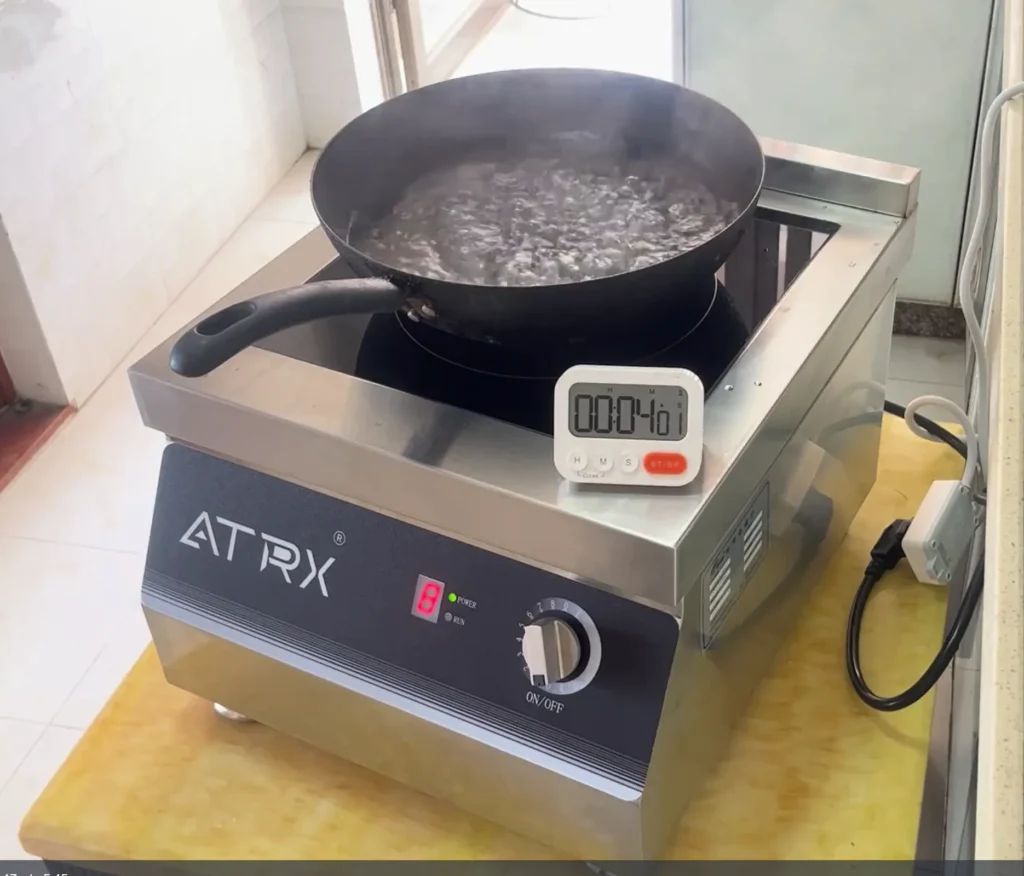
A restaurant operator in Southeast Asia raised this exact concern during pre-sales consultation: is 3.5 kW really enough to stir-fry kway teow? He bought a 3.5 kW 8-step ATRX unit to test. After two weeks of daily use, the verdict was that everyday kway teow and soups ran perfectly — only continuous large-pot boiling felt a touch slow. He ended up going 5 kW on the main zone and keeping 3.5 kW on the secondaries. Matching power to your actual menu beats chasing the biggest number every time.
Bottom line: bigger power isn’t always better, and just having steps isn’t enough. What matters is that these two specs line up with the food you actually cook. Start with your menu, then pick the numbers.
Panel Material and Safety Protections Are the Baseline for Any Commercial Unit
Beyond cooking performance, two hardware specs decide whether your machine lasts and stays safe. In a commercial kitchen, both are non-negotiable.
First: panel material. Most commercial induction hobs use ceramic glass (also called black crystal). Its Mohs hardness hits 7.0 or above — harder than stainless steel cookware — and it handles temperatures up to 700°C without warping under prolonged heavy use. Look at thickness and grade when buying. Commercial-grade panels run 5 mm to 6 mm. Units with thinner panels, or ones that swap in ordinary tempered glass, may crack or shatter within months of high-load use. The repair bill will far outweigh whatever you saved upfront.

Second: safety protections. Commercial kitchens are hectic — lots of people, constant activity, long hours. Three protections are mandatory on any commercial induction stove with multiple burners. Empty pot detection stops heating automatically when a pot is removed, preventing dry-burn damage or fire risk. Over-temperature protection cuts power when internal or surface temps spike abnormally, keeping components from burning out during overload.
Voltage protection guards the circuit against grid spikes and drops, so power fluctuations don’t fry your mainboard or IGBT modules. These aren’t premium extras. They’re the floor. If a model you’re looking at is missing any one of them, walk away — no matter how low the price. Use this checklist to verify during selection:
| Inspection Item | Passing Standard | Risk If Substandard |
|---|---|---|
| Panel material | Ceramic glass (black crystal), Mohs hardness ≥ 7.0 | Ordinary tempered glass has lower hardness; prone to cracking under high-temp, high-frequency use |
| Panel thickness | Commercial-grade 5 mm–6 mm | Thin panels have poor impact resistance; heavy pots or thermal cycling can cause shattering |
| Empty pot detection | Automatically stops heating when cookware is removed | Dry-burning damages panel and coil; severe cases pose fire risk |
| Over-temperature protection | Auto power cut when temperature is abnormal | Overheated components burn out, shortening unit lifespan |
| Voltage protection | Auto circuit protection on voltage spikes/drops | Grid fluctuations can fry mainboard or IGBT modules — expensive repair |
Commercial equipment often runs 10+ hours a day. Any gap in safety features gets magnified fast under that kind of load. Check each item on this list, and you’ll filter out the units that don’t belong in a professional kitchen.
Confirm Your Electrical and Installation Conditions First
A home induction cooktop plugs into a regular outlet and works. A commercial multi-zone induction hob is a different animal. Total power runs into thousands or tens of thousands of watts, and that means hard requirements on your electrical supply and physical setup. Skip this homework, and the most common result is equipment that shows up but can’t power on — or starts tripping alarms within days.
This section covers the two biggest pitfalls: electrical capacity and heat dissipation.
Different Burner Counts Have Very Different Electrical Requirements
Burner count drives total power. Total power drives what your electrical supply needs to deliver. But here’s what many buyers miss: even at the same burner count, countertop and freestanding models wire up completely differently. The table below lays it out using the standard 3.5 kW / 5 kW per-zone specs:
| Installation Type | Total Power Range | Power Supply Requirement | Wiring Method |
|---|---|---|---|
| Countertop | 3.5–5 kW | 220V / Single-phase | Each burner wired independently with its own cable |
| Freestanding | 14–20 kW | 380V / Three-phase | Entire unit connected via a single three-phase cable |
Short version: countertop models run on 220V single-phase, each burner on its own line. Freestanding models run on 380V three-phase, one cable for the whole machine. So even if your place only has single-phase 220V, you can still run a 4-burner or 6-burner — just pick countertop.
The catch: your single-phase meter has to handle every burner at full power simultaneously. A 6-burner countertop at 5 kW per zone is 30 kW at full load. That’s a huge ask for a single-phase setup. Do the math before you buy.
If you need a freestanding model but only have single-phase power, the first step is contacting your local utility to apply for a three-phase upgrade. Don’t wait until the equipment lands. The approval and installation process typically takes one to three weeks — sometimes over a month. Start the application the moment you confirm your hob specs, so the power is ready when the machine arrives.
Inadequate Cooling Space and Ventilation Will Affect Normal Operation
Electrical sorted? Good. Now here’s the other trap people only discover after installation: not enough room for heat dissipation. A multi-burner commercial induction cooktop doesn’t produce open flames or heavy exhaust like a gas stove, but it packs power modules, IGBT elements, and coils inside — all generating serious heat during operation. Internal fans pull in cool air and push out hot air. Block those airflow paths, and trouble starts fast.
Key points for installation:
1. Leave clearance on all sides.
Keep at least 50 mm of open space behind and on both sides of the unit. Air needs to flow in and out freely. If you’re installing inside a cabinet, cut ventilation holes in the back panel — at least as large as the exhaust vent — and consider adding an auxiliary fan inside the cabinet.
2. Keep vents clear of clutter.
Rags, plastic bags, seasoning bottles — the usual kitchen clutter — will spike internal temperatures fast if they block intake or exhaust. Mild case: overheating protection kicks in and throttles power mid-stir-fry. Severe case: the unit shuts down completely and won’t restart until it cools.
Long-term operation under poor cooling also ages capacitors, power transistors, and other critical parts much faster, cutting the machine’s useful life short.
3. Think about the room, not just the machine.
In a tight, poorly ventilated kitchen, multiple high-power units running at once will push the entire room temperature up fast. That makes every unit’s cooling problem worse. Built-in fans can’t fix a room-level heat issue. You’ll need exhaust fans or ductwork to move hot air out of the space.
One rule covers it all: if cooling conditions aren’t right, even the best unit won’t perform. Plan your space and airflow before the install, not after.
Cookware Compatibility for Multi-Zone Induction Hobs
Getting the hob installed is only half the job. If your pots don’t work with induction, it doesn’t matter how many burners you have. The whole point of a 4-burner or 6-burner is running multiple zones at once for parallel output. That only works if every zone has a compatible pot on it.
Induction heating sets hard rules on both material and size. Wrong material means the coil’s magnetic field can’t generate eddy currents in the pot base — the burner won’t even turn on. Wrong size means the base can’t cover the coil’s minimum sensing area — the unit detects no pot and refuses to start.
More burners means more pots needed at once. One bad pot turns one zone into a decoration. Below are the two biggest cookware mistakes on multi-zone setups: material mismatch and size mismatch.
Incompatible Cookware Material Means You Paid for Zones You Can’t Use
Induction heating works nothing like open flame or electric elements. A coil creates a high-frequency alternating magnetic field. That field induces eddy currents in ferromagnetic material on the pot base. The Joule heat from those currents is what actually gets the pot hot. Translation: the hob only recognizes pots whose base a magnet sticks to firmly.
Many buyers don’t find out they have a problem until the machine arrives and certain zones “won’t fire” when a pot is placed on them. Run through these steps before you order — not after:
1. Magnet-test every pot you own.
Grab an ordinary fridge magnet. Flip each pot over and test the center and edge of the base. Sticks firmly and doesn’t slide? That’s compatible — cast iron, carbon steel, and composite-base pots with a magnetic 430 stainless steel outer layer all pass. Won’t stick, or barely clings? Pure aluminum, pure copper, ceramic, glass, and non-magnetic 304 stainless steel outer layers all fail. Zero heat output on induction.
2. Count: how many can stay, how many need replacing?
On a single-burner, one bad pot is one pot to replace. On a multi-zone unit, the damage multiplies. Six zones, three aluminum pots — that’s three zones sitting idle forever. You paid for six, you use three. Write down the “needs replacing” number. It directly determines your extra spend.
3. Add the replacement cost to your budget now.
Commercial-grade magnetic stainless steel or cast iron pots are not cheap. Buying three or four at once can add roughly 15% to 25% on top of the hob price. Build that in upfront. “Can afford the hob but not the pots” is a real budget trap. The ATRX pre-sales team typically asks clients to finish the magnet test before confirming any multi-zone order — specifically to prevent cookware gaps from delaying a launch.
4. Watch for “stealth incompatibility” in composite-base pots.
Some pots say “stainless steel” on the label and look the part, but the outer layer is non-magnetic 304 instead of magnetic 430. Put them on a zone and you’ll get a flashing error code. During the magnet test, these show weak, unconvincing attraction. Put them in the “replace” pile. Don’t hope for the best.

When Multiple Zones Are Loaded at Once, Wrong-Sized Pots Will Collide
Here’s something that only matters on a multi-zone commercial induction hob: all the zones sit on one machine, and the center-to-center spacing is fixed at the factory. That creates two problems single-burner units never face — pots too wide will jam into each other, and pots too narrow won’t trigger detection.
We’ve seen this play out firsthand. A chain restaurant operator bought a 4-burner from another supplier, then sent us site photos showing the problem: four 36 cm woks placed on all zones at once, rims locked together, handles impossible to grip. They ended up skipping every other zone. A 4-burner turned into a 2-burner. The hob was fine. The mistake was not checking pot diameter against zone spacing before ordering.
The table below lines up the “too big” and “too small” scenarios so you can screen for both during selection:
| Comparison Dimension | Oversized Cookware (outer diameter exceeds zone spacing) | Undersized Cookware (base diameter below minimum detection threshold) |
|---|---|---|
| Key dimension to measure | Maximum outer diameter of pot body (including protruding handles/ears) | Flat base diameter contacting the cooktop surface (not rim diameter) |
| Common industry thresholds | Adjacent zone center-to-center distance is typically 40–50 cm; pot outer diameter must be less | Most commercial units require flat base diameter ≥ 12–14 cm |
| Typical consequences | Rims or handles collide; forced to skip zones, cutting usable burners in half | Sensor can’t detect pot; zone flashes error or won’t start |
| Common mistakes | Measured rim only, ignored handle protrusion — collision found after placement | Rim says 28 cm but flat base is only 18–20 cm — looks fine, actually too small |
| Pre-purchase check | Measure each pot’s max outer diameter with handles; get the zone layout diagram from the manufacturer and compare | Flip pot, measure actual flat contact diameter; compare to the machine’s minimum detection spec |
Do both measurements. Confirm that your widest pot clears the zone spacing and your smallest pot meets the minimum detection size. Only when both pass will every zone on your commercial induction range multi burner unit actually fire at the same time — no “enough zones but the pots won’t fit” and no “pot’s on but the zone won’t recognize it.”
About the author

Induction Cooker Manufacturer in China