

Commercial Double Hob Induction Cooker | Types, Power, and Installation Guide
10/05/2026
Estimated reading time: 2 minutes

When the dinner rush in the restaurant kitchen begins, it is easy to determine if there is sufficient cooking space. One pot may need to be turned down to low heat, while the pot behind it must remain on a gentle simmer. Some pots are cooking noodle soup, while others are still frying and stir-frying.
This article describes the differences between countertop, built-in and standalone dual-stove induction cookers. After reading this article, the purchasing teams of restaurants, hotels, cafeterias, food trucks and central kitchens will be able to clearly identify which structure is the most suitable for their cooking areas.
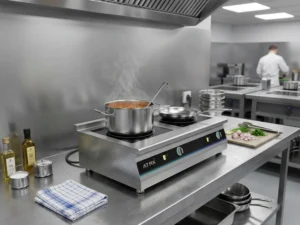
What types of commercial double-hob induction cookers are available?
The difference between the three main structures is easy to feel when standing at the cooking line. A countertop unit sits directly on the worktable and can be moved relatively quickly. A built-in hob becomes part of the countertop and suits a fixed workstation. A freestanding unit comes with its own stand or cabinet, separating the cooking area from the prep table.
| Style | How it fits into a kitchen | Best suited to | What to check first |
|---|---|---|---|
| Countertop double-hob unit | Placed on a stainless-steel worktable or mobile worktable | Restaurant kitchens, food trucks, shared kitchens, and temporary extra cooking stations | Countertop load capacity, orientation, ventilation, and power supply |
| Built-in double-hob unit | The hob sits almost flush with the countertop | Hotels, canteens, central kitchens, and fixed standardized workstations | Cutout dimensions, space underneath, wiring, and service access |
| Freestanding double-hob unit | Stands independently on the floor with a stand or cabinet | Kitchens with limited countertop space, continuous service, or a need for an independent cooking station | Footprint, working height, floor level, and site electrical conditions |
Countertop double-hob induction cookers
A countertop double-hob unit can be placed on a worktable, prep table, or mobile workstation and put into service without cutting into the countertop first. The kitchen does not need a long construction schedule simply to add two more cooking positions. When a restaurant adds a temporary dinner station, a food truck changes its prep location, or a shared kitchen adjusts its equipment layout to suit the day’s menu, the countertop format is easier to work with.
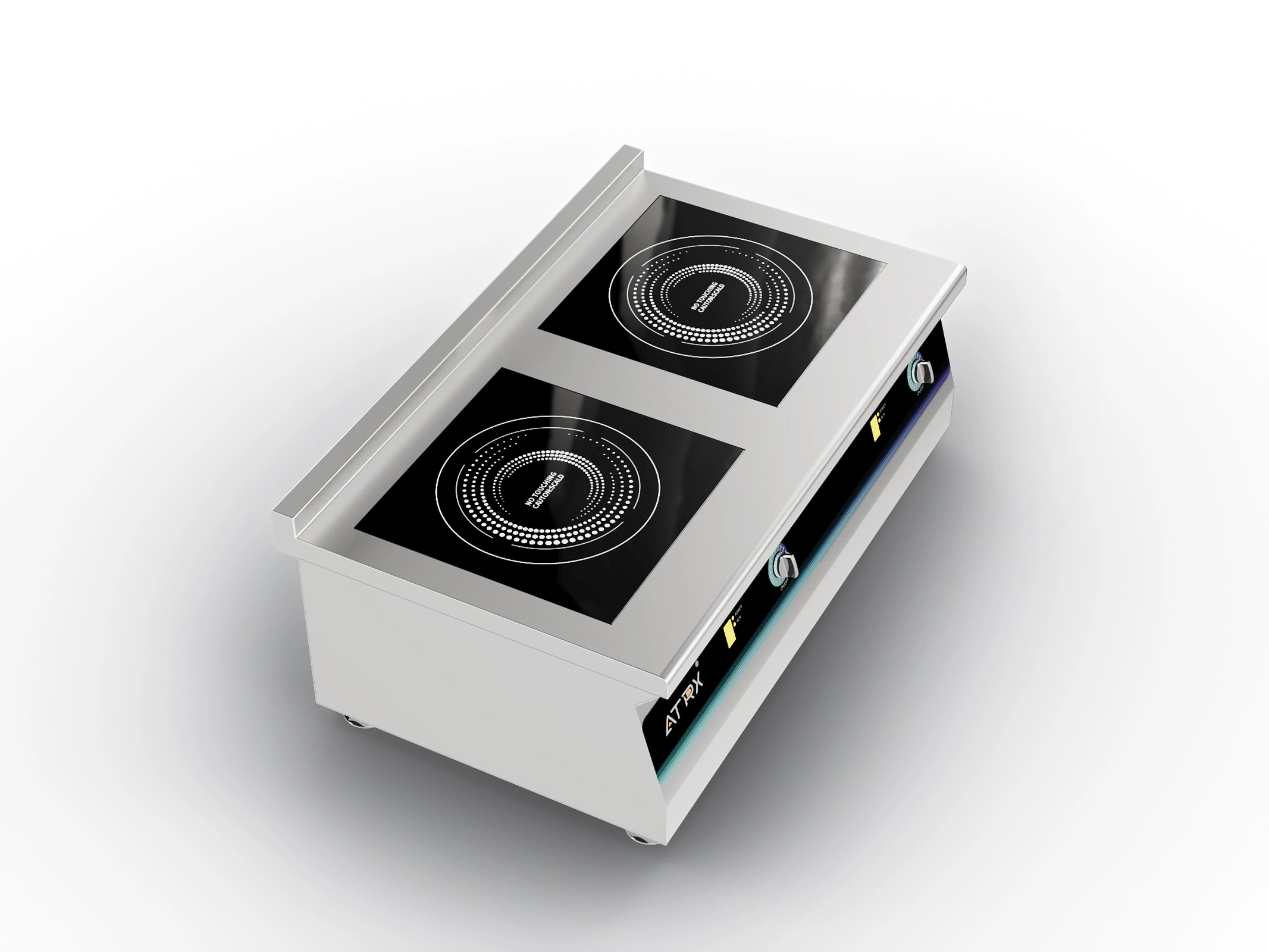
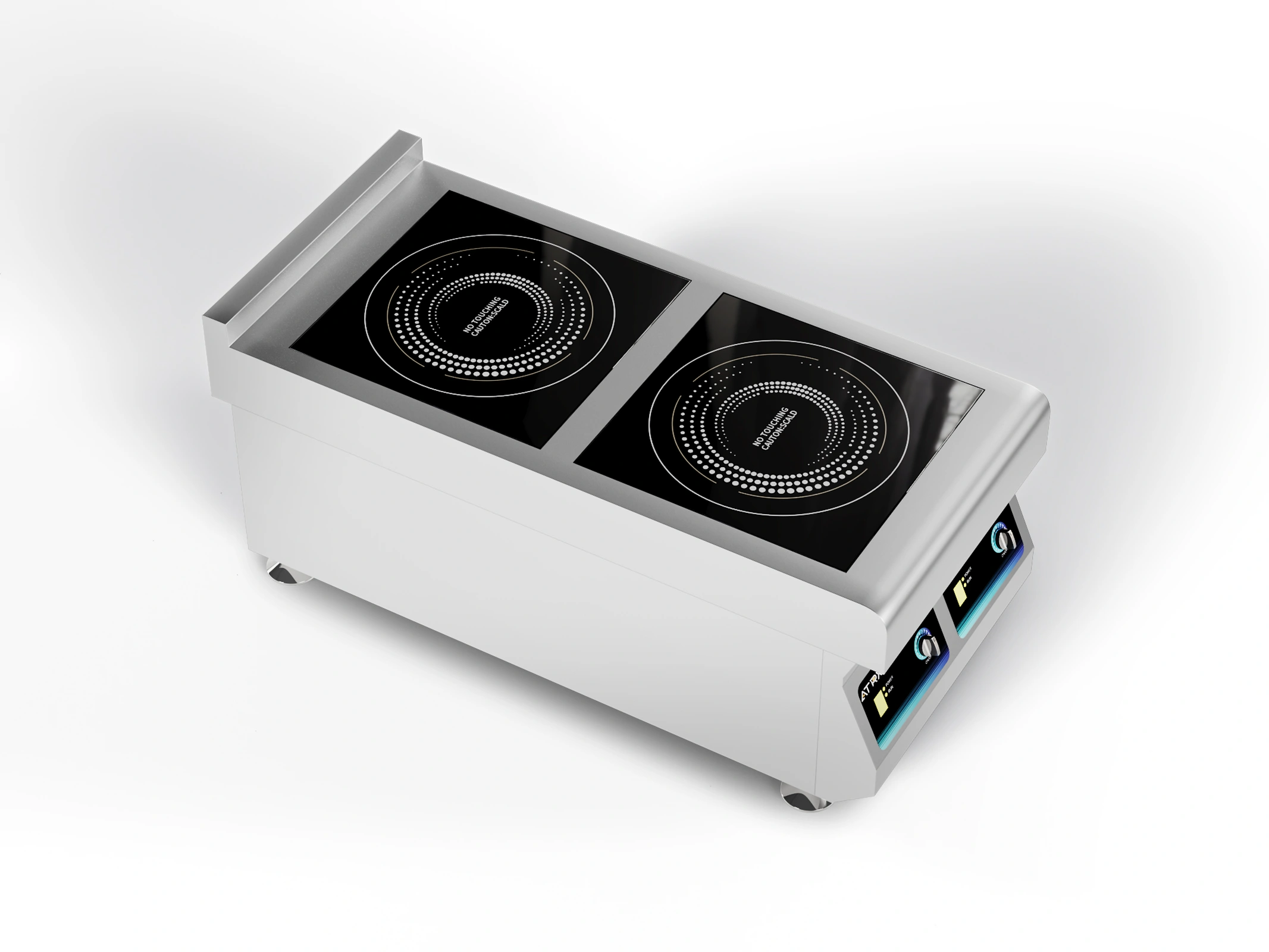
Swipe picture to view more product →
Built-in double-hob induction cooktops
A built-in double-hob induction cooktop is installed into a custom countertop or equipment cabinet. Once fitted, the cooking surface sits almost flush with the worktable. A chef can slide a pan from the prep area onto the hob and continue along the same work line from heating to ingredient handling and plating. If sauce splashes onto the counter, a cloth can pass across the surface in one continuous motion without the appliance base getting in the way.(The picture shows a single-headed product. Double-headed versions can be customized here. The two heads will naturally connect together.)

For embedded projects, a PDF file containing the hole dimensions is usually more useful than product photos. If you are interested in the specific structure and hole range of the embedded component, you can refer to the following PDF three-view drawings I have provided.
Freestanding double-hob induction cookers
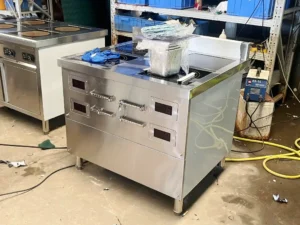
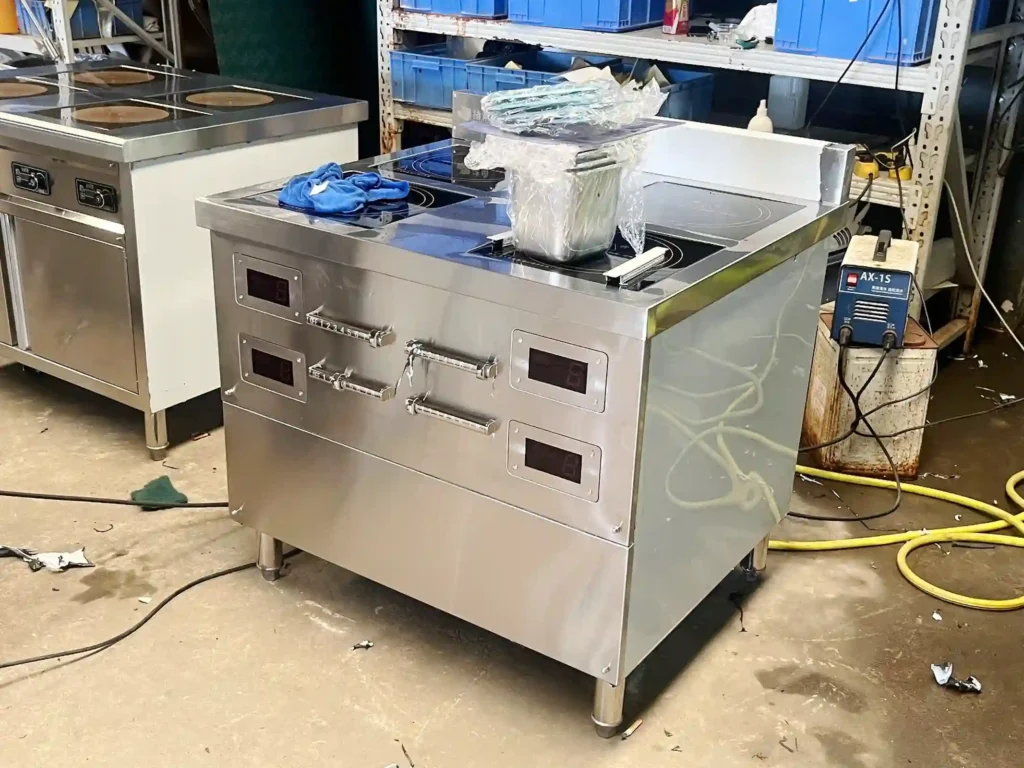
A freestanding double-hob unit comes with its own stand, cabinet, or independent cooking base. It suits a kitchen where the worktables are already covered with ingredient trays, cutting boards, and small appliances, yet the chefs still need a fixed cooking station. Once the cooker stands independently, the countertop can continue to serve as a prep area, while the hobs can be set at a comfortable standing height.(The picture shows four products. The double-headed ones can be customized here. Just remove the two heads on one side.)
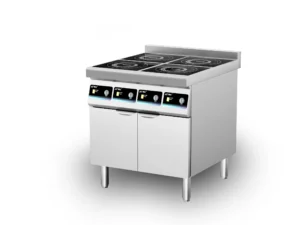
Freestanding equipment requires more floor space and places greater demands on transport. Before installation, confirm the floor level, passage width, rear ventilation, and the space needed for staff to move around the unit. It is a good fit for a permanent independent workstation. Frequent relocation is easier with a countertop unit.
Can both hobs be used at the same time, and how should they be operated?
Yes. ATRX’s standard double-hob induction cookers use two independent hobs with the same power rating, and both heating areas can operate at the same time. Under the standard configuration, running one hob does not force the other hob to reduce its output. The point that needs to be confirmed on site is whether the electrical capacity and wiring can support the full load of the appliance.
Both hobs can heat at the same time
During the dinner rush, the front pan may be reducing while the stockpot behind it stays at a gentle simmer. That is where a double-hob cooker earns its place: both jobs can happen at the same workstation. One hob can sear a steak while the other reduces a sauce. Water can come to the boil for noodles while the soup base is kept at temperature. The two pans do not have to wait for each other, and the chef does not need to keep turning between two separate appliances.
In normal use, a chef will usually work through the following sequence:
- Place suitable cookware in the center of the corresponding heating zone;
- Turn on the front and rear hobs, or the left and right hobs, separately;
- Adjust each power setting according to the dish and the condition of the food in the pan;
- When one dish is finished, switch off only that hob while the other continues operating.
Each hob can be adjusted separately and operated independently
When both hobs are in use, their power levels do not need to match. A stockpot may need a low setting to maintain a gentle simmer, while a frying pan is already on a high setting to brown and tighten the surface of the food. Independent control lets each hob follow its own cooking stage. Adjusting one hob leaves the other at its existing setting.
ATRX’s front-to-back double-hob product page shows an independent control knob and eight power levels for each hob. For a chef, the control method is direct: turn the knob to the required setting, watch how the food responds, then increase or reduce the power as needed. During a busy service, clear controls are easier to use than a complicated menu.
What cookware, voltage, and installation space does it require?
Whether a double-hob induction cooker can go into service smoothly is often decided during the cookware and installation stages. If the pan base is unsuitable, the hob may not detect it. If the power circuit is undersized, turning on both hobs may trigger protective shutdown or prevent the unit from reaching the expected output.
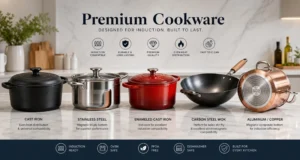
Choose flat-bottom cookware that a magnet can attract to
Induction cooking requires a magnetically conductive pan base. Before purchasing, place a small magnet against the bottom of the cookware as an initial check. Cookware that holds the magnet firmly is more likely to work with an induction cooker. Cookware with no magnetic response may fail to start or may heat less efficiently.
A flat base matters just as much. A flat pan makes more stable contact with the ceramic-glass surface and transfers heat more evenly. If the base is visibly warped, some areas of the pan may heat slowly, and pan detection may cut in and out. In a service kitchen, a small problem like this quickly turns into repeated waiting.
| Cookware condition | General compatibility | What to check in use |
|---|---|---|
| Cast-iron or iron cookware | Usually suitable | Check that the base is flat and that the weight is manageable for staff |
| Stainless-steel cookware with a magnetic composite base | Usually suitable | Check the base marking, then confirm it with a magnet |
| Pure aluminum or pure copper cookware | Usually unsuitable | May work only if it has a qualified magnetic layer |
| Glass or ceramic cookware | Usually unsuitable | Check the construction of the base |
| Severely warped flat-bottom cookware | Not recommended | May affect pan detection and heating uniformity |
Confirm the 220V single-phase supply and the exact wiring requirements
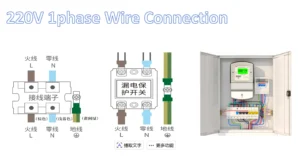
ATRX’s standard published countertop double-hob models are mainly based on 220V single-phase power. The AT-CTEBZ-003 and AT-CTPII-003 use 3.5 kW × 2. Their listed rated current is 15.9A per hob, with 4 mm² copper cable and a 20A RCD. For the 5 kW × 2 version, the listed rated current is 22.7A per hob and the listed breaker configuration is a 32A RCD. The exact requirements for each model should be confirmed from the nameplate, wiring diagram, and final specification sheet.
Leave enough ventilation and working space around the equipment
Because the hob has no open flame, the kitchen air usually receives less waste heat during cooking. The power components, control board, and fan inside the unit still produce heat, though. When both hobs run for a long period, the thermal load inside the body increases. If a cabinet panel blocks the air intake or the rear of the unit sits tightly against a wall, heat will take longer to escape.
The ventilation priorities vary by structure:
- For countertop units, keep airflow open below, behind, and beside the appliance, and keep the air intake clear of stored items;
- For built-in units, reserve the lower ventilation and service space shown on the installation drawing, and allow enough room around the cutout for the cooling structure;
- For freestanding units, leave space behind the appliance for ventilation and enough room for staff to pass around it. Other equipment must not block the intake area.
In August 2026, The Guardian reported on restaurants switching from gas to induction. The article noted that some restaurants, cafés, and bakeries in the UK were adopting induction equipment in hot kitchen environments. The chefs interviewed said that more heat stayed concentrated in the cookware and food, making the kitchen more comfortable. This reflects the experience of the foodservice businesses featured in the report; it does not establish that every kitchen will achieve the same cooling or energy-saving result. It does show why induction can reduce some cooking heat released into the surrounding air. The equipment itself still needs to be ventilated according to the installation drawings.
Confirm countertop load capacity and equipment dimensions before installation
Once a double-hob unit is placed on a worktable, the load on the table comes from the machine, the cookware, and the food inside the pans. The short bursts of force created when a chef slides or pulls a pan are transferred to the table and its supports as well. Before placing the equipment on a thin stainless-steel table, a mobile cart, or an older worktable, check the support structure first.
Dimension checks also need to relate to actual positions:
| Dimension to check | What it may affect |
|---|---|
| Overall length, width, and height | The workstation, doorways, and transport route |
| Distance between the cooking surface and hobs | Whether both pans can sit securely at the same time |
| Control panel position | Knob access and the layout of adjacent equipment |
| Power cable exit | Possible conflicts with the wall, cabinet, or drawers |
| Bottom height and ventilation area | Built-in cabinet and ventilation design |
| Total weight of the equipment, cookware, and ingredients | Countertop and support stability |
Which is better for your kitchen: a countertop or built-in double-hob induction cooker?
There is a practical question worth asking during selection: will this cooking station still be in the same place six months from now? If the answer is uncertain, a countertop unit offers more flexibility. If the workstation has already been fixed, a built-in unit fits more naturally into the complete workflow. If the countertop has no room left, a freestanding solution should be assessed.
Countertop models suit kitchens that need mobility or flexible station layouts
A countertop double-hob induction cooker does not require a permanent cutout. Place it on a suitable worktable and a new cooking station can be ready. This makes it easier to deploy when a restaurant adds a takeaway station, a food truck changes its prep location, a shared kitchen changes tenants, or a business wants to observe actual service volume before committing to a fixed layout.
It also suits projects that need to start operating first and refine the workflow based on real movement through the kitchen. After the unit has been used for a while, it becomes clear whether the chefs prefer side-by-side pans, which side should hold the ingredient trays, and whether the power cable interferes with traffic. Once those answers are known, deciding whether to build a fixed countertop is usually more reliable than making the decision from a floor plan alone.
Built-in models suit fixed installation and a standardized countertop layout
A built-in double-hob cooker suits a kitchen with a settled layout and a long-term plan to use the same cooking station. Hotel buffet counters, chain restaurant kitchens, central kitchens, and large canteens often standardize the countertop height, staff movement, cookware positions, and power connections. Once installed, the built-in surface connects more naturally with the surrounding worktable.
During continuous prep, a chef can collect ingredients from the left, heat them on the hob, and move toward the plating area on the right. With fewer changes in countertop height, cleaning is easier as well. A fixed position also reduces the adjustment required when staff move between shifts.
The trade-off is a greater amount of coordination before installation. The countertop, cabinet, electrical work, and equipment drawings need to agree before construction begins, and later changes are more difficult than with a countertop unit. Built-in equipment therefore suits kitchen projects that have already entered the engineering and installation stage.
Choose according to the kitchen space and the way the equipment will be used
Base the decision on how the kitchen actually works. A countertop unit is more suitable when the team needs mobility, quick deployment, or a temporary extra cooking station. A built-in unit is more suitable for a fixed workstation, a unified countertop, and long-term standardized operation. When prep work already occupies the available counter space and the kitchen needs an independent working height, a customized freestanding solution should be assessed.
| Kitchen requirement | More suitable structure | Main reason |
|---|---|---|
| Temporary extra cooking station | Countertop | No cutout is needed and the layout can be changed quickly |
| Food truck or narrow prep line | Front-to-back countertop layout | Uses less width |
| Fixed workstation and standardized countertop | Built-in | Fits more easily into the complete workflow |
| Limited countertop space | Freestanding | Stands independently and does not occupy the prep table |
| Long periods of high-load operation | Assess the power supply, ventilation, and model-specific testing | The installation format alone cannot replace engineering confirmation |
ATRX’s published information covers countertop double-hob cookers, built-in induction cooktops, and freestanding multi-hob equipment. The manufacturer’s materials also show quality procedures such as PCB processing, constant-temperature aging, constant-temperature and humidity testing, salt-spray testing, and thermal-shock testing. During purchasing, bring the questions back to the target model: Has the double-hob unit been tested with both hobs operating at the same time? Has the cooling structure been verified for continuous commercial use? Can the built-in solution be supplied with the final cutout and wiring drawings?
About the author

ATRX Team| 18 Years Commercial
Induction Cooker Manufacturer in China
Induction Cooker Manufacturer in China
Related Posts
Best Commercial Induction Cooktop: Types &Buying Guide
10/09/2026
Commercial Double Hob Induction Cooker | Types, Power, and Installation Guide
10/05/2026
Commercial Induction Cooker 3500W: Model Selection, Commercial Power and Installation
09/29/2026
How to Install a Built-In Induction Cooktop: A Step-by-Step Guide
09/17/2026
How to Clean a Commercial Deep Fryer: A Step-by-Step Guide
09/13/2026
High Quality Commercial Induction Cooker Manufacturer
09/09/2026
Automatic Wok Machine: Types, Specifications, Applications and Buying Guide
08/18/2026
Commercial Induction Range: How to Choose the Right Size, Power, and Configuration for a Commercial Kitchen
08/15/2026
What Is a Commercial Induction Cooker and How Does It Work
08/13/2026
Commercial Induction Range for Hotel Kitchens: How to Choose the Right Model
08/11/2026