

Commercial Induction Wok Range: What to Cook at Every Power Level (3.5 kW–30 kW)
07/05/2026
Estimated reading time: 2 minutes

3.5 kW to 30 kW induction wok range: What Each Power Level Can Actually Cook
- Dish range by power tier:
- Below 5 kW boiled noodles and stir-fried greens.
- 8 kW covers home-style stir-fries.
- 12 kW and above delivers stable flash-frying.
- 20 kW is hotel-grade. 30 kW is built for bulk batch cooking.
IN THIS ARTICLE
Low-Power Range (3.5 kW–8 kW): What You Can and Can’t Cook
3.5 kW–5 kW: Good for Boiling and Gentle Stir-Frying—Not Any Flash-Frying
This range reliably handles stir-fried vegetables (sautéed choy sum, garlic broccoli, vinegar-dressed cabbage), boiled noodles and rice noodles (noodle soup, wonton soup), heated soup bases (hot pot base reheating, rolling stock), and steam-and-simmer tasks (steamed egg custard, heated soy milk, congee). None of these dishes need sustained fierce heat. Ingredients cook through and develop flavor just fine at moderate temperatures.
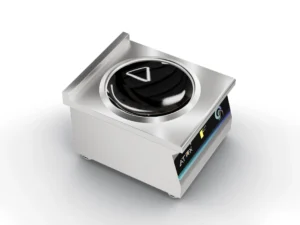
But the dishes 5 kW and below cannot handle need to be stated just as clearly: flash-fried kidney, dry-fried green beans, high-heat char kway teow, flash-fried pork liver, and flame-seared goose intestine. These all demand instant surface searing to lock in texture and produce wok hei. At 5 kW the wok temperature recovers far too slowly after ingredients hit the pan. The temperature plummets, ingredients boil in their own released moisture, and the result comes out watery, soft, and completely wrong in texture.
8 kW: Covers Most Home-Style Stir-Fries, but Has a Clear Ceiling
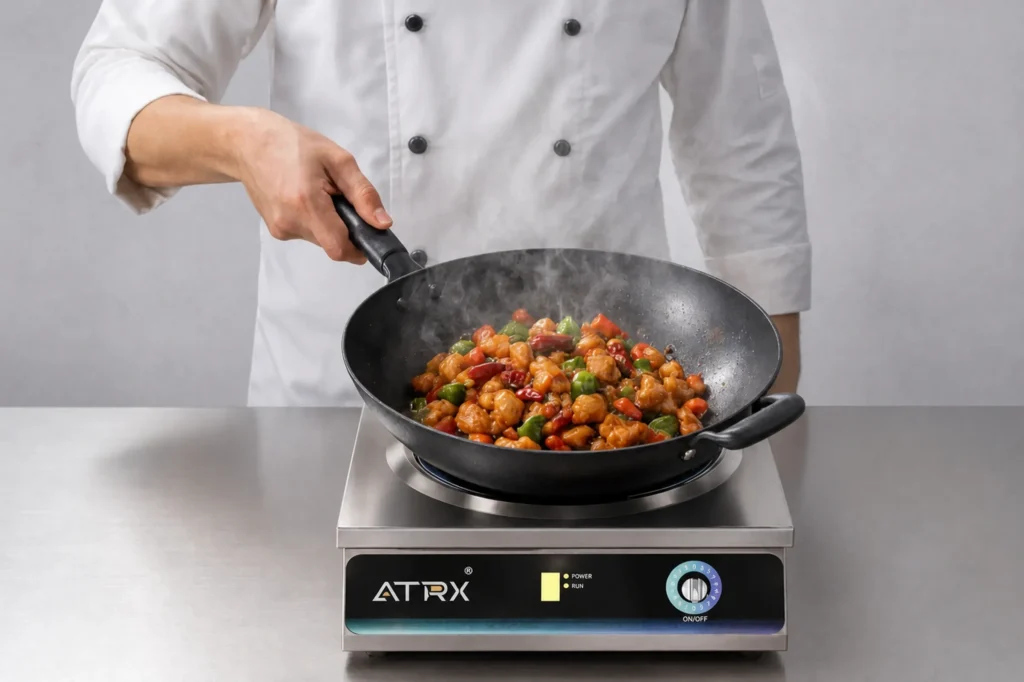
At 8 kW, single-portion quick stir-fries like tomato and egg, shredded pork with green pepper, twice-cooked pork, fish-fragrant shredded pork, and kung pao chicken are all well within reach. At this induction wok power level, the sustained heat output is enough to keep the wok hot throughout the tossing process.
However, 8 kW still falls short for dry-pot dishes (dry-pot bullfrog, dry-pot cauliflower), large-batch stir-frying (two or three portions of fried rice at once), and pan-searing tasks like frying whole fish or searing pork ribs. At these demands, an 8 kW commercial induction wok burner runs out of thermal headroom. Plates come out slowly, and quality gets inconsistent.
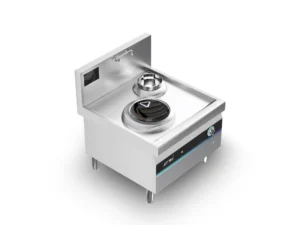
Low-Power Range Selection Takeaway
If your menu includes any dish with “flash-fried,” “dry-fried,” or “dry-pot” as a regular item, 8 kW is the absolute ceiling for this range. Anything beyond that must step up into the mid-to-high power tier.
A common pattern our ATRX team sees during selection consultations: a client plans to buy 5 kW to control budget. But once we walk through the full menu dish by dish, they realize three or four items simply cannot be cooked at that power—and voluntarily move to 8 kW or even 12 kW. Choose the wrong power level and you save on equipment cost but lose on the quality of every dish you serve.
Mid-to-High Power Range (12 kW–30 kW): What Level of Wok Cooking Each Tier Supports
Starting at 12 kW, a commercial induction wok enters the true professional Chinese cooking zone. Each step up in power doesn’t just mean “more heat.” It unlocks an entire category of dishes the previous tier couldn’t do, or couldn’t do well. Below we break out 12 kW, 15 kW, 20 kW, and 30 kW individually, listing the typical dishes each tier handles and the key capability it adds over the one below.
| Power Tier | Typical Use Case | Representative Dishes | Key Capability Over the Previous Tier |
|---|---|---|---|
| 12 kW | Primary wok station in small-to-mid-size Chinese restaurants | Flash-fried kidney, dry-fried green beans, chili chicken (laziji), boiled meat in chili broth (the high-heat oil-drizzle step), single-portion char kway teow | Compared to 8 kW, the core breakthrough is “flash-frying without temperature drop.” Wok temperature rebounds quickly after ingredients hit the pan, dishes develop wok hei, and the vast majority of standard quick-fry, flash-fry, stir-fry, and pan-fry dishes are covered. |
| 15 kW | Chinese restaurants serving 200–300 covers per day | Large-portion fried rice, large-portion fried noodles, large-portion dry-fried beef ho fun, continuous wok-tossing during lunch rush | Compared to 12 kW, the core breakthrough is “sustained fierce heat at large volume.” 12 kW handles a single portion of fried rice fine, but back-to-back large portions drain its heat reserve. 15 kW keeps output quality stable through peak service. |
| 20 kW | Star-rated hotel Chinese kitchens, mid-to-upscale restaurants | Whole pan-fried fish, dry-pot series (dry-pot bullfrog, dry-pot shrimp, dry-pot ribs), high-heat sauce reduction braised dishes (red-braised pork knuckle reduced to a thick glaze), teppanyaki pre-heating and sustained heating | Compared to 15 kW, the core breakthrough is “high-temperature searing and high-heat sauce reduction.” Pan-frying a whole fish requires the wok temperature to never drop, or the fish sticks. Dry-pot base oil needs sustained high heat for aromatic toasting. 15 kW can manage these but not reliably; 20 kW handles them in one smooth pass. |
| 30 kW | Large central kitchens, schools/factories/military mess halls serving 500+ meals per day | Bulk-batch twice-cooked pork, bulk-batch stir-fried shredded potato, bulk-batch stir-fried vegetables (paired with 800 mm–1000 mm large woks, 50–100 servings per batch) | Compared to 20 kW, the core breakthrough is not dish variety but a leap in “wok diameter and single-batch ingredient volume.” 30 kW ensures ingredients in a large wok heat evenly and cook through quickly, eliminating the problem of edges burning while the center is still raw. |
The core logic of this power ladder: each upgrade unlocks not just “more heat” as a single variable, but a full leap in cooking scenario—from what dishes you can cook, to how large a portion you can cook at once, to how many people you can reliably serve. The most dependable approach when selecting an industrial induction wok burner is to work backward from the most demanding dish on your menu, rather than working forward from your budget to settle for something “probably good enough.”
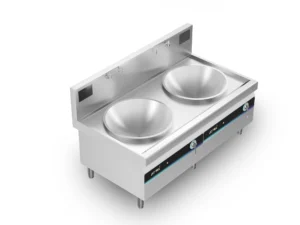
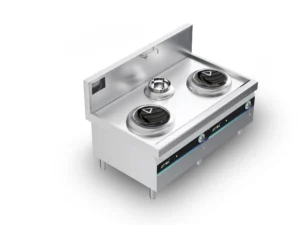
Where Exactly the Heat Differences Show Up Across Power Levels
The heat differences across the 3.5 kW–30 kW range in commercial induction wok ranges come down to two things. First, heat-up speed and post-loading temperature recovery—the higher the power, the faster the wok bounces back after cold ingredients go in, and the more the food is genuinely “stir-fried” rather than “boiled.” Second, whether the unit can break through the temperature threshold needed to produce wok hei. Below 12 kW that’s hard to do reliably. Only above 15 kW can you get consistent seared-aroma results across continuous service.
Below we unpack both dimensions, using real comparisons between power tiers to show where the gaps are.
Heat-Up Speed and Post-Loading Temperature Recovery: How Much Do Power Tiers Actually Differ?
Empty-wok heat-up speed is the most visible expression of power difference. Using a standard 34–36 cm commercial carbon-steel wok as the benchmark, the time from room temperature to working temperature (about 250 °C) varies dramatically across tiers. And post-loading recovery—the bounce-back after cold ingredients go in—is what ultimately decides whether a dish comes out “stir-fried” or “stewed.”
1. Empty-Wok Heat-Up: Doubling the Power Cuts Wait Time by More Than Half
A high power induction wok stove putting out roughly 5 kW takes about 15 seconds to bring an empty wok from room temperature to 250 °C. Models at 15 kW and above finish the same heat-up in under 5 seconds. At 25–30 kW, the wok reaches temperature almost the instant power is applied. During peak-hour continuous service, high-power units have virtually zero “waiting for the wok to heat up” dead time between rounds. That directly controls how tightly you can compress your plating rhythm.
2. Post-Loading Recovery: The Real Dividing Line
When 0.5–1 kg of cold ingredients hits the wok, the temperature plunges instantly. On a 3.5 kW unit, recovery can take 30 seconds or longer. During that time the food isn’t being “stir-fried”—it’s being boiled and steamed in its own released moisture, with noticeable impact on texture and appearance. Units at 15 kW and above push enough thermal energy into the wok body to recover within 5 seconds, keeping ingredients in a searing-and-tossing state rather than a boiling one.
At 20–30 kW, recovery becomes virtually imperceptible. The industry calls this “zero recovery time.”
3. When Recovery Is Insufficient, Chefs Are Forced to Trade Process for Speed
When power isn’t enough, the chef’s only option is to shrink each batch to barely hold wok temperature. A single dish might need two or three separate rounds of stir-frying before being combined. That’s slow, and it hurts the overall flavor integration of the finished plate.
One chain restaurant we worked with during equipment selection ran into exactly this problem. Their head chef reported that on their old 5 kW countertop unit, dry-fried green beans had to be done in three separate wok loads and combined afterward—plating speed was completely bottlenecked during lunch rush. When they tested a 15 kW floor-standing unit side by side, the same quantity went in all at once, stayed at high temperature the whole way through, and single-dish plating time dropped from nearly 4 minutes to under 2. That’s what recovery capability does: it decides whether a given dish “can be properly wok-fried” or “can’t.”
Wok Hei and Seared-Aroma Effect: What Power Level Produces Them Reliably?
Wok hei is the single most recognizable flavor signature in Chinese cooking, and achieving consistent wok hei induction cooking is one of the biggest concerns chefs raise when moving away from open flame. It comes from a set of instantaneous chemical reactions between ingredients and oil at extremely high wok temperatures. These reactions have a clear temperature threshold. Below that line, no matter how good the ingredients or how fast the chef’s hands, the dish only tastes “cooked”—never “fragrant.” Knowing where that threshold falls across power tiers is the most important consideration when choosing equipment.
Wok hei depends on two processes happening at the same time. First is the Maillard reaction: proteins and sugars begin to brown above 150 °C at the wok surface, but producing the rich seared aroma Chinese flash-frying demands requires the surface to hold steadily at 200 °C or above—ideally 250–300 °C. Second is the instantaneous atomization and vaporization of oil: at high temperatures, oil breaks into tiny droplets that flash-evaporate on the wok surface, creating that distinctive smoky aroma you can smell but can’t quite name. Both processes are essential, and both require the wok surface to stay elevated after ingredients are loaded—not crash below the critical line the moment food hits the pan.
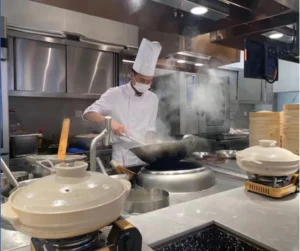
So where does the power threshold actually fall? Here’s how wok hei performance compares across tiers during real cooking:
| Power Tier | Can the Empty Wok Reach 250 °C+? | Wok Temperature After Loading | Wok Hei / Seared-Aroma Performance |
|---|---|---|---|
| 3.5–5 kW | Yes, but heat-up is slow | Drops rapidly below 150 °C—enters the “boiling zone” | Virtually no wok hei; ingredients mainly steamed/boiled; no surface sear |
| 8–10 kW | Yes, reasonably fast | Briefly dips below 200 °C; recovers in about 8–10 seconds | Wok hei appears intermittently; some seared edges, but uneven |
| 12–15 kW | Reaches temperature quickly | Holds near 200 °C; stabilizes in about 3–5 seconds | Wok hei appears reliably; seared aroma covers the full wok |
| 20–30 kW | Almost instantly | No noticeable drop after loading | Wok hei is abundant and uniform, matching professional open-flame performance |
This is exactly why the flash-fry station in a professional Chinese kitchen almost always runs at 15 kW or even 20 kW and above. It’s not that lower power “can’t be used at all.” It’s that only above this line can wok hei show up stably on every wok load, every portion—especially under the pressure of continuous plating during lunch and dinner rush.
If you’d also like to understand how wok hei is produced at the chemistry and hardware level—what temperatures the Maillard reaction and oil vaporization each need, and how induction technology approaches open-flame wok hei performance—we cover that in a separate deep dive: How Induction Wok Ranges Achieve Wok Hei.
Match the Right Power Level to Your Menu and Service Volume
There are only two deciding factors when choosing power. Your menu structure sets the power floor. Your service volume sets the headroom on top of it. Start by finding the single most heat-demanding dish on your menu—noodle-and-light-fare menus map to 3.5–5 kW, home-style stir-fry menus map to 8–12 kW, flash-fry / dry-pot / teppanyaki menus start at 15 kW minimum. Use that dish to set your baseline. Then add 30%–50% headroom based on your peak-hour plating density, so your Chinese restaurant induction cooker never becomes the bottleneck when it matters most. Don’t size for average demand. Size for the worst case.
Below we break apart both dimensions and walk through exactly how to benchmark and how to size your headroom.
The Most Heat-Demanding Dish on Your Menu Sets Your Power Floor
Many restaurant owners pick a wok cooker by asking “how much heat do most of my dishes need?” That logic runs backward. The dish that truly sets your power floor isn’t the one you cook the most—it’s the one that demands the most heat. The method isn’t complicated. Follow these steps and you’re unlikely to choose wrong.
Step 1: List your complete menu and sort by cooking method. Divide all dishes into three categories: boiled/braised/steamed; standard stir-fry; and flash-fried/dry-pot/teppanyaki. Boiled noodles, blanched greens, and soups fall into the first. Twice-cooked pork, small-fried pork, and tomato-egg stir-fry fall into the second. Flash-fried kidney, dry-pot pork intestine, and teppanyaki black-pepper beef fall into the third.
Step 2: Find the category with the highest heat ceiling on your menu. If you run a noodle shop or light-meal café with dishes in the first category, 3.5–5 kW covers your full menu. If your core offering is home-style stir-fries and quick-service rice plates, 8–12 kW is the baseline to protect output quality. If your menu has a significant share of third-category dishes, anything below 15 kW won’t hold up. The instantaneous heat and sustained high-temperature demands of those dishes far exceed standard stir-frying.
Step 3: Use the most heat-demanding dish as your benchmark and set your power floor. Even if that dish only moves a dozen portions a day, it still determines the minimum capability your commercial induction wok stove must have. Insufficient power means the wok can’t recover after cold ingredients go in. Food goes from “seared and tossed” to “boiled,” coming out without wok hei, soft and limp. Either you cut that dish from your menu or accept a quality compromise every time you plate it—both cost your restaurant. When our ATRX team helps clients with selection, the first thing we ask for is the menu, not “what power level are you looking to buy.”
Service Volume and Continuous Wok Rhythm Determine How Much More Power You Need on Top
Once you know the power floor your menu demands, you still can’t buy a unit at that exact number. There’s a second critical variable: service volume. The same dish at 30 servings per hour and at 80 servings per hour places completely different real-world demands on an induction wok range. At 30 per hour, the wok has tens of seconds between loads to fully recover. At 80 per hour, the chef finishes plating and immediately adds oil and ingredients. The wok never reaches ideal temperature before cold ingredients drag it down again, and output quality starts drifting by the third or fourth load.
A reliable industry rule of thumb: if the chef runs the wok virtually nonstop during peak, power should be at least 30%–50% above the single-load requirement. The table below helps you gauge the headroom you need:
| Peak-Hour Servings per Hour | Single-Load Power Baseline | Recommended Actual Power Tier | Headroom Reference |
|---|---|---|---|
| Under 30 (relaxed pace) | Single-load test power is sufficient | At or slightly above baseline | 0%–10% |
| 30–60 (moderate density) | E.g., single-load test needs 8 kW | 10–12 kW | ~30% |
| 60–100 (high-intensity continuous plating) | E.g., single-load test needs 12 kW | 15–18 kW | ~30%–50% |
| 100+ (institutional catering / central kitchen) | E.g., single-load test needs 15 kW | 20–25 kW or higher | 50%+ |
Put simply, service volume doesn’t determine “whether to go up in power.” It determines how far above your menu-driven baseline you need to go. A neighborhood quick-service spot doing 200 covers a day and an institutional caterer doing 800, even with identical menus, will end up one to two power tiers apart in their induction wok requirements.
Buying based solely on single-load performance without accounting for sustained output is the root reason many restaurants only discover “the stove can’t keep up” after the equipment is already installed. The right approach is to simulate your busiest window’s plating rhythm for testing—not look at an empty wok and ask “can it get hot.”
Getting the power right means matching your equipment to your hardest dish and your busiest hour. Go too low and you save once on procurement but pay every day in slower plating and weaker flavor. Go too high and the incremental energy cost is far less than the customer loss from slow service and subpar food. If you’re mid-decision and not sure which tier fits your menu and volume, reach out to the ATRX technical team—send your menu over, and we’ll go through it dish by dish with a specific power recommendation and model proposal, so you don’t find out after purchase that your unit can’t keep up.
If you’d like to go beyond power selection and explore the full decision-making framework for commercial induction wok stoves—covering size, electrical infrastructure, durability, and more—read our Complete Buyer’s Guide to Commercial Induction Wok Ranges, from power to installation in one read.
Common Questions People Ask
Q: I’m currently using a gas high-flame wok burner and want to switch to induction. How do I convert the power ratings?
A: A typical commercial gas wok burner runs at roughly 35%–40% thermal efficiency, while an induction wok range hits 90% or above. So a gas burner rated at 20 kW delivers effective heat to the wok roughly equivalent to 8–10 kW from an induction unit. That said, don’t just apply the ratio mechanically. Induction heating is concentrated, directional heat transfer focused on the wok bottom, which differs from the wraparound pattern of gas in how temperature distributes across the wok surface. The most reliable approach is to judge by actual dish-by-dish cooking results.
Q: Can I buy one high-power unit and use lower settings to cover all dishes?
A: In theory, yes. In practice, two issues come up. First, cost: a 30 kW unit and the electrical infrastructure it needs cost significantly more than a 15 kW unit. If your menu is fully covered at 15 kW, the extra spend has no payback. Second, control feel: some high-power models at low settings lose temperature precision and heat-output linearity compared to purpose-built mid-power units, making slow braising and gentle stir-frying harder to dial in. The smarter setup is to mix and match—equip flash-fry stations with a high power induction wok stove, and put low-power units on the soup and noodle stations.
About the author
ATRX Team| 18 Years Commercial
Induction Cooker Manufacturer in China
Induction Cooker Manufacturer in China
Related Posts
Best Commercial Induction Cooktop: Types &Buying Guide
10/09/2026
Commercial Double Hob Induction Cooker | Types, Power, and Installation Guide
10/05/2026
Commercial Induction Cooker 3500W: Model Selection, Commercial Power and Installation
09/29/2026
How to Install a Built-In Induction Cooktop: A Step-by-Step Guide
09/17/2026
How to Clean a Commercial Deep Fryer: A Step-by-Step Guide
09/13/2026
High Quality Commercial Induction Cooker Manufacturer
09/09/2026
Automatic Wok Machine: Types, Specifications, Applications and Buying Guide
08/18/2026
Commercial Induction Range: How to Choose the Right Size, Power, and Configuration for a Commercial Kitchen
08/15/2026
What Is a Commercial Induction Cooker and How Does It Work
08/13/2026
Commercial Induction Range for Hotel Kitchens: How to Choose the Right Model
08/11/2026